


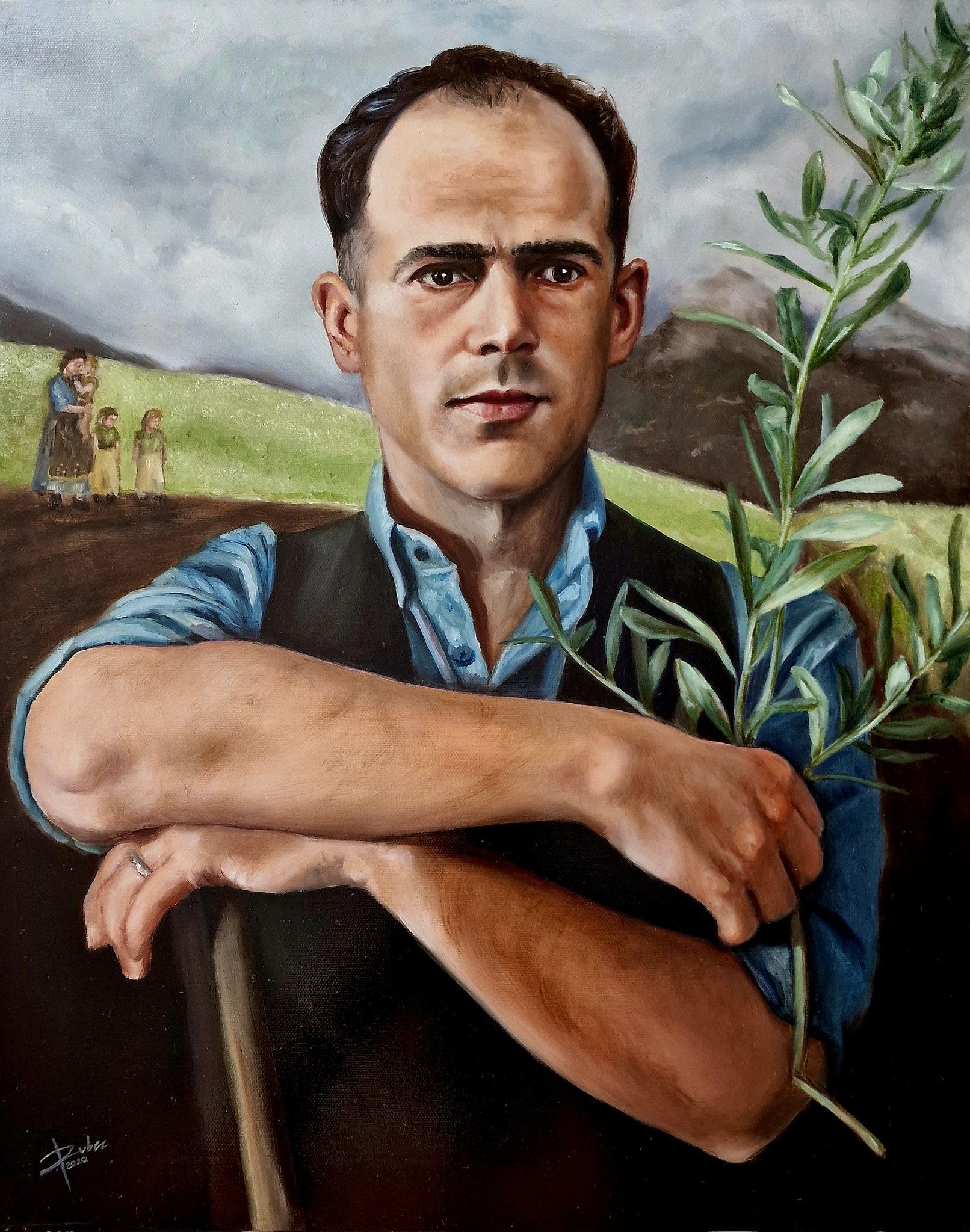
Would you be willing to sacrifice everything, including your safety, your family, your very life, to stand up for what you believe is right?
In the shadow of Nazi Germany’s expansion, one man’s quiet defiance in a small Austrian village became a striking example of the power of personal conscience. Franz Jägerstätter (1907-1943), a farmer, husband, father, and devout Catholic, stood apart from the wave of conformity and complicity that swept through his community during World War II. His refusal to serve in Hitler’s Wehrmacht, rooted in his Christian faith, ultimately cost him his life but left a legacy of moral courage. Once overlooked, Jägerstätter’s story now stands as a challenge to tyranny, raising enduring questions about duty, faith, and the price of standing by one’s convictions in a world demanding compliance.
Early Life and Transformation
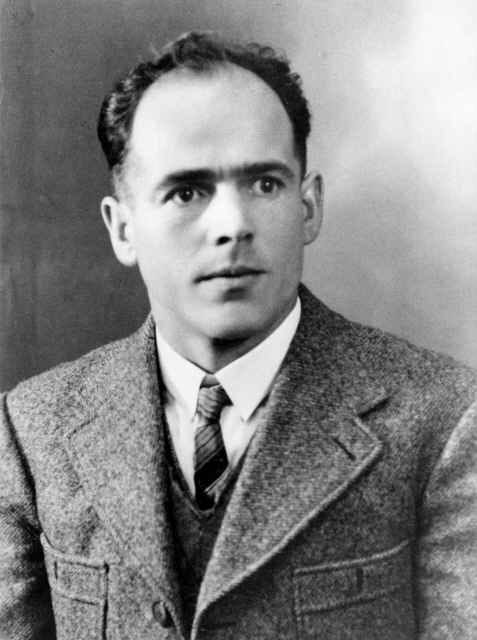
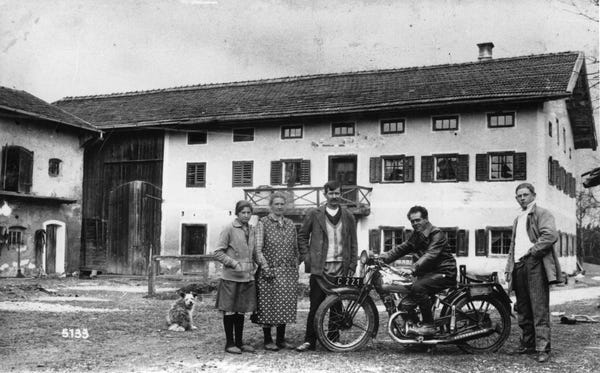
Franz Jägerstätter was born on May 20, 1907, in St. Radegund, a tight-knit rural village in Upper Austria, to Rosalia Huber and Franz Bachmeier, who died in World War I. Raised by his grandmother and later adopted by his stepfather, Heinrich Jägerstätter, Franz’s early years were marked by a rugged, somewhat rebellious spirit, as well as wit and camaraderie, which made his later isolation more striking. Known for his love of reading, motorbikes and occasional brawling, Franz was hardly the image of a future martyr. In 1933, he fathered a daughter, Hildegard, out of wedlock, a fact that later contributed to his spiritual self-examination.
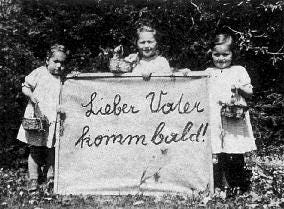
His marriage to Franziska Schwaninger in 1936 marked a turning point. Franziska’s deep faith inspired a profound spiritual awakening in Franz. Together, they embraced Catholic practice, attending Mass regularly, studying scripture, and even making a pilgrimage to Rome for their honeymoon. Franz also became the sexton of their parish church, a role that further deepened his religious commitment. Their marriage, which produced three daughters—Rosalia, Maria, and Aloisia—became central to Franz’s moral and spiritual life. For him, faith was not theoretical but lived, rooted in a conviction that Christianity demanded active resistance to evil, even at great personal cost.
The Shadow of Nazism
The rise of Nazi Germany cast a long shadow over Austria, culminating in the Anschluss of 1938, when Austria was annexed into the Third Reich.1 While many Austrians welcomed annexation, bolstered by propaganda and economic promises, Jägerstätter stood apart. In St. Radegund, he was widely believed to be the only villager to vote against it in the plebiscite, a solitary act of dissent that foreshadowed his later resistance. He also refused Nazi welfare benefits for farmers, reinforcing his principled stance.2 His opposition was not political but grounded in his belief that Nazism was fundamentally incompatible with Christianity. He saw the regime’s ideology, with its cult of personality around Hitler and its brutal policies, as a betrayal of moral and spiritual truth.
Jägerstätter’s concerns were not abstract. He witnessed the Nazi regime’s persecution of the Catholic Church, including the suppression of religious institutions and the arrest of clergy.3 The T4 euthanasia programme, which targeted the disabled and mentally ill, horrified him, as did the regime’s broader campaign of dehumanisation.4 His readings of scripture and the lives of saints like Thomas More, who died for his faith rather than swear allegiance to King Henry VIII, reinforced his belief that obedience to God superseded loyalty to any state.5 By 1940, Franz had resolved that he could not, in good conscience, serve in Hitler’s military.
The Cost of Conscience
Drafted into the Wehrmacht in 1940, Jägerstätter initially received deferments as a farmer, a critical occupation for the war effort. But each call-up intensified his internal struggle. He sought advice from his parish priest and Bishop Joseph Fliesser, hoping for guidance, but found little support. The Church, navigating its own precarious position under Nazi rule, often counselled pragmatism, urging Franz to consider his duty to his family. Despite this pressure, Jägerstätter remained uneasy with compromise, later reflecting, “I can say from my own experience how painful life often is when one lives as a halfway Christian; it is more like vegetating than living.” His community, too, viewed his stance with confusion or even hostility. To many, military service was a matter of survival, not ideology, and Franz’s refusal seemed reckless, even selfish, given the risks to his wife and children.
Despite this, Jägerstätter’s resolve only strengthened. In his writings, later compiled in works like Franz Jägerstätter: Letters and Writings from Prison, he articulated a clear moral vision.6 “If I must write… with my hands in chains, I find that much better than if my will were in chains,” he wrote, reflecting his belief that true freedom lay in integrity of conscience. He rejected the idea that he could serve in the military while inwardly dissenting, insisting that even non-combat roles would implicate him in an unjust war. When called up again in February 1943, he refused to take the oath of loyalty to Hitler or serve in any capacity.
Trial and Martyrdom
Jägerstätter’s refusal led to his arrest and imprisonment, first in Linz and then in Berlin’s Tegel prison. There, he described a dream he’d had years earlier of a shiny train, which crowds of people, including business leaders, bishops, and people of all classes, were eagerly trying to board. When he asked where the train was going, the conductor took his hand and said, “This train is bound for hell.” Upon waking, he interpreted the train as representing the Nazi cause and concluded that one should jump off such a train if they know its destination, regardless of the cost.
In July 1943, he was tried by a military court for “undermining military morale,” a charge that carried the death penalty. Despite assurances of leniency if he recanted, he remained steadfast, writing, “I am convinced that it is still best that I speak the truth, even if it costs me my life.” On August 9, 1943, at the age of 36, Franz Jägerstätter was executed by guillotine at Brandenburg-Görden prison, minutes after refusing to sign a document that could have saved his life. The execution was carried out swiftly, with no public announcement, reflecting the Nazis’ desire to suppress his story. His final letters to Franziska reveal a man at peace with his decision.
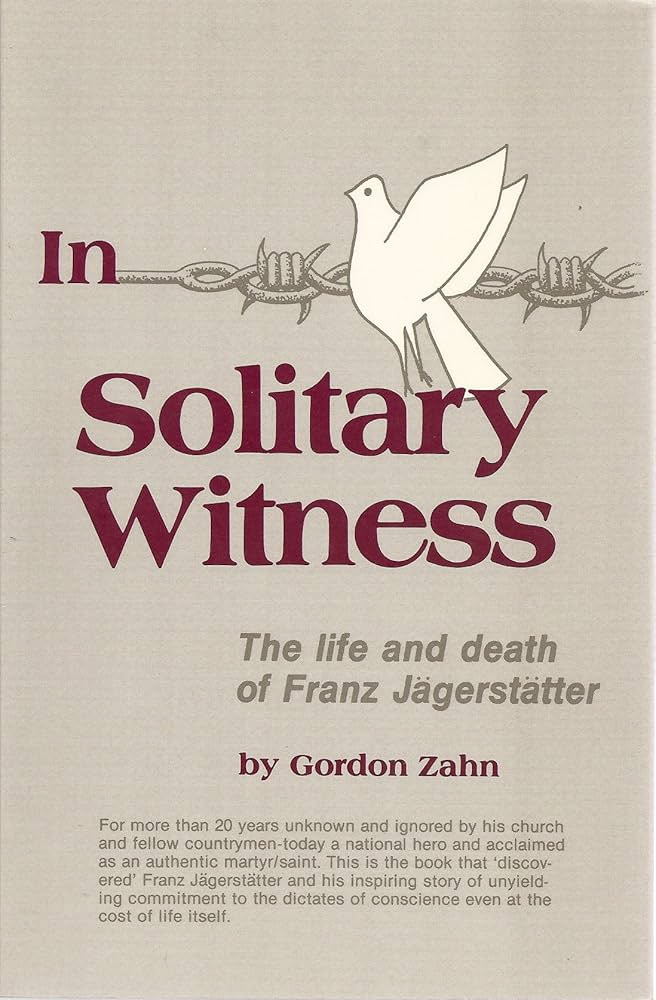
Franziska endured hardship and ostracism as the widow of a “traitor.” After learning of his death, she wrote, “I have lost a good husband and exemplary father for my children…However, the loving God had ordained things to be otherwise, and our beautiful union was lost.” The village of St. Radegund, like much of post-war Austria, initially viewed Jägerstätter’s actions with ambivalence. Many Austrians saw Wehrmacht service as honourable, and Franz’s defiance was perceived as futile. His story might have faded into obscurity if not for American sociologist Gordon Zahn, whose 1964 book In Solitary Witness brought Jägerstätter’s life to wider attention.7 Zahn framed him as a conscientious objector, though some argue Jägerstätter’s resistance was specifically against Nazism, not war in general.
Legacy and Canonisation
Jägerstätter’s story was largely suppressed until the 1960s, but over time his legacy grew. In 2007, Pope Benedict XVI beatified him as a martyr, recognising his death as a witness to faith, not just a political act. The ceremony, held in Linz, was attended by Franziska, then 94, and marked a turning point in Austria’s reckoning with its Nazi past. She died in 2013, shortly after her hundredth birthday.
Jägerstätter’s story challenged Austria’s post-war narrative of collective victimhood, forcing a confrontation with the complicity of ordinary citizens. His life inspired Terrence Malick’s beautiful yet harrowing 2019 film A Hidden Life, which explores the personal and spiritual dimensions of his sacrifice. Malick drew the film’s title from a line in Georg Eliot’s Middlemarch:
“…for the growing good of the world is partly dependent on unhistoric acts, and that things are not so ill with you and me as they might have been, is half owing to the number who lived faithfully a hidden life, and rest in unvisited tombs.”
It was Malick’s film that first led me to Jägerstätter’s story and inspired me to research and write this essay. The score by James Newton Howard is superb.
Jägerstätter’s writings, filled with reflections on faith, conscience, and the cost of discipleship, continue to resonate. Unlike high-profile resisters like Dietrich Bonhoeffer or Sophie Scholl, Jägerstätter was an ordinary man—neither a theologian nor a revolutionary—yet his solitary stand carries universal significance.8
Broader Implications
Jägerstätter’s life raises questions about the nature of resistance and the role of conscience in confronting systemic evil. His refusal to compromise, even at the cost of his life, challenges the idea that individual actions are powerless against overwhelming forces. While some may argue that his sacrifice changed little during the war, his story has inspired others to reflect on the demands of moral integrity. In an era when conformity often masquerades as pragmatism, Jägerstätter’s example suggests that fidelity to principle can have a ripple effect, even if its impact is not immediately visible.
His story also highlights the complex relationship between religion and resistance. While the Catholic Church in Austria largely accommodated the Nazi regime, Jägerstätter’s faith led him to resist, illustrating how religious conviction can challenge state authority. His beatification recognises his prophetic witness, but also prompts reflection on the institutional failures that left him so isolated in his lifetime.
The Legacy of Conscience
Franz Jägerstätter’s life demonstrates the power of conscience in the face of tyranny. An ordinary farmer, transformed by faith and love, he chose death over complicity, leaving behind a legacy that continues to inspire. His story is not just a historical footnote but a call to examine our own moral choices in times of crisis. As he wrote in his final days, “If God gives me the grace… I will try to take the path that leads to eternal life.” Jägerstätter’s path—solitary, costly, and unwavering—reminds us that true heroism is often found in the quiet, resolute refusal to betray one’s soul. His example also invites us to consider whether, over a long enough timeline, even the ultimate expression of entropy—death itself—can give rise to new forms of syntropic order and meaning.
Gordon Zahn’s book combines the analytical perspective of a social scientist with the depth of a skilled biographer. Drawing on interviews with those who knew Jägerstätter personally, Zahn not only provides keen insights but also narrates his own journey to Austria in the early 1960s as he seeks out Jägerstätter’s legacy:
The Anschluss of 1938 refers to the annexation of Austria by Nazi Germany, which took place on March 12–13, 1938. German troops marched into Austria without resistance, and Adolf Hitler, himself Austrian-born, was welcomed by large crowds. The term “Anschluss” means “connection” or “joining” in German, signifying the political union of Austria with Germany. This annexation violated the Treaty of Versailles and the Treaty of Saint-Germain, both of which explicitly forbade the unification of Austria and Germany after World War I. Although some Austrians opposed the move, many welcomed it, and a controlled plebiscite held in April 1938—under conditions of intimidation—claimed over 99% support for the union. The Anschluss marked the first major act of Nazi territorial expansion and emboldened Hitler to pursue further aggressive policies, as Britain and France did not intervene to stop it.
It is historically documented that the Nazi regime offered a range of incentives to farmers in annexed Austria, such as subsidies, access to modern equipment, guaranteed prices for agricultural products, and social welfare programs, as part of their efforts to secure rural support and food production for the war effort.
The Nazi regime persecuted the Catholic Church through a range of measures including the closure of Catholic schools, youth groups, and publications; confiscation of Church property; and arrests of clergy—many of whom were imprisoned in concentration camps such as Dachau. Despite the 1933 Reich Concordat intended to protect Church rights, the Nazis systematically undermined the Church’s influence, restricted religious activities, and targeted clergy and lay leaders with intimidation and violence, particularly in occupied territories. This repression aimed to isolate the Church from society and eliminate any opposition to Nazi ideology.
The T4 euthanasia programme, also known as Aktion T4, was a secret Nazi initiative launched in 1939 to systematically murder people with physical and mental disabilities, whom the regime considered “life unworthy of living”. Authorised by Hitler and directed from the Berlin address Tiergartenstrasse 4, the programme targeted adults and children in hospitals and care institutions across Germany and Austria, as well as occupied territories. Victims were selected by physicians and killed by methods including lethal injection, starvation, and, most commonly, carbon monoxide gas in specially constructed gas chambers at six main killing centers. Although officially halted in 1941 due to public protest, the killings continued covertly until the end of World War II, with estimates of the total number of victims ranging from 275,000 to 300,000.
Thomas More (1478–1535) was an English lawyer, scholar, and statesman who served as Lord Chancellor to King Henry VIII. A devout Catholic, More opposed Henry VIII’s separation from the Catholic Church and refused to accept the king as Supreme Head of the Church of England. In 1534, when required to swear an oath recognising Henry’s religious authority and the legitimacy of his marriage to Anne Boleyn, More refused, citing his conscience and loyalty to the Catholic faith. He was imprisoned, tried for treason, and executed by beheading on July 6, 1535. At his execution, he famously declared, “I die the King’s good servant, but God’s first.” More was later canonised as a Catholic saint and is remembered as a martyr who chose to die rather than betray his religious convictions or swear allegiance to an earthly authority over his faith.
Putz, E. (Ed.). (2009). Franz Jägerstätter: Letters and writings from prison (R. A. Krieg, Trans.; Introduction by J. Forest). Orbis Books.
Zahn, G. (1964). In solitary witness: The life and death of Franz Jägerstätter. Holt, Rinehart and Winston.
Dietrich Bonhoeffer was a Lutheran pastor, theologian, and member of the Confessing Church, which opposed Nazi interference in church affairs. He was an early and vocal critic of Nazi ideology, participated in underground resistance activities, and was involved in plots to overthrow Hitler. Bonhoeffer also helped Jews escape Germany and wrote influential works on faith and ethics. Arrested in 1943, he was executed at Flossenbürg concentration camp in April 1945 for his resistance activities.
Sophie Scholl was a university student and a leading member of the White Rose, a non-violent resistance group she formed with her brother Hans and others. The group distributed anti-Nazi leaflets and called for Germans to resist Hitler’s regime, emphasising moral responsibility and civil disobedience. Sophie and Hans were arrested after distributing leaflets at the University of Munich, tried, and executed by guillotine in February 1943. Their courage made them enduring symbols of moral resistance to tyranny.
Both Bonhoeffer and Scholl are remembered for their principled opposition to Nazism and their willingness to face death rather than betray their beliefs.
Thanks John, a really well written article and as ever thought provoking.