


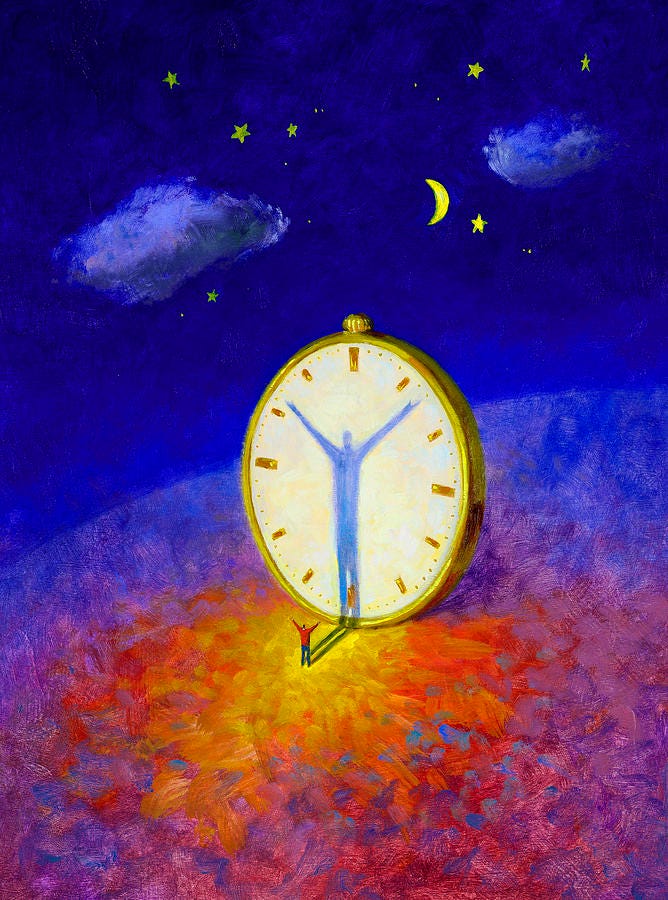
Henri Bergson (1859–1941) was a French philosopher and Nobel laureate who saw time not as something to be measured, but as something to be lived. At the dawn of the 20th century, as science carved the world into fixed laws and equations, Bergson offered a different vision: one that pulsed with movement, intuition, and inner depth.
For him, life was not a sequence of moments ticking past, but a continuous flow—creative, conscious, and unfolding from within. He showed that the rhythms we feel inside often bear little resemblance to the clocks we follow, and that true understanding comes not from dissecting time, but from inhabiting it.
His ideas invite us to return to the felt sense of being, to reawaken a quieter, deeper knowing beneath the noise of modern life. Not a retreat from progress, but a reminder of the pulse that animates it. A call to move not just through time, but with it.
Duration: Time as a Living Flow
At the core of Bergson’s philosophy lies “duration” (durée in French): time not as a chain of discrete units, but as a seamless unfolding of experience. Duration is the movement of consciousness itself, a ceaseless becoming where past and future blend into the vibrant present.
Think of a favourite song. You don’t hear it as a collection of isolated notes; you feel it as a whole, each moment shaped by what came before and carrying the momentum of what’s to come. Freeze a note, and you lose the music’s life. So it is with duration: time as a living tapestry, impossible to fragment without losing its soul.
In his seminal work, Creative Evolution (1907),1 Bergson wrote:
“Duration is the continuous progress of the past which gnaws into the future and which swells as it advances.”
In our experience, the past is not behind us, nor the future ahead; they braid together within the present, thickening it with memory, hope, and movement. Time is not a line of points ticking by; it is being-in-becoming.
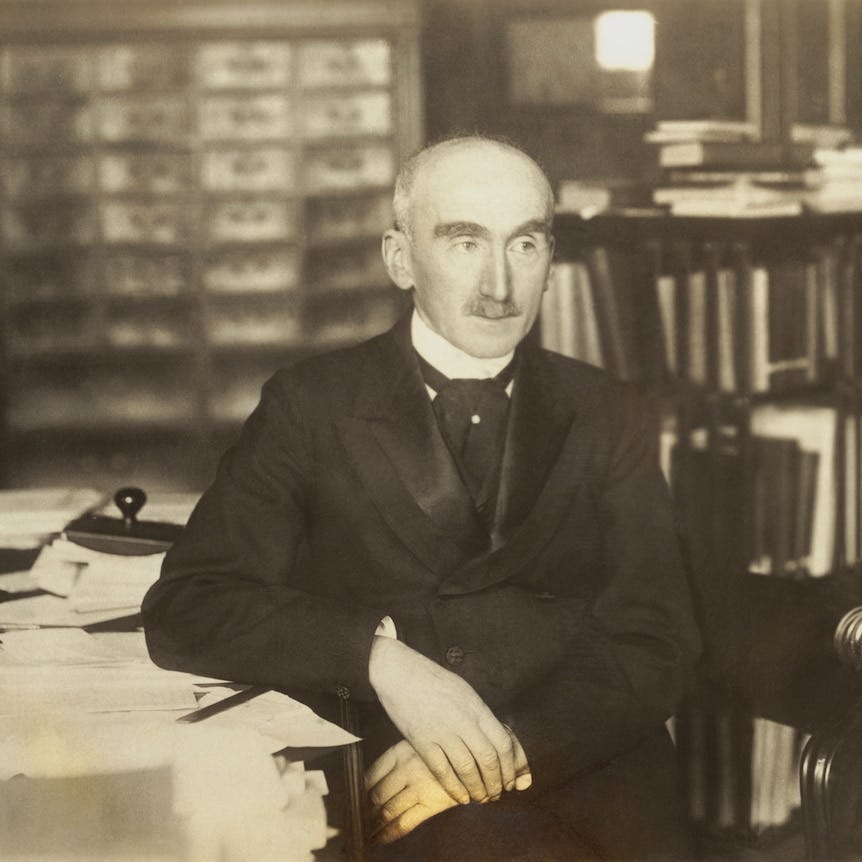
Two Times: Clock Time and Lived Time
Bergson drew a vital distinction between two modes of time: the mechanical and the lived.
Clock time divides and measures. It’s the time of schedules, deadlines, and timetables; essential for organising the world, but foreign to the texture of life itself.
Lived time stretches and contracts with experience. An hour lost in laughter feels nothing like an hour spent in grief. Time dances, swells, and recedes, according to the rhythms of the heart.
Both kinds of time have their place. Yet when we reduce life to mere measurement, we risk trading the richness of being for the rigidity of efficiency. Clock time helps us catch a train; lived time helps us catch our breath.
The Limits of Language and Science
Part of the confusion, Bergson suggests, lies in our habits of thought. Language spatialises and turns the fluidity of life into fixed concepts: “a long day,” “a short meeting,” “a point in time.” Our words reduce the flux of life to static concepts, as if it were a thing we could map or hold. We say, “I was young, now I’m old,” as if these were discrete boxes we step between, but lived experience resists such neat containment.
Science, too, necessarily slices time into units for the sake of precision. Yet this very act can sever us from the living flow it seeks to understand. Bergson offers a striking thought experiment to illustrate:
Imagine a magical force doubles the Earth’s rotation, so day and night complete in 12 hours instead of 24, with all physical processes speeding up proportionally. Instruments would detect no difference; proportions would remain unchanged. Yet, for those living through it, the tempo of life would shift profoundly: a thinning of experience, a diminishment of the fullness typically woven between sunrise and sunset. The philosopher can look at this felt dimension. The scientist, by training, must look away.
Intuition: Grasping Time from Within
To apprehend duration, Bergson calls for intuition; not in the sense of a gut feeling or vague hunch, but a disciplined turning inward, a sensing of wholes rather than fragments. Analysis dissects and categorises. Intuition inhabits and moves. Like a musician who feels the soul of a melody before striking a note, intuition invites us to live time as a flowing reality, not a measured abstraction.
This kind of knowing asks for patience and presence, requiring the mind, Bergson says, to “do violence to itself” to resist our ingrained intellectual habits. It asks us to dwell, to attune, to listen—to let the music of life play through us rather than standing apart from it, score in hand.
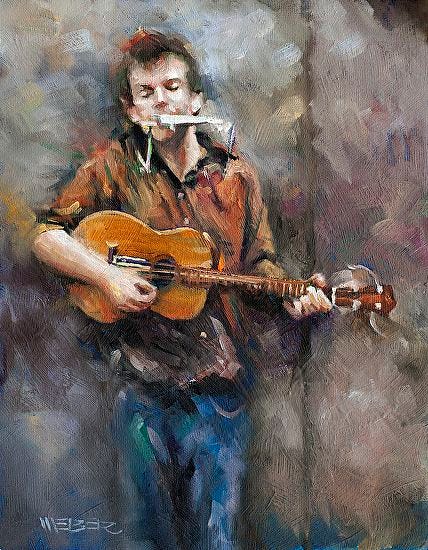
Memory: The Past Alive in the Present
For Bergson, memory is not a filing cabinet of static snapshots. It is alive, braided into the now. He distinguishes between habit memory—automatic routines like riding a bike or typing a password—and pure memory, the living preservation of experience. When we truly remember, we do not retrieve a file; we relive a movement, a colour, a scent, a shiver of feeling.
The French novelist Marcel Proust, who was heavily influenced by Bergson, captured this beautifully in In Search of Lost Time: the taste of a madeleine cake dipped in tea unleashes not an image, but a flood of childhood memories; the past alive in the present moment, imbuing it with meaning.2 Our memories are not left behind. They course within us, deepening every present breath.
Ray Peat and Élan Vital: The Creative Pulse of Life
Bergson’s insights extend beyond human experience to life itself. Against the mechanistic models of evolution,3 he proposed the élan vital, a vital impulse surging through all living things, driving them not mechanically but creatively into new forms.
Life, for Bergson, is not a machine but a movement. Its creativity cannot be reduced to chance or necessity alone. Like a river that carves new pathways as it flows, life invents its own future. We glimpse the élan vital in moments of inspiration: in the first words of a story, in the first steps of a child, in the spontaneous laughter that rises without cause. Creation, in Bergson’s view, is not an exception to nature but its deepest law.
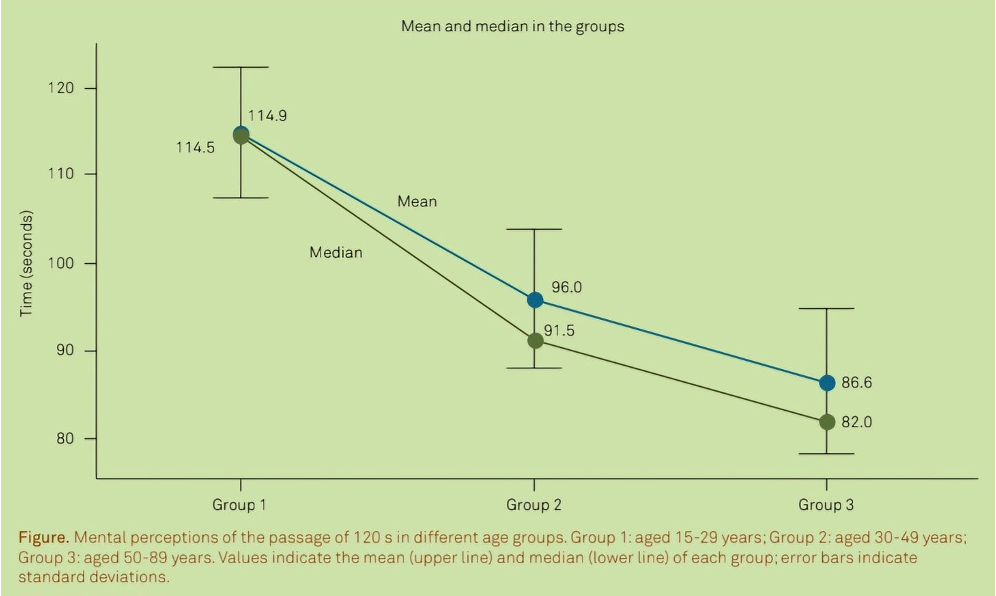
Notably, Ray Peat, who I discussed in my last post, spoke of energy in much the same way.4 For Peat, metabolism wasn’t just cellular housekeeping; it was the biological ground of consciousness, emotion, and even perception of time. He noted that people with higher metabolic energy tend to experience time as slower, richer, more expansive—while those in low-energy states often find time slipping by in a blur. Studies have shown this too.56
In this light, élan vital isn’t just a poetic metaphor; it may have a mitochondrial basis. To raise your energy is to reclaim time. To become more vital is to become more present. As participants in this syntropic flow,7 we are not passive objects but co-creators in a universe that thrives on change, driven by the vital impulse within us.8
Living with Duration: A Practical Path
What then does Bergson offer us today? Not a programme to manage time better, but an invitation to live more fully within it. To rediscover the movement of life not through measurement, but through presence.
Pause and Feel the Moment: Instead of reaching for your phone while waiting, tune into the textures of the now: the play of light, the murmur of distant voices, the subtle swell of your own breathing.
Move with the Flow: Notice when you are forcing life into rigid schedules. Trust organic rhythms. Some of the richest growth happens off the clock.
Listen to Intuition: Before analysing a choice to exhaustion, listen inward. What subtle pull, what quiet rhythm, moves you?
Revisit a Memory: Not to escape the present, but to deepen it. Let the past rise not as a frozen image, but as a living vibration within the now.
In doing so, we do not abandon the tools of modern life. We simply remember that beneath the measured beat of the clock, another current runs: one we can rejoin at any moment, if we only dare to feel it.
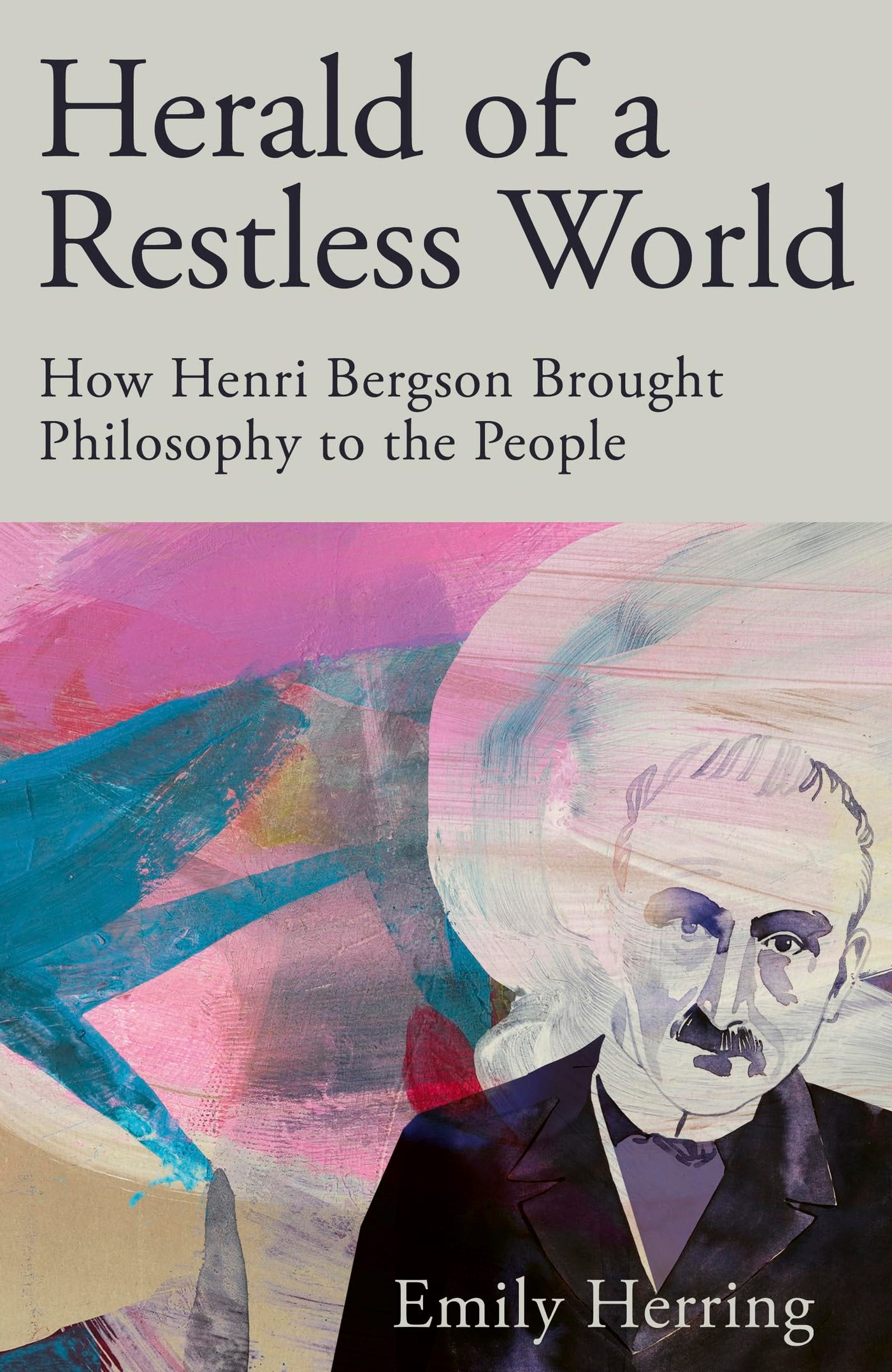
If you would like to dig deeper into Bergson, Emily Herring’s recent book on his life and work is an excellent place to start:
Creative Evolution (L’Évolution créatrice) was first published in French in 1907. The English translation, by Arthur Mitchell, appeared in 1911. It was Bergson’s most well-known and influential book during his lifetime, propelling him to international fame, and sparking widespread academic and public debate. The book’s impact was so significant that it was compared to major philosophical works like Kant’s Critique and caused a cultural sensation, with Bergson becoming an international celebrity.
In his heyday before the First World War, Bergson was the most famous philosopher in the world, attracting huge audiences to his public lectures. He was especially popular with women, and influenced artists and writers, none more famously than Marcel Proust. Proust’s seven-volume In Search of Lost Time, published between 1913 and 1927, is over a million words in length and is a literary meditation on memory, time, and the inner life. The novel follows the narrator’s recollections of his childhood and experiences as he grows into adulthood, set mainly in Paris and Normandy during the late 19th and early 20th centuries. Proust, like Bergson, showed how the smallest moments can contain entire lifetimes.
In Creative Evolution, Bergson embraced evolution as a scientific fact but argued that Darwinian theory, focused on natural selection, overlooked a crucial dimension: the qualitative nature of real time (duration). He posited that neglecting this temporal flow obscures life’s unique creativity. Bergson introduced the élan vital, a vital impulse driving evolution, not as a replacement for mechanisms like selection, but as the dynamic, creative force at its core, continuously unfolding and generating novelty through time’s living current.
Ray Peat and the Art of Becoming: A Philosophy of Aliveness (Substack Post)
Metabolism generally declines with age. 233 subjects were asked to close their eyes and mentally count the passing of 120 seconds. Mental calculations of 120s were shortened by an average of 24.6% (28.3 s) in individuals over age 50 years compared to individuals under age 30 years.
Ferreira, V. F., Paiva, G. P., Prando, N., Graça, C. R., & Kouyoumdjian, J. A. (2016). Time perception and age. Arquivos de neuro-psiquiatria, 74(4), 299–302. https://pubmed.ncbi.nlm.nih.gov/27097002/
When asked to estimate duration of time elapsed, studies show that in almost all cases, rate of subjective time increased when body temperature increased above normal (a sign of higher energy metabolism), and decreased when body temperature was lowered below normal.
Wearden, J. H., & Penton-Voak, I. S. (1995). Feeling the heat: body temperature and the rate of subjective time, revisited. The Quarterly journal of experimental psychology. B, Comparative and physiological psychology, 48(2), 129–141. https://pubmed.ncbi.nlm.nih.gov/7597195/
Episode 146: Henri Bergson pt. 2 - Vitalism, The Philosophize This! Podcast (YouTube)