


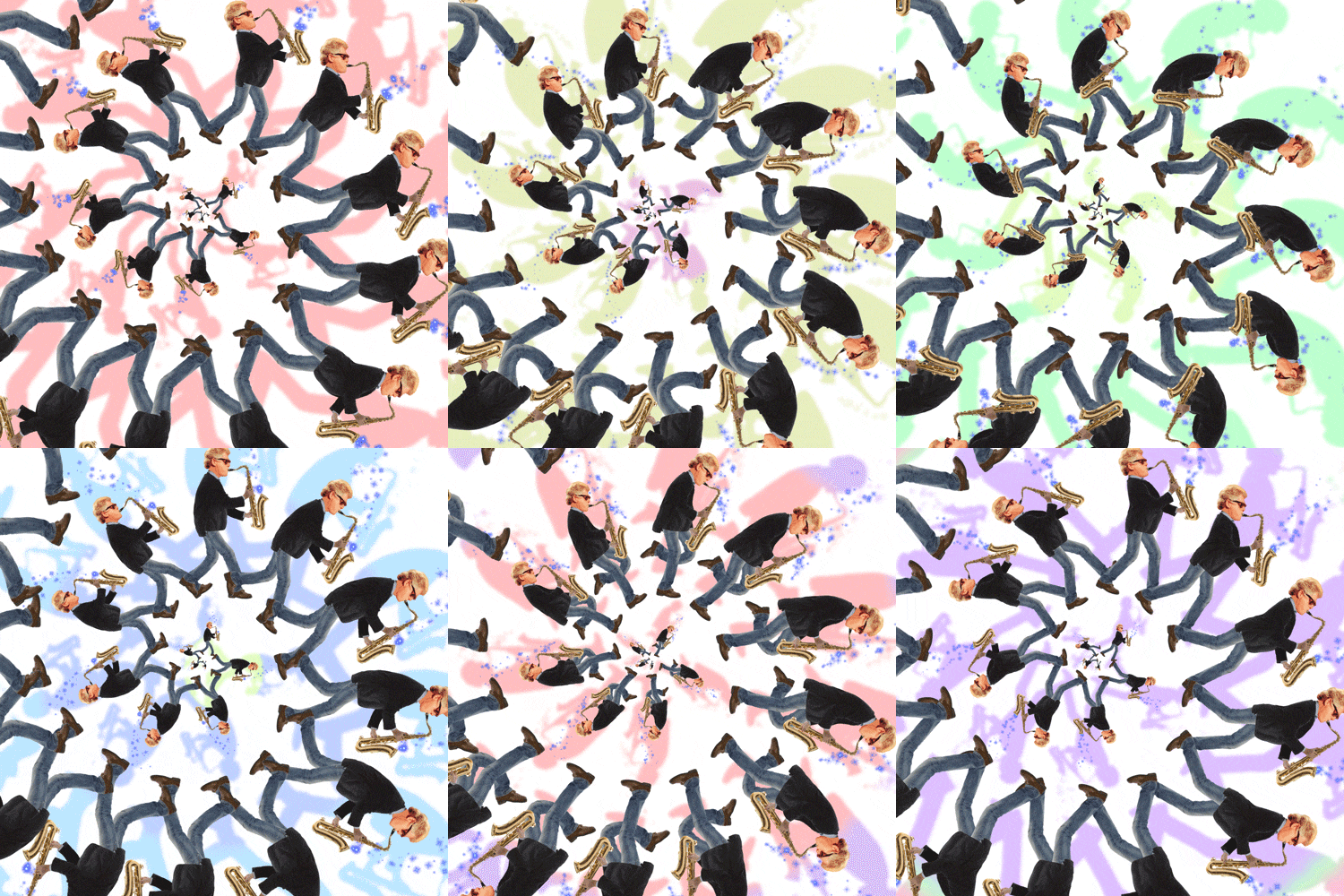
“Life is achingly beautiful and creative once you free yourself from the mind-numbing shackles of neo-Darwinian dogma.” — Mae-Wan Ho1
“I have no doubt that life is quantum coherent. Organisms are quantum jazz players, dancing life into being.” — Mae-Wan Ho2
Mae-Wan Ho (1941-2016) was a proper badass. She was a Chinese-English geneticist, biophysicist, science activist, artist, critic of genetic determinism, neo-Darwinism, and GM biotechnology, and later a defender of ideas about quantum coherence, liquid-crystalline water, subtle energy, and the idea that living organisms are shimmering wholes rather than a collection of parts.
Her big word was “Coherence.” For Ho, the body wasn’t just a sack of biochemical reactions with genes pulling the strings. It was a living whole: rhythmic, responsive, luminous, and self-making. A process so deeply coordinated that the usual machine metaphors simply didn’t fit.
I came to Ho the way I’ve come to a lot of things: through Ray Peat. He mentioned her now and then in interviews, usually with the air of a man pointing at something most people had walked straight past. In one conversation he told a story about Michoacán in Mexico, where the fishmongers used to lay their catch out on newspaper. One of them was so fresh and clear you could read the print through its body. Bones, blood vessels, organs, all visible, and yet the whole thing was so transparent it was like looking through glass. To Peat, that made sense only if Ho’s way of seeing things was correct. As he summed up her view, “she sees the body as a liquid crystal…it’s an ever-changing crystal.”3
As I’ve written about a lot, especially through the McGilchristian lens of the left hemisphere, modern science is brilliant at parts. Divide the organism into genes, proteins, membranes, enzymes, neural circuits and molecular pathways, and you can learn a lot. But the living body isn’t chopped up. It’s a whole in motion, and Ho wanted a science that could do justice to that motion.
You can get an immediate feel for her energy and vibe in this short clip (2 mins) from On the Back of a Tiger:
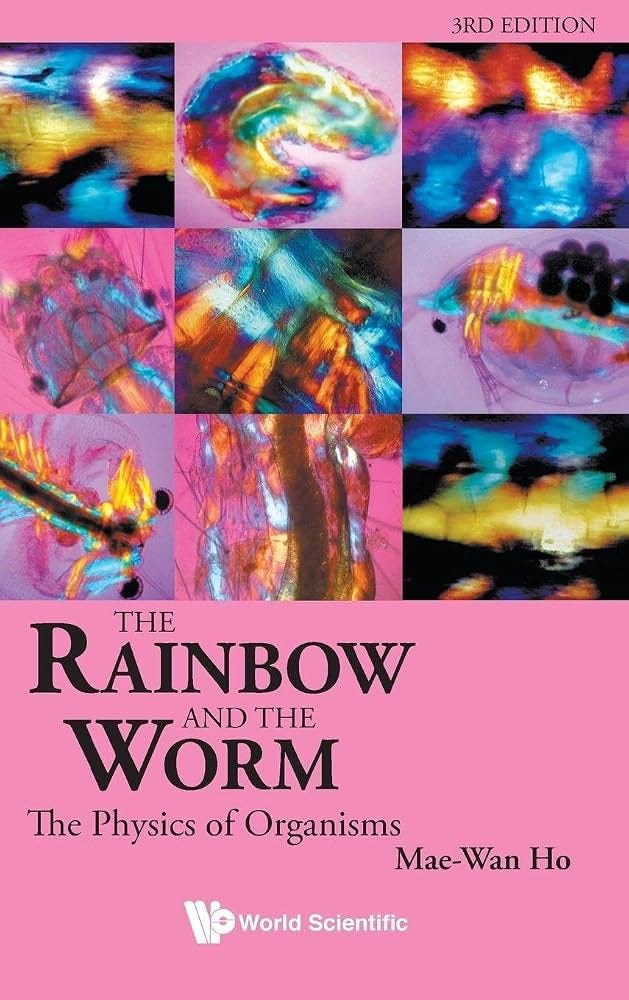
The Rainbow and the Worm
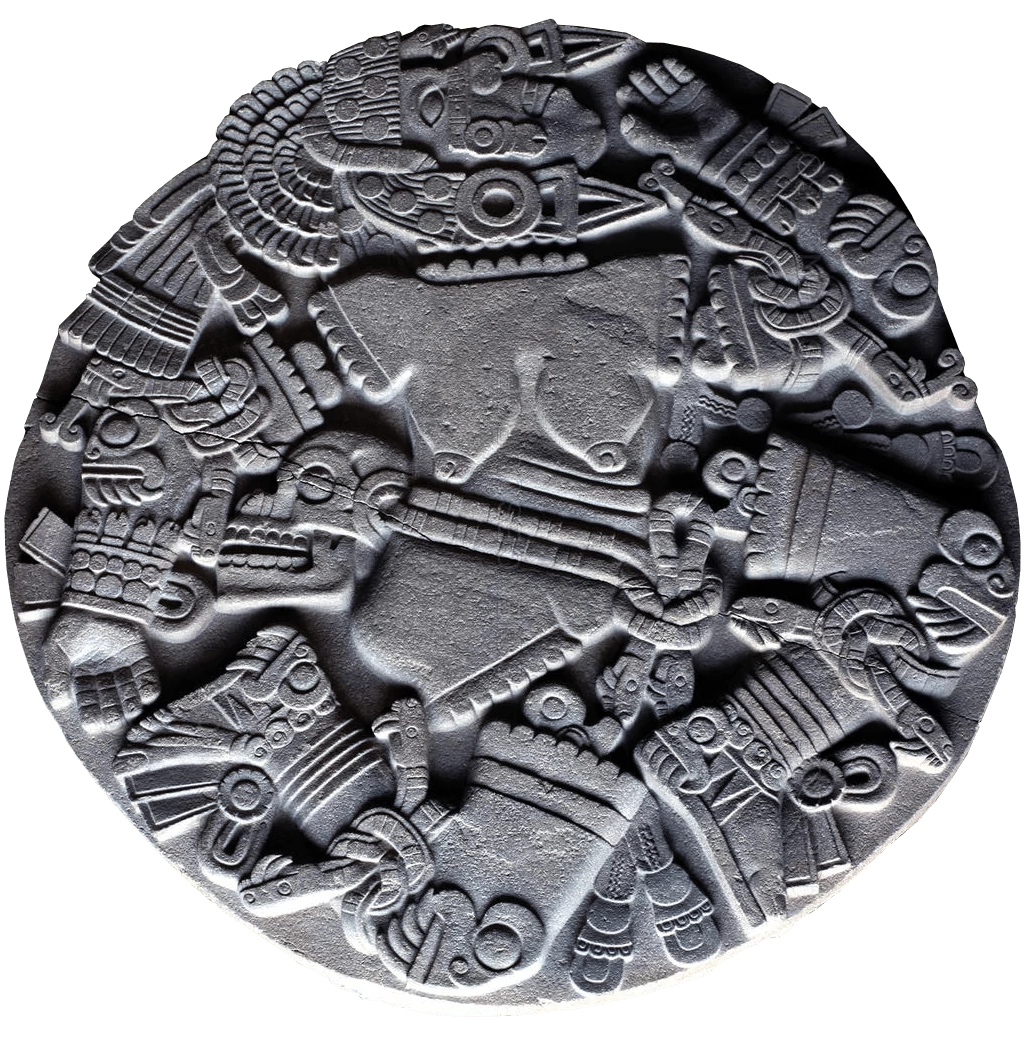
In the summer of 1991, Ho was in Mexico City when she saw a huge carved disc of stone, about three metres across, showing the Aztec moon goddess who’d been killed and dismembered by her brother, the sun god. What caught her attention wasn’t the violence but the shape of it. The symmetry seemed to pull the severed parts back towards each other, with the tearing apart and the putting back together both held in one image. She later found out it was a calendar, its thirteen joints marking out the divisions of the year, the whole cycle of death and rebirth carved into a single wheel. She called that moment “the immediate prelude” to her theory of the organism, which she started writing up not long after.4 The stone seemed to show her that wholeness isn’t a state a thing arrives at and keeps but more like a tendency, always coming apart and always trying to gather itself back together.
That realisation would be confirmed a year later by an image at the centre of her work, which gave her best-known book its title. In 1992, Ho persuaded a visiting BBC microscopist to point a polarising microscope at some fruit-fly embryos. What they saw became a new imaging technique, and what it showed astonished her: all the colours of the rainbow in a living, crawling larva, about a millimetre long.5
This wasn’t colour in a metaphorical sense but actual colour. The kind you get when polarised light passes through ordered materials.6
Ho described it like someone who couldn’t quite believe her eyes. The larva, she wrote, “weaves its head from side to side flashing jaw muscles in blue and orange stripes on a magenta background.”7 The segmental muscle bands switched from turquoise to vermillion as waves of contraction ran along the body. The first time she saw it, she said, it was breathtaking, like a “psychedelic worm,” and even after seeing it again and again, she never lost that sense of wonder.8
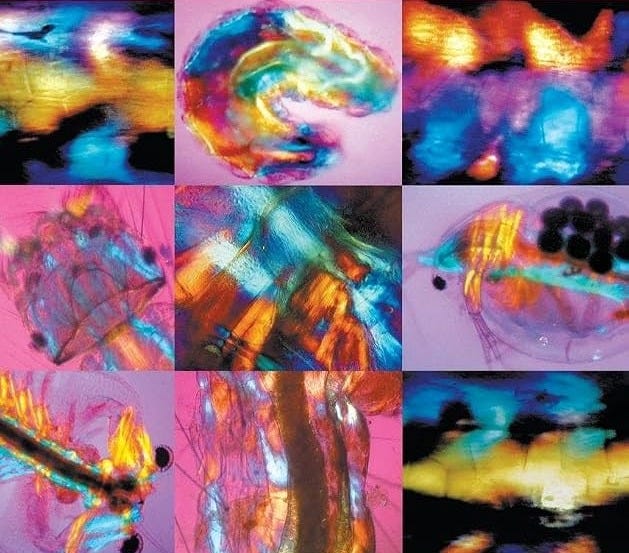
It mattered to Ho because crystals produce those colours through molecular order. But the larva wasn’t a dead crystal. It was alive, moving, growing, and metabolising. The molecules were in motion everywhere, and yet the organism still showed pattern and order. She took that as a clue that life isn’t order imposed on motion but order through motion.
The colour was evidence, or at least a strong hint, that organisms are liquid crystalline: not solid, not chaotic fluid, but dynamically ordered, with aligned molecules and structured water that can carry energy and information very efficiently.9 For Ho, living organisms weren’t just coherent in the ordinary systems sense. They were also, in a deeper way, quantum coherent. The body, she thought, is a shimmering field of coordinated activity, with water playing a central role in all that coordination.10
And for Ho, water wasn’t just the backdrop to that coordination but the thing that made it possible. The body is mostly water, and she thought that water, structured and lined up around the molecules it surrounds, was what let signals and energy move through the organism fast and coherently enough for it to act as one thing rather than a load of separate bits. So not just the stuff life happens in, but the stuff that lets life happen as a whole. The rainbow in the worm, as she liked to say, is a rainbow within, a watery echo of the one in the sky.
A machine doesn’t do that. It holds together because it has fixed parts that someone has bolted together from the outside. The piston or gear doesn’t improvise or wonder what it’s doing. Machines are impressive because they repeat themselves. For Ho, life is impressive because it doesn’t.
A living organism is stable, but it isn’t static. It maintains itself by changing all the time: skin repairs, bones remodel, blood renews, the immune system learns, the gut listens, and the heart adjusts. Cells divide and die so the body can live. What looks like a thing is actually a stream of small remakings.
The mechanical worldview struggles here because it imagines wholeness as assembling the bits together in the right order. But in an organism, the whole is already present in the parts from the beginning. An embryonic cell can become many tissues; remove one part and the rest can reorganise. A salamander can regrow a limb. A wound can heal. The part isn’t just a detachable spare component but part of a living field that’s always becoming itself.
Ho wasn’t the first to suggest this. She knew she was following in the footsteps of the process philosophers, and she said so. She leans on Henri Bergson, for whom time isn’t the measured, clock-divided quantity of physics but “duration”—the lived, flowing quality of experience that the language of science flattens into a “simulacrum.” And she takes from Alfred North Whitehead his definition of an organism as “a locus of prehensive unification”—a field of activity that draws on its experience of the environment to make itself whole. The organism, on this view, isn’t a thing in time so much as a gathering of time. I’ve written about both Bergson and Whitehead elsewhere; what matters here is that Ho’s worm is their philosophy made visible, flashing under a microscope.11
That’s why she describes an organism as having an “irrepressible tendency towards being whole.”12 The key word there being tendency. Not a finished thing but a directional leaning and striving. A living pull toward wholeness. The organism isn’t simply a whole as though the job were already done. It’s always becoming whole, always adjusting, integrating, repairing, and recovering. The embryo does it. The wounded body does it. The psyche does it. Even a good conversation does it.
And Ho followed that pull all the way out, suggesting the same tendency that heals a wound is at work in what we call love. “Love is a desire for wholeness,” she wrote, “a longing to embrace and complete a larger whole,” and it’s what drives our social and creative acts and even our knowledge of nature. Whether it’s a cell reaching to rejoin the body, a person reaching for another, or a scientist reaching to understand, for Ho, these aren’t separate phenomena but the same tendency showing up at different scales.13
It’s important to note that Ho wasn’t against analysis. She was a passionate scientist, after all. Her problem was the arrogance of analysis when it forgets what it’s done. If you cut an organism into bits, you might learn something useful. But the bit you’re studying is no longer living the life you claim to be studying. You’ve gained clarity by taking the thing apart. That’s fine sometimes. But it should make you humble, not full of grand theories.
She’d felt the gap herself. She went into biochemistry, she explained, because a professor had quoted Albert Szent-Györgyi saying that life “was interposed between two energy levels of an electron,” and she thought that was “sheer poetry” and wanted to know what life is. But what she found was a discipline that “was about cutting up everything, grinding up everything, separating, purifying,” and that “told you nothing about what life is.”14
As someone who spent years inside the academy, I think the arrogance Ho is describing here isn’t just a personal failing of bad scientists but structural. The whole publish-or-perish game rewards the clean result you get by isolating a part.
Modernity Made It a Worldview
A big issue is that modernity has turned the analytical method into the dominant way of seeing the world. We started treating reality itself as if it were made of isolated parts. The body became a machine. The mind became software. The gene became code. Nature became a resource. Society became a mechanism. Education became input and output. Health became optimisation. Work became productivity. Attention became fuel. Even our self-improvement talk sounds like an engineering manual written for anxious machines.
Hack your habits. Track your macros. Rewire your brain. Optimise your morning. Upgrade your system.
Ho’s work is a revolt against that language. She was especially suspicious of the idea that genes run life. DNA mattered, of course. But for Ho, the gene wasn’t some little boss sitting inside the cell handing out orders. The genome was fluid, responsive, and embedded. Genes are switched on and off depending on the cellular, bodily, ecological, and developmental setting. They don’t stand above the organism. They belong to it.15
This wasn’t just a grumble. With the mathematician Peter Saunders, Ho argued for a positive alternative to neo-Darwinism. In their picture, development steers evolution rather than the other way round. The organism doesn’t just wait for random copying mistakes and then hope selection picks the winners. It makes non-random changes in response to what’s around it. The fluid genome isn’t a lump sitting there being mutated. It responds. That made neo-Darwinism, for Ho, not just incomplete but the intellectual licence for genetic engineering. It’s the same control-from-above logic, just dressed up as biology.16
That’s why “genetic programme” is a bit of a dodgy phrase. A programme runs because the code tells the machine what to do. But the organism isn’t a machine, and the gene isn’t the boss. Life is more like an ongoing conversation, with messages moving in many directions at once: genes to cells, cells to tissues, tissues to organism, organism to environment, and the environment back again into gene expression.
Ho put the difference pretty bluntly. Mechanical systems, she said, work through “a hierarchy of controllers and the controlled,” and you can see that same logic in a lot of our institutions: bosses deciding, managers passing the instructions down the chain, and workers carrying out orders. Organic systems are the opposite. They work, she said, through “intercommunication and total participation.” In the organism, “no part of the system has to be pushed or pulled into action.” Everyone, in her words, is “simultaneously boss and worker, choreography and dancer.”17
A mechanical system, she wrote, “works like a non-democratic institution.” An organism has “no bosses, no controllers and no set points. It is radically democratic, everyone participates.”18 Late in life she made the point even more provocatively. In a 2010 interview, she complained that Western education “divides you up into the observer and the observed, the controller and the controlled,” when life is nothing like that. “Life is spontaneous and free,” she said, “and everything works by intercommunication. It’s a perfect social anarchy because each player is as much in control as he or she is sensitive and responsive.”19
That image of a body without a boss may be the most important thing in Ho’s work, because it doesn’t just apply to biology. A body gets ill when communication breaks down. Not always, and not in a neat simple way, but often enough to matter. Cells stop listening. Systems fall out of rhythm. Inflammation becomes chronic. Feedback loops distort. The organism no longer hears itself clearly.
A psyche does the same thing. Parts split off and feelings go underground. The body says one thing while the life story says another. A person starts to feel less like an organism and more like a little internal bureaucracy, with one bit issuing commands and another quietly sabotaging them. But, as Ho writes:
“The whole is never static, it is constantly dying and reborning, decaying and renewing, breaking down to build up again. The same cycles of disintegration and re-integration occur whether one is looking at the energy metabolism of our body or the stream of consciousness out of which we individuate our psyche. During the normal ‘steady state’ of our existence, the multitudes of infinitesimal deaths and rebirths are intricately balanced so that the old changes imperceptibly into the new. However, whenever the attracting center of the new is radically different from the old, a larger, and at times, complete disintegration may be needed before the new can individuate. It is like a caterpillar which must completely dissolve so that the beautiful butterfly can emerge.”
That last move, the dissolving before the new can come, is exactly the one capable people resist. I spend a fair amount of time with people who run things, and the most common error I watch able people make, with their own lives as much as with what they run, is to apply more control at exactly the point where what was needed was more coherence. Organisations do it too. So do whole societies. Control expands when trust collapses and procedure multiplies when communication fails. Everyone gets managed because nobody’s listening and the living whole turns into administration.
Ho’s organism gives a different picture of order.
Jazz Instead of Clockwork
When she wanted to explain what coherence actually feels like, Ho didn’t reach for clockwork but for music. Coherence, she insisted, doesn’t mean uniformity of everyone doing the same thing all the time. You can think of it, she suggested, like “a large jazz band, where everyone is doing his or her own thing, as yet keeping perfectly in tune or in step with the whole.” Then she pushed the image further, into an “immensely huge superorchestra” with instruments spanning seventy-two octaves, each one playing its own line, endlessly varying, changing key and tempo as needed, all without losing the shape of the music.20
This clip (2 mins), from the documentary Being in the World,21 links jazz to Heidegger’s philosophy, but I think it’s equally relevant to what Ho is saying, too:
Jazz isn’t chaos. It has form, timing, memory, discipline, and listening. But it also has freedom. A player doesn’t just execute a score. The music happens between the players. The whole comes together as they play. Ho thought the organism worked the same way: every molecule, cell, tissue, and organ taking part in a vast improvisation, with no conductor standing outside the music.
Her more technical way of saying this came from her physics: a coherent state “maximizes both global cohesion and also local freedom.”22
Whether or not you accept her full quantum account, the philosophical force of that line is immense. Most of the ways we’ve been taught to think about freedom and belonging treat them as opposites. Either the individual is free and the collective is weak, or the collective is strong and the individual gets squashed. Ho’s organism suggests a third way. In a living whole, local freedom and global belonging rise together. The cell isn’t less itself because it belongs to the body. It becomes itself through the body. Its autonomy isn’t isolation, but participation.
And that isn’t just a fluffy bit of sentimental biology either. Cancer is also a kind of freedom, but freedom without relation. The cancerous cell refuses the whole. It grows, but no longer belongs. It pursues its own expansion at the cost of the organism that makes its life possible, which isn’t vitality but coherence breaking down.
A Syntropic Moral Philosophy
A good life isn’t one in which every impulse gets what it wants. And it isn’t one where every impulse gets crushed by discipline either. A good life is one where the different parts can get into a better relationship with each other. Desire, thought, habit, vocation, body, memory, love, work, place. Not all shoved into obedience, and not all left to fight it out, but held in a living pattern.
That’s also where the idea of syntropy makes sense.
If entropy is dissipation, things scattering and running down, syntropy isn’t just stiff “order.” A prison is ordered, as is a bureaucracy. A corpse can be arranged neatly. Syntropy is better understood as living coherence: energy gathered into forms that can keep creating. So not frozen or rigid order, but generative, rhythmic order.
Ho kept coming back to that point in her thermodynamics. Living systems don’t just burn through energy and collapse into waste. They hold energy in cycles. Breath, heartbeat, metabolism, sleep, seasons, and ecological loops. Energy gets captured, stored, mobilised, and returned. The organism delays dissipation by coupling processes together. What’s released here is taken up there. What would become waste becomes a resource.23
She called this “circular thermodynamics.”
To her, that was nature’s own economy. “Everything goes in cycles, and is recycled to minimize waste and dissipation.” It is, she said, “how nature continually recreates and renews itself,” how an organism keeps transforming material and energy “to regenerate and recreate themselves from moment to moment.” Put that beside the straight-line economy we’ve built for ourselves, which she saw as basically a maximum-waste, maximum-dissipation machine, and you can see what she meant.24 A living thing doesn’t just run down. It runs round.
She came to hear something old-school in all this. When asked how to picture the coherent organism, she said it was like a symphony, and then added something more revealing: “I’m a Taoist at heart. And quantum coherence and Taoism are one because coherent action is like effortless action.”25
That’s basically wu wei wearing physics clothes.26 The coherent body doesn’t have to bully itself into action. It moves without strain because every part is already in tune with every other part. Nietzsche, who saw striving as the very essence of life, would be spinning in his grave at this, but effort, in this picture, is mostly the sound a system makes when it’s fallen out of coherence and is trying to compensate by forcing.
Ho even suspected the same might be true of aging. She put it almost as a koan:
“If you have a fully quantum coherent system, you will never age and you will never die. But we do age and we do die. That's because of incoherence of varying degrees.”27
Time itself, she suggested, is really the accumulation of incoherence, so in true Peaty style, a happy, coherent person might age more slowly than someone full of strain and angst.28 Whether or not the thermodynamics works that out neatly, it makes intuitive sense to me: a good life is a life that’s stopped fighting itself.
And that’s why the machine metaphor is dangerous. Machines are useful because they externalise purpose. They don’t ask what they’re becoming or suffer if they’re used until they break. When we imagine ourselves as machines, we make ourselves available for machine treatment. When we imagine nature as machine, we feel entitled to redesign it without listening to it. When we imagine society as machine, we start looking for engineers instead of cultivating citizens.
A Language of Wholeness
The history of knowledge is full of things that couldn’t be seen because the metaphor on offer had nowhere for them to go. The organism has suffered from that especially. It’s too active to be a thing, too integrated to be a pile of parts, too intelligent to be a mechanism, too embodied to be just information, and too relational to be reduced to genes. Ho saw how shallow biology becomes when it doesn’t have a serious language for wholeness.
She thought the problem ran right down into the way we think about knowledge itself. To really understand nature, she once said, “a scientist needs to have the sensibility of the romantic poet and the artist’s feeling for wholeness and coherence.” Mechanistic science had cut that out, she thought, by separating the knower from the thing known and trusting only the rational mind, “divorced from feeling or passion.”29 A biology built on that sort of split will always struggle to see the whole, because it has trained itself not to feel it, as she explains here (2 mins):
That’s why her work still feels lively. She’s not just asking us to make mechanism more complex but to change the metaphors completely. From machine to organism. From control to communication. From programme to participation. From fixed structure to rhythmic coherence. And that change changes how you actually live.
Take health. If the body is a machine, the job is repair: find the broken part, replace it, suppress it, and optimise it. Sometimes that’s exactly what medicine needs to do, and it saves lives. But if the body is also an organism, then health isn’t just repair. It’s restored coherence. So alongside “what’s broken?” you start asking “what’s fallen out of rhythm here, and what would help it find that rhythm again?” Sleep, light, nutrition, movement, company, etc. Not instead of repair but underneath it.
Take education. If the mind is a machine, learning is just information transfer. Put the content in and test the output. But if the person is an organism, then learning is transformation. So the job isn’t to cover more material faster. It’s to give people time and the right conditions to digest, connect, and embody what they’re learning, until it actually changes them.
Take work. If human beings are machines, productivity is extraction. Get more output from the system. But if human beings are organisms, the practical question becomes where rhythm has been stripped out, and what would put it back. Rest that’s actually restful. Work that connects to something. A pace a body can keep without eating itself.
Take ecology. If nature is a machine, sustainability becomes resource management. If nature is organismic, the question is which cycle you’re standing inside, and what participating in it honestly requires of you, rather than what you can extract before it breaks.
None of this stays abstract for long. The practical work is always much the same: stop forcing things, and restore the conditions where a living thing can sort itself out. My potatoes won’t grow by me optimising the allotment. I have to tend it. Similarly, you don’t command your body back to health; you remove what’s jamming its signals and give it what it needs to hear itself again. Coherence can’t be bolted on from the outside, but you can clear the ground for it. Which is the difference between engineering and cultivation, and most of what Ho cared about sits right in that gap.
The Results are Everywhere
Exhausted bodies, anxious minds, brittle institutions, stripped-down ecosystems, lonely networks, and clever technologies wrapped around impoverished forms of living.
Against this, Ho doesn’t give you some neat little programme to follow. She’s not a lifestyle guru selling you “seven habits of quantum coherence” or any of that nonsense. What she gives you instead is an image: a tiny worm under polarised light, alive with colour; a body with no conductor; a whole that isn’t shoved in from above but composed from within. It’s a way of thinking about freedom without separation, and a science that hasn’t forgotten how to wonder.
The deeper question is what sort of world finds her way of seeing so threatening? Maybe a world built on control that likes dead matter because dead matter doesn’t answer back. A world that wants life to be complicated enough to use, but not mysterious enough to humble us. Mae-Wan Ho refused that world. She wanted to know what life is from the inside. She saw the organism as a temporary victory over dissipation, a dancing coherence, a self-making whole that holds together by communicating across every scale of its being. Science, she insisted, was never supposed to be about laying down eternal laws and telling us what we can and can’t think. It was, in her lovely phrase:
“to initiate us fully into the poetry that is the soul of nature, the poetry that is ultimately always beyond what theories or words can say.”30
That might be science, philosophy, or even poetry trying to become biology. More likely, it’s a bit of all three, which is probably the point. The question she leaves us with is one modern life keeps burying beneath its machinery: Where have we mistaken control for coherence? In our bodies, our work, our institutions, our idea of freedom, in the way we treat the earth, and in the private way we talk to ourselves.
The organism isn’t a machine. It’s something different altogether: rhythmic, participatory, self-renewing, open to the world while still becoming itself. And if Ho is right about even some of that, then the job isn’t to optimise our lives like engines, but to listen for the music they’re already trying to make.
I’ll leave the final word with her and the optimistic vision she had for combining the love of people and the love of science to save the world:
I recorded a Ho-inspired mix to accompany this essay if you fancy getting your groove on like a psychedelic worm 🐛
Ho’s The Rainbow and the Worm is well worth a read. My copy, and therefore page references in this essay, are to the 2nd edition (World Scientific, 1998). The book was reissued in a substantially expanded 3rd edition in 2008, where the pagination differs; chapter titles are stable across editions, so I give those alongside page numbers where it helps.
Ho (1998), “Organism and Psyche in a Participatory Universe,” In: The Evolutionary Outrider. The Impact of the Human Agent on Evolution, Essays in Honour of Ervin Laszlo (D. Loye, ed.), pp. 49-65, Praeger, 1998.
Ho, “Pursuing the Science of Global Coherence” (2010 interview); the closing words of the interview.
Ray Peat, in conversation with Bud Weiss, “The Biology of Carbon Dioxide,” recorded 9 October 2010 (video; an archived transcript is at raypeat.rodeo). Peat returned to Ho, liquid-crystalline tissue, Gilbert Ling, and Gerald Pollack’s work on structured water across many interviews; she was one of his recurring touchstones.
Ho tells the story of the Aztec calendar stone in “Organism and Psyche in a Participatory Universe” (in D. Loye, ed., The Evolutionary Outrider, Praeger, 1998), the essay in which she first set out her theory of the organism.
Mae-Wan Ho, The Rainbow and the Worm: The Physics of Organisms, 2nd ed. (Singapore: World Scientific, 1998), Ch. 10 (“Life is All the Colours of the Rainbow in a Worm”), p. 164.
The colours are interference colours, produced when polarised light passes through birefringent material: material whose molecular order splits light into two components that travel at different speeds and then recombine. Rock crystals, fibres, and liquid crystals all do this. The striking thing, for Ho, was seeing it in a living, moving animal rather than in a static crystal, which is why she read it as evidence of dynamic molecular order rather than mere fixed structure (Ho, Rainbow, Ch. 11, “Interference Colours and Liquid Crystals,” pp. 175ff).
Ho, Rainbow, p. 164.
You can watch Ho describing and explaining this moment here:
A liquid crystal is a genuine state of matter between solid and liquid: its molecules flow like a fluid yet stay collectively aligned, as in the displays that took the name. Ho’s claim was that the aligned proteins, collagens, and bound water of living tissue form a liquid-crystalline continuum running through the whole body, which would let it conduct signals and energy rapidly and coherently. See Ho, Rainbow, Ch. 11 (“The Liquid Crystalline Organism”) and Ch. 12 (“Crystal Consciousness”).
Ho developed the role of water at book length in Living Rainbow H2O (Singapore: World Scientific, 2012), which extends the argument of The Rainbow and the Worm toward “liquid crystalline water” as the medium of coherence.
Ho, Rainbow, Ch. 14 (“How Coherent is the Organism?”) and the theory chapters around it; the Bergson material is in the chapter she titles “Bergson’s ‘Pure Duration’” (p. 232ff) and the Whitehead in the section “Whitehead’s ‘Organism’ and Bohm’s ‘Implicate Order’” (p. 236ff). She states the debt most plainly in her 1998 essay “Organism and Psyche in a Participatory Universe” (in D. Loye, ed., The Evolutionary Outrider, Praeger), where she names Bergson (Time and Free Will, 1916) and Whitehead (Science and the Modern World, 1925) as the “mere handful of visionaries” who “articulated an organicist philosophy in place of the mechanistic,” and lays out a point-by-point table contrasting the mechanical and organic universes. “Prehensive unification” is Whitehead’s phrase, which she quotes directly.
The phrase recurs across Ho’s work, but she defines it most directly in “Organism and Psyche in a Participatory Universe” (1998).
Ho, “Organism and Psyche in a Participatory Universe” (1998): “Love is a desire for wholeness. It is a desire for resonance, for intimacy, a longing to embrace and complete a larger whole. And it is that which motivates our social and creative acts and our knowledge of nature on the most universal plane.” She drew the idea partly from the Scottish psychologist Ian Suttie, who argued that love, distinct from sex, is the primary drive of all social organisms.
Ho, “Pursuing the Science of Global Coherence” (2010 interview).
See Living with the Fluid Genome (London: Institute of Science in Society / TWN, 2003). Her point was that gene expression is regulated by, and responsive to, the cell, the body, and the environment, so that the older “central dogma” picture of one-way command from DNA outward badly understates the traffic running the other way. This places her near what’s now mainstream in epigenetics and developmental biology, even where her stronger evolutionary conclusions remain heterodox.
Ho’s positive programme was developed largely with the mathematician Peter Saunders, with whom she edited Beyond Neo-Darwinism: An Introduction to the New Evolutionary Paradigm (Academic Press, 1984) and published on the role of development and non-random variation in evolution. This was very much an epigenetic, developmental, neo-Lamarckian view. The line from this to her opposition to genetic engineering is one she drew herself, most fully in Genetic Engineering: Dream or Nightmare? (1998) and through the Institute of Science in Society, which she co-founded in 1999. For Ho the reductive gene’s-eye view and the biotech industry it licensed were two faces of the same control-from-above paradigm.
Ho, Rainbow, Ch. 6, p. 92.
Ho, “Organism and Psyche in a Participatory Universe” (1998)
“Mae-Wan Ho, PhD: Pursuing the Science of Global Coherence,” interview by David Riley, Rollin McCraty, and Suzanne Snyder, Alternative Therapies in Health and Medicine 16, no. 4 (July/August 2010): 76–83. The “perfect social anarchy” line and the “observer and the observed, the controller and the controlled” line are both from this interview. Note the resonance with her essay “In Search of the Sublime,” where she writes about the Chinese artistic tradition cultivating spontaneity, which gives the Taoist reading below its grounding in her own thought rather than mine.
Ho, Rainbow, Ch. 13 (“Quantum Entanglement and Coherence”), p. 210. A note on the phrase for accuracy: the exact words “quantum jazz” don't appear in The Rainbow and the Worm, and Ho used them as a title only later (a 2006 article, then a 2008 collection). But she plainly regarded the analogy as belonging to the book’s picture.
Ho, Rainbow, p. 210; the claim is restated in the more technical discussion at pp. 213–215. Her underlying idea is factorisability: in the idealised quantum-coherent state she describes, the parts are correlated with one another and with the whole, yet remain mathematically separable, so each can act independently while staying in step. That, for her, is why a coherent state can “maximise both global cohesion and local freedom” at once.
This is the argument of the thermodynamic chapters of The Rainbow and the Worm (especially Chs. 2–5) and of her later paper “Bioenergetics and Biocommunication” (in J. of Design & Nature and Ecodynamics, 2009). The intellectual background is Ilya Prigogine’s work on dissipative structures: open systems held far from equilibrium that maintain order precisely because energy flows through them. Ho extends this with the idea of nested, coupled cycles that store energy and delay its dissipation, so the organism behaves, in her phrase, almost as if it could cheat the second law locally while paying its dues globally. She received the Prigogine Medal in 2014. By her own account (2010 interview) her route ran through several teachers: Fritz-Albert Popp (quantum coherence and biophotons), the solid-state physicist Herbert Fröhlich (coherent excitations; the cell pumped like a laser into coherence), the thermodynamicist Kenneth Denbigh (The Thermodynamics of the Steady State, whose work she extended with his blessing), and Schrödinger's What Is Life?, of which she noted that the famous DNA prediction “was only half of the book. The other half… was about coherence.”
Mae-Wan Ho, interviewed by Mónica Fernández, “From Genetics and GMOs to Quantum Biology and Cosmology,” Institute of Science in Society (i-sis.org.uk), 8 July 2015.
Ho, “Pursuing the Science of Global Coherence” (2010 interview).
Wu wei (無為), often rendered “non-action” or “effortless action,” is the Taoist ideal of acting in accordance with the grain of a situation rather than against it, so that effort disappears into fit. The point is not passivity but unforced efficacy: the skilled response that costs nothing because nothing in it is being resisted. I’ve written about Taoism before here.
Ho, “Pursuing the Science of Global Coherence” (2010 interview).
Ibid. She’s explicit that this is suggestive rather than demonstrated: “I’m not saying that quantum theory is the be all and end all… but it gives you an insight into how to think about these things.”
Ho, interviewed by Mónica Fernández (2015). She immediately contrasts this with “modernist Western science,” which separates the knower from nature and proceeds “via ‘objective knowledge’ of the rational mind divorced from feeling or passion.”
Ho, Rainbow, Preface, p. xiii.
Oh wow! I hadn't heard of Mae-Wan Ho. Excited to explore her deeper... her work feels very in line with writing I'm working on right now, but from the perspective of an artist rather than scientist. Thank you!!
Our inner state becomes our outer environment
https://substack.com/@onemosthigh/note/c-281079650?r=1nm0v2&utm_source=notes-share-action&utm_medium=web