


Right now, as you read this, you’re breathing. Your heart is beating, your lungs are filling and emptying, and your skin is registering changes in temperature and light. Before you think, plan, or decide anything, you’re simply here, alive and immersed in the flow of life.
We rarely pause to notice this quiet bodily intelligence: the ongoing regulation of physiological processes like homeostasis, digestion, and balance that happens without conscious effort. But what if this so-called “inert” bodily wisdom is just as fundamental to who we are as our thinking minds? That’s exactly where the French philosopher Maurice Merleau-Ponty (1908–1961) asks us to begin.
Merleau-Ponty refused to see life as something we watch from a distance; for him, it’s something we’re always in. In his major work, Phenomenology of Perception (1945), he challenged the old idea that we’re minds locked inside bodies.1 You’re not a brain steering a machine. You’re a living, sensing being in constant interaction with the world. “The body is our general medium for having a world,” he wrote. Wherever you go and whatever you do, you’re not just “in” the world; you’re part of it.
How We Lost Touch With the Body
As I’m often banging on about, modern life constantly pulls us toward distraction, disconnection, and abstraction. Screens grab our attention, schedules divide up our days, and nonstop information crowds out awareness. This distance from the lived body has deeper philosophical roots. Back in the 17th century, René Descartes famously declared, “I think, therefore I am,” planting the idea that mind comes before body.2 The body was reduced to mere machinery, a vehicle for a thinking self.
Merleau-Ponty pushed against this view. Centuries earlier, Spinoza had already argued that mind and body are one, inseparable reality.3 We’re part of nature, and our thinking is tied to our moving and feeling. In his unfinished final work, The Visible and the Invisible,4 Merleau-Ponty critiqued what he called “high-altitude thinking,” the sense that we can understand life by rising above it. Even Edmund Husserl, the father of phenomenology, tried to “bracket” the world to isolate pure consciousness.5 But Merleau-Ponty found this stance too remote. We never actually leave our bodies. We’re not detached minds hovering over experience, we’re what he called “corps-sujet”: living, sensing, embodied subjects shaped by and shaping the world.6 For Merleau-Ponty, “the body is our point of view on the world, the place from which all perceptions and actions unfold.”
Martin Heidegger also emphasised our groundedness, reminding us we’re never mere spectators. We’re “always already” in the world, caring, acting, and responding to particular situations. We’re Dasein, beings for whom being matters.7 Both thinkers bring us back to a simple truth: we live through our bodies, not above them. Ray Peat, the biologist and metabolic thinker, also echoed this. He rejected the mechanical view of the body and saw it instead as a responsive, self-organising system powered by energy, light, food, movement, and attention.8 Like Merleau-Ponty, Peat brings the body back into the centre of how we understand ourselves.
The “Where Are You?” Experiment
To bring this idea into focus, consider a classic philosophical thought experiment: if your brain were removed and kept alive in a vat, separate from the rest of your body, where would “you” be?9 Would your identity still be in the jar? Or would something important be lost?
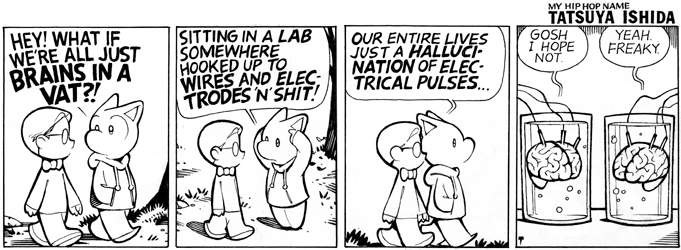
Merleau-Ponty would say you’re not located in your brain alone. The self isn’t just thoughts in a skull. It’s our full bodily encounter with the world. Thinking, feeling, being: all of it lives in the interaction between body and environment. A brain can’t live meaningfully on its own, and a body “left behind” isn’t just leftover tissue, it’s a record of ongoing intelligence that usually works without us even noticing.
The Primacy of Perception
At the heart of Merleau-Ponty’s philosophy is the idea that perception comes before everything else: before language, reasoning, or theory. Our first mode of contact with the world is bodily and pre-reflective. We don’t start by thinking about things, we encounter them.
To feel this instantly, try watching the video below. It’s from what might be the worst sport in the world, where people take turns slapping each other. I bet your body will brace or flinch, even though you “know” it’s only pixels on a screen. Your body reacts before your mind has time to process. That physical reaction is perception at work. You don’t just see pain, you register it somewhere inside.
Experiments with mirror neurons and the famous “rubber hand illusion” suggest that perception is active and embodied. We don’t passively watch the world, we’re already part of it as we perceive. Your heart races, your stomach flips, your skin tingles, your palms sweat. You don’t just observe emotions but feel their echo in your own body.
As Merleau-Ponty put it, “The world is not what I think, but what I live through.” Perception isn’t just data collection or projecting inner ideas outward. It’s a kind of co-creation between you and your surroundings. This perspective aligns with philosopher Alfred North Whitehead, who thought of reality as a continuous process of becoming.10 In the same spirit, Francisco Varela saw cognition as “enactive,” emerging from the ongoing interaction between organism and world.11
But Merleau-Ponty goes further. Perception isn’t just subjective experience or an external snapshot. It’s a criss-crossing and mixing. Before we make sense of things, we’re already in contact. To see something is already to be in a kind of relationship with it. This is a philosophy that sees the world as alive with meaning and possibility. A chair “invites” you to sit. A path “pulls” you forward. What you perceive depends on how your body relates to what’s around you. This feels close to Ray Peat’s view, where better metabolic health makes you more perceptive and responsive. A higher rate of energy flow seems to sharpen not just attention, but presence.
Merleau-Ponty shows that a more awake, more grounded body helps us reconnect with the subtler textures of the world.
An Invitation to Dwelling
This bodily anchoring leads to one of Merleau-Ponty’s most memorable lines:
“Our body is not in space like things; it inhabits or haunts space. It applies itself to space like a hand to an instrument. And when we wish to move about, we do not move the body as we move an object.”
He’s pointing out something we often overlook: your body isnt just in space. It moves through it, wraps around it, changes it. Movements like walking a path, reaching for a mug, or turning toward a sound aren’t mechanical. They’re how you live inside the world.
Growing, Changing Bodies
Merleau-Ponty didn’t build his ideas on fixed categories. He focussed on the changing, developing body, from infancy to old age. He did what most philosophers hadn’t done before him by making real, growing bodies the basis for understanding perception and experience. The child’s world is full of touch and motion. As we grow older, we often get more abstract, more in our heads, and forget the original mix of body and world we used to live in so naturally.

Merleau-Ponty’s approach is both rigorous and generous. He doesn’t reduce the body to brain chemistry, nor does he make perception into just a mental event. He leaves space for difference, change, and complexity, the real stuff of ordinary life.
The Chiasm: Meeting the World Halfway
In his later work, Merleau-Ponty developed the idea of the “chiasm,” a crossing over and mutual entangling. When you touch something like a tree, it touches back. When you look, you are also seen. There is no one-way perception. You and the world always meet halfway. As Merleau-Ponty wrote, “There is a reciprocal insertion and intertwining of one in the other.”
His term “flesh” doesn’t mean body tissue, it means the shared material of being, the in-between where body and world mix. This is where real perception happens: not in our heads or out in objects, but in this shared, lived space. Simone Weil, the philosopher and mystic, captured the same spirit when she described attention as “the rarest and purest form of generosity.”12 Like Merleau-Ponty, she invites us to receive the world instead of trying to master it. To attend, not to conquer.
Practicing Presence
Merleau-Ponty’s philosophy is something we can live practically. It invites you to return to your body and the immediacy of being here, not as another mindfulness trick or productivity hack, but as a return to where you already are.
Try this:
Notice your breath: Feel the rhythm of each inhale and exhale.
Move intentionally: Walk or stretch. Pay attention to how your body moves. My wife loves reformer pilates for this.
Dance or move as children do: Put on some tunes and let yourself groove.
Touch something: A leaf, stone, or mug. Let your body feel it.
Listen and connect: In conversation, let your body tune into gestures, tone, silence, space.
These small shifts pull us out of abstraction and back into experience.
The Wisdom of Being Here
Merleau-Ponty reminds us we don’t need to transcend the body to know the truth. We need to come home to it. In a world drawn toward overthinking, overworking, and overexerting, even in the name of spirituality, his work is a quiet call to presence.
We don’t need to go anywhere. We’re already in the right place.
We just need to notice we’re here.
If you’d like to explore more, the BBC podcast In Our Time did a good episode on Merleau-Ponty’s life and work recently. Listen here.
Merleau-Ponty’s Phenomenology of Perception (1945) is a foundational work in 20th-century philosophy that rethinks the nature of perception, embodiment, and consciousness. In this book, Merleau-Ponty argues that perception is the primary way humans engage with the world, challenging both empiricist and intellectualist traditions that treat perception as either a passive reception of sensory data or as a construction of the mind. It has influenced fields beyond philosophy, including psychology, cognitive science, gender studies, and the arts, by foregrounding the role of the body in shaping meaning and reality.
First stated in his 1637 work Discourse on the Method, this serves as the foundational point of certainty in Descartes’ philosophy, demonstrating that the act of doubting or thinking is proof of one’s own existence. This became the foundational starting point for modern philosophy, moving away from reliance on tradition or external authority and instead grounding knowledge in individual reason.
Baruch Spinoza (1632-1677), a 17th-century philosopher, rejected the dualism of mind and body proposed by thinkers like Descartes. In his major work, Ethics, Spinoza argued that mind and body are not separate substances but rather two attributes of a single substance—nature or God. For Spinoza, human beings are modes of this one substance, and our mental and physical experiences are deeply interconnected. Thinking, sensing, and acting are all expressions of our existence as part of nature, and understanding this unity leads to greater freedom and well-being.
Merleau-Ponty’s The Visible and the Invisible is his unfinished final work, published posthumously, in which he develops a new ontology that seeks to move beyond the traditional subject-object dichotomy found in much of Western philosophy. The book is both a manuscript and a collection of working notes, reflecting Merleau-Ponty’s evolving thoughts at the time of his death
Edmund Husserl’s (1859-1938) method of “bracketing” (epoché) involves suspending or setting aside all assumptions about the existence of the external world to focus on how things appear in consciousness. This approach aims to reveal the essential structures of experience by isolating consciousness from its usual context and examining it as pure subjectivity. However, this method still maintains a subtle separation between the observer and the world, as it treats consciousness as something that can be studied in isolation. Merleau-Ponty critiqued this stance, arguing that we are always already involved in the world through our bodily existence, and that true understanding cannot come from detachment but from recognising our ongoing participation in the world we experience.
In traditional Western philosophy, especially post-Cartesian thought, the body was often treated as an object, distinct from the mind (the “thinking thing”). Merleau-Ponty argued that we don’t have a body; we are a body. The corps-sujet expresses this idea: the body is not just something we “use” to perceive the world; it is the means and medium through which we perceive, act, and engage. All experience is rooted in embodiment. Vision, touch, movement, and attention are not activities of a detached mind—they are part of the body’s active relationship with the world.
Heidegger’s concept of “Dasein” (literally “being there”) refers to human existence as fundamentally situated in the world. In Being and Time (1927), Heidegger argues that we do not exist as isolated minds looking out at the world, but as beings who are always engaged with our surroundings, relationships, and concerns. The phrase “always already” (immer schon) emphasises that we never start from a position of detachment; instead, we find ourselves already involved in a world of meaning, shaped by history, culture, and circumstance. Heidegger calls this condition “thrownness,” meaning we are born into situations not of our own choosing, and our existence is defined by how we respond to and care about what matters to us.
Ray Peat and the Art of Becoming: A Philosophy of Aliveness (Substack post)
The “brain in a vat” thought experiment is a modern philosophical scenario first fully developed by Hilary Putnam in his 1981 book Reason, Truth and History. It updates René Descartes’s 17th-century “evil demon” hypothesis for the age of neuroscience: imagine your brain has been removed from your body, placed in a vat of nutrients, and connected to a supercomputer that sends signals replicating real experiences. For the brain, these simulated experiences would be indistinguishable from “real” life, raising skeptical questions about knowledge, reality, and the self.
Alfred North Whitehead and the Dance of Life: Finding Your Way in a World in Motion (Substack post)
Francisco Varela (1946-2001), along with colleagues Humberto Maturana and Evan Thompson, developed the “enactive” approach to cognition. This perspective holds that knowing is not a matter of passively receiving information from the world, nor is it simply a process inside the brain. Instead, cognition emerges through the active engagement of an organism with its environment. Perception and action are inseparable: as we move and respond, we help bring forth the world we experience, and the environment in turn shapes our actions and perceptions. This ongoing interaction blurs the boundary between subject and object, emphasising that meaning and knowledge arise from participation rather than observation alone.
See Varela, F. J., Thompson, E., & Rosch, E. (1991). The embodied mind: Cognitive science and human experience. MIT Press.
Simone Weil (1909-1943), a French philosopher and mystic, believed that true attention involves a kind of self-emptying, where one sets aside personal desires and ambitions to receive the world as it is. In her essay “Reflections on the Right Use of School Studies with a View to the Love of God,” she describes attention as a spiritual act—an openness that allows reality to reveal itself without distortion. For Weil, this form of attention is the foundation of both compassion and genuine understanding, and she likens it to prayer because it requires humility, patience, and a willingness to be changed by what one encounters.
David Abram’s book “Becoming Animal” brings M-P’s perspectives alive in an engaging, compelling way. (His earlier “Spell of the Sensuous” was a far more academic entry point, explicitly in conversation with the forefathers of phenomenology)
His books are beautifully written. You will enjoy them.