



When a sunset stops us in our tracks or a stranger’s kindness gives us pause, we often dismiss these moments as fleeting emotions. For German philosopher Max Scheler (1874–1928), however, such experiences are more than passing moods: they are windows into a deeper layer of reality. Beauty, justice, and love, he insisted, are not just personal preferences or social conventions, but objective values, as real as gravity itself. In these moments, our hearts do more than react; they discern. Feeling, for Scheler, is a mode of perception, a way of knowing. In a world preoccupied with metrics and measureable outcomes, Scheler’s vision encourages us to trust the intuitive intelligence of our emotions. By attending to what moves us, we become attuned to a richer, more textured experience of life. One that reveals not just how things function, but what matters most.
Feeling as Knowing
Scheler emerged from the early 20th-century phenomenological movement—a term that sounds intimidating but describes a straightforward idea: look closely at lived experience before dissecting it into theories and explanations.1 He began in the orbit of Edmund Husserl, sharing the call to return to “the things themselves.”2 Yet, while Husserl emphasised rational intuition and saw the intellect as the main avenue to truth, Scheler placed the heart at the centre of philosophical inquiry.3 This shift, which affirmed emotion as a genuine and powerful form of knowledge, was revolutionary, making Scheler a kind of rebel within phenomenology.
For Scheler, emotions are not irrational or subjective noise. They are acts of value-perception: modes through which we become aware of things we can’t see or measure like courage, dignity, or tenderness. Grief reveals what truly matters. Awe discloses the sacred. Anger unmasks injustice. Far from being merely internal states, these emotions are disclosures of objective value qualities embedded in the fabric of the world. Just as the eyes see colours, the heart intuits value. This bold claim—feeling as a form of cognition—radically reorients our understanding of emotional life. Rather than distract from truth, emotions illuminate it.
The Hierarchy of Values
For Scheler, values form a kind of moral topography. They are not flat or subjective, but layered and hierarchical, some deeper and more enduring than others.4 At the base lie sensory and utility values like comfort, pleasure, and usefulness. Above these are vital values, such as nobility and admirability, exemplied by loyalty and humility, or their opposites like treachery and arrogance. Higher still are spiritual values: truth, beauty, justice, and their negative counterparts. At the very summit are holy values, revealed in experiences of reverence, sanctity, and unconditional love.
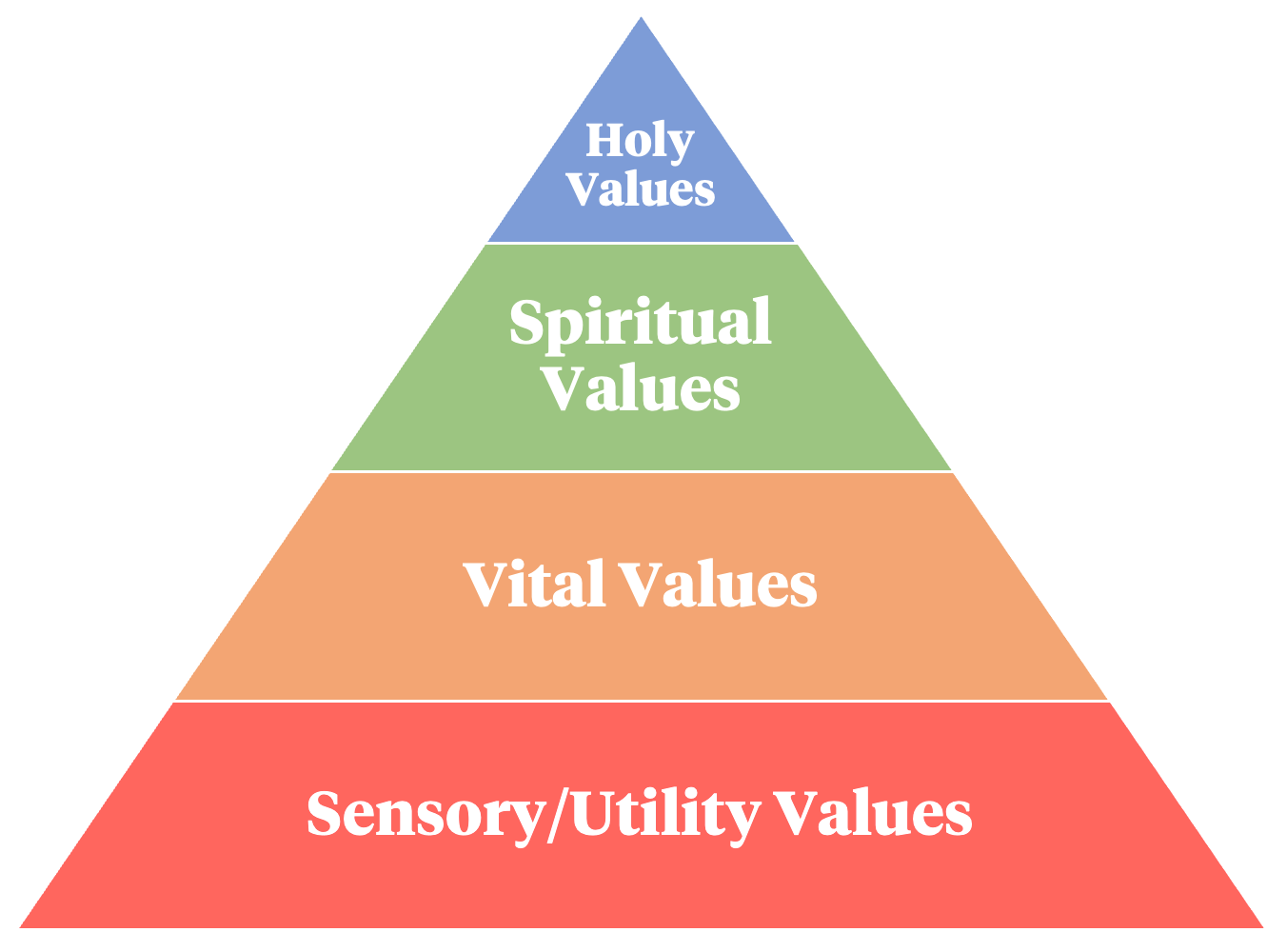
This hierarchy is not based on utility or preference, but on the degree of depth and universality each value entails. While pleasure is fleeting and relative, justice or holiness has a more enduring and universal claim. Importantly, Scheler held that these values precede us: they are discovered, not invented. Our emotional responses are not arbitrary reactions, but acts of recognition. We suffer, Scheler believed, not only from poor choices but from misalignment with this order of values.
Think of skipping a walk in nature to binge-watch a show on Netflix. It may bring temporary comfort, but the lingering unease you feel the next-day goes beyond guilt. Your body and soul are reacting to a neglected value like presence, vitality, or beauty. If you wince at a cruel joke, this reaction isn’t because you’re “soft” or oversensitive. Instead, your heart has detected a subtle fracture in the moral order.
But just as emotions can reveal truth, they can also distort it, especially when left unchecked.
Ressentiment
Scheler’s concept of “ressentiment” names a spiritual malady: a bitter, corrosive mindset that arises when we feel disconnected from higher values.5 Unable to attain love, truth, or courage, we devalue them instead, mocking what we secretly yearn for. This process begins with the suppression of normal human emotions. Scheler identified several as central: revenge, hatred, malice, envy, the impulse to detract, and spite.6 If left unexamined, these emotions harden into a worldview. Over time, ressentiment distorts the soul’s vision. The thirst for revenge is especially dangerous, not the immediate kind, but the kind that simmers and lingers.
Scheler considered existential envy the deepest root of ressentiment. This envy is not about status or possessions, but about being itself. “I can forgive everything,” he wrote, “but not that you are—that I am not you.” The mere existence of another becomes unbearable, felt as a kind of humiliation or “reproach.” Nietzsche famously diagnosed ressentiment as the root of “slave morality”: the revenge of the weak against the strong.7 Scheler agreed on its dangers, but not its remedy. Where Nietzsche saw humility as weakness and a resentment-driven mask, Scheler saw it as a strength and higher value in its own right. Where Nietzsche labelled and condemned, Scheler sought healing through love.8
Sour-Grapes Logic
Ressentiment distorts value-perception. When we sneer at sincerity, it is not because sincerity is false, but because it hurts too much to believe in. We mock goodness as naive, reduce beauty to vanity, and attribute success to mere luck. Unable to attain what we desire, we declare it worthless. Rather than facing envy or feelings of inferiority, we shield ourselves by lowering the stakes.
This sour-grapes logic acts as a kind of “self-poisoning of the mind.” We invert Scheler’s value hierarchy, mistaking the base for the noble and elevating trivial things as if they matter most. The compass spins, not out of malice, but to ease the pain of comparison or failure. Over time, ressentiment corrodes more than just feeling; it distorts judgement itself. When we lose the ability to recognise value, meaning begins to fade.

Love as Illumination
If values are like the colours of the world, then love, for Scheler, is the light that reveals them. Love is not blind emotion or sentimentality. It is a dynamic, spiritual force that opens us to the value of the other.9 It doesn’t create value but discloses it. You comfort a friend not because it’s efficient, but because your heart sees their worth. You stop scrolling your phone when a child laughs, not out of nostalgia, but because something real has broken through the noise.
Where Kant anchored ethics in duty and obligation, Scheler found that too blind to life’s richness.10 Kant asked, What must I do? Scheler wondered, What is worthy of love?11 To love someone is to perceive their irreducible value and to respond accordingly. In this way, even small gestures like watering a plant, listening patiently, or showing up on time, can become acts of moral significance. They affirm that meaning arises not from what we produce, but from what we choose to honour. Love, for Scheler, clears the lens of perception and brings the world into sharper focus. It is the act that most fundamentally discloses value.
Scheler’s World, and Ours
Scheler wrote in the shadow of World War I and its aftermath, a time marked by spiritual disillusionment and political upheaval. Even after his death, his work was banned by the Nazis, not only because of his Jewish heritage but also for his passionate defence of human dignity, which transcended racial and religious divides.12 He did not write from a place of comfort, but from crisis. Yet, amid the turmoil, Scheler’s philosophy is animated by hope: that the heart, when properly attuned, can still discern what matters.
In our age of burnout and busyness, we track steps, clicks, and KPIs, yet rarely pause to ask: what truly counts? Scheler offers an alternative compass: one oriented not towards metrics, but toward meaning. His vision doesn’t ask us to escape the world, but to reorient ourselves within it: to become not more productive, but more percepetive. While another major figure in phenomenology, Martin Heidegger, explored the nature of Being, Scheler focused on Value: what gives life its weight. Where Heidegger’s Dasein confronts death and anxiety,13 Scheler’s person responds to love. His philosophy is not about explaining life, but learning to live it well.14

Why Scheler Matters Now
Because our crisis is not a lack of information—but of meaning. We’re awash with data, but starved for insight. In a distracted and often cynical world, Scheler calls us to become value-detectors: not reactive, but responsive. Not numb, but alive.
Imagine a rushed morning: your inbox overflowing, your phone pinging relentlessly, your mind scattered. Then, someone hands you a cup of tea, or you catch a glimpse of the sky between meetings. That brief flicker of feeling isn’t trivial: it’s an act of value-perception. It signals what is still sacred. When you read about ecological collapse and feel grief, that grief is a form of knowledge. You are perceiving the value of life, and its violation. Scheler reminds us: these aren’t just emotions. They are recognitions. They tell us we are still seeing.
A Practice of Seeing
Scheler gave us no rigid system. He offered a practice. He urged us to tune our hearts and cultivate emotional discernment, asking not simply “What do I feel?” before acting, but “What value am I responding to here?” This isn’t moralism. It’s clarity. It’s a practice of seeing. And it starts small.
So take a moment today to notice what moves you. Perhaps a silence, a gesture, or a glimpse of beauty. Then ask yourself, What value is being revealed in this moment? Is it tenderness? Justice? Wonder? Care? This isn’t woo, mystical, or abstract. It is clarity. It is seeing. In Scheler’s world, to ask that question sincerely is already to begin living with depth.
If you fancy digging deeper into Scheler, Gregory Sadler has a nice series of lectures on his thought:
Phenomenology is a philosophical method and movement that originated in the early 20th century, focusing on the direct investigation and description of lived experience as it appears to consciousness, prior to any theoretical explanation or interpretation. Its aim is to return to “the things themselves,” uncovering the essential structures and meanings of experience by suspending (or “bracketing”) preconceived assumptions about the world. In this approach, what matters most is not just the object of experience, but how it is given and perceived in consciousness.
Agarwala, Anasuya. (2017). Phenomenology: ‘Back to the Things Themselves’ (with reference to Husserl’s idea of phenomenology and Heidegger’s being and time). International Journal of Recent Scientific Research. 08. 16555-16558. 10.24327/ijrsr.2017.0804.0170
Edmund Husserl (1859-1938), founder of phenomenology, emphasised rational intuition, a direct intellectual insight into the essences of things. It’s not sense perception or logical deduction, but a kind of inner “seeing” by which we grasp essential truths (like the nature of a triangle, justice, or grief). This intuitive awareness is central to his method of phenomenological reduction, where we set aside assumptions about the external world to attend to what appears in pure consciousness.
Scheler outlined his hierarchy of values in Formalism in Ethics and Non-Formal Ethics of Values (1913/1916), where he developed a phenomenological ethics based on the direct experience of objective values. He ranked these from lower (e.g. pleasure) to higher (e.g. spiritual or holy), forming a value hierarchy that remains central to phenomenological ethics.
Scheler, M. (1919). Vom Umsturz der Werte: Abhandlungen und Aufsätze (On the Overthrow of Values: Essays and Treatises).
Friedrich Nietzsche (1844-1900) introduced ressentiment in On the Genealogy of Morals (1887) as a reactive state born from powerlessness. Unable to act on revenge or assert themselves, the weak internalise their frustration, turning it into moral condemnation of the strong. This, he argued, underpins “slave morality” (e.g., Christian ethics), which elevates values like humility to mask resentment. For Nietzsche, ressentiment stifles vitality and authentic self-expression.
Scheler, building on Nietzsche, explored ressentiment in depth in his 1912-1915 book of the same name. Like Nietzsche, he saw it as a self-poisoning of the mind caused by repressed emotions like envy or revenge, leading to distorted value judgments. But Scheler viewed it not just as psychological, but also social and ethical, often rooted in a failure to empathise with those who possess higher values. While destructive, he argued ressentiment could also drive moral insight or social reform, depending on how it’s expressed.
Scheler, M. (1921). Vom Ewigen im Menschen (On the Eternal in Man).
Scheler, M. (1913–1916). Der Formalismus in der Ethik und die materiale Wertethik (Formalism in Ethics and Non-Formal Ethics of Values).
Immanuel Kant (1724–1804) held that morality is grounded in reason, not emotion or outcomes. For Kant, an action is moral if done from duty, the rational recognition of what is right, regardless of consequences. His key principle, the Categorical Imperative, commands: “Act only according to that maxim whereby you can at the same time will that it should become a universal law.” Moral worth lies in acting from duty alone; for example, telling the truth not because it feels good or benefits others, but because it is the rational thing to do.
Bahr, A. M. (2023, January 1). Max Scheler. EBSCO. https://www.ebsco.com/research-starters/history/max-scheler
Dasein, Martin Heidegger’s (1889-1976) term for human existence, means “being there.” In Being and Time (1927), it describes the human as a self-aware, questioning being, thrown into the world, defined by care, possibility, and being-toward-death. Dasein is always engaged—with the world, with others—not a detached observer but an involved presence.
Heidegger came on the scene not long after Scheler and quickly overshadowed him. While Heidegger focused on Being, Scheler focused on Value: what makes life meaningful and worth living. Heidegger turned inward toward existential structures, while Scheler looked outward toward the real moral and spiritual landscape we navigate.