


“No one doubts that an ordinary man can get on with this world: but we demand not strength enough to get on with it, but strength enough to get it on. Can he hate it enough to change it, and yet love it enough to think it worth changing? Can he look up at its colossal good without once feeling acquiescence? Can he look up at its colossal evil without once feeling despair? Can he, in short, be at once not only a pessimist and an optimist, but a fanatical pessimist and a fanatical optimist?”
― G.K. Chesterton, Orthodoxy1
I keep hearing people, especially some popular intellectuals, beating the same drum: we’re living through a meaning crisis, an AI crisis, a loneliness crisis, or even a meta crisis of everything. And the proposed fix is often a case of rewinding the clock and recovering what we supposedly used to have. Something has been lost. Something terrible is coming. How do we get back?
Things do get lost, and technologies can change things in ways we won’t understand until much later. Ways of life that took centuries to develop can be wiped out pretty quickly. But there’s also something suspiciously evergreen about humans feeling that everything was better back in the day.
Around 700 BCE, the Ancient Greek poet Hesiod was already moaning about having the misfortune to be born into the worst age of humanity:
“Would that I were not among the men of the fifth generation, but either had died before or been born afterwards.”2
His was the age of iron, where people worked too much and children didn’t have any respect for their elders. Justice was disappearing, and bad people were prospering while decent people suffered. Civilisation was basically going to hell in a handcart. That was nearly 3,000 years ago, yet here we still are.
I’m sure Hesiod had plenty to complain about, just like today’s doomsday pundits.3 But I think diagnosing civilisational decline can be seductive, and once it becomes the whole story, it can become a substitute for actually living. Pessimism, despair, and nihilism can end up being your whole relationship with the world, where you just spectate and treat it like something to lament instead of something you’re involved in and can help change. If everything you see arrives pre-interpreted as proof of the decline, the world ends up looking like a giant Pinterest board for conclusions you’ve already reached.
So much so I’m starting to think this is part of the so-called meaning crisis itself. Maybe meaning isn’t something we used to have and somehow lost, but we’ve just become less able to be reached by the world in the first place.
When the World Goes Quiet
The German sociologist Hartmut Rosa has a useful way of thinking about this. For Rosa, one of the problems of modern life is that our whole relationship with the world can become damaged and the world goes mute. He thinks there’s a tragic irony in the way we do stuff like tracking our sleep, curating our playlists, hitting specific heart-rate zones, and planning holidays like military operations. You can know loads about the world, but somehow it stops answering back. That’s because the more you try to make things fully controllable, the more dead and drained of life they can become. Instead of connecting you to life, hyper-optimisation just induces alienation.
Life, Rosa says, only comes alive when you experience what he calls “Resonanz” (resonance), which is basically a sort of two-way acoustic relationship with reality.4 Something external calls out to you, like a song or a little gardening project, and touches you (Afektion). You then answer back in your own authentic voice, and both sides are transformed in the encounter. A bit like two tuning forks vibrating in sympathy.
Living well requires you to take a responsive stance where you can hear and answer, rather than treating the world as something to be mastered. Without going too Fight Club, the key rule of resonance is that it has to be “unverfügbar” (uncontrollable). It can’t be bought, planned, hoarded, or manufactured by sheer will. You can buy the most expensive seats for the concert, or spend a fortune on the wedding venue, but you can’t compel the moment to move you.
And “letting go” can’t just become another optimisation hack either. Rosa’s point is that resonance is never guaranteed. Something reaches you, you answer back, and neither side of the encounter remains completely untouched. Rosa describes resonance as a relationship in which the world can speak, touch, and address you, and in which you can respond and be transformed through the encounter. Which sounds way more interesting to me than asking where all the meaning has gone. In fact, maybe the opposite of a meaning crisis isn’t having more meaning but just having a world that can still get through to you.
Johann Wolfgang von Goethe (1749–1832) seemed to understand this more than most. In his autobiography Poetry and Truth, written between 1811 and 1833, Goethe suggested that the danger isn’t simply a world that’s lost its meaning but our losing the capacity to be reached by it:
“All comfort in life is based upon a regular recurrence of external things. The change of day and night—of the seasons, of flowers and fruits, and whatever else meets us from epoch to epoch, so that we can and should enjoy it—these are the proper springs of earthly life. The more open we are to these enjoyments, the happier do we feel ourselves.”5
Then he describes what happens when the same world is still there, but those recurring experiences no longer engage us:
“If we are insensible to such beautiful offers, then comes on the greatest evil, the heaviest disease—we regard life as a disgusting burden.”
The leaves are still changing colour in autumn, and the blossom hasn‘t disappeared in spring, but something has happened to the relationship. There’s quite a subtle difference that I think is important here. If the problem is that meaning has disappeared from the world, your task is to find whatever used to provide it and put it back. But if part of the problem is that you’ve become so unreceptive to the world, then rebuilding the past might not help very much. The key might be getting your senses back online and relearning how to notice those things. Not in a cheap optimism way of forcing yourself to be cheerful and pretending the house isn’t on fire, but by refusing to let pessimism be your whole relationship with reality.
The biologist Ray Peat (1936–2022) came at something similar from a different direction. In a 2021 interview, when asked what he thought was a healthy or unhealthy way to look at the world, he said:
“I think it’s important to get pleasure from looking at the world, intrinsically the process of being involved and learning from the world gives pleasure; insight is pleasurable; and the attitude towards the world that it’s a place to be dutiful and do your work, that is a less healthy approach to reality. Everything should be more or less spontaneous and fun and intrinsically motivating to continue in that direction.”6
Obviously there’s always going to be some pretty horrific things in the world you could look at, but Peat is describing an orientation. Maybe we could see it as falling in love with the ordinary or what everyone else fails to see as magical. A kind of curiosity rather than resignation and involvement rather than just spectating from the sidelines. There are still people to meet, things to learn, pleasures to discover, places you haven’t seen, books you haven’t read, conversations you haven’t had, work worth doing, and things that badly need changing.
Learning to Be Reached
In his book The Poetics of Reverie (1960), the French thinker Gaston Bachelard (1884–1962) distinguished between nighttime dreams and what he called waking reverie (la rêverie): a sort of gentle, peaceful awareness, like watching the flickering of a fire, chimney smoke curling into the air, or following the flight of a butterfly across a garden. Nothing particularly useful is happening, which is probably why our productivity-obsessed culture tends to dismiss it as laziness or wasted time. But rather than some sort of intellectual void, Bachelard thought la rêverie is where your psyche gets a bit of a rest and the world stops looking like an obstacle course of problems you need to solve:
“Reverie is not a mind vacuum. It is rather the gift of an hour which knows the plenitude of the soul.”7
For a while, you begin to inhabit your surroundings instead of trying to extract something from them, and the dividing line between you as an observer and the world around you starts to melt away. This restores what Bachelard saw as a childlike cosmic relation with existence, where you can marvel at the ordinary texture of things without restlessly needing to own them or make them another project. He says:
“When the human world leaves him in peace, the child feels like a son of the cosmos…Cosmic reveries separate us from project reveries. They situate us in a world and not in a society.”
Society is full of purposes, deadlines, roles, comparisons, expectations, and things to prove. But the world is also woodsmoke, a puddle reflecting a rainbow, a dog asleep on the couch in a patch of sun, a weird cloud, or a song coming from your neighbour’s kitchen. Psychologically speaking, Bachelard thinks reverie gives you a peculiar kind of freedom because you’ve stopped insisting reality justify itself to you.
If you filter everything you encounter by weighing up whether it’s useful or more evidence for your theory that everything is going to shit, you stop noticing what else might be happening. Which means huge portions of existence can start to become invisible, and instead of meeting the world, you just meet your interpretation of it.
But even if the world begins to reach us again, modern time itself often prevents us from staying long enough for anything to happen.
Stop Trying to Get Through Everything
Hans-Georg Gadamer (1900–2002) was really tuned into our relationship with time.
In The Relevance of the Beautiful (1977), he criticises the way modern life turns time into an empty container you have to keep filling up with purposeful activity. We talk of “spending” time, “killing” time, and “saving” time, which treats every minute like some sort of currency. Gadamer contrasted this calculative time with the time of a festival or of a genuine encounter with a piece of art:
“The calculating way in which we normally manage and dispose of our time is, as it were, brought to a standstill.”8
For Gadamer, rather than being a chance to schedule some downtime before getting back to the grind on Monday, a festival has a time of its own that:
“…fulfils every moment of its duration…it proffer[s] time, arresting it and allowing it to tarry.”
He uses the German verb “verweilen,” usually translated as “tarrying,” “lingering,” or “dwelling,” to describe our mode of staying with something rather than trying to consume it as quickly as possible and get it boxed off.
Borrowing one of Heidegger’s classic scenarios, let’s say you’re waiting for your delayed train home.9 As you’re standing there on the platform, the forty extra minutes make you impatient and bored, and the time can feel agonisingly empty. You’re basically just scrolling your phone, getting through it so you can reach your future arrival. But when you tarry, Gadamer says, the present moment is dense and self-sufficient. The same forty minutes spent talking to someone you love can vanish without you wanting them to end. Clock time hasn’t changed, but your relationship with it has.
When it comes to tarrying with art in particular, there’s a sort of receptive, expectant openness to what the artwork might disclose. It has its own “temporal rhythm,” a kind of attentive staying-with rather than just a delay. He thinks learning to linger without having an exit strategy (let’s call it the art of tarrying) is one of the ways you can escape the domination of calculated time and experience a different kind of human freedom.
But being able to stay in the present doesn’t help much if you’ve already given up on the future.
Believe in This World
This is where Gilles Deleuze (1925–1995) can also help. When he was writing about post-war cinema, he said something that goes well beyond watching films:
“The modern fact is that we no longer believe in this world.”10
He didn’t mean we’ve literally stopped believing the world physically exists (although I’m sure there’s an online conspiracy theory about that somewhere). Deleuze just thought that the link between us and the world has become damaged. Things happen like love, death, work, politics, and natural disasters, but somehow they feel as if they only half concern us. You might watch, comment, analyse, and produce content about the analysis, but increasingly you experience yourself as a spectator of a film somebody else is making. Deleuze actually says the world can start to look like a bad film, and I think there’s something of that in the constant diagnosing of crisis.
There’s a comfort in being the person who’s seen through it all, waxing lyrical about why modernity has failed and the old ways were wiser, without necessarily having to do very much about it. I do it myself sometimes, and some of the criticism is fair. But then what? Sooner or later you have to decide what you’re actually going to do with it.
Deleuze wanted you to stop pining for some other, purer world in your head, and recover some faith in the one you’re already in. Enough, at least, to believe reality is still open enough to surprise you, and that your relationship with it isn’t finished yet. As he puts it:
“Only belief in the world can reconnect man to what he sees and hears.”
That’s a much harder thing to do than nostalgia because nostalgia already knows what the answer is: the good stuff is back there somewhere and the job is to retrieve it. Believing in this world is messier and requires a tolerance for unfinishedness as you can never quite know what the finished thing is supposed to look like.
The great German poet Friedrich Schiller (1759–1805) had also spotted another problem with nostalgia long before any of this. He thought modern people had become more reflective and self-conscious than the Ancient Greeks, who seemed able to inhabit the world with a kind of unbroken naturalness. As we’ve seen, the tempting response is to mourn that lost unity and try to get back to it, but Schiller thought that was impossible.
Once you become conscious of the split as a modern person, you can’t just unknow it or pretend you haven’t learned what you’ve learned. Getting all sentimental and trying to recover some earlier harmony of an unreflective past would mean chucking away everything reflection, culture, and reason had given you. Schiller’s way of putting this was modern humanity can’t go back to the innocence of childhood or Arcadia because the genie is already out of the bottle. The task is to move forward towards Elysium: a different kind of wholeness that integrates everything we’ve learned along the way. As he wrote:
“…our culture should lead us back to nature, upon the path of reason and freedom.”11
Which is where Big Ernst Bloch comes in.
Home Is Ahead of Us
Ernst Bloch (1885–1977) was the king of the not-yet. Instead of treating home as somewhere you’d come from, in the fullest sense, Bloch saw it as somewhere you’d maybe caught glimpses of but never actually been. His concept of “Heimat” can mean home, homeland, or a sense of belonging, but not in the sense of trying to go back to some idyllic golden age where everyone knew the greengrocer and no one had an iPhone. True home is the world we haven’t managed to build yet: somewhere you could feel like you genuinely belong and not be estranged from your work or the people around you. His philosophy is full of this reversal, where feeling nostalgic might actually be a longing for the future.
At the end of his three-volume, 1,400-page beast, The Principle of Hope, Bloch says Heimat is something:
“which shines into the childhood of all and in which no one has yet been.”12
Put simply, you might think you’re homesick for somewhere you’ve been when actually you’re longing for a way of living you’ve never fully experienced.
Let’s say you have a brilliant holiday or a top night out with friends, and years later you find yourself reminiscing and wishing you could turn the clock back. But go back to what exactly? The restaurant? The hotel? The pub? Thursday 14th July at 10.43pm? If you could perfectly reconstruct the physical circumstances ten years later, it probably wouldn’t work.
Bloch might ask what was possible in that moment. Maybe you felt really connected to people or just felt totally at ease in your own skin. The interesting question for Bloch then becomes: what was that experience showing you about how life could be? Which is where his idea of the “not-yet” comes in. Bloch sees hope as an active orientation towards:
“possibility that has still not become.”
Certain experiences can give you little glimpses of ways of living that haven’t found a lasting form yet. They often appear briefly, imperfectly, and sometimes almost accidentally, before disappearing again. Bloch’s hope is about learning to notice them. Which isn’t to say you should just have more holidays and nights out. For Bloch, Heimat is a shared achievement, and it goes way beyond mere passive optimism about the future. It needs people who:
“throw themselves actively into what is becoming, to which they themselves belong.”
You’re already in it. There’s no observation platform outside history from which you can wait for somebody else to fix the century you’re living in. You have to get your hands dirty and take part in bringing possibility about. Heimat is the horizon of that hope: the possibility of finally becoming at home in a world you helped create.
If people are alienated by the organisation of work, housing, technology, community, or economic life, you can’t solve all that by just teaching everyone to chill out and look harder at butterflies. The conditions of shared life matter, which means Heimat has to be made together. Yes, the world needs changing, but you’re going to be more capable of changing it when you haven’t already decided that it’s dead.
The Animal That Begins
Hannah Arendt (1906–1975) gives us one final reason not to treat the future as merely an extension of the present, through her idea of “natality.”
Where a lot of twentieth-century existential philosophy made a big deal of death, in that we’re mortal creatures who know we’re going to die, Arendt looked in the other direction at something almost embarrassingly simple. She saw that yes, you’re gonna die, but you also get born. People keep rocking up who’ve never been here before, and they bring with them the capacity to start things. You can disrupt what’s already going on, start relationships, make promises, speak up, fall in love, create art, and do all manner of things that might change what’s possible for the people who come after you. Arendt says:
“The fact that man is capable of action means that the unexpected can be expected from him.”13
I think that’s a cracking line. The unexpected maybe can’t be predicted, but it can be expected. History still matters, obviously, because you don’t just turn up from nowhere. But it doesn’t get the final word either. People will always arrive and do odd, stupid, brilliant, potentially horrible, and unexpected things that weren’t just sitting there waiting in the forecast. In a world increasingly chock-a-block with people, models, and algorithms claiming to know what you’ll do next, it’s important to remember the future isn’t already included in the present. There’ll always be something wonderfully irritating about humans: we keep doing stuff the models didn’t expect.
Meaning Is a Verb
Having said all this, maybe we’ve got the meaning crisis slightly backwards. Maybe it isn’t a precious substance previous generations had loads of before all this modernity nonsense kicked in with capitalism, secularism, smartphones, and AI. Maybe meaning happens in relationship. Something catches your attention, you stay with it, and it changes you. You respond and something becomes possible that wasn’t possible before.
Importantly, none of the thinkers I’ve mentioned here ask you to pretend that everything is hunky dory: there’s loads wrong and there always has been. Yes, there are things that need resisting or tearing down, and some genuinely valuable traditions, shared rituals, communities, and institutions probably do need recovering. But the past can’t tell you exactly how to live now because nobody in the past has dealt with this specific combination of circumstances. Which might be scary, but it’s also pretty exciting.
The world is unfinished, and so are you. The task is to stay receptive and open enough to notice what’s here. To stay imaginative enough to sense what isn’t here yet and involved enough to help bring some of it about. Bloch’s home is somewhere no one has yet been. So get out there. Get your hands dirty and take part in the world. Stop moaning about meaning and start making the future.
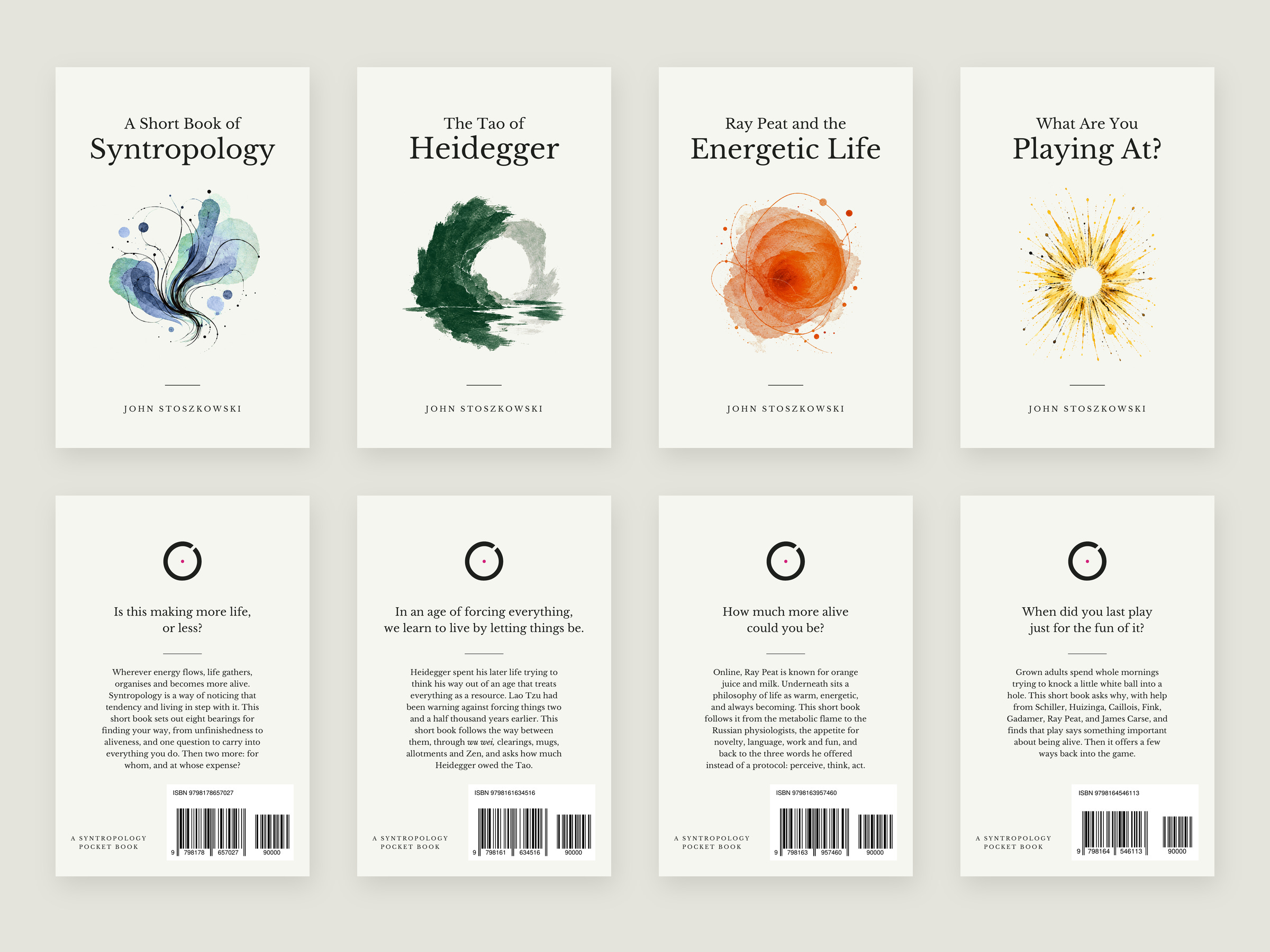
If you enjoyed this, I recently published a series of Syntropology pocket books. They’re available on Amazon, with my royalties going to charity. I’ve also built an interactive version of the first one you can play with here.
G. K. Chesterton, Orthodoxy (1908), ch. V, “The Flag of the World.”
Hesiod, Works and Days, ll. 174–201, trans. Hugh G. Evelyn-White.
In fairness, I think the version of the meaning-crisis argument that says the stuff that used to orient us and give us a sense of belonging has been weakened is solid. Things like shared rituals, local communities, and intergenerational ties have been substituted for things that feel much thinner and more temporary and individualised (e.g., therapy, curated online communities, productivity systems, etc.). But even if the diagnosis is right, it still doesn’t mean that the obvious solution is to rewind.
Hartmut Rosa, Resonance: A Sociology of Our Relationship to the World, trans. James C. Wagner (Polity, 2019); and The Uncontrollability of the World, trans. James C. Wagner (Polity, 2020).
Johann Wolfgang von Goethe, The Autobiography of Goethe: Truth and Poetry, From My Own Life, trans. John Oxenford (London: George Bell & Sons, 1897), pp. 503–504.
Ray Peat, interview on Generative Energy Podcast, episode 64, “Life | Energy | Estrogen | Fibrosis | Calcification | Process Theology | Altruism,” 2 August 2021, 46:16–46:53. (Transcript)
Gaston Bachelard, The Poetics of Reverie: Childhood, Language, and the Cosmos, trans. Daniel Russell (Boston: Beacon Press, 1969).
Hans-Georg Gadamer, “The Relevance of the Beautiful,” in The Relevance of the Beautiful and Other Essays, ed. Robert Bernasconi, trans. Nicholas Walker (Cambridge University Press, 1986), pp. 41–42.
Martin Heidegger, The Fundamental Concepts of Metaphysics: World, Finitude, Solitude, trans. William McNeill and Nicholas Walker (Indiana University Press, 1995).
Gilles Deleuze, Cinema 2: The Time-Image, trans. Hugh Tomlinson and Robert Galeta (University of Minnesota Press, 1989).
Friedrich Schiller, “On Naïve and Sentimental Poetry,” trans. Daniel O. Dahlstrom, in Friedrich Schiller: Essays, ed. Walter Hinderer and Daniel O. Dahlstrom, The German Library, vol. 17 (New York: Continuum, 1993).
Ernst Bloch, The Principle of Hope, trans. Neville Plaice, Stephen Plaice and Paul Knight, 3 vols. (MIT Press, 1986).
Hannah Arendt, The Human Condition, 2nd ed. (University of Chicago Press, 1998).
believing is the worst word
meaning not much better than timing
just call it worlding
and chillax