


“The Soviet concept of the orienting, or exploratory, reflex is the most important single holistic ‘informing principle’ in biology and psychology. It comes close to being the definition of an organism.”
— Ray Peat, Mind and Tissue1
If you asked a typical evolutionary biologist or Freudian psychologist about the main drive of a living thing, they’d likely give you a familiar answer: survival, avoidance of pain, or reproduction. The organism is portrayed as a defensive system, on perpetual alert against a hostile world.
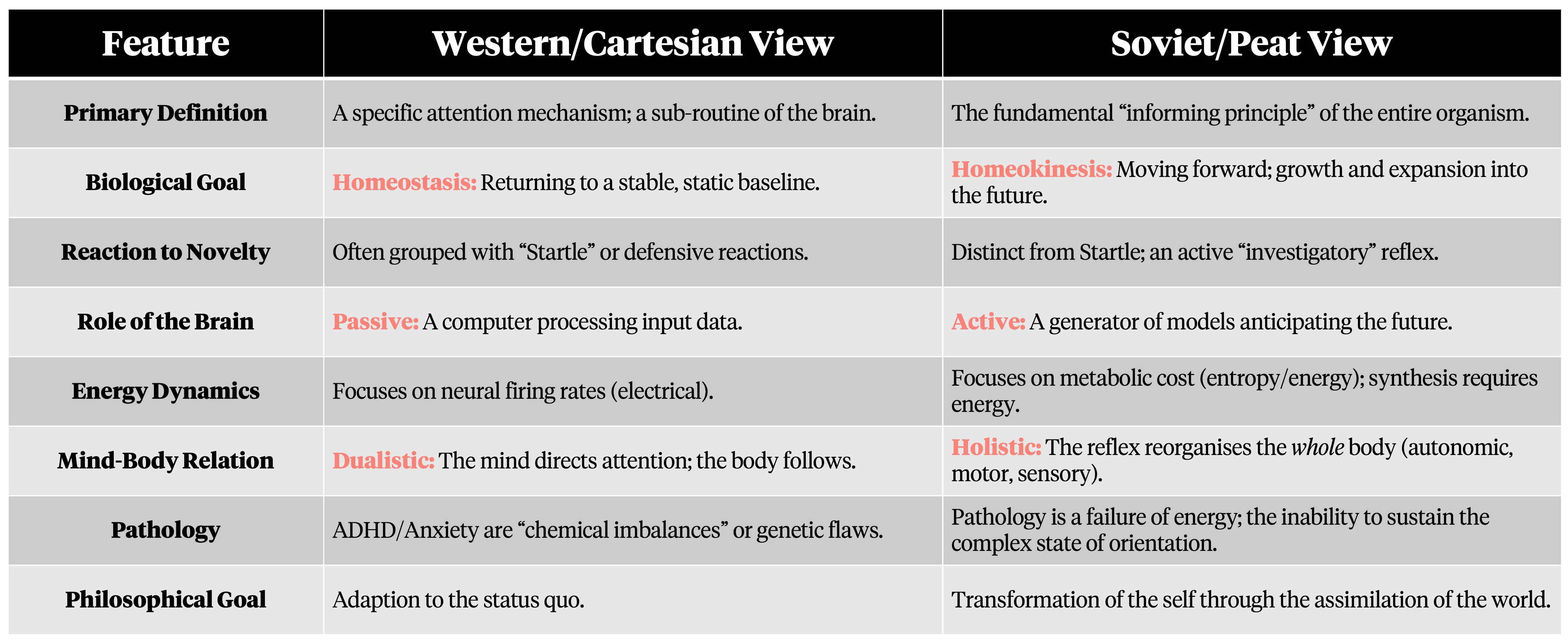
Ray Peat, however, offered a very different emphasis, drawing from a century of largely overlooked Soviet physiological research. He argued that a healthy, energised organism naturally gravitates toward active engagement with novelty. The Russians called this systemic response to the unexpected the “Orienting Reflex”—a coordinated process by which the organism turns toward the new, assimilates it, and incorporates it into itself internally. This isn’t a “drive” in the motivational sense but an expression of the organism’s energetic capacity to confront and integrate the unknown.
The “What Is It?” Reflex
This reflex signifies a fundamental difference in how East and West have approached brain function. In the late 1800s, Russian physiologist Ivan Pavlov became famous for his experiments on dogs and conditioned reflexes.2 During these studies, he noticed that any unexpected stimuli, like the sound of a door creaking or a sudden shadow moving on a wall, would interrupt the animals’ behaviour and pull their attention toward the new event. Pavlov called this the “What is it?” reflex.
Decades later, in the 1950s, Soviet researcher Evgeny Sokolov expanded this idea by proposing a new way to understand how the brain processes information.3 He argued that the brain isn’t a passive mirror simply reflecting what we sense. Instead, it acts as an active prediction engine, constantly creating an internal “neural model” of what it expects to happen next. When the real world doesn’t match these predictions (i.e., when something unexpected occurs), the orienting reflex kicks in. This reflex triggers a full-body alert: muscles tense, posture shifts, senses focus on the new stimulus, and brain activity intensifies. The purpose of this response is to help the brain update its internal model, sharpen perception, and adapt behaviour accordingly.
Love him or hate him, Jordan Peterson thinks Sokolov should have been awarded a Nobel prize for this discovery (1 min video):
Unlike the defensive startle reflex, which triggers a sudden jump or recoil to protect the body, the orienting reflex is expansive and inquisitive. It represents the body leaning in and actively “questioning” its surroundings through a coordinated physical adjustment that turns attention and posture toward what’s new. This is supported by autonomic changes like altered heart rate and heightened brain activity. Together, these responses prepare the organism to take in whatever just appeared, rather than simply recoil from it.4
The Cortical Trap
Peat extends this physiological framework to critique the modern “cortical person”—the abstract intellectual, bureaucrat, or Cartesian scientist—who splits mechanical thought from embodied reality.5 He explains that such people are dominated by what Pavlov called the “second signal system” (language, symbols, abstract concepts), while neglecting the “first signal system” based on direct sensory perception.6 As Peat puts it:
“The cortex is the mediator between inside and out... But the cortex is activated by processes in lower or older parts of the brain, so that it functions with the greatest energy and intensity when it is openly collaborating with the instincts.”
Peat warns that when the cerebral cortex becomes a rigid dictator, suppressing the body’s instinctual wisdom, life turns brittle and energy-starved. The organism becomes alienated from the vitality needed for creative and adaptive engagement with novelty. This disconnection undermines the natural flow between perception, feeling, and action that sustains life.
Contemporary thinkers, such as Iain McGilchrist and Maurice Merleau-Ponty, echo the theme that rigid, abstract forms of cognition create a disconnection from embodied perception and meaningful experience. Merleau-Ponty sees perception not as a detached mental process but as an active bodily engagement with the world, where the body and environment exist in a reciprocal relationship.7 McGilchrist highlights how understanding ultimately must return to the body, as embodied experience grounds all meaning. Viewed through Peat’s bioenergetic lens, this disconnection is explained as a fundamental metabolic insufficiency that weakens the orienting reflex and coherence of perception, undermining our capacity to engage fully with life’s dynamic and embodied nature.

The Energetics of Coherence
Synthesising a complex world into a unified, holistic understanding requires substantial energy. A jumbled up, chaotic pile of facts represents high entropy, or disorder. While a coherent, integrated understanding reflects low entropy, or order. Creating and maintaining order is metabolically costly, but a well-functioning nervous system invests energy to sustain a flexible and integrated grasp of reality. As Peat suggests:
“It’s reasonable to guess that a unified, generalized picture of the world will take less energy to support than will a jumbled, chaotic collection of images... A higher degree of holism would be the existence of a tendency toward completeness.”
When energy levels are low, due to stress, hypothyroidism, or impaired mitochondrial respiration, the brain struggles to preserve its coherence. The orienting reflex weakens, reducing the organism’s ability to filter irrelevant stimuli and maintain the inhibitory control needed for focused, anticipatory attention.
Peat proposed that symptoms often associated with ADHD, such as distractibility and hyperactivity, may arise from this low-energy state. He noted that stimulants enhancing metabolic and adrenergic function can improve these symptoms, supporting the idea that insufficient energy limits the proper functioning of frontal lobe inhibitory processes:8
“Various theories of what causes hyperactivity, e.g., low blood sugar, weak radiation from fluorescent lights and TV, or food additives, and the observation that drugs which stimulate the sympathetic or adrenergic nerves (ephedrine or caffeine, for example) will relieve the symptoms, are all consistent with the idea that not enough energy is being supplied to permit this tissue to function properly.”
Appetite as Exploration
Peat extends the idea of the orienting reflex beyond the brain to include the gut. Hunger is not a passive emptiness but an active orientation towards what’s missing: a kind of metabolic “gap” between the current depleted state and a more complete one of satiation. This involves a mental “intention image,” or craving, representing what would restore balance.

As Peat explains:
“This intention image is the means for regulating behavior--for ‘collating the actual and the intended’--and is sometimes called the ‘acceptor of action.’ That is, the action is refined, until the perceived result of the action corresponds accurately to the guiding image of the desired situation.”
From a “Marxian,” or Soviet dialectical materialist perspective crucial to Peat, the organism is inherently self-organising and goal-directed (teleological).9 It doesn’t simply respond mechanically but is pulled purposefully toward restoring functional integrity, whether through food, knowledge, or social connection.
This mental image embodies an accumulated history, like a kind of working hypothesis the organism tests through interaction. When faced with something truly novel, with no ready-made plan, the organism mobilises perception to learn more and create a new image. This mobilisation is the orienting reflex: a turning toward the unknown to update the map.
Therapy and the “Growth Reflex”
Soviet researchers applied these insights clinically through “conditional reflex therapy,” which aimed to break maladaptive patterns by altering sensory environments and retraining the nervous system’s expectations.10 Peat took this further philosophically, interpreting the orienting reflex not merely as a mechanical survival response but as a “growth reflex”—a biological correlate of openness, transformation and continual becoming. As Peat explains:
“The orienting reflex is always a growth reflex, since it allows the self to approximate itself to a novel aspect of the world, becoming something different in the process of assimilating strangeness.”
This idea aligns with Alfred North Whitehead’s process philosophy, which views life as an ongoing embrace of infinite possibilities:
“Our minds are finite, and yet even in these circumstances of finitude we are surrounded by possibilities that are infinite, and the purpose of life is to grasp as much as we can out of that infinitude.”
A stressed or hypothyroid organism struggles to grow when confronted by novelty.11 Rather than explore, it may withdraw into submissive passivity or respond with anger. The orienting reflex diminishes, leaving the individual trapped in despair or rigid control; both signs of a failed engagement with life’s unfolding possibilities.
Waking Up
In today’s world, the orienting reflex is often suppressed. Algorithms keep feeding our existing biases and beliefs, blocking the “mismatches” that would trigger learning and growth. Meanwhile, chronic stress shifts our physiology toward defensive “startle” responses, making novelty feel threatening rather than inviting.12
Peat describes a “dependency or insecurity culture” particularly in Western education. He suggests:
“One aspect of mild ‘psychopathology’ probably relates to the simple fact that a child can become accustomed to looking exclusively to others to resolve questions, rather than being carried by the orienting reflex directly to the relevant practical, material reality for his answer.”
Reclaiming this reflex requires a physiological foundation that supports curiosity and coherence: healthy thyroid function, efficient mitochondrial respiration, stable glucose, and adequate CO₂ production. It also demands openness to the “dreamy,” intuitive synthesis beyond rigid cortical reasoning. A well-fuelled brain faces the world openly, while an energy-starved brain withdraws.
Importantly, Peat extends the orienting reflex beyond individual environmental engagement to relationship building. From infancy, mutual orienting—such as a baby tuning into a mother’s voice and expressions and vice versa—is the basis of emotional bonding, empathy, and learning. The reflex grounds how we pay attention to and connect with each other, emphasising relationships are embodied, energetic engagements rather than mere cognitive exchanges.
Ultimately, Peat reminds us that living beings aren’t built only for defence or mechanical survival but for adaptive growth. With a well-fueled brain and supportive environment, we can face novelty and others with a full-body question: “What is it?” This gesture opens the door to creativity, connection, and a vibrant life of becoming more than we were.13
Cultivating the Exploratory State
If the orienting reflex marks healthy engagement with the world, then true health transcends merely avoiding disease. It requires a sustained metabolic capacity for flexible, coherent interaction. Practically, this entails:
1. Energy as the Foundation
Coherent perception and flexible orientation demand significant metabolic resources. When metabolism weakens, organisms default to older, less energy-intensive programmess. Supporting oxidative metabolism—with stable blood sugar and readily metabolised carbohydrates like fruit, honey, and milk—helps sustain the energy base essential for curiosity and mental clarity.14
2. Safety before Exploration
Psychological safety is important, yet without physiological safety it amounts to a superficial haze of learned helplessness. Chronic stress hormones push the nervous system toward reactive inhibition. Minimising stressors, avoiding metabolic suppressors like polyunsaturated fats, and supporting mitochondrial function reduce internal noise and free energy to fuel exploration.
3. Re-engage the First Signal System
Peat emphasised the importance of the first signal system: direct sensory engagement. Complex, novel environments that demand active perception foster orienting processes. Immersion in art, nature, rich music, or learning new physical skills promotes this. Passive digital novelty or endless abstraction fails to engage the system.
4. Embrace Mismatch
In the Soviet model, mismatch drives learning. A rigid mind rejects it, while a healthy organism uses it to continually refine internal models. This ongoing physiological and psychological flexibility enables growth rather than stubborn fixation.
5. Walk the Talk
Walking creates a dialogue between body and world, dissolving overthinking through active presence. From Aristotle to Kierkegaard, philosophers valued walking as perception in motion, where insight emerges through movement, mirroring the orienting reflex’s whole-body inquiry toward novelty and adaptation.15
6. Meditation
Many meditation practices cultivate the orienting reflex by nurturing a sustained turning toward experience, softening the rigid self into ongoing novelty. This loosens the brain’s reductive filters, allowing abstract thought to float over a foundation of bodily sensation and intuition.
Pavlov’s famous dog experiments demonstrated classical conditioning: by repeatedly pairing a neutral stimulus (such as a bell or metronome) with food, he showed that dogs could learn to salivate in response to the previously neutral signal alone. This learned link between stimulus and automatic response became known as a “conditioned reflex” and laid the foundations for modern behaviorist psychology.
E. N. Sokolov’s Neural Model of Stimuli as Neuro-cybernetic Approach to Anticipatory Perception (Article by Dobilas Kirvelis and Vygandas Vanagas)
Modern neuroscience shows that this orienting-to-novelty triggers increased neural plasticity and heightened attention, foundational for learning and creativity in education and workplaces. Mindfulness-based therapies, promoted by Jon Kabat-Zinn, help rehabilitate this reflex by training sustained, open attention—encouraging the brain to welcome fresh stimuli rather than retreat into automaticity.
The term “Cartesian scientist” refers to the philosophical and scientific approach derived from René Descartes (1596–1650), who emphasised reason and doubt as the foundations for knowledge. Cartesian dualism separates mind and body, viewing the body as a mechanical system governed by physical laws, while the mind is a distinct thinking substance. This view prioritises objective, mechanistic explanations of natural phenomena and laid the groundwork for modern science’s emphasis on rationality, measurement, and prediction.
Ivan Pavlov (1849-1936) distinguished two types of signaling systems in the brain. The first signal system is shared by humans and animals and involves direct sensory stimuli—real-world signals like sights, sounds, or smells that produce conditioned reflexes. The second signal system is unique to humans and involves language, which acts as a “signal of signals.” It enables abstract thinking and generalisation by allowing words to represent and organise the first level sensory information. This dual system helps explain how humans process concrete reality and symbolic concepts differently.
Maurice Merleau-Ponty and the Art of Being Here (Substack Post)
Hans Selye’s pioneering stress theory complements Peat’s bioenergetic framework by elucidating how chronic strain depletes physiological resources necessary for cognitive coherence. Clinical research on metabolic treatments for ADHD and fatigue disorders resonates with Peat’s view that energy deficits impair frontal lobe function critical for focus and planning. Interventions involving dietary glucose stabilisation, thyroid support, and stress reduction improve metabolic capacity, thus restoring the Orienting Reflex’s ability to synthesise complex information. This integrative understanding aligns with emerging biomedical evidence highlighting nutrition and metabolism as central to cognitive health and mental resilience.
Ray Peat and the Dialectic of Life (Substack Post)
Soviet conditional reflex therapy was a clinical approach developed mid-20th century based on Ivan Pavlov’s theory of conditioned reflexes. It aimed to disrupt maladaptive behavioural and nervous system patterns by altering sensory environments and retraining reflexive responses. This therapy was used extensively for treating conditions like alcoholism and other psychiatric disorders, often in group settings. It emphasised the nervous system’s plasticity through conditioning mechanisms, viewing reflexes as fundamental units of psychological phenomena. The approach aligned with Soviet ideological goals by positioning behavior as controllable through environmental shaping and physiological retraining, often subordinating subjective experience to physiological processes.
Pavlov P. I. (1927). Conditioned reflexes: An investigation of the physiological activity of the cerebral cortex. Annals of neurosciences, 17(3), 136–141. https://pmc.ncbi.nlm.nih.gov/articles/PMC4116985/
Energy, Structure, and the Perception of Novelty (Substack Post)
Hypothyroidism impacts metabolism and circulation, which affects the inner ear’s function and thus may increase auditory sensitivity and reactive responses to stimuli like loud noises.
The Hypothyroid Organisation (Substack Post)
Ray Peat and the Bioenergetics of Being Alive (Substack Post)
Solvitur Ambulando: It Is Solved by Walking (Substack post)
John, your piece really stayed with me. It helped me see primary schools as a kind of “over‑stretched organism,” where teachers and children often don’t have the safety or surplus to truly orient, notice and explore in their environments.
Excellent John. I’ve utilized much of Peat’s work and what you’ve covered here in my therapeutic practice. The shift towards vitality has been so difficult for many of my patients, especially those who have been “poly-saturated” in entropy in the guise of freedom within our culture. Keep up the good work!