



“Suppose that we said yes to a single moment, then we have said yes not only to ourselves, but to the whole of existence. For nothing stands alone, either in ourselves or in things; and if our soul did but once vibrate and resound with a chord of happiness, then all of eternity was necessary to bring forth this one occurrence - and in this single moment when we said yes, all of eternity was embraced, redeemed, justified, and affirmed.”
— Friedrich Nietzsche, Will to Power, §1032
Nietzsche’s invitation reminds us that no event stands alone. Every moment is woven from an unbroken process, a living continuity where past, present, and possibility interpenetrate. To say yes to a single moment is to affirm the whole stream.
Now picture a seesaw.
Entropy sits on one side: scattering, dissolving, and unravelling. Syntropy sits on the other: gathering, patterning, and intensifying life.
These are tensions within a larger process, held in dynamic relation. But you’re not just watching this seesaw passively from the sidelines—you’re standing on it. You’re an expression of it. Every choice you make adds weight.
This is the essence of Syntropology: a philosophy of coherence, grounded in becoming and the idea that life leans forward. Reality isn’t a static block universe but an unfolding field of possibility, what Alfred North Whitehead called “the creative advance.” What Henri Bergson called “élan vital.” What Ernst Bloch described as the “Not-Yet” humming inside every human being.
Syntropology is more than a theory about that movement. It’s a way of living inside it. It navigates the tension between emergent contingency and metaphorical teleology, leaning into the Not-Yet without assuming a fixed end.
What follows is an attempt to sketch the foundations of that philosophy, not as a grand system but as a lived orientation.
The Syntropic Map (TL;DR)
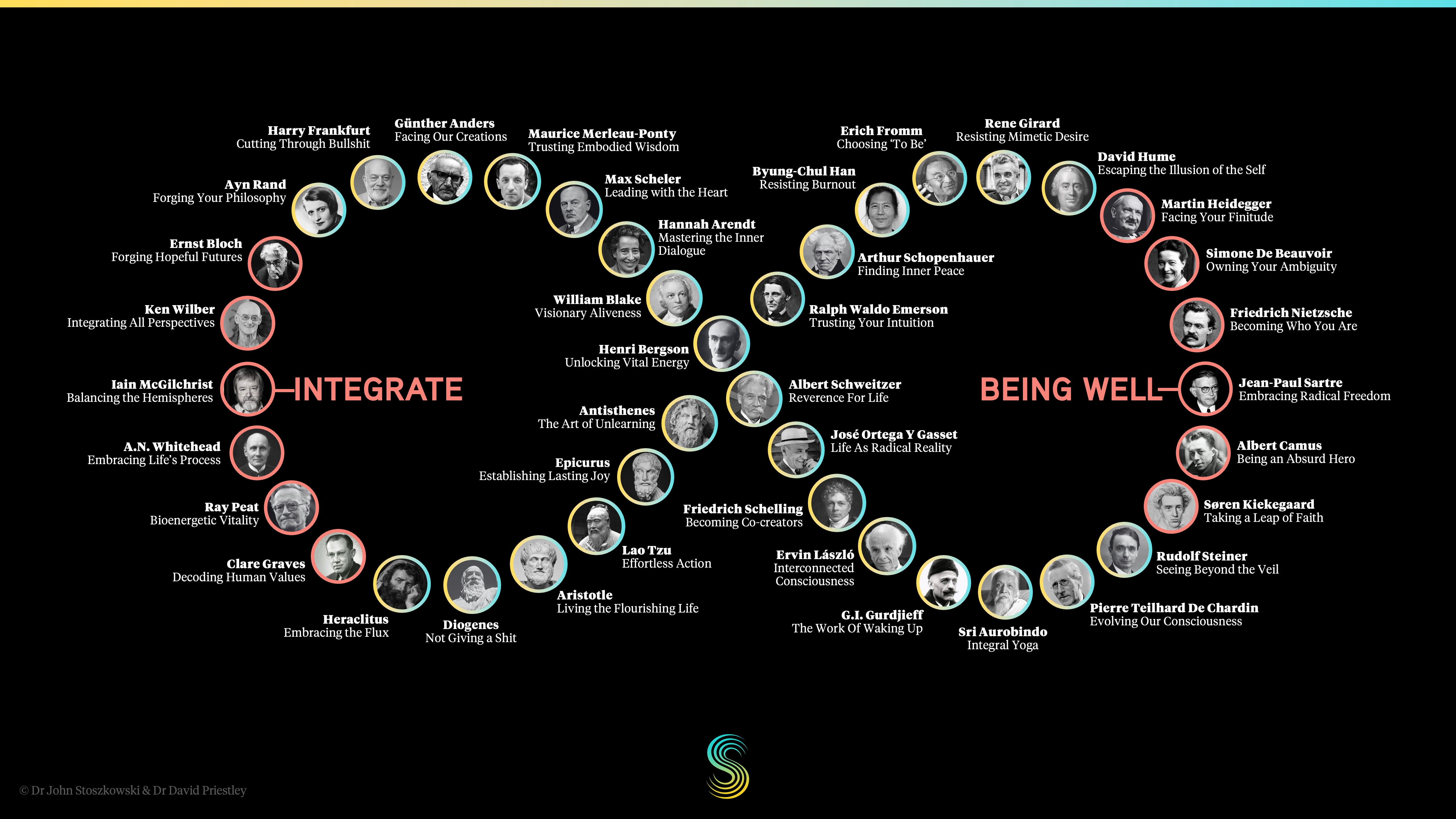
This is a long read, synthesising the work of over 40 thinkers into a single framework. It’s not a fixed dogma but an ever-evolving work in progress, grounded in 40+ years of combined experience across sport, education, business, and the creative industries. Here’s the map of the territory:
I. Etymology: Syntropy is the “turning together” of energy into complexity, countering the “turning inward” of Entropy into disorder.
II. Ontology: Reality is a generative tension between the resistance of entropy and the emergent drive of syntropy.
III. Epistemology: We can’t know syntropy by dissecting parts; we know it by participating in the wholeness of the system.
IV. Ethics: Good is whatever deepens coherence and metabolic energy; Bad is whatever fractures, extracts, or induces helplessness.
V. Praxis: We must overcome the drift of habit through Natality (starting something new) and Work (the friction of creation).
VI. Aesthetics: Beauty is the ontological signal that a system is alive and coherent.
VII. Politics: We must build Convivial institutions that generate “Power-With” (cooperation) rather than “Power-Over” (coercion).
VIII. Theology: The Divine is the Lure of the future pulling us toward the next level of integration.
I. Etymology
The Roots of the Turn
Before we explore the philosophy, we must ground the word itself. Far from a poetic metaphor, Syntropy has a precise mathematical and linguistic lineage in the attempt to describe why life behaves differently than dead matter. Syntropology uses it primarily as a heuristic—a lens through which to understand the observable drive of life to organise itself against the drift of decay.
The word derives from the Greek syn (together) and tropos (turning or tendency).
Entropy (en-tropos) refers to “inner transformation”—specifically, the turning of useful energy into unusable heat. Physically, this manifests as divergence: energy spreading outward from a centre, dissipating into disorder.
Syntropy (syn-tropos) refers to “turning together.” Physically, this manifests as convergence: energy concentrating inward toward a centre, building structure and complexity.
In 1944, the physicist Erwin Schrödinger famously argued that life evades decay by feeding on “negative entropy,” extracting order from the environment.
The term Syntropy was proposed as a more active alternative. In 1941, the mathematician Luigi Fantappiè noticed a duality in the equations of quantum physics and relativity:
Diverging Waves: Energy spreading out from a center (Entropy/Causality).
Converging Waves: Energy concentrating toward a center (Syntropy/Finality).
Fantappiè suggested that physical matter follows the law of entropy (decay), whereas life follows the law of syntropy (growth). While the physics of “retrocausality” remains a subject of debate, the metaphor is undeniably powerful for describing human experience: we feel pushed by the past (trauma, habit), but we also feel pulled by the future (purpose, vision, love).
The researcher Ulisse Di Corpo modernised this into the Theory of Syntropy, speculatively connecting these waves to human consciousness. He argued that entropy manifests as anxiety (energy dissipating), while syntropy appears as Love (energy converging). For Di Corpo, the heart acts as an “antenna” for these future-oriented waves. Whether literal or metaphorical, this framing allows us to orient ourselves toward coherence.
The concept found fertile ground in biology. The Nobel Prize-winning biologist Albert Szent-Györgyi (discoverer of Vitamin C) seized upon it in 1974, proposing that science replace the passive term “negentropy” (negative entropy) with Syntropy. He saw life not just as “resisting” death, but as driven by an “innate force to perfect itself.” He famously observed that while a machine wears out with use, a living organism improves with use (plasticity). This self-repairing, self-organising capacity is the biological definition of syntropy.
The visionary Buckminster Fuller later expanded this into a design principle, viewing syntropy as the “comprehensive integrity” of the universe—the metaphysical glue that prevents total dissolution.
Add a little -logy (from Greek logos, via -logia, meaning “study of” or “discourse about”) and voilà, we arrive at Syntropology: the philosophy and study of this “turning together”—mathematically, biologically, and philosophically.
Syntropology adopts this term not as a settled law of physics, but as a philosophical heuristic. It names the observable tendency of complex systems to evolve toward higher levels of coherence, treating any “pull from the future” as metaphorical rather than literal.
II. Ontology
Reality as Emergent, Tensional, and Pulled by Possibility
Standard materialism suggests the universe is a machine winding down: a closed system sliding inevitably into “heat death.” This is true for isolated systems, but the world revealed by experience—the world of growth, learning, innovation, creation, and relationship—thrives in open systems, exchanging energy with their surroundings.
Life also moves against the grain.
Across nature, pockets of increasing coherence appear: organisms, ecosystems, cultures, and human consciousness. Far from anomalies, these stand as expressions of emergent processes. Friedrich Schelling saw nature as self-unfolding power, revealing itself form by form. Henri Bergson deepened this with his “élan vital,” emphasising intuition and creative evolution over mechanical causality. The chemist Ilya Prigogine grounded it specifically in “Dissipative Structures,” systems that maintain their order by dissipating energy into the environment, like a whirlpool or a living cell.
But matter isn’t dead, inert stuff in a closed system. As the process philosophers argued, it possesses an immanent teleology—a drive toward novelty. The past is determined in that it’s finished, and it conditions the present, but it doesn’t determine the future. It’s not billiard-ball causality. The gap between conditioning and determining is where novelty—and freedom—arises.
The Russian geochemist Vladimir Vernadsky expanded this to the planetary scale. He defined the “Biosphere” not just as a collection of living things, but as a geological force that captures cosmic energy (solar radiation) and concentrates it into “living matter,” reversing the entropic drift of dead rock. For Vernadsky, the emergence of the “Noosphere” (the sphere of human thought) is the next inevitable stage of this terrestrial evolution: the mind itself becoming a geological power.
Jeremy Lent frames this connectivity as the “Patterning Instinct.” He bridges Vernadsky’s planetary scale with biology by arguing that the universe isn’t composed of separate things, but of “Li”—dynamic, self-organising patterns that connect everything from a neuron to a nebula. This confirms that coherence isn’t something we impose on the world, but the fundamental grain of reality we align with.
This brings us to the bioenergetic core of Syntropology. The biologist-philosopher Ray Peat argued that this concentration of energy is the very definition of structure. For Peat, the organism isn’t a machine made of parts, but a dynamic “flame” maintained by the flow of electrons.
Peat posited that “energy and structure are interdependent, at every level.” High-energy states, driven by efficient oxidative metabolism and thyroid function, allow for complexity, regeneration, and coherence. When energy flow is abundant, the organism is flexible, intelligent, and “open” to the future (Syntropy). When metabolism fails, the system defaults to stress, inflammation, rigidity, and calcification (Entropy). In this ontology, freedom itself is a biological property: it’s the result of surplus energy. Or, as Peat noted: “If we keep our thoughts on the living substance, the pervasive ideologies lose their oppressive power.”
Reality follows two currents:
Entropy: The constant pressure of dissolution.
Syntropy: The emergent drive toward integration.
Consider the Metabolic Cascade of life, where these two currents dance in a necessary cycle:
The Sun (Syntropic Source) emits light and heat, expanding outward (Entropy).
Plants absorb this dissipated energy, concentrating it into structure and sugar (Syntropy).
Animals eat the plants, breaking down their structure (Entropy) to fuel their own growth and movement (Syntropy).
Humans consume the animal, breaking down that complex protein (Entropy) to sustain a pregnancy or build a brain (Syntropy).
Death eventually reclaims the organism, dissolving it back into the soil (Maximum Entropy), which then becomes the fertile ground for new plants (Renewed Syntropy).
This reveals a stark truth: Localised order (Syntropy) can only emerge if large-scale disorder (Entropy) precedes it. You can’t have the soaring structure of an oak tree (Syntropy) without the chaotic decay of the forest floor (Entropy).
Crucially, however, we must admit that reality has an Entropic bias. Because of the First Law of Thermodynamics, the universe leans toward the path of least resistance: separation, wear, and destruction. Decay is the default end of all things when left to the dispassionate hands of time.
Syntropy is the exception. It’s the path of most resistance. It’s characterised by results which bring things closer together, increase inclusion, and heal existing systems. But unlike Entropy, Syntropy is always temporary. It requires constant energy input to maintain. Without the proper work continuously added to a given entity—whether a body, a relationship, or an organisation—it will naturally slide back toward dysfunction and breakdown.
Syntropology sees this dual movement as a Tao-like interplay—yin and yang, tension and harmony, decline and creation—each completing the other within a deeper order. The Taoist lesson is that order arises not from force but from attunement with the flow of becoming. Heraclitus declared, “War is the father of all.” The arrow flies only because the bow (tension) resists the string. Without the constant threat of disorder, life would have no reason to organise, adapt, or evolve.
William Blake crystallised this: “Without Contraries is no progression.” He saw that Reason (Order) and Energy (Chaos) are both essential for existence. Friedrich Engels and Karl Marx echoed this in dialectical materialism, where tensions between opposites drive qualitative leaps forward—thesis meeting antithesis in synthesis, rooted in material conditions rather than mysticism.
The Spanish philosopher José Ortega y Gasset anchored this in human experience. He argued that “Life is Radical Reality.” Before we can speak of stars or atoms, we must speak of my life—the immediate drama of the self dealing with the world. Unlike a stone, which simply is, a human being must craft their own existence. We’re “shipwrecked” into the world and must swim.
This necessity to build a life is the syntropic imperative. As Ortega put it: “I am myself and my circumstance, and if I do not save it, I do not save myself.” Syntropy transcends the private act; building coherence within demands that one must “save” (syntropise) the surrounding world.
Psychologically, Clare Graves mapped this trajectory in human consciousness. He argued that human nature is an open-ended system. When entropy rises—life conditions outstripping current thinking—we’re not doomed to collapse. Instead, we’re driven to leap to a higher, more complex level of existence. Graves’ “emergent, cyclical” model describes this upward growth, a syntropic response to prior entropy.
Gilles Deleuze and Félix Guattari radicalise this vitalist impulse, emphasising becoming as a process of creative flows and assemblages. Rather than a linear “upward” progression toward higher complexity (as in Graves and Aurobindo below), they propose a rhizomatic model: non-hierarchical, multi-directional connections that spread like roots, forming plateaus of intensity without a predetermined telos.
In this light, Syntropy manifests less as a vertical ascent and more as a horizontal proliferation of relations—“deterritorialising” rigid structures (entropy’s stasis) to reterritorialise in novel, vital configurations. This complements Syntropology’s emergent drive, reminding us that coherence can emerge from nomadic flows as much as structured leaps, fostering a more pluralistic unfolding.
Spiritually, Sri Aurobindo described a double movement: the “Involution” of Spirit into matter, and the “Evolution” of matter back into Spirit. For Aurobindo, the aim isn’t to escape the world (entropy), but to draw higher consciousness down into matter to transform it. Syntropy, in this sense, is the Divine working through us to bring forth a higher life on Earth.
This ontology redefines time as an open horizon charged with potential. Ernst Bloch’s “Not-Yet” becomes metaphysical architecture. Ervin László’s “Holotropic Attractor” names the subtle pull toward wholeness (holos) and connection. This attractor acts like a magnet, drawing dispersed parts in complex systems into higher orders of deeper coherence.
This “pull” serves as a poetic frame for observed self-organisation, not a literal predestination—balancing the teleological lure with the contingent, rhizomatic flows of becoming, where direction emerges from the interplay, not imposition.
The future draws us forward, metaphorically speaking. As Ray Peat noted, living systems develop by increasing their capacity for organised energy flow. As Iain McGilchrist reminds us, reality reveals itself through relationship, context, and unfolding meaning rather than mechanical determinism.
The implication is clear: We’re shaped as much by what is calling us forward as by what has been, though this “call” arises from emergent possibilities, not predestined ends.
III. Epistemology
Knowing as Attunement, Resonance, and Imaginative Coherence
If reality is process, becoming, and tension, then knowing can’t be the cold dissection of parts. To know is to participate.
Aristotle grounded this in empiricism. Unlike Plato, who looked for truth in a transcendent realm beyond this one, Aristotle saw truth in the thing itself. He taught that Form is inherent in Matter. To see syntropy is to perceive latent order emerging from chaos.
William James radicalised this in his “Radical Empiricism,” where relations—the experiences of “and,” “with,” “toward,” and “against”—are as real as the things they connect. The feeling of coherence acts as a natural fact rather than a subjective mood. When we sense that things are resonating or “coming together,” we glimpse fundamental reality.
To learn is to resonate with the new, not merely to store data. As Peat noted, the “Orienting Reflex” is our most dominant biological drive—inhibiting habit to allow for the grasping of new information. We have an innate drive for exploration. Because of this, there’s no static, Kantian “Truth” sitting outside of time. All truths are, as Whitehead said, “half-truths”—snapshots abstracted from the flux. Language tends to freeze this flow into static concepts (the map), but we must never mistake it for the living territory.
To perceive this wholeness requires an Integral view. Ken Wilber provides the map with his concept of the “Four Quadrants.” He argues that every moment of reality has four irreducible dimensions: the Interior-Individual (Psychology/Intention), the Exterior-Individual (Biology/Behaviour), the Interior-Collective (Culture/Values), and the Exterior-Collective (Social Systems/Environment). Entropic thinking occurs when we collapse these dimensions—reducing a human to a neuron, or a society to a statistic. Syntropic knowing requires holding all four quadrants in a coherent view, refusing to flatten the depth of the world.
This participatory knowing finds its neurological grounding in the work of Iain McGilchrist. He argues that the brain has two distinct ways of attending to the world. The Left Hemisphere focuses on the narrow, the static, and the known; it breaks the world into parts to manipulate them. This is the logic of entropy: fragmentation. The Right Hemisphere, however, attends to the whole, the flowing, and the implicit. It sees the connections that the Left ignores. For McGilchrist, the tragedy of modernity is the usurpation of the Master (Right) by the Emissary (Left). Syntropology requires re-balancing this attention: restoring the Right Hemisphere’s primacy to perceive the whole before the parts.
In syntropic knowing, understanding arises when heart, mind, body, and world align. Maurice Merleau-Ponty described us as embodied participants, “intertwined” with the world we perceive. To know syntropy is to feel its resonance in our lived body, grounded in empirical attunement, testing intuitions against observable outcomes to distinguish true coherence from bias.
Neural networks in the heart, Iain McGilchrist’s hemispheric balance, Whitehead’s ecological interdependence: all point to meaning as perceived, not extracted.
Owen Barfield traced the evolution of human consciousness from an ancient, unconscious union with nature to our modern state of “Onlooker Consciousness,” a detached, entropic view where the world feels like a collection of dead objects to be measured.
For Barfield, we can’t go back to the innocence of that unconscious past. We must move forward into “Final Participation.” This is a conscious, willed reweaving of self and world, with imagination as an organ of perception creating what it perceives.
Max Scheler called this the “Ordo Amoris” (Order of Love). He argued that we perceive value through feeling before we understand it through logic. We “feel” the ascent of syntropy or descent of entropy as a distinct emotional intuition.
William Blake saw this with uncanny precision. He declared that “As the true method of knowledge is experiment, the true faculty of knowing must be the faculty which experiences.” For Blake, imagination wasn’t fantasy or escape, but sharpened perception—the ultimate experimental faculty. Ray Peat sharpens this by contrasting Blake with the passive empiricism of Locke or Hume. For Peat, Blake understood that “Reason is only the ratio of things that are presently known.” It’s a closed loop of the past.
To break that loop, we need a faculty that can touch the future. As Peat argued:
“In a world that’s alive and developing, new knowledge is always possible, and imagination has the prophetic function of reporting the trends and processes of development.”
In the syntropic view, “Reason is subordinate to invention and discovery.” This makes the mind not a storage vat for tradition, but a generator of new forms (Syntropy).
Peat radicalises this further by reclaiming Vladimir Lenin’s definition of materialism: “the belief that there is something beyond what is presently known.” This challenges what Thomas Kuhn called “Normal Science”—the status quo that assumes that beyond our current knowledge there’s nothing. For Peat, true materialism asserts the objectivity of time: matter is potentiality, our future waiting to be known.
This counters epistemic entropy, which Harry Frankfurt rigorously defined as Bullshit. Unlike the liar, who respects the truth enough to hide it, the bullshitter is indifferent to reality. They disconnect language from the world to manipulate impressions. This indifference creates a fog of noise where shared reality dissolves. Syntropology demands the opposite: a radical care for what’s real.
This clearing of noise requires what the Cynic philosopher Antisthenes called the most necessary education: “To unlearn.” Before we can participate in the truth, we must “unlearn what is untrue.” Syntropic knowing is often a via negativa, stripping away the entropic layers of social conditioning, false certainty, and bullshit to reveal the coherent structure underneath.
Knowledge, then, is judged by its generative power: Does it create more order, more vitality, more depth, more capacity to perceive truly and act wisely? If yes, it’s real. If not, it’s noise.
IV. Ethics
Integration as the Ground of the Good
If reality is the interplay of entropy and syntropy, then ethics becomes a question of which current we feed, while recognising trade-offs.
Good is whatever deepens coherence, within a person, a relationship, a team, an organisation, a community, a society, an ecosystem. Bad is whatever fractures, exhausts, extracts, or accelerates decay. Yet short-term entropy can serve long-term syntropy: a forest fire clears deadwood for new growth; a painful breakup fosters deeper self-integration.
This distinction transcends the moralistic to become existential. A syntropic act enriches the field of life and strengthens interdependence. That increases the integrity of the whole—think of symbiotic ecosystems, where one species’ waste nourishes another.
Arthur Schopenhauer argued that the “Principium Individuationis”—the principle that makes us feel separate from one another—is ultimately an illusion. He believed true ethics arises from “Mitleid” (compassion): the intuitive realisation that the same “Will to Live” pulsing in me also pulses in you. To hurt another is to hurt the One Life we share, though his pessimism reminds us suffering often accompanies striving.
Albert Schweitzer’s “Reverence for Life” (Ehrfurcht vor dem Leben) declares that the fundamental principle of morality is that “good consists in preserving, promoting, and enhancing life, and that destroying, injuring, or inhibiting life is evil.”
Ayn Rand sharpens this reverence with a vitalist edge. She argued that “Life is the standard of value”—that the very concept of “value” only exists because living beings face the constant alternative of existence or non-existence. For Rand, morality isn’t just about avoiding harm, but about the active commitment to Productive Work—the process of using one’s mind to sustain one’s life. Passivity surrenders to entropy; productivity serves as the fundamental syntropic act.
Yet Syntropology synthesises this individual agency with interdependence, recognising that true power emerges from the tension: the self-reliant flame that illuminates and warms the shared ecosystem, where one’s freedom amplifies the other’s.
Erich Fromm expanded this into a psychological orientation. He distinguished between “Biophilia” (the passionate love of life and all that is alive) and “Necrophilia” (the attraction to the mechanical, unalive, and purely predictable). The syntropic life cultivates the “Being Mode” of existence, focused on shared aliveness, over the “Having Mode,” which seeks to possess and control.
Here again, Peat offers a bioenergetic clarification. For Peat, “Learned Helplessness” is a biological state caused by low energy (low thyroid). When an organism lacks the energy to solve a problem, it gives up; it succumbs to entropy. Therefore, the ethical imperative includes the stewardship of one’s own metabolic health. To generate energy is to generate the capacity for moral action.
Nietzsche provides the ultimate definition of this bioenergetic vitality. He rejected the weak definition of happiness as mere comfort. Instead, he asked: “What is good? All that heightens the feeling of power, the will to power, power itself in man. What is bad? All that proceeds from weakness.” In Syntropology, “Power” doesn’t imply domination over others; it means the Power to Be: the metabolic surplus required to impose coherence on chaos and overcome resistance.
But coherence must be enjoyable, not just dutiful. Epicurus argued that the highest good is “Ataraxia” (untroubled mind) and “Aponia” (absence of pain). This isn’t the “entropic pleasure” of endless consumption or distraction, which leaves us drained. It’s Syntropic Pleasure: the stable, enduring joy that comes from living in alignment with nature, cultivating friendship, and removing unnecessary desires. For the Syntropologist, joy is a signal of coherence.
Simone de Beauvoir extends this capacity outward. She argued that true freedom can’t be solitary. In The Ethics of Ambiguity, she asserts that “to will oneself free is also to will others free.” If I oppress another—if I block their becoming—I’m creating a pocket of entropy that eventually limits my own movement. Syntropic ethics, therefore, is the active liberation of the other. My coherence is inextricably bound to yours.
Syntropology embraces this mandate. Lao Tzu called it alignment with the Tao. Martin Heidegger called it “Care” (Sorge): the way beings show up as meaningful when we stand authentically in the world.
Value is found in relational depth. Progress means integration, not accumulation. Wisdom, then, is the capacity to perceive what enhances life and what drains it, and to choose accordingly, navigating trade-offs—sometimes embracing entropy’s creative destruction to tip toward greater coherence.
V. Praxis
Syntropising as Creative Participation
Philosophy becomes real only when lived through action. Syntropising is the practice of tipping the seesaw toward life.
Hannah Arendt spoke of natality, the miracle that human beings can interrupt the automatic, entropic processes of nature to start something new. To act is to begin.
Syntropising is natality in motion.
It carries terrifying responsibility. As Jean-Paul Sartre famously declared, we’re “condemned to be free.” There’s no fixed script to follow; existence precedes essence. To pretend otherwise, to claim we had “no choice” but to drift with entropy, is to live in “Bad Faith.” Syntropic action accept this radical freedom as creative duty.
But this freedom presents a problem. As David Hume famously observed, when we look inside ourselves, we find no permanent “Self,” but only a “bundle” of fleeting perceptions. We start as entropy, a fragmented stream of consciousness.
This is why freedom alone isn’t enough; it requires integration. Søren Kierkegaard warned of lives stuck in the “Aesthetic” sphere—a state of drifting, scattered experiences (Hume’s bundle). He urged the “Leap of Faith,” not into religious dogma, but Passion. It’s the courage to trust the “Not-Yet”—to commit to a vision of the future that can’t be proven by the logic of the present. As someone once said to me, “jump and the net will appear.” For the Syntropologist, a self is not given; it’s a task achieved through passion and commitment.
Heidegger sharpens this urgency. He argued that we spend most of our lives in the mode of “The They” (Das Man), drifting in the inauthentic chatter of the herd (social entropy). What wakes us up? Being-towards-death (Sein-zum-Tode). Only by facing our own finitude do we snap out of the drift. This confrontation creates “Resoluteness” (Entschlossenheit), literally “un-closed-ness.” It’s the act of unlocking oneself from the mass to stand firm in one’s own existence.
And what if the rock rolls back down? Albert Camus recognised the “Absurd”—the inevitable clash between our desire for coherence (Syntropy) and the universe’s silence (Entropy). Yet Camus concluded that “the struggle itself toward the heights is enough to fill a man’s heart.” We must imagine Sisyphus happy. Why? Because the act of pushing—the act of Syntropising—is the victory. The meaning is in the sweat, not at the summit.
Sustaining this passion means we must defy the pressure of the crowd. Ralph Waldo Emerson warned that “society is a joint-stock company” that demands conformity in exchange for bread. To conform is to succumb to social entropy. Emerson’s “Self-Reliance” is the refusal to scatter one’s energy. It’s the insistence on maintaining the coherence of one’s own character, trusting that “nothing is at last sacred but the integrity of your own mind.”
This is the spirit of Diogenes. When he rolled his tub across the city while others prepared for war, he famously said he was “rolling his tub so as not to be the only idler among so many workers.” Diogenes rejected the “scripts” of society (the status games and performative busyness) to live in radical alignment with his own nature. Syntropy requires this “Cynic” courage: the willingness to disregard social performance (to “not give a shit”) in order to preserve the integrity of the self.
This allows us to step out of the hall of mirrors described by René Girard. Girard showed how human beings rarely desire spontaneously; we want what others want, which he termed “Mimetic Desire.” This imitation creates a feedback loop of envy and rivalry that leads inevitably to conflict. To syntropise is to break this mimetic trance and discover what is distinctly yours to do.
G.I. Gurdjieff warned that most people live in “waking sleep,” a mechanical state where we react rather than act. In this state, we’re purely entropic, drifting with the path of least resistance. To generate a soul—to achieve true coherence—requires “conscious labour and intentional suffering.” It demands that we introduce friction against our mechanical habits.
Syntropy, therefore, doesn’t banish chaos; it transforms it. As Nietzsche declared: “One must still have chaos in oneself to be able to give birth to a dancing star.” Syntropising means gathering the chaos of one’s own life and forging it into a star: a point of light and order.
To syntropise is to wake up and consciously join the movement of creation.
It can begin small: Tidying a room, mending a relationship, tending a neglected corner of yourself. These intervene in entropy. They matter.
Or it can be large: Starting a business, rebuilding a dysfunctional team, transforming a harmful system.
All demand Blake’s “divine imagination,” the capacity to see not only what is, but what could be. Heraclitus’s fire is always burning. Bloch’s hopeful Not-Yet is always pressing forward. Arendt’s call to action is always open.
This goes beyond optimisation or performance tuning. To syntropise is to consciously participate in reality’s becoming.
VI. Aesthetics
Beauty as the Glow of Truth
Syntropy appears as Beauty.
Here, beauty acts as more than mere prettiness or fashion. In Syntropology, beauty is ontological. It’s, as the classical philosophers claimed, the “splendor of truth”—the visible signal that a system is flourishing.
The architect Christopher Alexander spent his life identifying the “Quality Without A Name,” a profound sense of wholeness found in certain buildings, gardens, and objects. He argued that true beauty is objective; it’s the perception of life in a structure. When a room, a painting, or a melody is “syntropic,” it feels alive. It helps you feel more alive.
Ernst Bloch deepened this by linking beauty to the future. He saw art as a “Vorschein” (Pre-appearance): a shining forth of the utopian potential hidden within matter. Beautiful forms act as “wish-landscapes” that anticipate the future wholeness of the world. A beautiful object is a postcard from the “Not-Yet.”
Byung-Chul Han adds that this beauty applies not only to space, but to time. In our “Burnout Society” of accelerating information, time disintegrates into fleeting points. Han argues that “rituals are to time what things are to space.” They make time habitable, so we feel “at home in the world.” They create “duration.” A syntropic aesthetic, therefore, involves the restoration of ritual, creating structures of time that halt the entropic rush and let us linger.
Syntropic aesthetics value character over perfection, echoing the Japanese concept of “Shibui.” This is an unobtrusive, quiet beauty that possesses inherent power. Or “Wabi-Sabi,” which finds deep resonance in the weathering of time. An old, cared-for wooden table is beautiful because it carries the history of life. It has coherence. It has resisted the entropy of forgetfulness.
Syntropic beauty prefers:
Complexity over complication: The rich, organic order of a forest versus the chaotic noise of a landfill.
Resonance over spectacle: Art that vibrates with the viewer’s inner life rather than just dazzling the eye.
Vitality over stasis: Forms that seem to breathe, move, and invite participation.
Creating beauty shapes matter so that it can hold more life. Every act of form-making, whether writing, designing, cooking, a sporting performance, or a quiet space, is an act of anchoring the “Not-Yet” into a concrete “Now.”
VII. Politics
The Polis of Vitality
If ethics aligns the self with syntropy, politics is the alignment of the collective.
Current political landscapes are largely entropic: defined by polarisation (splitting), bureaucracy (energy depletion), and the management of decline. Syntropology imagines a politics of “Conviviality.”
In his work Mutual Aid, Peter Kropotkin debunked the entropic myth that nature is a “war of all against all.” He demonstrated that cooperation, not competition, is the primary driver of survival and evolution. The species that flourish are those that syntropise their efforts through mutual support.
Ivan Illich defined a “convivial” society as one where tools and institutions enlarge the radius of human action rather than narrowing it. Entropic institutions extract and make you dependent; syntropic ones empower and give you agency.
We must also heed the warning of Günther Anders regarding “Promethean Shame”—the humiliating sense that we’re inferior to the perfection of our own machines. This shame drives a desire to become machine-like: predictable, efficient, and tireless. Syntropology rejects this surrender. It asserts that the “messiness” of biological life is the very source of coherence. We must build a world where technology serves the organic, not one where the organic is ashamed it’s not mechanical.
This rejection of machine-perfection leads to Donna Haraway’s call to “Make Kin.” In a damaged world, coherence is less about about purity or isolation and more about “staying with the trouble” and forging unexpected, symbiotic alliances across species and systems. Haraway reminds us there is “no kin without tension.” We must inherit the trouble of our history—to build alliances that aren’t innocent, but vital. To make kin is to weave ourselves back into the web of life as “messmates” in a shared metabolic destiny.
This aligns with Elinor Ostrom’s work on the “Commons.” She showed that communities can self-organise to manage resources sustainably without needing top-down force or bottom-line extraction. This is the politics of “Subsidiarity,” pushing decisions down to the local level, where the energy flows and the relationships are real.
Hannah Arendt drew a sharp distinction between Power and Force. Force is coercive; it treats people like objects. Power, she argued, “corresponds to the human ability not just to act but to act in concert.” Power springs up between people when they act together.
A syntropic politics builds Power-With, not Power-Over. It asks of every policy: Does this weave the social fabric tighter, or does it tear it apart? Does it generate trust, or does it require surveillance?
The goal isn’t a static utopia of perfect order (which is just another form of death), but a living “res publica” (public thing) where conflict is metabolised into creative solutions, and diversity strengthens the whole.
VIII. Theology
The Lure of the Possible
In Syntropology, the Divine is a dynamic verb.
Taoism, Baruch Spionza, and the process philosophy of Whitehead agree. The Tao that flows through the universe is the underlying current of existence, not a monarch imposing laws from a throne. It’s the “Watercourse Way” that seeks the path of least resistance yet possesses the power to carve canyons.
Spinoza stripped the Divine of human-like caprice. He declared “Deus sive Natura”—God or Nature. For Spinoza, God isn’t a distinct entity ruling over the universe, but the infinite substance of the universe itself. Crucially, Spinoza identified the “Conatus,” the innate striving of every being to persist and enhance its own existence. This striving surpasses mere survival, expressing the Holy Spirit of Syntropy itself. To act syntropically is to participate in the self-affirmation of the cosmos.
Whitehead complemented this internal drive with an external pull. He described God not as a ruler who coerces, but as the “Poet of the World” who leads by vision. In this view, the Divine is the Lure—the gentle, persistent persuasion toward novelty, complexity, and connection. It gives metaphysical substance to Rumi’s intuition that “What you seek is seeking you.”
The mystic Pierre Teilhard de Chardin envisioned an “Omega Point,” a final peak of cosmic unity drawing all life forward. Yet Syntropology holds this telos lightly, as metaphor for emergence rather than fate—tempering the purposeful lure (Teilhard) with Spinoza’s deterministic striving and Whitehead’s non-coercive vision, ensuring the Divine verb unfolds through tension, not blueprint.
Steiner provides the precise spiritual cartography for this. He warned that the human soul is pulled between two opposing extremes: Lucifer (the force of expansion, fantasy, and ungrounded dissolution) and Ahriman (the force of contraction, hardening, and cold mechanisation). For Steiner, the “Christ Impulse” is the dynamic balance that stands between these two. It’s the capacity to hold the centre: neither dissolving into the ether nor freezing into matter. Syntropy is this Christ-balance: the active maintenance of a living, breathing human form against the twin dangers of scattering and calcification.
This theology is “Panentheistic”: the Divine is in the world, suffering with its fragmentations and rejoicing in its integrations. It rejects the idea of a distant Watchmaker. Instead, it proposes a Reality that’s intimately involved in the struggle against entropy.
To “pray” syntropically is to quiet the noise of entropy long enough to hear the call forward. It’s to align one’s will with the creative advance of the universe. This is the essence of “Wu Wei” (action without strain): tipping the balance not by force, but by moving with the flow of life.
The Call to Lean Into the Not-Yet
Where does your seesaw tilt today?
Toward entropic drift and dissipation? Or toward syntropic coherence, clarity, and the quiet hum of things coming together?
You’ll know it when you feel it:
The conversation that steadies you,
The work that lights you up,
The idea that feels like a doorway,
The moment when something inside simply says, yes, this.
That’s syntropy. That’s the Not-Yet showing itself. But to see it requires more than optimism; it requires “Active Hope.” As Ernst Bloch taught us, hope isn’t mere optimism and a passive waiting for things to improve. It’s the “Principle of Hope”—a militant emotion that actively engages with the process of becoming. It’s the refusal to accept the “Now” as the final word.
Syntropy is the force.
Syntropology is the philosophy.
Syntropising is the practice.
This is Amor Fati—the love of fate. It’s the embrace of the struggle, the chaos, and the order. Tip the balance toward the living, breathing coherence that makes a world, and a life, worth inhabiting.
The universe isn’t done becoming. Neither are you.
Vamos!
At Syntropise, we offer a range of philosophy programmes, 1-2-1 coaching, and a wisdom community for senior leaders and elite performers seeking to shift their life, team, or organisation from entropy to syntropy.
You can explore them here.
Excellent! I just stumbled on your substack and I'm looking forward to diving in.
Wow! A long but very worthwhile read. Thank you!