



In recent essays, I’ve explored Ray Peat’s bioenergetics, Iain McGilchrist’s hemisphere theory, and the developmental stages of Spiral Dynamics. This one takes those ideas further. It diagnoses what I’m calling “organisational hypothyroidism”—a low-energy slump that shows up as bureaucracy and burnout. We’ll look at what’s causing it and suggest practical ways to boost energy and help systems regain their spark. The goal is to get work flowing smoothly again instead of hitting a wall.1
To keep things actionable, I also lean on Ken Wilber’s four quadrants model (AQAL).2 This framework splits what’s going on inside (our thoughts and culture) from what’s happening outside (our behaviours and structures), and considers both individual and collective levels. This shows how everything in an organisation, from personal energy to team dynamics, links together biologically. Combining this with Spiral Dynamics’ Stage Yellow (an integrative, systems-thinking level), we get a broader, meta‑systemic view of what’s going on, grounded in how energy drives development.
Psychological safety is the current buzzword du jour, but it stands on shaky ground. At its core lies physiological safety—the cellular signal of abundant energy—an indispensable foundation for any thriving organisation.3
Collective Physiology
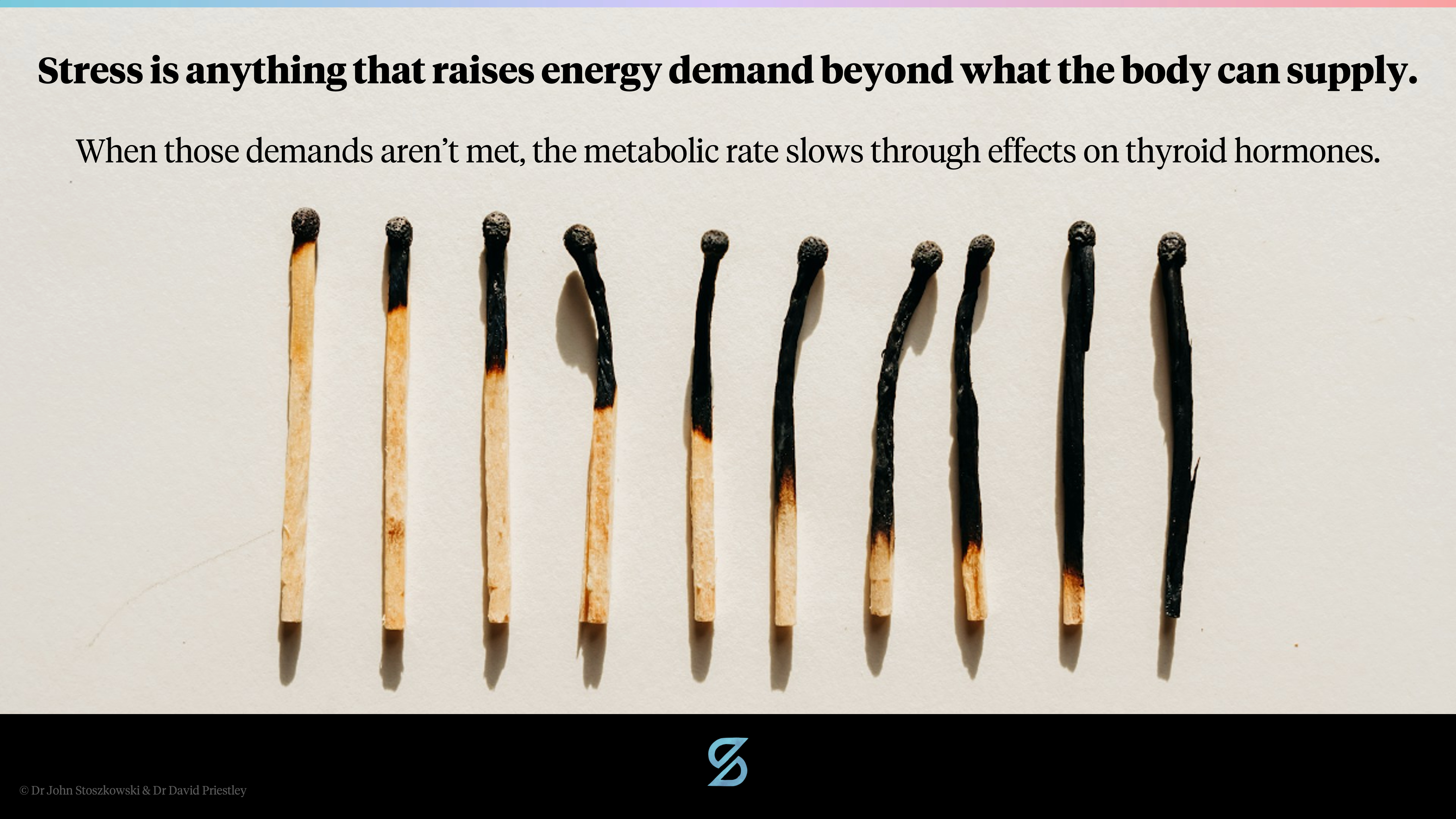
Ray Peat saw life as a dynamic dialectic, where form continually emerges out of flowing energy, like a river slowly carving its banks. When metabolic energy (the steady production of ATP and CO₂) is abundant, an organism can afford complexity, adaptability, and heightened consciousness.4 But when energy drops, everything tightens up. Structures stiffen, awareness narrows, and survival mode kicks in. Peat believed metabolism is literally the basis of consciousness itself.5
This fractal pattern shows up everywhere, from individual cells right through to whole organisations. Companies aren’t lifeless machines but living entities. Their “metabolism” turns raw inputs (ideas, capital, human effort) into tangible outcomes like decisions, products, and progress. And since perception ties directly to metabolism, how energised the system is affects how well it understands the world.

The Energetics of Perception
When energy runs low, whether in a person’s brain or a company’s boardroom, it becomes difficult to see clearly. Drawing from McGilchrist, the brain’s Left Hemisphere likes static maps and fixed categories, mirroring Parmenides’ idea of unchanging “being.” The Right Hemisphere, on the other hand, is attuned to flow and change. It perceives the living, shifting world, echoing Heraclitus’ idea of “becoming,” where everything is always in motion.6 When energy falls, the Left Hemisphre dominates. Complexity gets reduced to rules and labels, missing the “gestalt” (the bigger picture where the whole is more than the sum of its parts).7
On the flip side, a high-energy system can afford to relax into the Right Hemisphere’s wide-angle view, spotting links and nuances. How well an organisation thinks and acts isn’t that different from what’s happening at the cellular level—it’s the same logic just on a larger scale. When energy’s high, insight unfolds; when it’s low, awareness contracts as a survival hack. No fancy strategy beats this reality. A “hypothyroid” organisation mirrors a hypothyroid body, feeling sluggish and defensive. Signs like “bureaucracy,” “burnout,” or “stagnation” reveal this biological slowdown, costing firms big.8 It begins in perception, when muddled signals cause people to stop syncing, and the whole place starts talking past itself.
Healthy metabolism feels warm and generative. Dysfunctional metabolism is cold and stuck. To fix workplaces today, we’ve got to address this underlying metabolic issue, not just throw more quick-fixes or “well-being” perks at the problem. Wellness apps and free yoga won’t cut it if the core energy is tanked.

The Anatomy of Organisational Hypothyroidism
I’m stretching Peat’s ideas here beyond what he said directly, but the links between hypothyroid biology and stalled companies feel practical, not just metaphorical.
1. Metabolic Slowdown (Bureaucratic Drag)
Hypothyroidism hampers Cytochrome oxidase (a key energy enzyme), cutting ATP production and CO₂. The pulse slows, calcium builds up, and “brain fog” creeps in, making quick action almost impossible.
In organisations, this shows up as Stage Blue in Spiral Dynamics—a solid order and hierarchy that turns toxic when it gets stuck. Rules tighten, manuals grow, and meetings multiply to mask the inertia, keeping everything frozen in place. “Analysis paralysis” becomes a cultural mood and the Left Hemisphere takes control, favouring maps over reality. Nothing gets done, everyone’s waiting on someone else, and risk get vetoed with triple sign-offs.9 Blue’s stability is good, it’s only pathological when the organisation can’t evolve beyond it, blocking growth.
2. Systemic Inflammation (Defensive Operations)
When oxidative metabolism falters, stress hormones like cortisol and estrogen rise to keep things limping along. Tissue is broken down for fuel, lactic acid builds up, and inflammation spreads.
Organisations shift from creative flow (oxidative) to defensive hoarding (inflammatory). Siloed turf wars form and collaboration tools end up being places where people dodge responsibility or subtly blame each other. Job security drops and people focus on self-preservation. The place runs on the stress equivalents of knee-jerk reactions, control freakery, and endless “firefighting.” Instead of proactice root-cause solving, energy is wasted on politics.

3. The Glycolytic Shift (Performative Busyness)
When mitochondria fail to use oxygen, the cell falls back on glycolysis, an ancient, inefficient pathway yielding just 2 ATP per glucose molecule (vs. up to 36 in full oxidation). It keeps you alive but leads to fatigue and toxicity.
Teams hustle harder but get less done. Effort pours into the “performative work” of meetings, memos, “Cover Your Ass” emails, snarky Slack messages, and compliance theatre. David Graeber called these “bullshit jobs,” those meaningless tasks that feel busy but add no value.10 It’s a Left Hemisphere trap of obsessing over spreadsheets and dashboards instead of actually changing anything in the real world. Busyness wins, vitality fades, and cynicism grows.11
4. Coldness and Disconnection (Alienation)
Blood is pulled from the periphery to protect the core. The extremities grow cold and numb (hands, feet, nose), shrinking awareness.
Leadership isolates itself at the top, out of touch with the frontline realities. The “core” (leadership) hordes information while the “limbs” (frontline teams) starve. People check out and “quiet quitting” grows.1213 The “social thyroid” (basically the workforce’s pulse) gets suppressed, and the system grows slow and unresponsive. Interactions become scripted, mechanical, and devoid of life. The workplace spark dies, replaced by isolation and confusion.
5. The Hibernation Reflex (The Serotonin Haze of Sameness)
Dopamine falls and serotonin rises, inducing a torpor linked to inflammation and learned helplessness. Energy is conserved by reducing curiosity and movement, but at a cost of degeneration.
Culture retreats to “safe spaces,” not those of the psychological safety everyone bangs on about, but rather zones of avoidance. Novelty feels scary and complexity overwhelming. Mantras like “Let’s not rock the boat” and “This is how we’ve always done it” echo this serotonergic vibe. Procedures trump principles and empty routines kill the drive to learn. What gets called “sustainability” is really hibernation, a kind of comfortable, stagnating mediocrity that slowly stifles vitality.

The Environment is the Cause
Peat saw dysfunction as adapting to a hostile environment: “Energy and structure are interdependent at every level,” even socially. Hypothyroidism protects against starvation, toxins, or stress. Fix the environment, and function returns.
Organisations become hypothyroid when strapped for resources. They rely on “junk calories” like quarterly returns and financial tricks over real value. They cannibalise themselves through layoffs, cost-cutting, and erosion of quality—chasing short-lived energy spikes like a body running on adrenaline.
Biologically, polyunsaturated fats (PUFAs) suppress the thyroid and block respiration.14 Business “PUFAs” are constant “re-orgs,” trendy management fads, “business bullshit” (as André Spicer terms the jargon that empties language and stifles thought),15 surveillance tools, noisy open-plan offices, and harsh blue lighting. These create “oxidative stress” that makes everything stiff and brittle. More literally, even the corporate cafeteria (and the industrial seed oils it often serves) can fuel hypothyroidism too.
Restoring Organisational Vitality
Healing needs an energy surplus. It fuels evolution from rigid Blue through driven Orange and caring Green to flowing Yellow, and maybe beyond to holistic Turquoise. This isn’t something you can just decide to do; it requires metabolic work to engage Heraclitean becoming over stuck being.
Solutions work best when simple, clear, and team-owned. Small steps anyone can start tomorrow include:
1. Raise the Temperature
Warmth invites complexity. It comes from light, fuel, and safety. Get energy (information, decisions, resources) flowing freely.
Ditch cold blue lights for daylight or warm incandescents to boost alertness, mood, and reduce strain. Let people adjust their own workspace to feel good, increasing engagement and cognition.16 Stock kitchens with thyroid supporting fresh juices, good coffee, quality dairy, and saturated fats like coconut oil. Sugar is clean fuel here, just like trust and transparency in the organisation.17
Cut pointless meetings and reports. Empower choices and cycle “energy events” like team breakfasts, walking meetings, lunchtime games, or creative play activities to recharge interpersonal bonds and break ruts. As Ray Peat says below, “If you’re far from the euphoric condition, it means you’re basically degenerating.” These bring rhythm and life back. Adding art and nature to office sparks sparks curiosity and brain growth.1819
Update competency frameworks and performance criteria to reward people who bring different perspectives together and can handle complexity. Look for skills like “integrating multiple perspectives,” “designing feedback loops,” “experimenting and iterating,” and “thinking systemically rather than in silos.” Give talented people chances to work on complex, cross-team projects that build their comfort with uncertainty. Use practical tools like causal-loop mapping and after-action reviews to make progress visible and align with Yellow-level leadership thinking. (Wilber’s Upper Right: Exterior-Individual)
2. Reduce Inflammation (Calm the Defence State)
Chronic defensiveness wears down what it’s trying to protect. Swap blame for flow, replacing “Who’s at fault?” with “Where’s the energy blocked, and how do we improve it?” Break silos, rebuild safety, and dial down stress. Mimic protective hormones like progesterone and pregnenolone which buffer stress and promote clear thinking.20
Start meetings with energy check-ins and focus on clearing bottlenecks together. This shifts the culture toward collaborative problem solving.
After setbacks, hold learning-led reviews that highlight systemic causes and solutions, not blame games.
Appoint “stress clearers” who cut red tape, broker deadlines, and bridge gaps so others can create and connect.
Encourage real breaks and regular movement, laughter, silliness, play, and social time to reset stress-chemistry and signal safety.
Position the organisation as a living organism within a dynamic ecosystem. Its shared purpose transcends individual agendas, aligning collective intelligence toward adaptive growth. Encourage members to see tensions and disagreements as sources of creative energy rather than conflict. This reframes complexity as a field of learning where diverse perspectives contribute to systemic health. Use dialogue that blends values (e.g., Blue stability, Orange efficiency, Green care, Yellow integration) so the culture remains open and non-dogmatic. (Wilber’s Lower Left: Interior-Collective)
Cultivate “perspective literacy” through programmes in philosophy, systems thinking, dialectics, bioenergetics, and developmental frameworks like Spiral Dynamics and Integral Theory. Encourage leaders to develop the capacity to hold ambiguity and multiple truths without collapsing into “either/or” binary thinking. This nurtures metabolic stewardship, sustaining integrative intelligence and evolving wholeness. (Wilber’s Upper Left: Interior-Individual)
3. Re-engage “Oxidative” Work
Oxygen in a cell is like presence in a team. It’s the Right Hemisphere’s holistic attention. CO₂ helps deliver oxygen (Bohr effect: CO₂/pH shifts release oxygen where needed).21 Cultures “hyperventilating” on constant urgency and panic lose CO₂ and suffocate.
Create no-notification zones for focus on substantial tasks.
Set aside quiet time every week for focus and reflection, building collective CO₂ and restoring attention.
Distinguish between urgent and important and stop the constant “all hands on deck” broadcasts that create panic and burn out CO₂.
4. Nourish the “Social Thyroid”
The thyroid senses and signals energy use. Those closest to the real work fulfil that role.22 Feed them meaningful autonomy, fairness, and trust. Metabolic stewardship clears inflammation and fuels mitochondria, ensuring people grow and differentiate into energetic frogs, not fat f*cking tadpoles (FFTs).23
Let frontline staff rotate leading on team check-ins/projects, receiving feedback and trust rather than micromanagement.
Open up transparency on resource sharing, budgets, and decisions to allow everyone to track resource flows and cut starvation fears.
Celebrate “energy givers” who spark teams through kindness, ingenuity, or practical help, just as thyroid hormones spark meaningful growth.

Evolve beyond rigid hierarchies toward modular, project-based structures. Stable “home” teams anchor belonging and shared identity, while fluid cross-functional pods tackle complex, emergent challenges. Design governance and strategy as adaptive circuits, with real-time feedback loops bridging operations, metrics, and learning to sustain responsiveness and intelligence throughout the system. Adopt the principle of “Good enough for now, safe enough to try” to foster experimentation through small, reversible bets. This evolutionary rhythm allows the organisation to expand and renew itself organically, maintaining coherence while embracing change. (Wilber’s Lower Right: Exterior-Collective)
5. Embrace Hysteresis (Rhythm Over Rigidity)
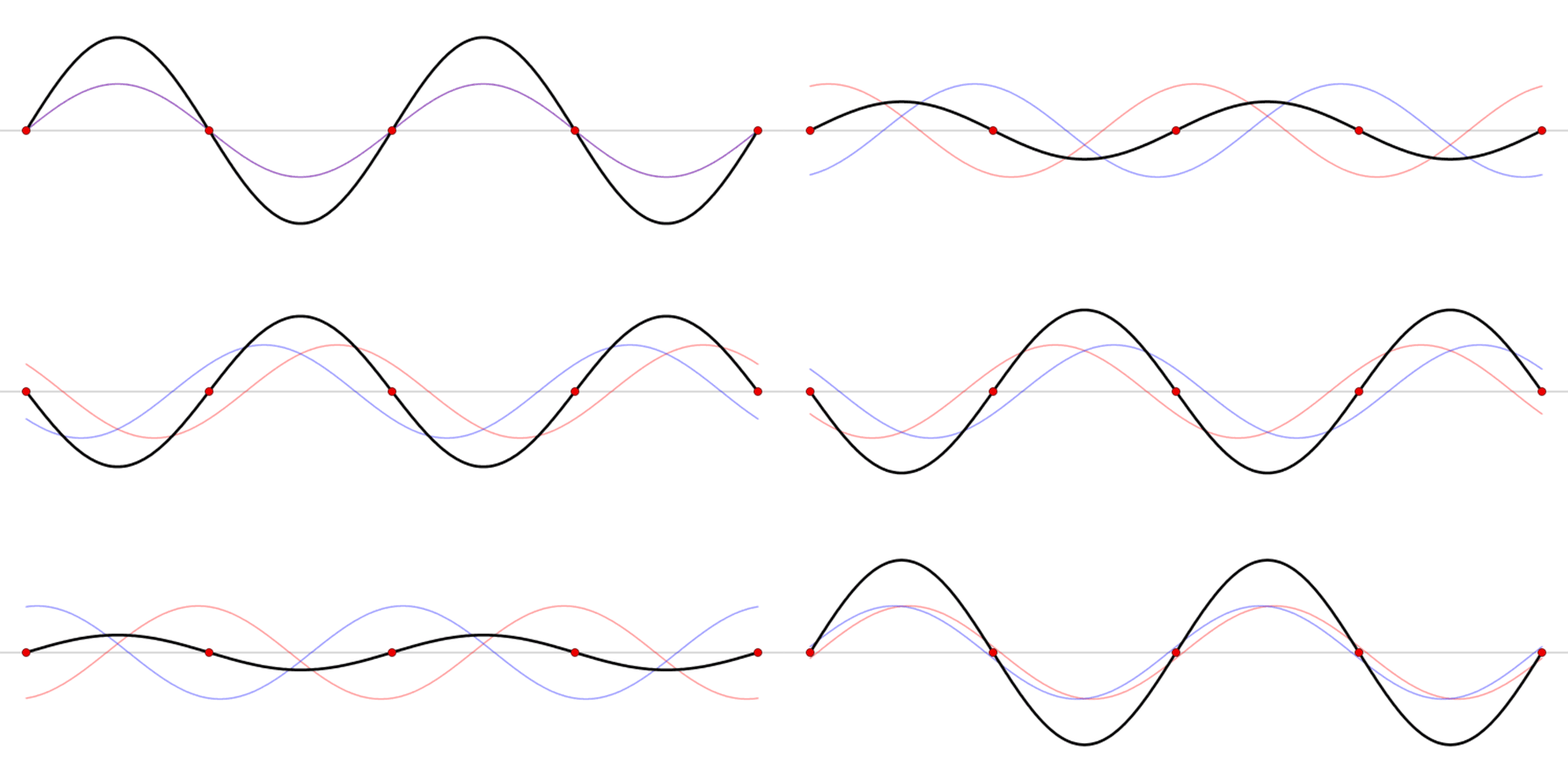
Peat talked about “hysteresis,” the physical memory of a system. A healthy system retains useful patterns (rhythm) without being trapped by them (rigidity). Vitality comes from rhythmic tension where the structure can flex and flow. Just like in the cell, gradients drive flow and life thrives in tension, not frozen patterns.24
End each week reviewing: What served our vitality? What created rigidity? What could be adjusted?
Balance steady rituals (fixed check-ins, weekly contests) with experiments (venue changes, skipped reports, invited guests) to keep the system breathing and responsive.
Cycle intensity and rest by structuring meetings, sprints, and feedback cycles to align with natural flows (i.e., periods of intensity followed by rest).
The Cellular Basis of Culture
No system can exceed the vitality of its parts. Organisational metabolism is simply the sum of the energy flowing through the nervous systems within it.
Low ATP signals “danger,” spiking cortisol and narrowing perception into the Left Hemisphere’s detail-focused map. High ATP signals physiological safety, inviting the Right-Hemisphere’s broad, generous, novelty-seeking view.
You can’t build a thriving, Yellow culture on depleted biology. When people run low on fuel and light, riding a wave of stress hormones, the organisation becomes hypothyroid: cold, paranoid, and rigid. Evolution to Yellow requires a metabolic surplus, having enough capacity to take in the whole picture without tightening up or panicking.
Revitalise with biological basics: light, sugar, rhythm, and physiological safety. Stoke the metabolic fire so rigid structures soften, coherence arises, and life begins to self-organise. When people have the energy they need, the organisation can move beyond basic survival and start developing in a more integrated, effective way.
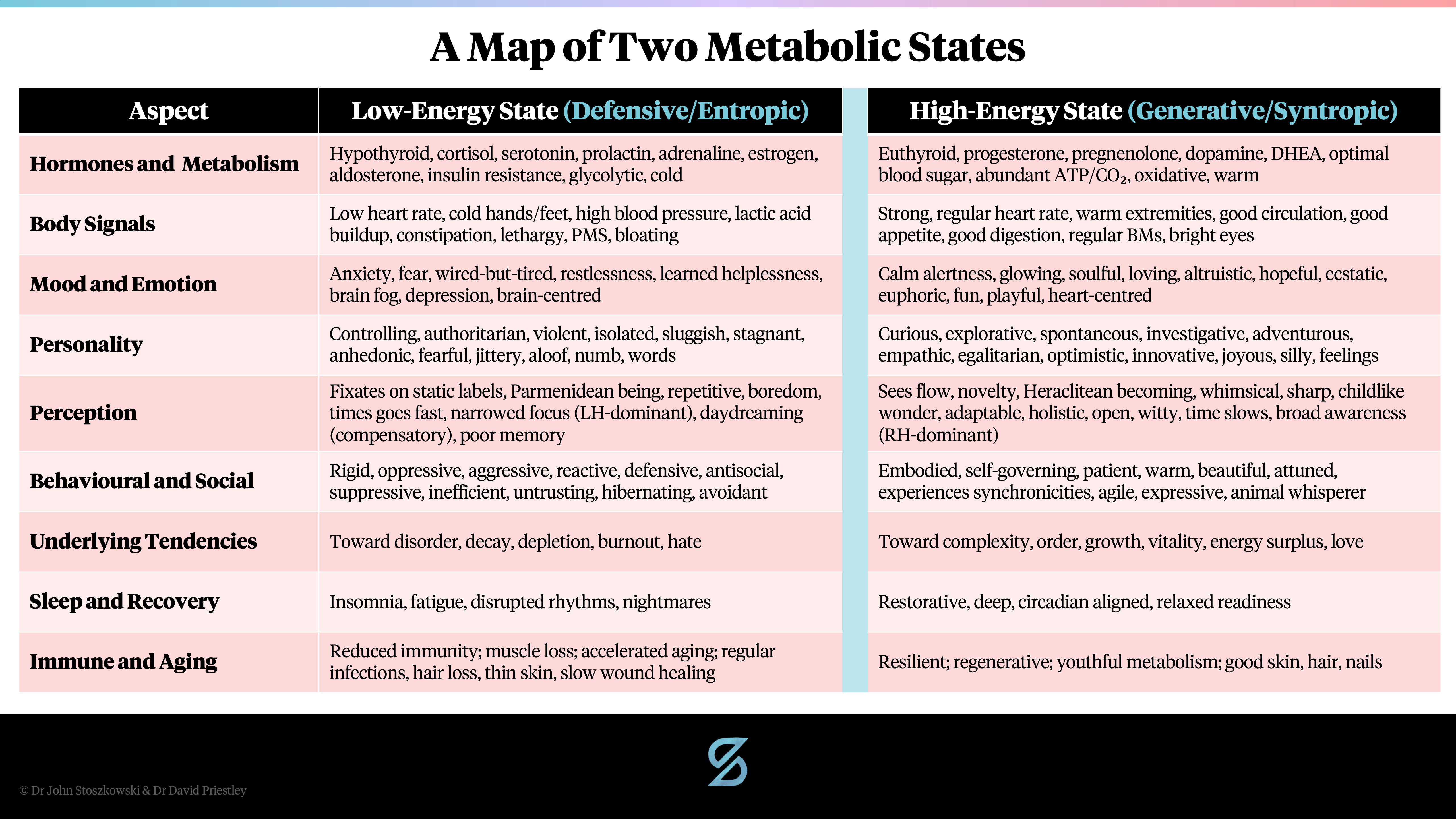
Your organisation’s vitality hinges on its metabolic temperature. Check your state:
A Soundtrack for Collective Flow
I recorded this mix a while ago. It kicks off with Ray Peat himself, setting the tone for some deep, progressive beats. Whack it on, sip some fresh OJ (maybe milk and honey), and feel the warmth kick in 😁
Clare Graves and the Evolution of Human Consciousness (Substack Post)
Ken Wilber’s Four Quadrants: Made Simple (Medium Article)
Psychological safety in the workplace refers to employees feeling safe to take interpersonal risks, such as speaking up, asking questions, or admitting mistakes, without fear of humiliation or punishment. However, this psychological safety depends on a more basic layer—physiological safety—which encompasses the biological and metabolic conditions that allow people’s nervous systems to remain calm, energised, and capable of engagement. Without this foundation, psychological safety cannot be sustained effectively, and organisations are prone to defensive, low-energy states that undermine performance and wellbeing.
In Peat’s bioenergetic theory, the functioning of the brain and nervous system depends on efficient cellular energy production, particularly mitochondrial ATP output. Psychological states—such as mood, motivation, clarity, or fatigue—reflect the state of cellular metabolism. When metabolism is robust, supported by factors like optimal thyroid hormone function and stable blood sugar, individuals experience clear thinking, emotional resilience, and steady mood. Conversely, when metabolic rate slows due to stress, poor nutrition, or hormonal imbalances, psychological problems like anxiety, brain fog, or depression emerge. Peat challenges the traditional view that the mind is separate from metabolism; instead, he argues that brain chemistry and psychological meaning are expressions of underlying metabolic energy availability.
Energy, Structure, and the Perception of Novelty (Substack Post)
Heraclitus and the Hidden Harmony of Change (Substack Post)
Gestalt is a German word meaning “form,” “shape,” or “whole.” In psychology, Gestalt theory emphasises that we perceive objects and experiences as integrated wholes rather than as separate parts. The phrase “the whole is greater than the sum of its parts” captures this idea: the meaning and function of something cannot be fully understood by breaking it down into individual elements alone. Gestalt perception involves recognising patterns and configurations that create unified, coherent experiences.
For example, $5m for a 1,000-employee company.
Martinez et al. (2025). The Health and Economic Burden of Employee Burnout to U.S. Employers. American Journal of Preventive Medicine, 68(4), 645-655. DOI: 10.1016/j.amepre.2025.01.011
Some 48% of employess feel trapped by bureaucracy in the workplace (Perceptx Article)
On the Phenomenon of Bullshit Jobs: A Work Rant (Article by David Graeber)
In 2025, global burnout rates have apparently hit an all-time high of 66% (Forbes Article)
Hervé, J., & Oh, H. (2025). Quiet Quitting in Times of Uncertainty: Definition and Relationship With Perceived Control. Human Resource Management, 64(5), 1421-1456. DOI: https://doi.org/10.1002/hrm.22317
Is Quiet Quitting Real? (Gallup Study)
Unsaturated Vegetable Oils: Toxic (Article by Ray Peat)
From inboxing to thought showers: how business bullshit took over (Article by André Spicer)
Flick of a Switch: How Lighting Affects Productivity and Mood (Business.com Article)
Ray Peat and the Bioenergetics of Being Alive (Substack Post)
Shibata, S., & Suzuki, N. (2004). Effects of an indoor plant on creative task performance and mood. Scandinavian journal of psychology, 45(5), 373–381. DOI: 10.1111/j.1467-9450.2004.00419.x
Zaidel D. W. (2014). Creativity, brain, and art: biological and neurological considerations. Frontiers in human neuroscience, 8, 389. DOI: 10.3389/fnhum.2014.00389
Progesterone Pregnenolone & DHEA - Three Youth-Associated Hormone (Article by Ray Peat)
The Bohr effect refers to the physiological phenomenon where hemoglobin’s affinity for oxygen decreases in response to increased carbon dioxide concentration and/or lowered pH in tissues. This effect helps unload oxygen efficiently where it is most needed, such as in actively respiring tissues generating more CO₂. By shifting hemoglobin to a lower-oxygen-affinity state, more oxygen is released to cells requiring it for metabolism, enabling effective cellular respiration and energy production. This process is critical for matching oxygen delivery to tissue demand and maintaining metabolic health.
Ray Peat and the Dialectic of Life: The Task of Vitality (Substack Post)
Energetic Frogs vs. Fat Tadpoles: Why size alone isn’t transformation (Substack Post)
In living cells, gradients—such as differences in ion concentration, electrical charge, and metabolic energy—drive flow and are essential for cellular function. Unlike the classic view that relies solely on membrane-bound ion pumps consuming large amounts of energy, Ray Peat and Gilbert Ling emphasised that these gradients are sustained through the structural and energetic properties of the cell’s proteins, water, and adsorptive interactions. Ling’s “association-induction hypothesis” highlights the role of structured water and protein interactions in maintaining ion distributions with minimal energy expenditure. Peat expanded on this by showing how cellular energy metabolism and the molecular environment influence these gradients and flows beyond textbook pump mechanics. Thus, gradients in cells are not just biochemical differences but dynamic, self-organising physical and energetic states that drive vital biological processes.