
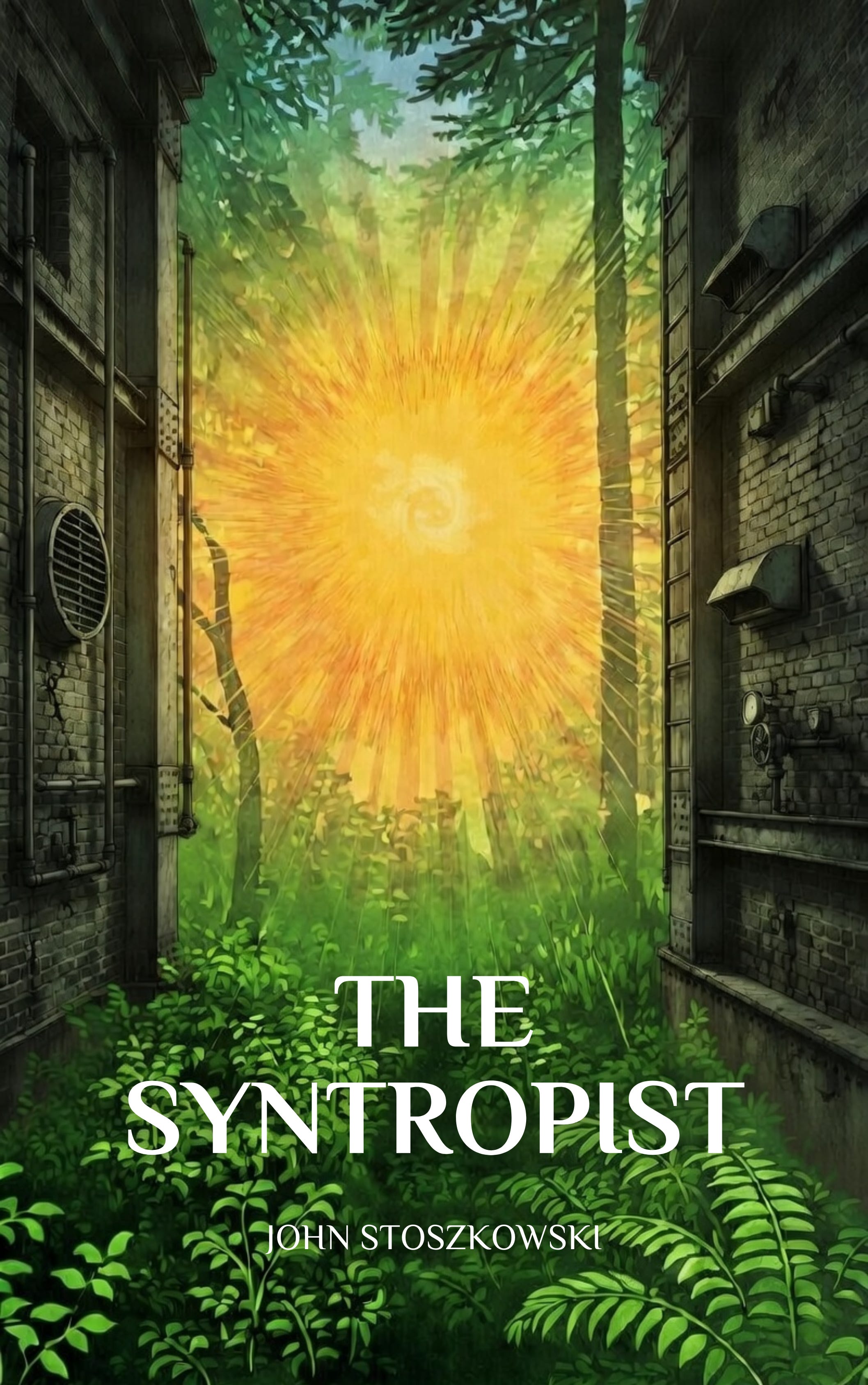
The Syntropist
A Novel for the Not-Yet
In what feels like a former life as an academic, I wrote loads of journal papers. Proper dry stuff, read by about eleven people, three of them peer reviewers poking holes.
But thanks to my Mam, I’ve always loved a good story. I’ve had my nose in books since I was little: The Hardy Boys, Roald Dahl, and C. S. Lewis’s Narnia are still firm favourites. Over the years, that grew into a quiet urge to have a go at writing fiction myself. Not in a romantic, “sitting-in-a-Parisian-café-with-a-leather-notebook” kind of way, just a nagging itch that never really went away.
The messy middle
I had plenty of ideas and half-starts that went nowhere. Then, a couple of years ago, I sat down and wrote a short story about a teenager who finds a living seed inside a factory pump. It was only a few thousand words: a grey city, a weird object, and a character I liked.
I thought that was it. It wasn’t.
The short story slowly morphed into a novella, then grew into a novel that I ended up abandoning more than a few times. The Word doc sat untouched on my computer for months at a time, then I’d get a second wind and dive back in. Eventually, the story got its hooks into me.
The novelist Frank Norris once said, “I don’t like to write, but like having written.” That’s definitely been the case for me. Writing this book has absolutely done my head in at times! Academic writing is nice and tidy; you know the rules and you’ve usually got a few co-authors to lean on. Fiction is far messier. You’re just bumbling around in the dark on your own until you find your way.
Well, all that bumbling eventually led to something I’m proud of: The Syntropist.
Living the Ideas
It’s a philosophical novel for teens and young adults, but hopefully anyone can get something out of it. I wanted to take the thoughts of some of my favourite syntropic thinkers and weave them into a story, where philosophy is something lived rather than explained.
You’ll find ideas inspired by people like Ray Peat, Iain McGilchrist, William Blake, Martin Heidegger, Friedrich Nietzsche, and Ernst Bloch showing up in the choices the characters make and the consequences they face.
Here’s the back cover blurb:
In a grey city run by a machine that has forgotten its own purpose, a seventeen-year-old tinkerer pulls a living seed from the guts of a dead pump.
It will lead her beyond the walls, into a hidden world the Grid tried to erase. It will connect her to people who remember what life tasted like before the suppression. It will show her a gift she shares with the mother who vanished when she was seven.
And it will ask her a question no one in Vithra has been allowed to ask for three hundred years:
What do you want to become?
Where the money goes
I didn’t write this to make a profit. All royalties from the book are going to Hospice at Home, a local charity that does incredible work supporting people at the end of life in their own homes.1 If this book can do some real-world good, that feels like syntropy to me: things becoming more than they started as.
Get it here
The Syntropist is out now on Amazon in both paperback and Kindle formats:
Also available in Germany, France, Japan, and other international stores.
I’ve put the first chapter below so you can see if it’s for you (or your kids). If it is, the book’s waiting. If not, no worries—not every seed lands in the right soil 😁
THE SYNTROPIST
PART I: THE SUFFOCATION
Everyone is the other, and no one is himself.
— Martin Heidegger, Being and Time
1
Elara’s hands were black with grease. She crouched in the dim corner of Factory 17, fingers working a seized bolt in the gear-pump’s guts. The metal resisted her, corroded into place by years of neglect, but she knew this machine. Knew its rhythms, its complaints, the whine it made when the third cog slipped.
She’d been fixing these pumps since she was twelve. Five years of rust and oil, and her hands had learned what her mind couldn’t name: how to listen to a thing that was stuck and help it move again.
The bolt gave. She felt the release in her wrist before she heard the click, and something in her chest loosened with it. A small victory. The only kind the Grid allowed.
Above her, the factory’s bones groaned with the Mechanism’s slow pulse, that low, ubiquitous thrum that ran through every wall and floor in Vithra, through the pipes and the streets and, she sometimes thought, through her own marrow. The air was thick with iron and ash. Each breath left a film on her tongue, metallic and stale, the taste of a city that had forgotten what wind was. She wiped her forehead with the back of her wrist, leaving a dark smear, and turned back to the pump.
Around her, the shift churned on. Bodies moved between the machines, tinkerers like her, grey-clad and silent, hands dancing over gears and levers with the mechanical precision the overseers demanded. No one spoke. Speaking drew attention, attention drew quotas, and quotas drew the gaze of the drones that circled overhead.
One of them hovered nearby now, its turbine whir cutting through the factory’s low roar. A red sensor-eye swept the floor in lazy, predatory arcs. Elara kept her head down. She’d learnt that lesson young. She dug into the pump’s cavity, pushing aside corroded springs. Her fingers brushed against a blockage deep in the intake valve. She worked it loose, anticipating the satisfaction of a clear line, and pulled it free.
It was just a fused gasket. A piece of twisted rubber, melted by friction and time into a useless black knot. She tossed it into the waste chute with a sigh. Just trash.
The shift whistle was minutes away. Her muscles protested, a dull ache radiating from her lower back, but Pump 4 was still stuttering. If she left it, the night crew would report it, and her efficiency rating would drop.
She moved to the final housing. This one was worse than the others, the intake completely choked. She reached in, her fingers scraping against the rough interior casing. “Come on,” she whispered, her voice lost in the din. Her fingers closed around the obstruction. It felt dense and jagged, wedged tight against the valve. She braced her boot against the housing for leverage and pulled. With a wet grinding sound, the blockage gave way.
Elara rocked back on her heels, the object clutched in her hand. She looked down, expecting another piece of slag or a calcified rat. It looked like coal. A rough, black lump of carbon, ugly and scarred, no bigger than her thumb. It was the kind of industrial refuse she swept up every day, dead, burnt, and heavy.
She shifted her grip to toss it into the recycler. Then she froze. The fragment burned feverish against her skin, defying the industrial chill. Elara stared at the black lump. It looked like dead rock, like the fossilised remains of burnt wood. But it was frantically, terrifyingly alive.
It beat against her palm. Thump-thump. A slow, heavy rhythm that matched her own blood. She held it up to the dim light. The rough surface seemed to absorb the shadows rather than reflect them. It was ugly. It was waste. Thump-thump-thump. The heat climbed up her wrist and lodged beneath her ribs. The vibration was organic, an intentional, living rhythm. Like a river trapped in stone.
A shadow fell over her. The drone had returned. It hovered ten feet away, its red eye fixing on her, the aperture dialling in. It sensed the anomaly. Elara’s hand closed instantly around the mass. She shoved it into the pocket of her overalls, beneath the fabric, pressing it tight against her thigh.
“Unit 734,” the drone’s speaker crackled, a voice of synthesised authority. “Report status.”
“Pump cleared,” Elara said, her voice steady despite the frantic drumming against her leg. “Debris removed. Resuming flow.”
The red eye lingered. It scanned her face, her grease-stained hands, the closed pocket of her overalls. Thump-thump. A secret heartbeat, loud enough to drown out the factory’s roar. It felt like holding a piece of fire that refused to go out.
“Proceed,” the drone said finally. It turned and drifted away, seeking other inefficiencies.
Elara let out a breath she hadn’t realised she was holding. She looked down at her pocket. The lump lay hidden there, ugly and impossible, beating with a life that had no business existing in a factory of dead things. The shift whistle blew. Elara stood, wiping her hands on a rag. She didn’t know what she’d found, only that it felt like the answer to a question she’d never dared ask.
She knew she wasn’t leaving it behind.
Elara joined the stream of workers shuffling toward the exit. The floor vibrated with the heavy tread of a thousand steel-toed boots, a rhythmic marching sound that usually lulled her into a trance. Today, it felt jarring. Every step drove the weight against her thigh. Thump. Thump. Thump. A frantic counter-rhythm to the factory’s mechanical pulse. She kept her hand pressed over the pocket, feigning a casual posture, fingers curled around the jagged shape through the fabric. She needed to get through the scanners. She needed to get home.
“Elara.”
The voice cut through the factory noise, sharp and familiar. She stiffened but didn’t run. Running attracted drones. She turned slowly.
Kael leaned against a support pillar near the main blast doors, arms crossed, watching her. He was several years older than her and wore the blue uniform of the Enforcement Corps, the silver badge on his chest catching the harsh overhead lights. His dark hair was cropped short, just as regulation stipulated. He’d worn it that way religiously since making Squad Leader.
He pushed off the pillar and walked toward her. His boots rang on the metal floor with the heavy, deliberate tread of an Enforcer, but his eyes were soft. Worried.
“You’re the last one out,” he said.
“Pump 4 was stuck,” she lied, the words gritty on her tongue. “I didn’t want to leave it for the night shift.”
“You always were too diligent for your own good.” He stopped in front of her, close enough that she could smell the starch of his uniform, masking the factory’s grease. He looked tired. There were shadows under his eyes that hadn’t been there years ago.
He studied her face, tracking the sweat on her brow, before his gaze dropped to her hand, which was still pressed against her thigh.
“You look pale,” he said. “Are you sick?”
“Just tired, Kael. It was a long shift.”
“It’s always a long shift.” He reached out, as if to touch her shoulder, then dropped his hand. The badge between them felt like a third person in the conversation. “Walk with me. I’ll escort you through the checkpoint.”
It wasn’t a request. Elara recognised the tone: protective and insistent, edged with the authority he tried to hide when they were alone. She nodded and fell into step beside him.
They walked through the factory gates, past the scanners that beeped rhythmically as workers passed through. The drones hovering above the exit tracked them but didn’t approach. Kael’s presence was a talisman, a signal that this worker was accounted for.
Elara held her breath as she passed the sensor arch. The device usually scanned for unauthorised tech or stolen components. She didn’t know if it scanned for whatever this was.
Beep. Green light. The tension leaked from her lungs in a slow, controlled exhale.
“You’ve been quiet lately,” Kael said as they stepped out into the plaza. The air here was colder, biting at her exposed skin, carrying the chemical tang of the processing plants in Sector 8.
“I’ve been working.”
“We’re all working.” He glanced at her sideways. “But you’re different. Distracted. Looking at things you never used to look at.”
Elara’s fingers tightened around the object in her pocket. “Like what?”
“Like the sky.” He gestured vaguely upward at the ceiling of smog that choked the city. “You stopped in the middle of the plaza yesterday. Just stood there, staring up, like you expected to see something other than grey.”
“Maybe I did.”
“Don’t.” His voice dropped, losing its softness. “Don’t start talking like that. Not out loud. Not where anyone can hear.”
He stopped walking and turned to face her. They were near the edge of the plaza, in the shadow of a cooling tower. His eyes were dark and intent now. Scared.
“The perimeter exists for a reason, Elara. The Wastes are death. And people who ask too many questions about what’s above the smog—”
He didn’t finish. He didn’t have to.
People who ask questions end up like your mother.
He didn’t say it. But she heard it in the silence between them.
“I’m not asking questions,” she said, lying again. “I’m just tired.”
He looked at her for a long moment, searching for the girl he’d once felt like a big brother to, the one who used to steal rations with him on the rooftops before the badge, before the distance. He seemed to find only the grease-stained tinkerer standing before him.
“Go home,” he said finally. “Eat something. Sleep. Real sleep, Elara. Not just staring at the ceiling.”
“I will.”
“I mean it. If you burn out, I can’t help you. The Grid doesn’t tolerate inefficiency.”
“I know.”
He hesitated, as if he wanted to say something else. Then he straightened, the Enforcer mask sliding back into place. “See you tomorrow.”
He turned and walked away, his blue uniform swallowed by the grey crowd. Elara watched him go. She waited until he was out of sight before she turned toward Block 4.
She walked quickly, head down, hand curled around the hidden weight. It had grown warmer. Like carrying a coal that seared her nerves but wouldn’t burn her skin. She climbed the stairs to her unit: 4A, third floor, identical to every other unit in the block. The door recognised her bio-signature and slid open.
Inside, there was a cot, a nutrition station, a waste processor, and a single window looking out at the grey. The sum total of her life. She locked the door. Only then did she pull the lump from her pocket.
In the dim light of her unit, it looked even uglier than it had in the factory. A jagged piece of black slag, pitted and scarred. It belonged in a furnace. It belonged in the trash. But when she set it on the small metal table, it rocked slightly. Thump. A faint tremor ran through it.
Elara sat on the edge of her cot, watching it. She reached out, hesitating, then pressed her fingertip to the rough surface. The reaction was instant. A shock of heat travelled up her arm and the black sweated. A tiny bead of moisture welled up from a crack in the carbon, clear and pure. And in that crack, for just a moment, she thought she saw something beneath the black. A glimpse of deep, translucent purple, before the shadow swallowed it again.
Find your spark. Her mother’s voice echoed in her mind, a standing order. Seris, with her dark hair and her secret garden and her hands that could make things grow in a city that had outlawed growth. Seris, who had whispered those words in the dark of their old apartment ten years ago, and then vanished into the Mechanism’s maw, never to come back.
Elara looked at the ugly, breathing rock. She didn’t know it was a seed, encased in the hardest, deadest armour it could find to survive the furnace of time. It was waiting.
She curled her hand around it, feeling the rhythm sync with her own heart. The factory was gone. Kael was gone. The grey city outside her window fell away.
For the first time in years, Elara wasn’t suffocating. She took a breath, and it felt like the first real breath of her life. And beneath the warmth, beneath the pulse that matched her heartbeat, something else stirred. Something she couldn’t name. Like a child pressing its face to a window, watching the world outside with wonder and longing.
The feeling passed so quickly she wasn’t sure it had been real. But for just a moment, the ugly lump of carbon in her hand had felt less like a thing and more like a someone.
Read the rest
The Syntropist is out now on Amazon in both paperback and Kindle formats:
Also available in Germany, France, Japan, and other international stores.
Hospice at Home Carlisle and North Lakeland (Hospice at Home) is a brilliant charity set up in 1997. They provide free palliative care and support to people with life limiting illnesses and their families and carers. Their main service is a nursing team, made up of Registered Nurses and Healthcare Assistants who provide individualised care during the last year of life and at the end of life. They also have a range of support services that aim to help people live well with their conditions, such as complementary therapy and occupational therapy. Their services cover town and rural locations across 1,500 square miles of North and East Cumbria, UK.


