


Heidegger is the only Western philosopher who not only intellectually understands Tao, but has intuitively experienced the essence of it as well.
— Chung-Yuan Chang, Tao: A New Way of Thinking (2013)1
As there tends to be nothing new under the sun, something I’ve always enjoyed is tracing lines of thought through different thinkers and philosophies. Martin Heidegger is one of those where you get to a point and start to think, “Hang on, has this guy just been ripping off Taoism all along and hiding it behind complicated language?” This essay explores the resemblance between two bodies of thought separated by two and a half thousand years, and asks how deep it goes.
Chang’s claim in the quote above is extravagant, but not ridiculous. Heidegger was no Taoist monk, Chinese sage, or specialist scholar of Chinese philosophy. He was a German thinker, formed by Greek philosophy, Christian theology, German poetry, and the long shadow of Western metaphysics. And yet the resemblance between his later thought and classical Taoism is sometimes so close that “kinship” begins to feel like too gentle a word.
Both ask us to loosen our grip. Both warn against calculation becoming the only way we relate to reality. Both turn towards paths, emptiness, non-forcing, natural emergence, the limits of language, and a kind of thinking that lets things show themselves instead of seizing hold of them.
And Heidegger wasn’t working in isolation from any of it. He read Lao Tzu and Zhuangzi in German translation, discussed Tao explicitly, spent decades in conversation with East Asian thinkers and, in 1946, worked with the Chinese scholar Paul Shih-yi Hsiao on translating portions of the Tao Te Ching.
Which leaves an awkward question hovering over everything that follows. Did Heidegger fight his way out of the wreckage of Western metaphysics and arrive, independently, on territory Taoism had occupied for over two thousand years? Or did Taoism quietly help him find his way? We’ll come back to that at the end.
First up, it’s fair to say Heidegger can at times be comically hard going to read. Which is a bit ironic, as the Tao itself is pretty plain, fundamental, and easy to follow. Here’s a genuine taste, which I’m sure you’ll agree doesn’t exactly slip off the tongue:
The thing stays—gathers and unites—the fourfold. The thing things world. Each thing stays the fourfold into a happening of the simple onehood of world. If we let the thing be present in its thinging from out of the worlding world, then we are thinking of the thing as thing.2
Brutal! But once you settle into the rhythm of him, something opens up. Like Chang, I think he gives us a Western doorway into an old Taoist truth: we don’t save our lives by forcing them harder. We learn to live by letting things be.
The trick is to read him slowly. Taoism helps because it draws out what’s most alive in his thought while shaking off some of the heavy drama that clings to him. The Tao is lighter than Heidegger. It’s funnier and less grand, and it doesn’t stomp around announcing the destiny of the West. Lao Tzu smiles where Heidegger broods.
The Way
The most obvious overlap is the language of the way.
“Tao” means something like “way,” “path,” or “course.” It’s not naming a thing that exists, but the way reality unfolds and the way we learn to move within it. Classical Taoism is organised around attunement to a path rather than an allegiance to a fixed system. Heidegger increasingly describes thinking in similar terms. His later writings and lectures are full of ways, paths, fieldpaths, and waymarks.
Thinking, for him, isn’t the construction of a final theory standing outside reality. It’s a journey in which the thinker is transformed by what they encounter.3 Heidegger writes:
Tao could be the way that gives all ways, the very source of our power to think what reason, mind, meaning, logos properly mean to say… All is way.4
That isn’t a passing metaphor. It goes to the centre of how he came to understand thought. Heidegger distinguished between calculative and meditative thinking. Calculative thinking plans, predicts, analyses, and produces results. It has obvious value. You wouldn’t want a structural engineer meditating poetically about a bridge instead of checking whether it will stay up. The problem begins when calculation becomes the only kind of thinking we recognise.
We start approaching everything by asking: What is it? What does it do? How can I use it? How can I improve it? How can I measure it? What’s the takeaway? Heidegger believed we’re losing the ability to “step back” and dwell with anything before deciding what it’s for. The constant demand to produce an answer can become precisely what prevents us from thinking. Many people who believe they’re thinking, on his account, are really just calculating. Lao Tzu also refers to calculative thinking, saying:
In the remote past, the man who was good in Tao did not lead his people to calculative thinking, But let them remain ignorant of it. The difficulty in cultivating men is that they are full of intellectual discrimination.5
You see it everywhere. A conversation has barely begun before someone wants the action points. A book is reduced to five key lessons. A walk must improve fitness. A hobby needs monetising. A quiet afternoon has to become “recovery.” We seem unable to leave anything alone long enough for it to tell us what it is.
For both Heidegger and Taoism, truth is therefore less like owning the correct map and more like learning how to walk. There are differences, of course, and we’ll come to those. The two aren’t interchangeable. Still, once you know Heidegger had worked on the Tao Te Ching, it becomes difficult to hear all these paths and ways as purely accidental echoes.
When Everything Becomes Useful
Zhuangzi, the most playful of the Taoist sages, is full of figures who are useless by conventional standards, like twisted trees, awkward people, and creatures that can’t be readily exploited. It’s their uselessness that protects them. Nobody cuts them down, conscripts them, or consumes them.
Heidegger develops a related suspicion of a world in which everything has to justify itself through usefulness. He called this way of seeing “enframing,” or Gestell. As usual, it’s a clunky word for a fairly simple idea. Modern technology gives us better tools, but it also trains us to see the world in a particular way. Gradually, everything starts to show up as a resource, or what Heidegger called “standing reserve” (Bestand).
A mountain becomes a mineral resource. A forest becomes timber. A river becomes hydroelectric potential. A person becomes human capital. A walk becomes “getting your steps in.” A conversation becomes data. Friendship becomes networking. Reading becomes content. The self becomes a project, and you spend your days, as Byung-Chul Han puts it, as an “achievement subject” endlessly managing and PR-ing your own life.6 We’re surrounded by tools promising more control, while almost everything can now be measured, managed, improved, and turned into a process.
And this goes well beyond the machines and gets into our eyes. You can stand in a beautiful field and see “yield per hectare.” You can talk to someone and listen only for how they fit your plans. You can look in the mirror and see a project that needs fixing. Just look at what’s happened to football. VAR, ball sensors, and semi-automated offside lines drawn to the millimetre: Heidegger might say we’ve enframed the game half to death, sucking spontaneity from the people who play it and the people who love it, all in the name of getting it right.
This is the world he was worried about. Not because he was a grumpy old Luddite who hated technology. I doubt he’d want us all lobbing our phones into the sea and moving into wooden huts. The danger, for him, is deeper. It’s that one way of seeing becomes the only way of seeing. When utility becomes the only measure, we lose the ability to encounter anything in its own terms. A tree can no longer simply be a tree. A river can no longer simply flow. A person can no longer simply dwell, play, think, or exist.
Once everything becomes useful, something sacred quietly starts to disappear.
Wu Wei and Letting-Be
The Taoist answer to all this forcing is wu wei, usually translated as “non-action.”
That can be a bit misleading because it doesn’t mean sitting around doing nothing but something closer to non-forcing, non-coercive action, or acting without strain. It means not imposing your anxious will and abstract plans onto a situation so aggressively that you destroy the very life you were trying to help. It belongs alongside “ziran,” a sort of naturalness, spontaneity, or “self-so-ing,” to which we’ll return shortly.
Any good gardener knows it. My wife and I grow fruit and veg on an allotment, and the whole game is wu wei. You can’t drag a strawberry out of the soil to make it grow faster. You can water, weed around it, protect it from slugs, improve the soil, pay attention to the weather, and get the timing right. Then you have to leave the thing alone and let it do what it does. Half of gardening is knowing when to keep your hands off.
You probably know what forcing feels like elsewhere too. Try to fix a relationship by explaining everything, and it often gets worse. Try to optimise your sleep, health, inbox, reading, parenting, or your own head, and somehow the more you optimise, the less alive it all feels. You can’t force someone to trust you. You can’t force insight. You can’t force a creative breakthrough, hurry grief along, or shout your own mind into peace. The Taoist sage therefore acts but doesn’t overact, leads but doesn’t dominate, and shapes without strangling. Lao Tzu says, “The wise is not excessive, overindulgent, or extreme.”7
Heidegger’s word for something close to this is “Gelassenheit,” usually translated as “releasement,” or “letting-be.” It means loosening the grip of wilful, calculating thought and meeting the world without the constant itch to seize hold of it. It creates room for things to appear in ways our plans haven’t already decided. This is one of the deepest links between Heidegger and Taoism. The concepts aren’t identical, but they’re close enough that Gelassenheit can sometimes sound like wu wei returning from a long stay in the Black Forest.
Both are trying to recover a kind of doing that isn’t driven by anxiety. Stop wrestling the world into submission. Pay attention. Listen. Let things ripen. Act when action is needed, and don’t mistake control for wisdom. On reducing the will, Heidegger writes:
Thirst for knowledge and a greed for explanations never lead to a thinking inquiry. Curiosity is always the concealed arrogance of a self-consciousness that banks on a self-invented ratio and its rationality. The will to know does not will to abide in hope before that what is worthy of thought.8
He also says, “letting-lie-before-us and taking-to-heart” means that “we let beings, as beings, lie before us and give our heart and mind to the ‘being’ of particular beings.”9 Jesus, Martin! But it’s undeniable that sounds quite similar to wu wei. Essentially let things be themselves before adding your own plans, fears, labels, and demands. He says that “thinking is not grasping or pretending…thinking knows nothing of the grasping concept.”10
Neither Taoism nor Heidegger is recommending passivity, though. The distinction is between action that forces reality into a preconceived form and action that responds skilfully to what the situation is already becoming. A carpenter who listens to the grain of the wood is closer to both thinkers than an engineer who assumes any material can be forced into any shape. A good leader understands the same thing.
Imagine two people running a team. The first forces everything. They over-explain, over-monitor, interrupt, correct, chase, measure, and meddle. The team tightens up. People stop thinking for themselves and wait to be told what to do. The second creates conditions instead. They’re clear about what matters, then they become quiet. They listen, give space, and step in when needed but not before. They trust people enough to let the intelligence in the room surface. The second person can look like they’re doing less. Often, they’re doing the deeper work. That’s wu wei, and it’s releasement too. Not abandoning responsibility, but acting in a way that lets life breathe.
Clearing Space for Life
Heidegger’s word “Lichtung” means clearing. A clearing is the open region in which beings can appear as meaningful at all. It isn’t another thing hidden behind everything else but the openness that allows presence and absence, concealment and unconcealment, to occur.
Think of a clearing in a forest. It’s not a thing the way a tree is a thing. You can’t pick it up or weigh it. But without the open space between the trees, nothing can appear there. People need clearings too: a bit of emptiness where something unexpected can arrive. Not laziness or lack of commitment, but something closer to structure at a deeper level. A musician knows that a note lands because of the silence around it. A comedian knows the pause can be the joke. Any teacher or coach worth their salt knows that the quiet moment is often where the real thing finally appears.
This sounds simple, almost too simple, but it cuts directly against the way we live because we fill every gap. Kettle boiling? Check your phone. Standing in a queue? Check your phone. A flicker of boredom? Open an app. A gap in the conversation, a space in your diary, a bit of quiet in yourself: fill it, book it, fix it. We’ve become suspicious of emptiness. As the great Heideggerian sage Micky Flanagan puts it, we’ve forgotten how to do “proper f*** all.”
Taoist emptiness has a similar quality. One of the most famous passages in the Tao Te Ching says that a wheel is useful because of the empty hub at its centre. A pot is useful because of the hollow that allows it to hold something. A room is useful because of the space within its walls. In all these examples, “constructed together in their non-being,” Lao Tzu says, “they give rise to function.”11 Emptiness, therefore, isn’t a deficiency but a kind of generative openness that allows something to happen.
This is very close to Heidegger’s thought that what isn’t itself a thing may nevertheless be what permits things to appear. Again, he reaches this point through Greek philosophy. But he reaches a strangely familiar place: a nothing that isn’t barren, an absence that gives, and an emptiness through which things become possible.
Taoism calls the spontaneous, unforced emergence of things “ziran.” Something like “self-so,” or becoming what one is from oneself rather than through external compulsion. Heidegger finds something comparable in the early Greek idea of “physis.” For him, it originally meant an arising, blossoming, or “coming-forth” into presence. A flower blossoms. A work of art opens a way of seeing. A good conversation finds its own direction. A child gradually becomes themselves. This is much closer to Taoist naturalness than to the modern picture of nature as dead matter pushed around by external causes.
Both oppose self-unfolding to manufacture, emergence to imposition, and cultivation to control. The wise person, therefore, doesn’t manufacture life from outside. They help create the conditions under which it can unfold from within. Sometimes the world reveals itself when we push. Sometimes it reveals itself when we do f*** all.
The Mug Isn’t Just a Mug
Heidegger became fascinated by ordinary things. A jug. A bridge. A field path. A farmhouse. A pair of shoes. A mug. This can sound twee until you clock what he’s pushing back against. Modern thought reduces a thing to an object: something over there with measurable properties. A mug is ceramic. It has a shape, colour, weight, and price. It holds tea, end of story. Heidegger wants more. “The thing” isn’t just an object. It gathers a world.
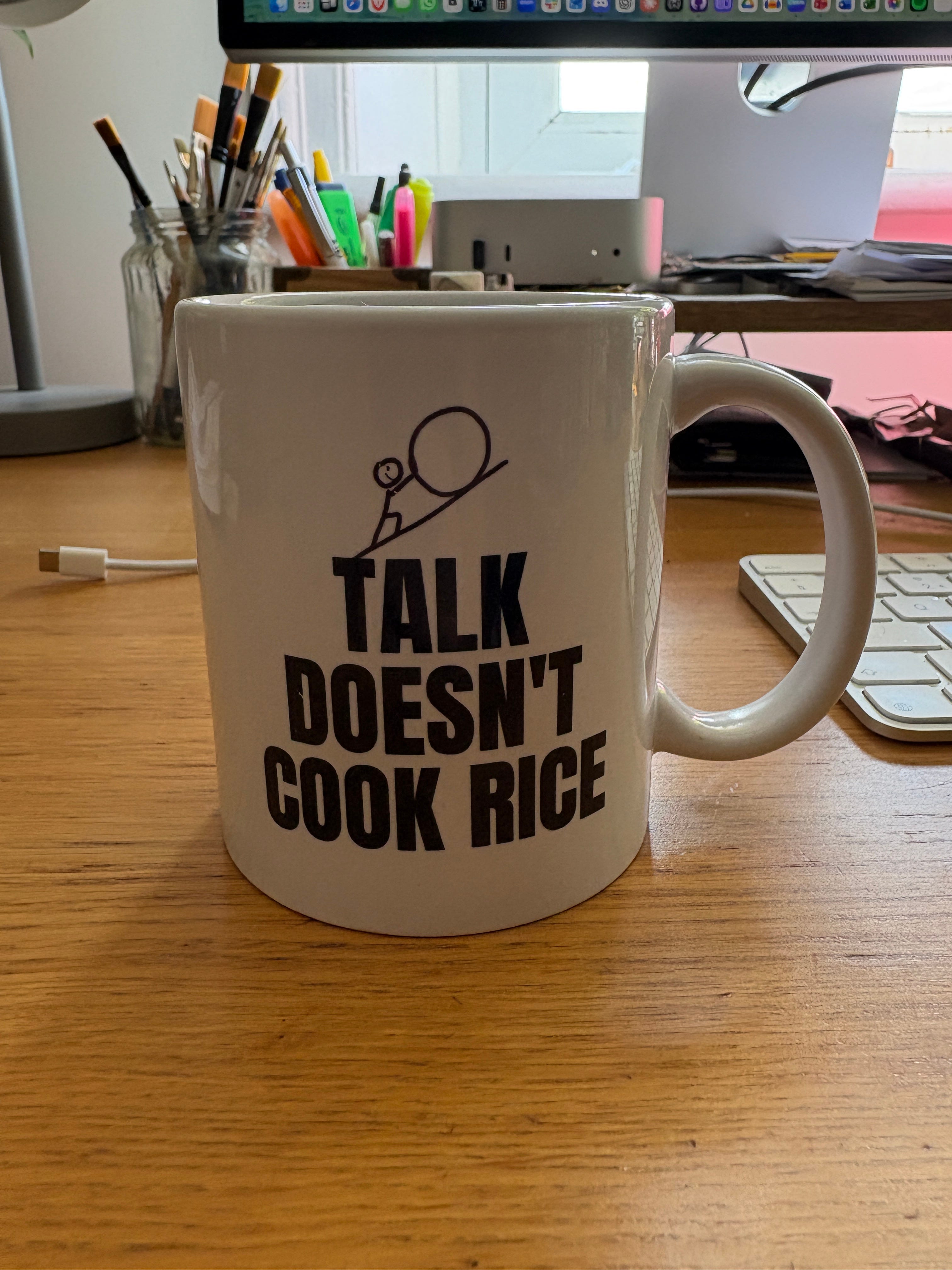
Take the mug on my desk. It holds tea, right enough. But it also holds a morning, a habit, a hand, a pause, and conversations between two people. It belongs to the kitchen where it lives and carries the marks of the person who made it. Earth became clay, fire hardened it, and water is poured into it. It reminds me of my friend Danny every time I take it out of the cupboard or wash it out. That’s nearer what Heidegger means by “the thing.” Not a lump of matter waiting to be used, nor just an object sitting in front of a subject. A real thing gathers relations and brings a world into presence.
Which is where Heidegger’s “fourfold” comes in. The language makes it sound like he’s wandered off into a woodland ritual: earth, sky, mortals, and divinities. But the basic idea is more down to earth than it first appears.
Back to the mug.
There’s earth: the clay, its material and weight, and the fact it came from somewhere.
There’s sky: weather, seasons, light, and the wider world in which the mug appears.
There are mortals: the potter who made it, the person who drinks from it, the friend remembered through it, and the fact that drinking tea is one small ritual inside a finite life.
Then there are divinities: not necessarily gods on thrones, but the dimension of meaning, mystery, gratitude, and reverence that can shimmer through an ordinary thing when we stop reducing it.
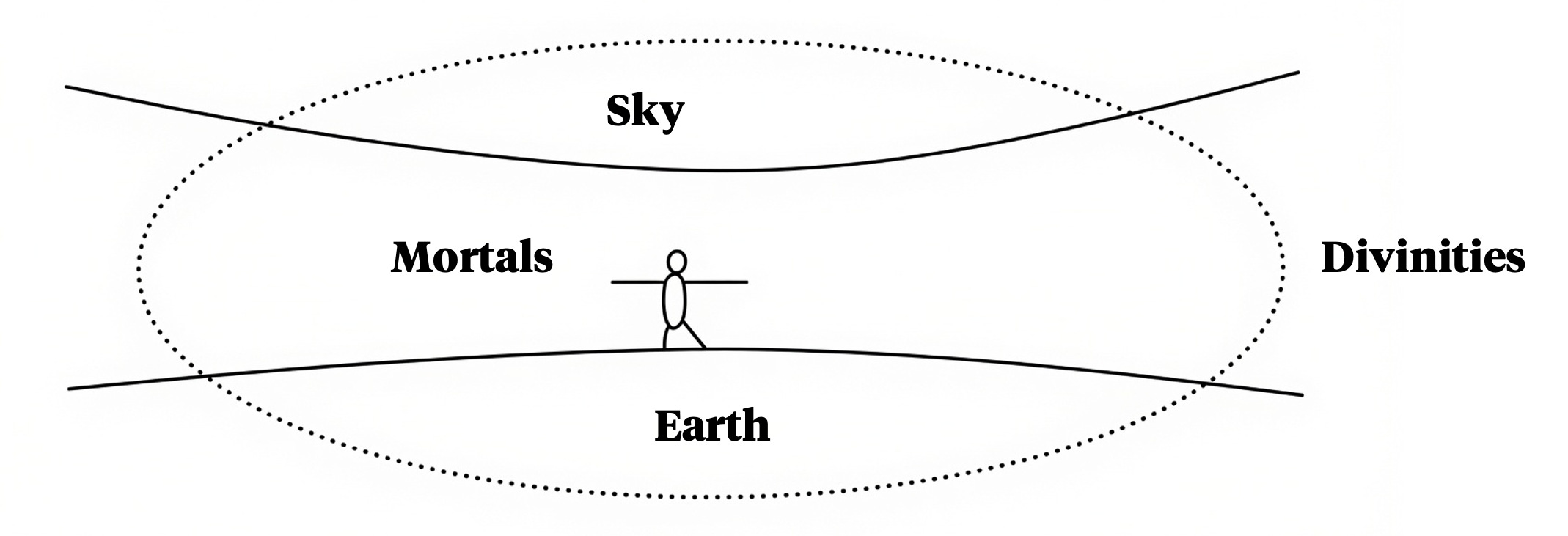
So the mug isn’t just a mug. It’s a small gathering of earth, sky, human life, and meaning. That might sound grand, but you know it already in your bones. A wedding ring isn’t just metal. A childhood toy isn’t just plastic. A kitchen table your family sat around for thirty years isn’t just furniture. A handwritten note isn’t just paper. These things gather worlds. They hold memory, place, time, grief, and belonging. Which is why it does your head in when someone pulls a Marie Kondo on you and calls a meaningful possession “just stuff.” It can’t be “just stuff” because human beings don’t live among bare objects. We live among meanings.
Taoism has always had this kind of sensitivity because it doesn’t see the world as a pile of separate objects waiting to be used either.12 It sees patterns, flow, seasons, timings, relations, and the way things belong together. A tree isn’t just wood: it’s soil, rain, light, shade, birds, insects, seasons, growth, and decay. A person isn’t a self-contained unit: they’re family, history, place, wounds, hopes, habits, and culture. “The thing things,” ridiculous as it sounds, is Heidegger’s way of saying that a thing stops being truly a thing when you strip it down to an object. It becomes a thing again when it gathers a world. To let it be isn’t to ignore it but to stop reducing it and allow it to be more than what it’s for. Which is hugely important because once we see everything only in terms of use, it doesn’t take long before we do the same to people.
Heidegger presents all this as a recovery of possibilities buried inside Western thought. Perhaps it is. But the further he walks into the fourfold, the more the Black Forest starts to look like ancient China.
Thinking Without Grabbing
Heidegger and Taoism share a suspicion of a particular kind of cleverness. The sort that cuts things up but can’t put them back together; that wins the argument and loses the room; that can explain love but can’t manage to love the person sitting across the table; that knows all the productivity hacks but can’t sit still for five minutes.
Western philosophy often depicts thinking as an active operation: defining, analysing, representing, categorising, calculating, and reaching conclusions. Heidegger and Taoism both recover a more receptive dimension. Thinking might mean waiting, listening, noticing, allowing, wandering, or remaining with a question. This isn’t irrationalism but recognition that aggressive cognition can destroy the very thing it’s trying to understand. Some realities reveal themselves only to the person capable of not immediately seizing them.
I notice the opposite habit constantly in my work with clients. There’s often an immediate need for clarity and application. How can I use this? What will it help me with? What’s the takeaway? There’s limited patience, at least initially, for letting truth reveal itself, and people want to put truth to work before they’ve allowed it to change them.
The Tao Te Ching can sometimes sound anti-intellectual, but it’s not against intelligence per se but intelligence losing touch with life. Lao Tzu writes:
To learn, one accumulates day by day.
To study Tao, one reduces day by day.
Through reduction and further reduction
One reaches non-action,
And everything is acted upon.13
Heidegger’s gripe with Western philosophy runs alongside this. We got brilliant at concepts, systems, representation, and mastery, but somewhere in the process, he thought, we forgot Being. “Forgetting being” sounds terribly abstract, but he just means forgetting the sheer fact that anything is here at all. The mug. The tree. The sky. The person across from you. Your own breathing. This brief, strange life. We rush past the miracle of existence because we’re too busy sorting everything into boxes:
Useful or useless.
Mine or not mine.
Efficient or inefficient.
Successful or unsuccessful.
Content or noise.
Art or slop.
Heidegger is trying to slow us down enough to notice that the world isn’t just a stockpile of material for our projects, like one massive game of Minecraft. It is. Too obvious to bother saying, perhaps. But the obvious is exactly what we’ve lost.
Words That Point Without Capturing
The Tao Te Ching famously opens with a warning that “the Tao that can be spoken is not the Tao itself.” But this doesn’t mean we should stay silent. Lao Tzu wrote a book, after all. It means language becomes false when it mistakes its names and distinctions for reality itself. The world runs deeper than our labels. It’s not used up by our concepts. The deepest way can’t be pinned down, owned, and turned into a tidy system. Lao Tzu says that “nature rarely expresses itself in words.”14
This already sounds like the later Heidegger. He came to distrust the idea that thinking was mainly a matter of defining things. He wanted thought to become more like listening: less grabbing, more waiting; less making reality fit our categories, more allowing things to show themselves.
Ordinary explanatory language can easily turn Being into an object or concept, so Heidegger turned increasingly toward poetry, etymology, wordplay, and indirect saying. He was after a language that could reveal without capturing. “Language is the house of Being,” he wrote. “In its home human beings dwell.”15 This is one reason his writing can be so annoying. He often sounds obscure because he’s trying to stop language from behaving like a machine. He doesn’t want words to just pin things down. He wants them to let things appear.
Taoist writing works in a similar way through paradox, image, reversal, humour, and strange little sayings that slip past the usual grip of the intellect. The soft overcomes the hard. The valley is powerful because it is low. The sage acts without forcing. These lines don’t march forward like bullet points in a slide deck. They work more like seeds. You carry one around, it niggles at you, and at some unexpected moment it opens. Lao Tzu says:
When words express truth, they are not refined.
When words are refined, they do not express truth.
One who is proficient does not depend on verbal disputation.
One who depends on verbal disputation is not proficient.
One who knows is not encyclopedic.
One who is encyclopedic does not know.
The wise does not accumulate.16
Heidegger loved poetry for a similar reason. A poem doesn’t just report the world; it discloses it. A good poem about a tree doesn’t hand you botanical data. It gives you the tree back. Some truths you can only approach indirectly because they’re too alive to be reduced to a clean definition.
Try defining love in a way that doesn’t kill it. Try explaining grief to someone who’s never lost anyone. Try putting fully into words what it means to stand under a clear sky at dusk while your dog does his evening ablutions and remember, out of nowhere, that you’re alive. You can say something, of course. But the thing always exceeds the saying. The world isn’t silent because it has nothing to say but because not everything real arrives as information.
Mystery, Freedom, and Dwelling
Taoism continually thinks through paired opposites: being and nonbeing, fullness and emptiness, high and low, difficult and easy, action and non-action. “To deviate is to be direct. To be concave is to be convex. To be exhausted is to be rejuvinated.”17 These aren’t simply enemies. Rather, they condition and generate one another. This unity of opposites, according to Lao Tzu, is what the wise grasps and applies to their daily activities.
Heidegger makes a related point about truth. Whenever something becomes visible, something else remains hidden. Every way of seeing reveals and conceals at the same time. A medical scan reveals something about a body. It may conceal the person. A balance sheet reveals something about an organisation. It may conceal the mood, trust, fear, and intelligence moving through it. A performance metric reveals something about an employee. It may conceal almost everything that makes their contribution human. There’s no final state in which reality stands completely exposed before us.
Heidegger says:
Truth is un-truth, insofar as there belongs to it the reservoir of the not-yet-uncovered, the un-uncovered, in the sense of concealment.18
This should produce a shared humility. Reality always exceeds the form in which it’s currently disclosed. The wise response isn’t to abolish mystery but to stay responsive to it. It also points towards a different kind of freedom.
We usually think freedom means more options, choices, tools, money, and control. There’s truth in that. Poverty and oppression aren’t freedom, and having no meaningful choices can crush you. But there’s another kind of unfreedom that comes from grasping too hard. You can have endless options and still be trapped by the need to optimise them. Endless tools and still be ruled by them. Endless opportunities and still feel unable to inhabit your own life.
Taoist freedom isn’t getting everything under control but becoming less possessed by the need to control. Heidegger’s releasement points in the same direction. Not passivity, but a changed relationship to action. This is where his thought hits hardest today. The modern world wants your attention: scrolling, clicking, reacting, comparing, posting, refreshing, and checking. It wants every spare scrap of consciousness converted into engagement. And the cost isn’t just distraction but a loss of world.
When attention is chopped into fragments, things stop appearing in their depth. We don’t dwell with them. This essay is nearly 6000 words long; I’d be amazed if many people have got to this point! We skim articles, people, places, and ourselves. “Dwelling” is Heidegger’s word, and it’s a good one. To dwell isn’t just to occupy a space but to inhabit it, to belong, and to stay with something long enough for it to reveal itself. You can’t dwell at speed. You can’t dwell while constantly checking your phone. You can’t dwell with a person while lining up your next reply. You can’t dwell in a place you only see as a backdrop for content. You can’t dwell in your life if you’re forever trying to be somewhere else.
Taoism teaches dwelling in its own dialect: return, simplicity, naturalness, and trust in how things unfold when you stop constantly disturbing them. It places human beings within a greater unfolding:
Man is in accordance with earth.
Earth is in accordance with heaven.
Heaven is in accordance with Tao.
Tao is in accordance with that which is.19
The human is decentred, but not devalued. Our dignity lies less in ruling the whole than in becoming capable of responding to it well. We aren’t sovereign minds confronting an inert exterior. We’re mortal inhabitants of a world that precedes us, sustains us, and will continue on without us.
So, was Heidegger a Taoist?
Not by tradition. Perhaps more than he admitted by influence.
This is where that awkward question from the start comes home. The case for the defence is real. Heidegger’s question of Being emerged from a distinctive confrontation with Greek philosophy and Western metaphysics, and several of his central moves were already under way before he sat down with Hsiao and the Tao Te Ching. Resemblance alone never proves borrowing.
But the innocent story is hard to sustain too. Heidegger wasn’t sealed inside Europe before stumbling onto Taoist territory. He read Chinese philosophy in translation, conversed with East Asian thinkers, worked directly on Lao Tzu’s text, and then produced a body of later philosophy saturated with ways, non-willing, openness, emptiness, gathering, simplicity, dwelling, and letting things be. The evidence permits suspicion more readily than conviction.
Most likely the truth sits somewhere between solitary invention and plagiarism. Heidegger recognised himself in Taoism. Lao Tzu and Zhuangzi gave him words, images and confirmations for a path he was already walking, and he drew those insights through Greek philosophy, German language, and his own peculiar vocabulary until they emerged recognisably Heideggerian. That doesn’t make the debt unreal. Philosophical originality rarely means creating something from nothing. It means receiving, transforming and giving back differently. The ethical question only begins when the receiving disappears from the story. And Heidegger, on the whole, left it out of the story.
There are still important differences, whatever the influence. Heidegger’s Being isn’t simply the Tao. Tao carries cosmological, practical, political, and ethical meanings that Heidegger’s thought doesn’t produce. Heidegger was also fighting a battle internal to Western philosophy, whereas Taoism emerged from very different Chinese questions about nature, language, government, cultivation, and social order. Early Heidegger can also feel markedly un-Taoist. Being and Time is full of anxiety, guilt, resoluteness, and being-towards-death, and it carries a severity and existential heroism far removed from the playfulness and strange humour of the Zhuangzi. Taoism contains explicit practices of self-cultivation too, while Heidegger resisted turning his thought into a teachable spiritual technique.
Still, Chang may have been right that Heidegger reached unusually deeply into the essence of Taoism. Heidegger gives Taoism a sharp modern diagnosis: we live in an age where everything becomes resource. Taoism gives Heidegger a gentler medicine: stop forcing, return to simplicity, and leave room for the way. Between them emerges a different posture towards reality:
Letting-be rather than willing.
Wu wei rather than forcing.
Clearing rather than filling every gap.
Dwelling rather than domination.
Poetic saying rather than exhaustive definition.
Mystery as an essential dimension of reality rather than ignorance to be eliminated.
The deepest overlap isn’t a proposition but a posture: don’t stand over reality and demand that it conform to your concepts. Become quiet enough to notice how it is already unfolding, and skilful enough to participate without destroying it.
The Tao of Heidegger is a different way of standing inside the modern world rather than a method to escape it. Use technology, but don’t let it decide what’s real. Make plans, but don’t worship control. Think deeply, but don’t mistake concepts for life. Act, but don’t force. Build, but leave space. Speak, but keep listening for what words can’t say.
There’s a line in the Tao Te Ching: “The way does nothing, yet nothing is left undone.” That sounds impossible. But we’ve all known moments when it felt true. The idea that appears once you stop chasing it. The child who opens up when you stop interrogating them. The allotment that gives you a glut of strawberries because you tended it and then, crucially, left it alone. The life that becomes richer when you stop treating it as a project.
Maybe that’s what Chang recognised: not simply a doctrine. Not East meeting West. An experience. The sense that life isn’t something waiting to be mastered. It already knows how to grow children, gardens, friendships, great conversations, great organisations, and even thought itself. They all flourish under the same strange condition: enough care to nurture them with enough restraint to stop forcing them.
Lao Tzu called it Tao. Heidegger called it letting-be. Whatever we call it, it may be one of the most important lessons our age has forgotten.
My philosophical novel, The Syntropist, is available worldwide on Amazon. All royalties go to Hospice at Home.
Chang, C.-y. (2013). Tao: A new way of thinking: A translation of the Tao Tê Ching with an introduction and commentaries. Singing Dragon.
Heidegger, M. (1971). Poetry, language, thought. Translated and with an introduction by A. Hofstadter. Harper & Row. (Original work published 1954)
One of my favourite bits of his meditative writing is The Fieldpath. You can actually listen to Heidegger reading in German with subtitles here, although, in a brilliant example of the modern technological mindset, YouTube might have autodubbed it into a weird English AI voice, and you’ll need to change it back to the original in the settings.
Heidegger, M. (1971). On the way to language. P. D. Hertz (Trans.). Harper & Row. (Original work published 1959)
Chapter 65 of the Tao Te Ching, Chang (2013) translation. Singing Dragon.
Han, B.-C. (2015). The burnout society (E. Butler, Trans.). Stanford University Press.
Chapter 29 of the Tao Te Ching, Chang (2013) translation. Singing Dragon.
Heidegger, M. (1971). On the way to language. P. D. Hertz (Trans.). Harper & Row. (Original work published 1959)
Heidegger, M. (1968). What is called thinking? F. D. Wieck & J. G. Gray (Trans.). Harper & Row. (Original work published 1954)
Ibid.
Chapter 11 of the Tao Te Ching, Chang (2013) translation. Singing Dragon.
Both Heidegger and Taoism undermine the familiar Western picture of a self-contained subject looking out at an external world. That picture is often pinned on René Descartes, although it has deeper and more complicated roots than any one philosopher. Descartes did give it an especially powerful modern form, though: a thinking mind on one side, an extended material world on the other.
Chapter 48 of the Tao Te Ching, Chang (2013) translation. Singing Dragon.
Chapter 23 of the Tao Te Ching, Chang (2013) translation. Singing Dragon.
Heidegger, M. (1993). Letter on humanism. In D. F. Krell (Ed.), Basic writings (pp. 213–266). HarperCollins. (Original work published 1946)
Chapter 81 of the Tao Te Ching, Chang (2013) translation. Singing Dragon.
Chapter 22 of the Tao Te Ching, Chang (2013) translation. Singing Dragon.
Heidegger, M. (1971). Poetry, language, thought. Translated and with an introduction by A. Hofstadter. Harper & Row. (Original work published 1954)
Chapter 25 of the Tao Te Ching, Chang (2013) translation. Singing Dragon.
This is absolutely brilliant! Thank you for this analytical take 👏
John, thank you very much for posting this essay. I felt an affinity for Heidegger when I was studying philosophy in college, and then was introduced to Taoism through an art history class at art school. I fell in love with it, and it’s shaped my life and art ever since.