


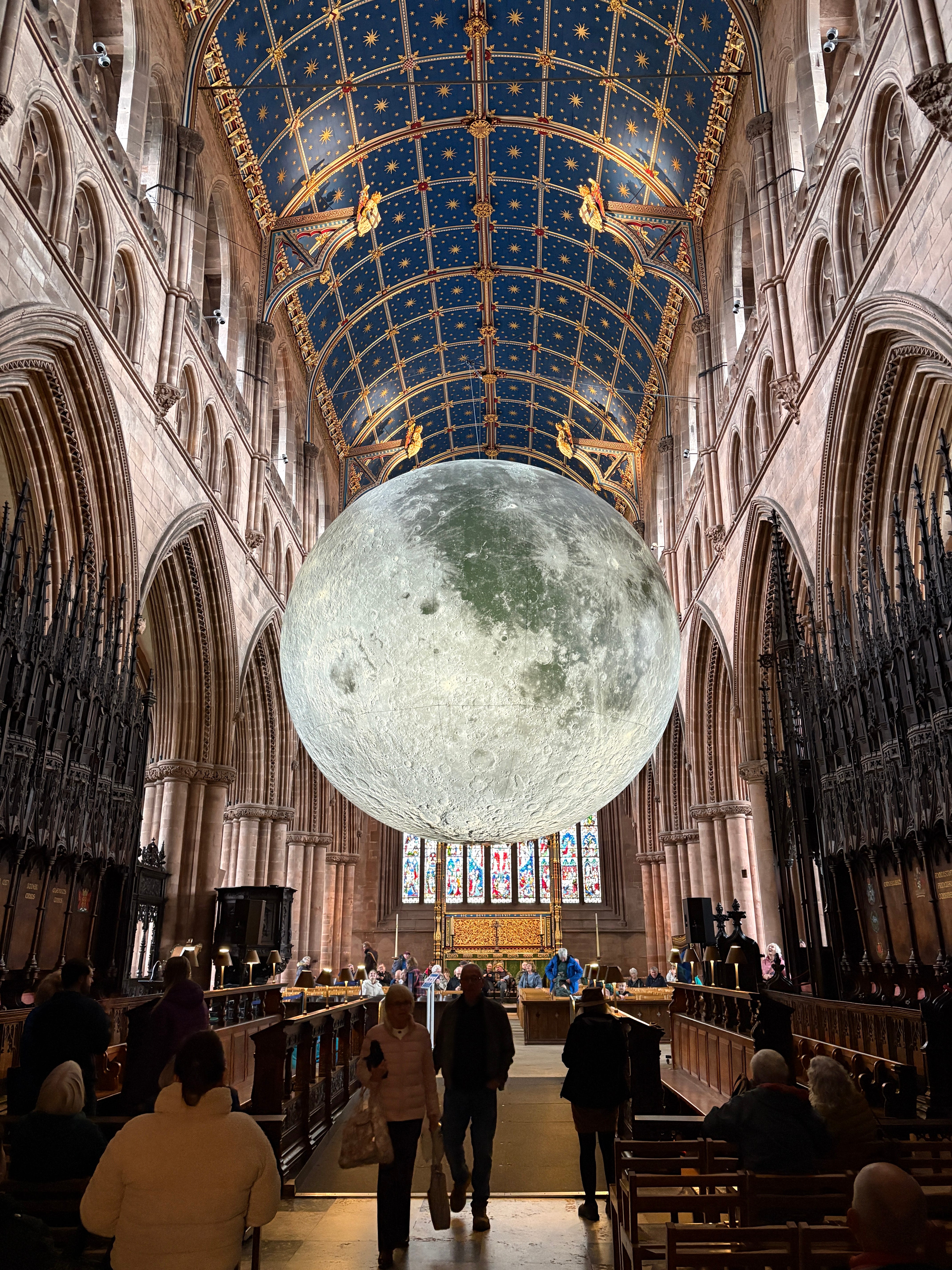
“We think that play and fairy tales belong to childhood: how shortsighted that is! As though we would want at any time of life to live without play and fairy tales! We give these things other names, to be sure, and feel differently about them, but precisely this is the evidence that they are the same things - for the child too regards play as his work and fairy tales as his truth. The brevity of life ought to preserve us from a pedantic division of life into different stages…”
— Nietzsche, Human All Too Human1
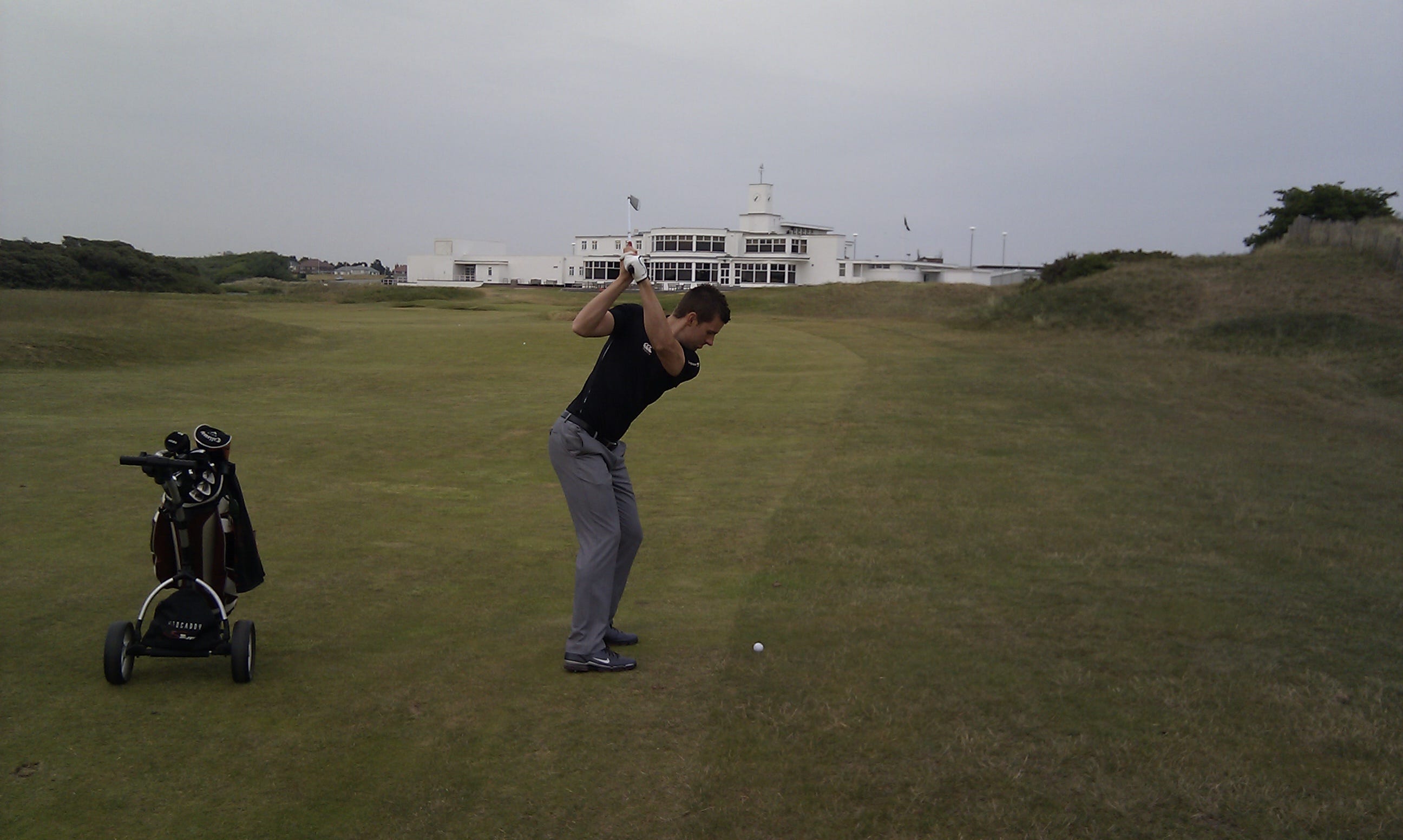
For a big chunk of my adult life, alongside other grown adults, I spent many a weekend trying to knock a little white ball into a hole that was 4.25 inches wide. We could have just picked the ball up and put it there, of course. But that would have ruined everything. Instead, we agreed to use long bits of metal and abide by a complex set of rules that made the task much more difficult. We bought ludicrously expensive equipment and travelled to specially prepared bits of land that charged us even more to use them, and much of the time the experience involved several hours of total frustration. Every now and again, one of us would hit a good shot and for a brief moment remember why we loved golf. For those few hours, getting the ball in the hole was everything.
To my friends and family looking in from the outside who didn’t play golf, the whole thing looked absurd. They pretty much thought we were maniacs. To us involved, though, we were so absorbed we’d barely notice the morning disappearing, which is partly what makes play so wonderful. We willingly create problems for ourselves and then spend a lot of time and energy trying to solve them. As we do that, we create a sort of pact to take things extremely seriously that would otherwise be pretty meaningless. We willingly step into worlds that have rules we’ve created and chosen to accept and experience amazing highs and devastating lows as we do it.
And then when the game finishes, we all shake hands, head home, and carry on with our lives until next time. WTF is all that about?!
Three different thinkers can give us a nice little philosophical lens onto this: the Dutch historian Johan Huizinga, the German phenomenologist Eugen Fink, and the American biologist Ray Peat. Each of whom approached play from a different direction but recognised something we tend to overlook when discussing its importance.
As an adult, you might tend to treat play as a pleasant interruption to the serious business of living, as something that kids do all the time, but you have to squeeze into whatever time is left after work and other obligations. Even when we encourage people to play more, there’s usually some sort of justification to sport, games, hobbies, or creative acts whereby they have to accomplish something, like keeping you healthy, managing stress, improving your cognitive function, or making you a better problem-solver. We’ve got very good at finding practical reasons for doing things we might otherwise enjoy doing for their own sake.
Which isn’t to say there’s anything wrong with these benefits, just that maybe something is lost when we get so used to justifying activities through their outcomes. The bigger, deeper, more syntropological question here, I think, is what if play tells you something really fundamental about the kind of being you are, and the conditions under which life becomes more expansive?
The Worlds We Play Into Existence
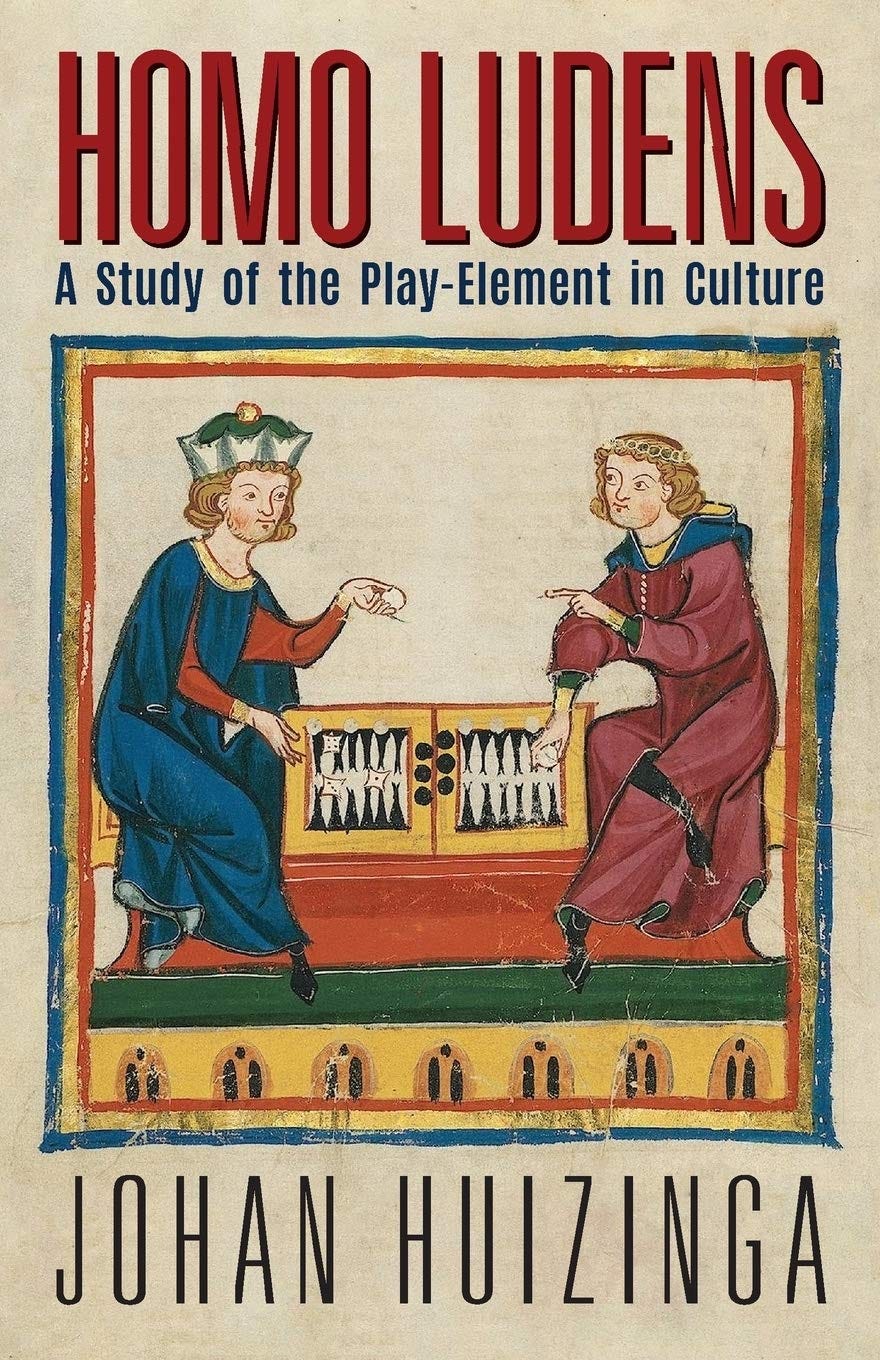
In 1938, Johan Huizinga (1872-1945) published Homo Ludens, usually translated as “Man the Player” or “Playing Man.” It’s a really interesting and well-thought-out book, not least because Huizinga asks you to reconsider something so familiar you probably rarely give it much thought. I’m betting you know what play is because you’ve done it, but if you tried to explain exactly what it is that makes an activity a game, or why a certain game matters to you so much, it would quickly get complicated. Huizinga was essentially suggesting that play has played a way bigger role in the development of human civilisation than most historians at the time had realised. In fact, he thought civilisation itself:
“…arises and unfolds in and as play.”2
Huizinga wanted to get to grips with the extent to which culture itself has developed through forms of playing. He was tracing the playful elements of culture through things like law, poetry, philosophy, community rituals, and ceremonial competitions and tournaments. Which isn’t to say he thought war was just a type of game or the consequences of cultural institutions weren’t serious. He was really into how we humans create meaningful activities through conventions that the people doing them recognise and stick with.
Let’s take chess as an example. Before you start the game, each piece is just an object on the board. But as soon as the game starts, each piece now has a particular significance. What was a piece of carved wood is now a bishop who can threaten a queen, while a king that can hardly move can decide the fate of the whole game. The objects still look the same and are made of the same stuff, but the way you make sense of them has totally changed.
Someone who’s never played chess before could look at the board and see thirty-two pieces of carved wood, while an experienced player sees moves, threats, opportunities, mistakes, patterns, and possibilities, often multiple moves into the future. The same collection of objects is disclosing a totally different world to each observer, and that world depends on the rules. If you and your playing partner go rogue and suddenly decide halfway through the game that bishops can now move like knights, the possibilities available would change instantly. A move that made zero sense five minutes ago could suddenly be decisive.
Most people tend to see rules as a restriction of their freedom, but in games it’s the rules that make certain types of freedom possible. If there were no rules of chess, there wouldn’t be any meaningful chess moves to make. Huizinga thought that the real heart of play is this willingness to step into a world with its own special rules. The activity has boundaries and its own internal logic, as well as a seriousness that someone looking in from outside likely won’t appreciate. You’ve no doubt found this out as an adult: woe betide the person who dares to not follow the rules of an imaginary game a child has created.
Huizinga gives the example of a little boy playing trains with a row of chairs.3 When his dad comes up to him and kisses him, the kid kicks off a bit because the other carriages might realise that their engine isn’t real. He obviously knows deep down that he’s pretending, but that doesn’t make the game he’s created any less important to him. Play creates this weird situation where you can know something is imaginary and still get totally absorbed in it: you don’t have to mistake it for ordinary “reality” to find meaning in it.
Huizinga also recognised that play is much older than human culture and is present in other forms of life. He starts the book with the example of some young dogs playing together. They look like they’re observing certain conventions whereby they’ll take the edge off their bites and exaggerate their aggression without the encounter turning into a full-on fight. What interests Huizinga, however, is how this seemingly innate capacity has contributed to the emergence of human culture and the way that we can collectively establish a world of meanings and then get absorbed in participating in it. In fact, it may be the significance of the objects and actions within things like a football match, a theatre play, or a religious ceremony that is partly what makes us human.
Huizinga was writing the book at a time when Europe was being increasingly dominated by political mobilisation and the approach of war. The book is permeated with worry about what happens when the playful spirit of culture gets lost to the sorts of competition that might look like games but lose their freedom and mutual recognition. He was particularly suspicious of the increasing professionalisation and organisation of sport, which has been on steroids ever since.4 A game that starts out as something people can freely enjoy gradually gets dominated by rankings, contracts, commercial interests, analysis, and the demands of outside spectators. The game is still recognisable as a game, and the players still follow its rules, but the experience of participating in it has changed a lot.
This raises the question of whether our capacity to play has less to do with the particular activities we engage in than the way we participate in them. It’s obvious that two people can play exactly the same game and have very different experiences of it. One of them might be enjoying the challenge and surprise of what’s happening, totally absorbed in the game’s unfolding possibilities. The other might be so obsessed and preoccupied with winning, guarding their reputation, pleasing their family, or avoiding embarrassment that they barely experience anything other than the pressure of the result. Both people are playing according to the rules (or not if you’re Man City 😁), but they’re likely not experiencing play in the same way.
This is where our man Eugen Fink can bring something to the party.
An Oasis in the Middle of Life
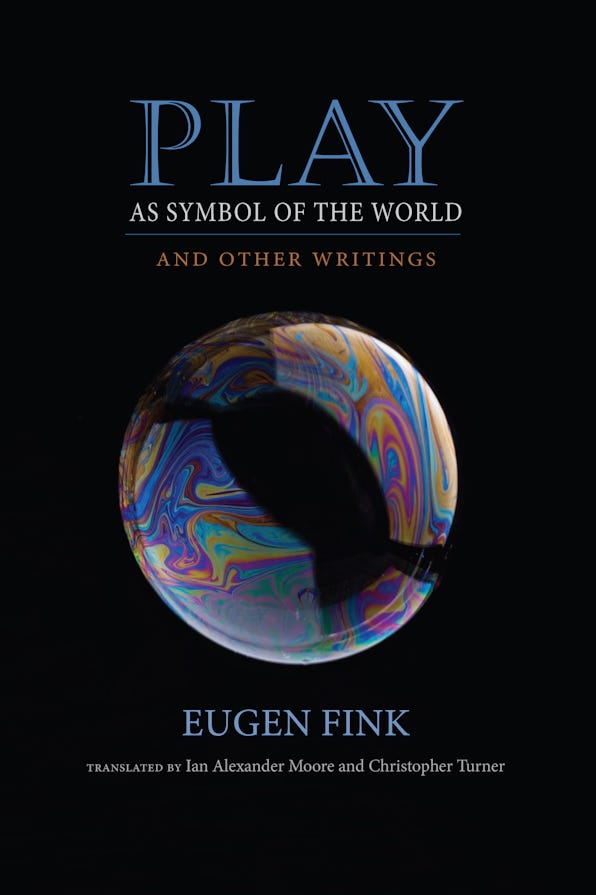
Eugen Fink (1905-1975) was a German philosopher who studied with Edmund Husserl and Martin Heidegger, later becoming Heidegger’s colleague at the University of Freiburg. In 1957 he published a short essay called Oasis of Happiness: Thoughts toward an Ontology of Play. Straight off the bat, that might sound overly complicated, as every kid on earth can play perfectly well without considering the ontology of what they’re doing. But what Fink was trying to do was get beyond the cultural significance of games and into what play reveals about the nature of human existence itself.
His starting point was the observation that most of your life is spent looking towards the future. You work to earn a living, you go to uni to get qualifications, you go to the gym to get fit, you save money for a holiday, and you make plans for the person you hope to one day become. You basically sacrifice the present to secure some imagined future that’s up ahead. And that even includes happiness, which becomes something you’re always working towards.
Fink connected this tendency with the ancient Greek idea of “eudaimonia,” which is typically understood as living well or flourishing. As a human being, you’re bothered about the meaning of your existence and you want your life to amount to something, but you’re never really certain what a genuinely successful life looks like. So you spend years pursuing things you think will make you happy, only to find out that reaching one destination just tends to reveal another one. There’s always something else to get done. And because day in, day out, you’re projecting into the future and pursuing goals that promise to make your life better, the present moment often just becomes preparation or a mere stepping stone to the next thing on your to-do list.
Fink thought play offers an interruption to this “incompleteness” in our way of living and a temporary release of pressure. It lets you enter a little self-contained world that doesn’t owe you a future return. Playing, he says, carries:
“…the character of a pacified ‘present’ and self-contained meaning—it resembles an ‘oasis’ of happiness arrived at in the desert of the striving for happiness and Tantalus-like seeking that is otherwise our condition. Play carries us away. When we play, we are released for a while from the mechanism of life—as though transported to another planet where life seems lighter, more buoyant, easier.”5
Imagine a good old game of five-a-side with your mates. You obviously want to win, you bust a gut chasing through balls, and you might lose your rag when somebody doesn’t track their runner. But unless you’re a full-on LinkedIn lunatic, you don’t come off thinking “lovely, that second-half shift has really boosted my personal development stack.” The point was just the match itself.
And while you were playing, things that might seem arbitrary from the outside mattered a lot. A painted line on the ground and whether a ball scraped over it by an inch. Whether it was actually a foul by Bob or not. For Fink, the meaning of the game is entirely within the game itself:
“The activity of play has only internal purposes, not ones that transcend it. And where, for instance, we play ‘with the purpose’ of training the body, of martial discipline or for the sake of health, play has already been distorted into an exercise for the sake of something else. In such practices play is guided by foreign goal-setting, and then clearly does not happen for its own sake.”6
As soon as it gets subordinated to some kind of exterior payoff, it basically becomes just another kind of work or exercise. Which doesn’t mean the game can’t have rules, stakes, rivalries, winners and losers, etc., just that it doesn’t need an ROI. As Fink put it:
“Play is a strange oasis, a dreamy resting point for restless wandering and continual flight. Play gives us the present.”
Think about the last time you got completely absorbed in something you enjoyed. Maybe it was a game, a piece of music, a good night out dancing, or an afternoon gardening. Because you were so involved and weren’t necessarily trying to achieve anything beyond the activity itself, you probably stopped paying too much attention to the passage of time. You might even have been disappointed when the activity came to an end. For Fink, this experience is philosophically significant.
Play offers you the opportunity of dwelling in the present without just experiencing it as a way of getting somewhere else. It has a completeness that your ordinary hustling and striving often lacks. Which I think is really interesting when you consider how much you’re bombarded with advice these days encouraging you to be more present. You’ve probably tried doing a bit of mindfulness, maybe even got an app for it. But many of the experiences in which you become most naturally absorbed involve no deliberate attempt to be present whatsoever.
A World Within a World
Fink’s argument gets even more interesting when he writes about the peculiar reality of the worlds we create through play, especially through his example of a little girl playing with a doll.
To someone watching, the doll is just another manufactured object of a particular size, weight, material, colour, etc. Someone somewhere made it, then someone bought it, and it can be picked up and examined. But within the girl’s game, the doll becomes a baby which she feeds, dresses, comforts, and takes on the role of its mother. Which isn’t to say she literally believes the doll has become her living baby. She knows fine well that she’s playing a game, but the situation has now got a reality of its own and the doll has become meaningful in a way that can’t be described just by its physical properties.
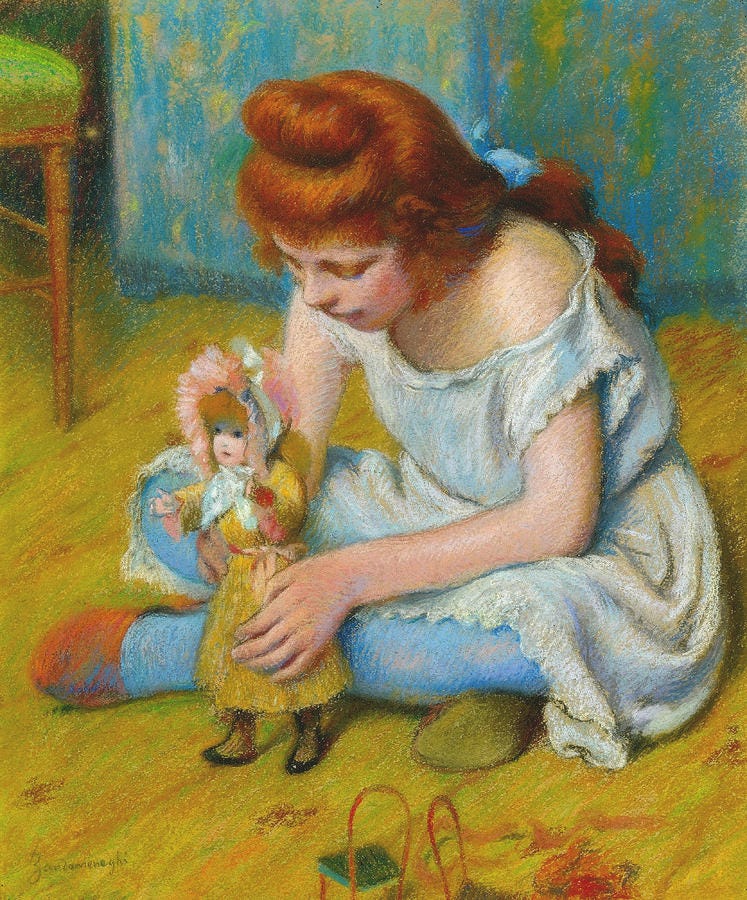
Fink says that playing is a kind of doubling of existence. You’re still in ordinary reality, but at the same time you inhabit an imaginary world that involves real objects and shared activities and relationships with other people. It also has its own experience of space and time. Let’s say you go to the theatre to watch a show. The actors are on a real stage, and you’re sitting in an actual building. Everyone knows everything being portrayed is all made up, but something real is still happening. You get absorbed in the lives of imaginary characters and experience emotions like fear, excitement, joy, or grief. A tragedy can even make you cry despite no one actually dying.
Fink also gives the example of a tree’s reflection in the surface of a lake.7 You’re standing there looking at the reflection and can see it plain as day right there in front of you. You could whip your phone out and take a picture of it if you wanted to. The reflection is “real,” but the tree appearing in the water isn’t physically growing there: the image exists, but the object it presents isn’t present in the same way. Fink says that’s exactly what play is like. The imaginary world isn’t just an illusion, nor is it just the ordinary physical objects that are involved in producing: playing allows you to bring something into the world that wasn’t there before.
Fink calls playing a finite form of creativity. A cereal box can become a light sabre and a hairbrush can become a microphone. The objects are still the same physically, but the possibilities through which you encounter them have been totally transformed. Which is where his argument starts to vibe with a broader understanding of life as something continually involved in bringing forth new possibilities. For Fink, you don’t encounter a world of finished objects with meanings that have already been finalised, because you can participate in making things meaningful.
Obviously every game still involves constraints. If you’re going to learn to play a musical instrument you’re going to have to submit yourself to certain limitations. You’ll have to work with the instrument’s physical characteristics, develop particular movements and techniques, and start to recognise and understand some musical relationships. But it’s those limitations that will gradually make new possibilities available to you. The better you get to know the instrument, the more you’ll be able to do with it, and things might start to happen that you could never have planned. Maybe you start jamming with a friend and they start responding to what you’re playing, before you know it the whole thing turns into something neither of you could have anticipated.
These moments can be fleeting, but their value is very intimately connected with the experience of taking part, even if it produces nothing that survives beyond that present moment.
Are We Still Playing When We Grow Up?
Fink also lays a big challenge down to the assumption that play is just something that happens in childhood. As we’ve seen, he says kids make their games pretty obvious, with their imaginary worlds visible in toys and the roles they adopt. But us adults tend to be far more discreet.
Fink points towards the importance of masks, titles, social conventions, and the elaborate performances of adult life. For example, think about how differently you behave depending on the roles you occupy. When you’re just chilling with your best friend, you’re probably footloose and fancy-free. But I bet you’re way more formal when chairing a meeting at work. You’ll alter and tweak particular words and gestures, because different expectations become more or less appropriate in different situations. It’s not that you’ve become someone else, just that you’re taking part in a social world with its own rules and recognised identities. Which takes us back to Nietzsche’s “eternal child” at the start of this essay. He says children see play as work and fairy tales as truth, while adults give these things different names. Fink takes the thought a bit further: maybe some of your most serious adult roles are forms of play you’ve gotten so familiar with you don’t see them as games anymore.8
Of course, your social roles and their consequences are still real and meaningful. A high court judge about to deliver a sentence is participating in an institution with very different potential outcomes from a child pretending to be Judge Judy at their dining room table. Fink just thinks that both situations reveal something about our capacity to inhabit roles within shared structures of meaning. Which raises another uncomfortable question.
How many of the things you regard as absolutely serious are based on conventions that human beings have collectively created?
Fink eventually pushes that thought to the limit. He brings in one of the GOATs in Heraclitus, who, as I’ve written about before, famously imagined the course of the world through the image of a child playing a board game:
“Time is a child playing, moving counters in a game; the kingdom belongs to the child.”9
Nietzsche would also explore a related idea centuries later: a world continually creating and destroying, without regarding some final moral purpose to justify its becoming:
“…as a play of forces and waves of forces, at the same time one and many, increasing here and at the same time decreasing there; a sea of forces flowing and rushing together, eternally changing, eternally flooding back…my Dionysian world of the eternally self-creating, the eternally self-destroying…without goal, unless the joy of the circle itself is a goal.”10
For Fink, this suggests a remarkable philosophical reversal by viewing the cosmos itself through the metaphor of play. We start by asking how human beings create imaginary worlds through play, but what if play itself offers a way of thinking about the world in which we already find ourselves? What if existence is less like a predetermined journey towards a final destination and more like an unfolding game in which new possibilities keep emerging?
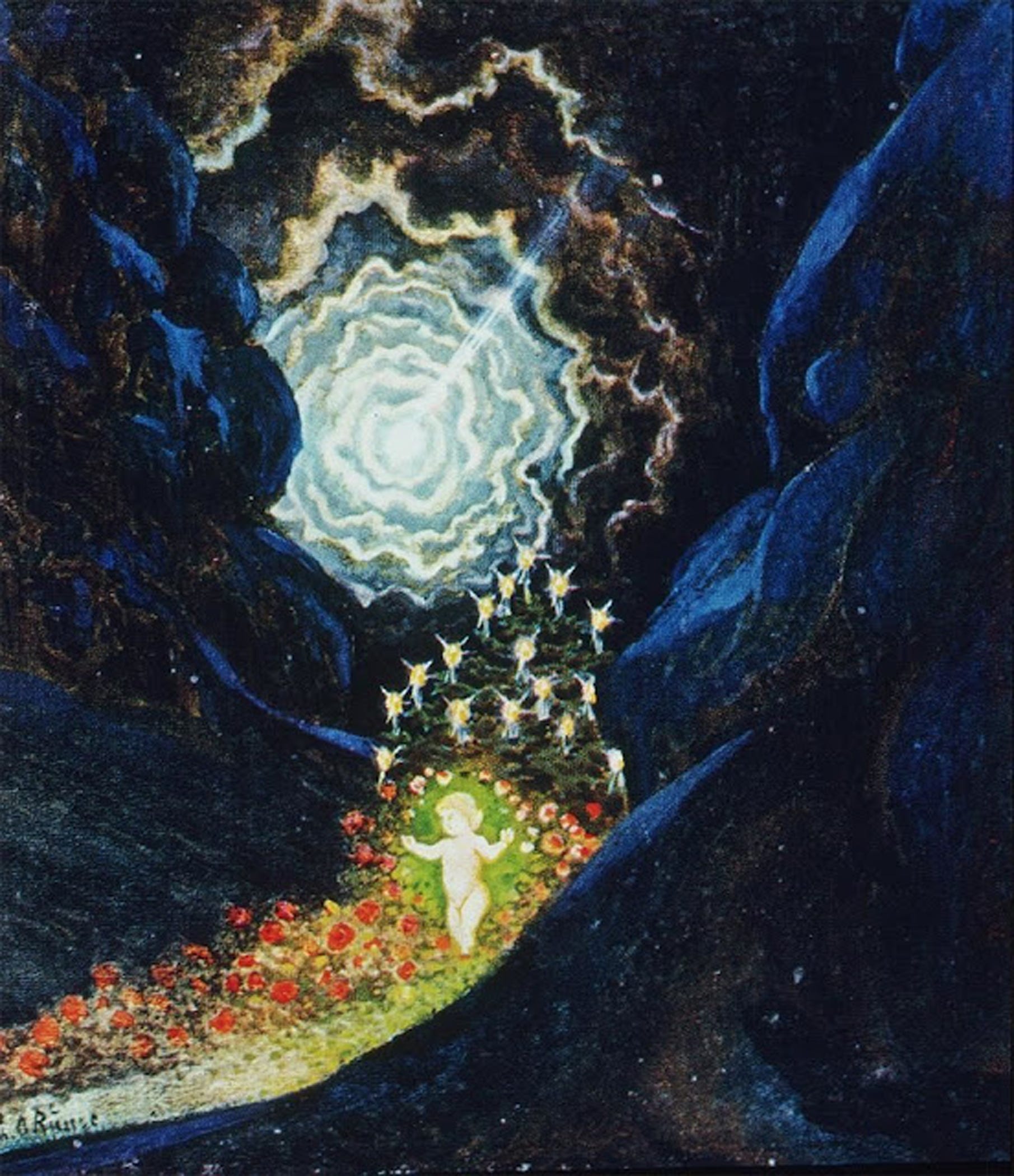
The Energy to Explore
At this point, I want to bring in Ray Peat (1936-2022), who approached play from a very different direction. Peat was an American biologist and philosopher whose broad work explored the relationships between metabolism, physiology, development, and intelligence. Regular readers will know I’m particularly interested in his tendency to think about living organisms as integrated wholes, rather than collections of separate mechanisms.
One of Peat’s recurring arguments was that you can’t understand intelligence independently of the physiological condition of the organism. In his essay Intelligence and Metabolism, he writes:
“Intelligence is an interface between physiology and the environment.”11
Most people tend to talk about intelligence like it’s a relatively fixed possession. You’re either intelligent or you’re not, with a certain level of ability, which can be measured and compared to other people. Peat thought that was massively inadequate. For him, intelligence involves the living organism’s responsiveness to its circumstances, and learning and thinking are inseparable from the energetic field and physiological processes that make them possible. What you as an organism can notice, understand, and do is very dependent on the condition in which you find yourself.
An animal responding to a threatening environment behaves very differently to the same animal exploring a relatively safe one that it knows well. When you’re knackered, overwhelmed, stressed, or anxious, your attention is probably going to zone in on whatever most requires an immediate response, and your ability to engage with other possibilities and opportunities will be restricted. The same you when you’re feeling good and in a more favourable situation will likely be far more curious, imaginative, and buzzing to explore. Neither of these situations indicates a change to some fixed quantity you might call intelligence. What they do reveal is how much your relationship with the world depends on the conditions in which that relationship takes place.
Peat was particularly interested in what happens when developing organisms are deprived of stimulation and opportunities to explore. He drew upon research that involved animals raised in different environments, which contrasted the effects of social isolation and restriction with those of more varied and stimulating surroundings. He also discussed people he saw as having considerable intellectual abilities, like John Stuart Mill, William James Sidis, and Bertrand Russell.
Mill, for example, had a very demanding education from his Dad and ended up experiencing a profound psychological crisis in later life. Sidis was a celebrated child prodigy, but had to endure a tonne of pressure and unwanted public attention. Russell, meanwhile, enjoyed a relatively independent intellectual upbringing and kept developing new interests all the way through his long life of 97 years. Peat used these examples to ask what he saw as an important question:
What’s the point of extraordinary intellectual ability if it comes at the cost of curiosity, emotional responsiveness, or just the ability to enjoy your life?
He was extremely suspicious of any educational arrangements that rewarded obedience and the rapid acquisition of approved knowledge while discouraging spontaneous inquiry. He was all about understanding the conditions that allow intelligence to stay responsive and, above all, alive. Peat thought playfulness was a big part of that picture.
What Happens When An Animal Stops Playing?
Peat observed that playfulness is closely associated with intelligent behaviour in animals. Indeed, young mammals often devote a considerable amount of time to activities that don’t seem to have any immediate survival purpose. As Huizinga identified, they chase after each other, investigate objects, wrestle and playfight, explore unfamiliar surroundings, and repeat behaviours that seem to accomplish very little if anything at all. Of course, these activities might have some pretty important developmental consequences.
Play can provide opportunities to practice social interactions and develop motor coordination, as well as expose animals to unpredictable situations that require them to adjust their behaviour. But Peat was way more interested in the conditions that make such activity possible, noting that stressful early environments, and social isolation especially, tend to reduce playful behaviour. In a banging line, he suggested that:
“Playfulness is contagious, but so is the inability to play.”12
If you’ve ever spent any time around a playful young animal like a puppy, you’ll recognise that first bit straight away. If a dog suddenly decides an ordinary object like a slipper is fascinating, it picks it up, drops it, retrieves it, throws it up into the air, and invites you to join in. It doesn’t take long until everyone in the room is laughing and getting involved in the game they had no intention of playing. The second part of Peat’s line is also very interesting.
You’ve probably been in rooms where spontaneous behaviour feels entirely inappropriate. Maybe everyone is petrified of making a mistake, or the atmosphere is dominated by judgement and competition, or maybe people have spent so long following the same routines that anything unexpected goes down like a lead balloon. Under those circumstances your willingness to experiment is going to be inhibited, and Peat connected this with the physiology of stress.
His broader theory emphasised the importance of cellular energy production and the way chronic stress could alter metabolism, perception, development, and just behaviour in general. He wrote and talked a lot in interviews about how organisms respond when their available resources become insufficient to meet environmental demands. For example, when you’re under sustained stress, you’ll likely become more restrictive and defensive, and immediate protection and survival will top trump exploration.
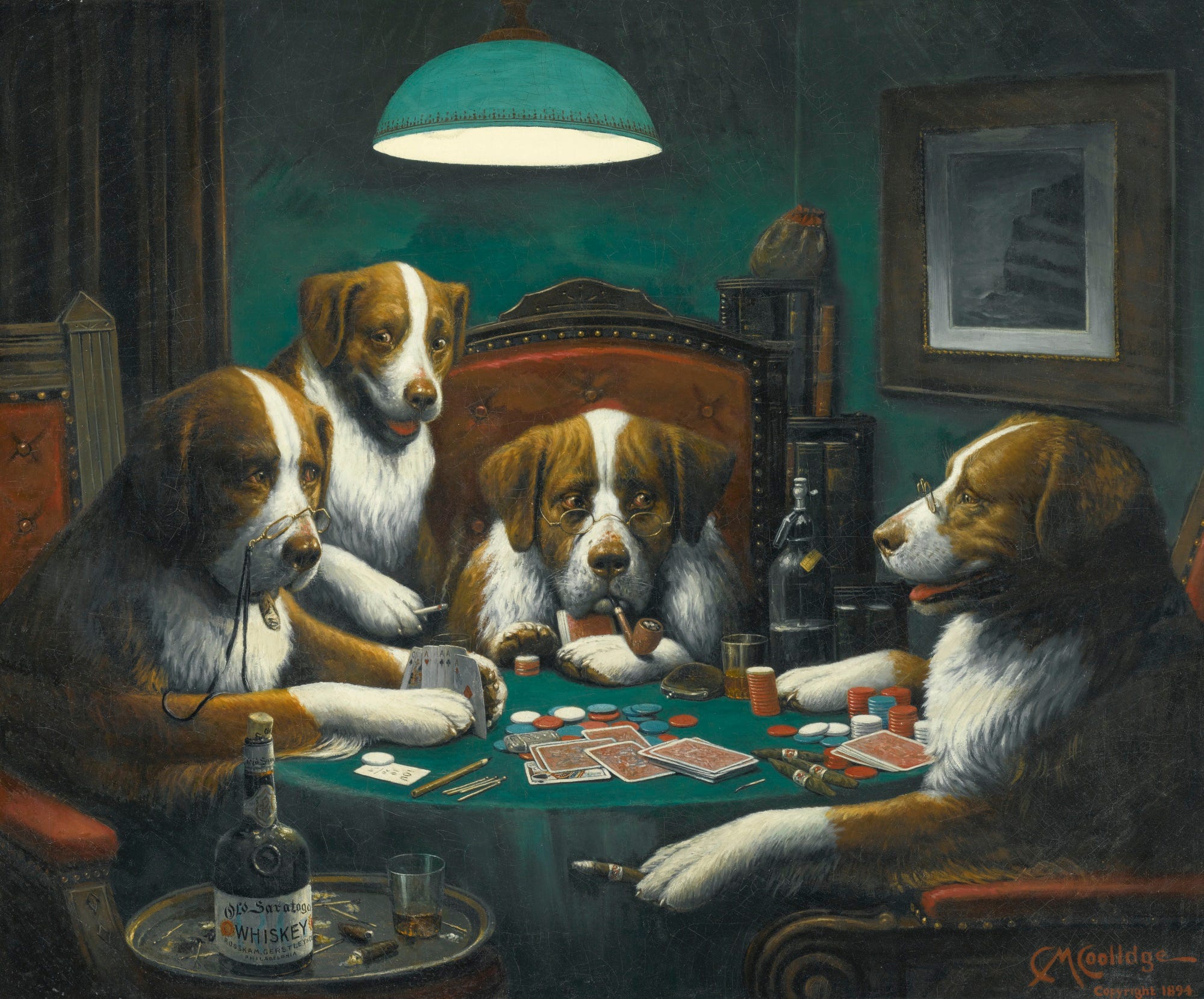
Which isn’t to say Peat has given us a black and white rule of a stressed animal never plays, or that the most playful animals are the healthiest. Living organisms are always far more complicated than that. Nevertheless, research on animal play does show relationships between the nervous system, social development, environmental conditions, and behaviour.13 The broad question Peat raises is a really valuable one:
What has to be happening within a living organism for the world to remain interesting enough to explore?
A World That Remains Open
This brings me to the point in the essay where I crowbar in a connection to Syntropology. Much of my thinking about syntropy starts with the observation that living organisms are continually maintaining and developing relationships with their surroundings. Life involves an ongoing exchange with the world whereby organisms respond to what they encounter, organise their activities and, under favourable conditions, develop new capacities. This process, however, is far from uniform, and there are circumstances in which the range of possible responses gets severely restricted.
A living organism under sustained threat might have very little chance to explore beyond its immediate needs. Similarly, when you’re overwhelmed by external demands, you rely on familiar routines and established ways of thinking about what’s happening around you. I’ve seen teams organise themselves so rigidly that anything novel or innovative is seen as a disturbance to the status quo that needs to be immediately shot down. In all of these cases, possibilities that could have been available are simply too difficult to recognise or pursue.
The opposite also happens too. New relationships and friendships develop, unexpected possibilities become visible, and established ways of doing things get modified through experimentation and interaction. The organism, person, team, or organisation becomes capable of responding to the world in ways that weren’t available before, which is one of the ideas I find most interesting about syntropy.
A syntropic orientation involves maintaining and developing the conditions through which life can keep generating meaningful possibilities. And that doesn’t mean everything new is always valuable, or that more complexity is always what you want. Sometimes genuine flourishing needs things to be simplified and the most appropriate response to whatever is happening involves restraint or even withdrawal. The key thing is the living system’s relationship with its possibilities, including its capacity to respond appropriately to changing circumstances. And play seems to me to offer a really interesting example of how those possibilities can emerge.
One of the biggest dangers of organising your life too tightly around predefined outcomes is that you can become less receptive to these unexpected developments. Perhaps paradoxically, I see this a lot in clients within sport. When every activity is judged primarily by what it might contribute towards a predetermined goal, anything that doesn’t appear to advance that goal basically becomes irrelevant. You get really selective about what deserves your attention, which can obviously be useful, but it can also prevent you noticing things that might have become meaningful if you’d allowed yourself to explore them. This is one of the ways a person’s world can get smaller and smaller, even as their knowledge and achievements grow. You get better at getting where you’re going, but less interested in what you might discover along the way. Playfulness offers a different possibility that involves a willingness to enter situations without already knowing where they might go and what they might become.
I think that willingness is a valuable expression of aliveness.
When Playing Stops Being Playful
Perhaps ironically, I also think there’s a danger whereby play can actually become entropic if you overlook some of the more troubling possibilities it has. It’s not all just a wonderland of fluffy bunnies, freedom, creativity, and openness.
Games can become compulsive and competition can overwhelm enjoyment, which definitely played a role in why I fell out of love with golf. I would get so absorbed in the scorecard that everything else pretty much disappeared from view. Play can also involve exclusion, cruelty, and destructive behaviour, and Fink especially recognised this ambiguity. He describes play as capable of expressing both a kind of creative self-possession and something closer to abandonment or surrender:
“For, sometimes a relief from the real world-actuality can extend all the way to rapture, to enchantment, to succumbing to the daemonic character of the mask. Play can contain within itself the bright Apollinian aspect of free selfhood, but also the dark Dionysian aspect of panic-stricken self-abandonment.”14
You can become so absorbed in a world that it seems to take possession of you, which again makes a lot of sense in a professional sporting context. You might start an activity because you enjoy it, only to find out that relationship is on increasingly thinner ice as rankings, rewards, and social expectations increasingly come to the fore. I know people who adored their sporting activity, but it became so dominated by external measures of success they pretty much despise it now and that original pleasure has been long lost. In situations like that it isn’t obvious at all how playing necessarily expands your possibilities. In fact, the obvious thing is how effective the game is at confining your attention, so we definitely can’t say play is inherently syntropic.
Life Without a Final Score
It’s normal to want to become more successful, more knowledgeable, healthier, better at cooking, or whatever else you’ve decided is important. And I don’t think there’s anything inherently bad in pursuing those things. But I do think it’s worth asking whether you’ve got so attached to the idea of progress that you sometimes struggle to recognise experiences whose value doesn’t depend on making any. What activities do you do that are meaningful just because you like doing them? Can you participate in activities without needing to know in advance precisely what those activities will lead to?
To me those questions are really relevant in a culture that places so much emphasis on planning for optimisation and measurable achievement. It’s no wonder you want to make your efforts count. But you can get so preoccupied with where you’re going that you overlook what’s happening while you’re getting there. You miss, as Big Al Pacino put it in Any Given Sunday, “the six inches, in front of your face.”
I started this essay with grown adults trying to get a small white ball into a hole. After several hours, they’ll hopefully manage it eighteen times. Then they’ll shake hands, complain or rejoice about the shots and wonder what might have been. Then within minutes, they’ll start looking forward to doing it all over again. Which is pretty weird when you really think about it. If putting the ball in the hole was really the whole point, someone could just put it there before we even get there. But nobody would want that. We want to play. And perhaps there’s something important about a life which can still tell the difference.
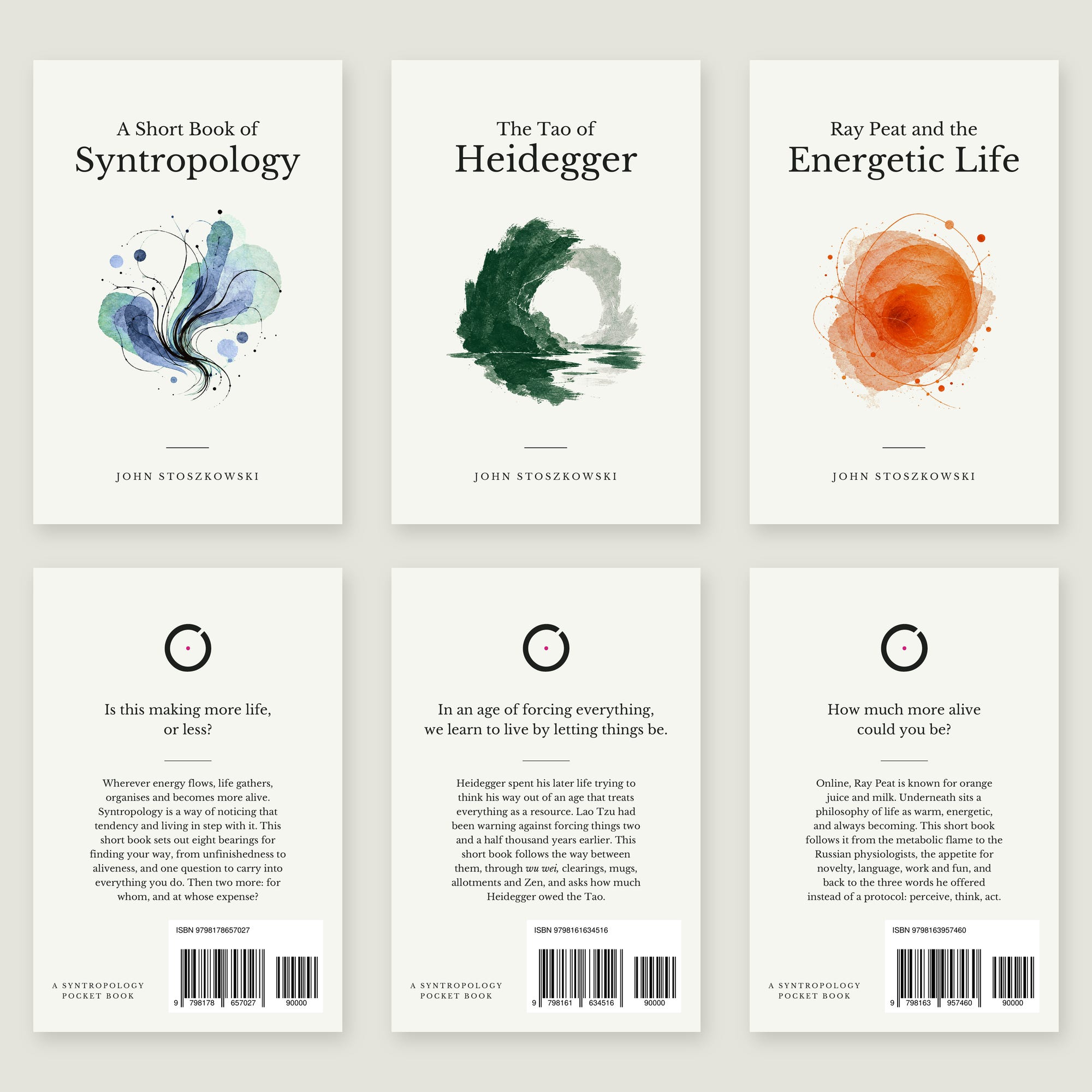
I recently started a series of Syntropology pocket books, mainly to send clients, but also in the spirit of physical objects gathering a world better than a screen does. They’re available on Amazon, with my royalties going to charity. I’ve also built an interactive version of the first one you can play with here.
Friedrich Nietzsche, Human, All Too Human II, “Assorted Opinions and Maxims,” §270, “The Eternal Child” (1879). Translation by R. J. Hollingdale, in Human, All Too Human: A Book for Free Spirits (Cambridge University Press, 1996).
Johan Huizinga, Homo Ludens: A Study of the Play-Element in Culture (1938), English edition (Routledge & Kegan Paul, 1949), Foreword, p. ix. Read the Foreword and opening chapter.
Huizinga, Homo Ludens, Chapter I, “Nature and Significance of Play as a Cultural Phenomenon,” p. 8. The story of the boy playing trains was recounted to Huizinga by the child’s father. His discussion of young dogs playing appears on p. 1.
Huizinga, Homo Ludens, Chapter XII, “The Play-Element in Contemporary Civilization,” pp. 197–198. Huizinga discusses the effects of increasing regulation and professionalisation on the character of sport. Read Chapter XII.
Eugen Fink, “Oasis of Happiness: Thoughts toward an Ontology of Play” (1957), translated by Ian Alexander Moore and Christopher Turner, Purlieu: A Philosophical Journal 1, no. 4 (Spring 2012), pp. 20–42. The passage on the oasis of happiness appears on p. 9 of the essay (journal p. 28).
Fink, “Oasis of Happiness,” p. 9 (journal p. 28). Fink distinguishes the internal purposes of play from purposes imposed on it from outside.
Fink, “Oasis of Happiness,” pp. 14–16 and 20–21 (journal pp. 33–35 and 39–40). These passages examine the plaything, the imaginary play-world, and the example of a tree reflected in water.
Fink, “Oasis of Happiness,” pp. 5–6 (journal pp. 24–25). Fink questions whether adults play less than children or merely play in more disguised forms.
Heraclitus, Fragment 52 (DK 22 B52), preserved in Hippolytus, Refutation of All Heresies, IX.4. See also Charles H. Kahn, The Art and Thought of Heraclitus (Cambridge University Press, 1979), p. 71. The Greek aiōn has been variously translated as “time,” “lifetime,” and “eternity.” Fink discusses the fragment in “Oasis of Happiness,” p. 22.
Friedrich Nietzsche, unpublished notebook fragment 38[12] (June–July 1885), subsequently included as §1067 of The Will to Power, edited by Walter Kaufmann and translated by Walter Kaufmann and R. J. Hollingdale (Vintage Books, 1968). This is a posthumously assembled text, rather than a book completed by Nietzsche. Read §1067.
Ray Peat, “Intelligence and Metabolism,” Ray Peat. The opening discussion presents intelligence as a relationship between physiology and environment.
Peat, “Intelligence and Metabolism.” The discussion of playfulness follows his comparison of Mill, Sidis and Russell and his treatment of the effects of early-life stress and isolation.
E. J. Marijke Achterberg and Louk J. M. J. Vanderschuren, “The Neurobiology of Social Play Behaviour: Past, Present and Future,” Neuroscience & Biobehavioral Reviews 152 (2023), 105319. https://doi.org/10.1016/j.neubiorev.2023.105319. This review examines the neural mechanisms of social play, particularly in rats, including environmental influences and early-life experiences.
Fink, “Oasis of Happiness,” p. 17 (journal p. 36). Fink distinguishes the Apollonian aspect of playful freedom from the Dionysian possibility of enchantment and self-abandonment.