



Regular readers know I often bang on about Ray Peat’s bioenergetics and Iain McGilchrist’s brain hemisphere theory. What follows is a real-world example viewed through both lenses: a pattern in storytelling that many people sense but struggle to name. Increasingly, films, TV shows, and books seem to distrust the audience. Rather than inviting viewers to imagine and engage with subtle cues, characters now often state their motives and actions outright, as if we can only grasp what’s explicitly spelled out.
My aim in this essay isn’t to blame everything on low energy. Instead, I want to explore how attention, physiology, and culture influence each other. These forces quietly alter how stories are told and reflect broader shifts in how we think and perceive.
The Cringe Dialogue Trend
In recent years, Netflix screenwriters have reported a recurring instruction to make characters explicitly “announce what they’re doing.” This makes plots easy to follow even if the show is playing in the background.1 Critics describe this as a move toward simpler, more expository scripts optimised for “casual” or “second‑screen” viewing. Essentially, it’s writing optimised for people scrolling on their phones.23
This trend violates the longstanding “show, don’t tell” principle of screenwriting, which trusts audiences to notice and interpret what’s happening through behaviour, action, and visual metaphor rather than direct narration. As Jason Hellerman says, “it’s the difference between a character stating they’re an expert marksman and a scene showing them hitting a bullseye.”4 Modern writing assumes divided attention, so everything must be explained outright. The result is dialogue that often ends up feeling flat, unnatural, and a bit “cringe.” It serves more as a delivery system for plot points than as authentic character interaction.
Though these are anonymous insider reports and not official policy, the pattern they highlight is hard to miss. Netflix has popularised a type of “backgroundable” content, where heavy exposition ensures stories remain understandble with minimal focus.5
A striking example is season 5 of Stranger Things. Watch almost any minute or two from the first few episodes and you’ll hear characters describing their emotions and plans in tidy, overly direct sentences that no one would say in real life. At times, it sounds like they’re literally just reading their stage directions out loud.
In this clip you’ll get an immediate feel for this (no spoilers):
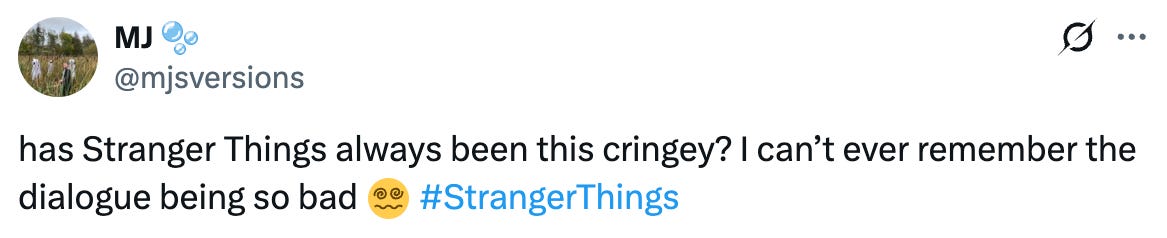
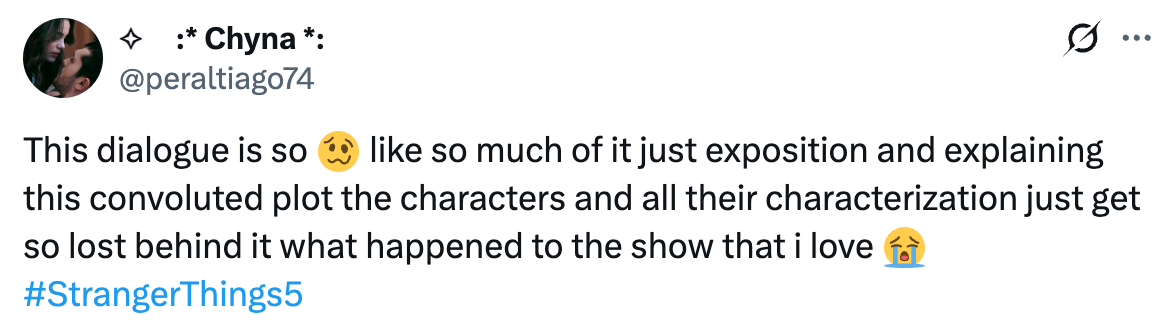
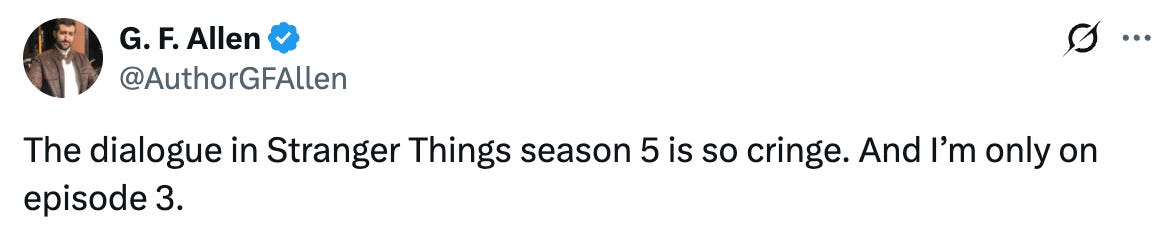
Viewer reactions on X (formerly Twitter) capture the frustration: a common complaint is that the show no longer trusts the audience to pick up on anything subtle or implied.

Data as Dialogue
Iain McGilchrist’s work helps explain what’s happening here. The left brain hemisphere prefers clear, step-by-step information without context. The right hemisphere, by contrast, handles nuance, tone, implicit meanings, metaphor, and the unspoken elements that give life to a scene. The directive to “have characters say what they’re doing” is a classic left-hemisphere approach: it strips away ambiguity and subtlety, allowing half-distracted viewers to follow without needing to infer from small cues like silences, glances, or atmosphere.
This isn’t to demonise the left hemisphere—it’s vital for tasks requiring precision and analysis—but when its mode of attention dominates culture, storytelling flattens into checklists of discrete informational units rather than immersive worlds to explore. “Backgroundable” content prioritises surface-level details and neatly packaged facts over emotional depth or unexpected twists. This aligns with McGilchrist’s warnings about a cultural drift toward mechanical, fragmented perception.6
Peat on Language, Metaphor, and Rigid Thinking
The other piece of the puzzle comes from Ray Peat, who, beyond his work on hormones and metabolism, spent decades exploring how language influences thought.7 He distinguished between an “exploratory analogical mind” that learns by forming and testing broad metaphors and comparisons, and a “rule-bound” mode confined to narrow, pre-defined, “closed compartments.”8
In his book, Mind and Tissue (1976), Peat elaborated on this by contrasting a “verbal-symbolic” style of thinking, where attention fixates on isolated concepts marked by labels, with an intuitive “landscape-like” mode that perceives a broader field of patterns and relationships.9 The verbal-symbolic mode restricts thought to deduction from fixed symbols, emphasising sameness and repetition. The landscape mode is expansive and synthetic, leaning toward novelty and discovery. Some people get stuck in the verbal-symbolic mode. They fill their inner world with words and abstractions that make their understanding of science, art, and nature feel hollow and disconnected from lived experience.
This maps closely to McGilchrist’s hemispheres: the “flags on peaks” of verbal symbols align with the left hemisphere’s preference for explicit, pin-pointed information, while the unifying landscape reflects the right hemisphere’s holistic integration.
Peat believed early learning is naturally expansive and metaphorical. Children probe new experiences, compare them to what they know, and build flexible worldviews. But when rigid formulas, jargon, and authority shut down curiosity, thinking becomes deductive and boxed in. Instead of questioning or exploring, you just manipulate tokens within a closed system. The joy of discovery gives way to the comfort of ticking the right boxes.
Language, for Peat, is both a preserver of understanding and a potential barrier. Words begin rooted in sensory, intuitive experiences, but over time, they can detach into free-floating abstractions. This allows “understanding” without direct encounter. People accept ideas as true simply because they’re articulable. By our mid‑20s, most of us carry a load of unexamined assumptions embedded in our language.10
In a 2021 newsletter, Peat described language as a kind of energetic flow:
“Energy, thought, and language flow in one direction, through time, building up persistent structures. The structure of a flame, or of a sentence, is definite, but it takes its form from its situation. The symbolic aspect of language is trivial, subordinate to the energy that supports it.”11
A sentence isn’t static code but a contextual event shaped by energy. When symbols are treated as self-contained objects, language loses its relational vitality, as in Netflix’s on-the-nose dialogue, which pins everything down with verbal labels rather than inviting intuitive engagement.
Alfred North Whitehead, whom Peat admired, emphasised what’s lost: a sentence or symbol alone is inert, just marks or sounds. Its value comes from the imaginative leap it inspires, using ambiguity to open new possibilities for integration into personal experience. Reduced to formulas and clichés, language becomes an administrative tool, closing off those possibilities.
Peat linked this to personality and politics.12 Drawing on psychologist Bob Altemeyer’s model of authoritarian personalities, characterised by conventionalism, submission to authority, and aggression towards outsiders, Peat noted that these traits involve compartmentalised reasoning that tolerates contadictions if sanctioned by power.13 In hierarchical cultures that prioritise rote learning over creativity, such patterns become embedded in institutions. This was certainly my experience in academia: rule-heavy, jargon-laden language protects dogma, rewards recitation, and discourages genuine inquiry. Paired with McGilchrist’s hemisphere imbalance, it shows language evolving from exploratory to procedural, progressively closing down worlds of meaning.
Low-Energy Attention and Why Literalism Feels Good
Peat added a physiological dimension to all this. Good metabolic function, especially efficient glucose oxidation in the brain, supports flexible, context‑rich thinking. Low metabolism, however, pushes us toward rigid, simplified patterns. When energy is scarce, nuance and subtlety become exhausting, while black-and-white answers feel reassuring.14
Chronic stress hormones, sluggish thyroid function, excess polyunsaturated fats, and poor sleep reduce cerebral blood flow and impair glucose oxidation. This shrinking metabolic margin limits the ability to tolerate complexity and hold multiple threads of meaning. Ambiguity becomes metabolically expensive. Literal statements provide relief because they cost less to process: no need to decode a glance or silence; the character simply says, “I’m angry at you.”

Peat compared it to a violin that has been soaked in water:
“…it will sound very odd when it’s played. Its various parts won’t resonate properly. Similarly, the living substance has to be in a particular state to resonate properly with its environment.”
Even if you bow it in exactly the same way, the swollen wood and glue won’t resonate properly, so the sound is thin and wrong. Similarly, a stressed, under‑fuelled nervous system can’t easily “resonate” with the complexity of a scene. It receives the signals but can’t organise them into rich patterns. Clear, explicit statements are like loud, single notes on a compromised instrument in that they’re easier to produce and process.
Peat didn’t see this as laziness but as a systemic metabolic shift reshaping perception. Modern environments amplify stress, constricting attention, dulling imagination, and making literalism seem practical. A society of fatigued nervous systems gravitates to verbal-symbolic thinking, hopping between fixed labels rather than exploring landscapes. Expository dialogue fits this constrained space perfectly: low-effort media for “consumption” without tracking relationships or uncertainty. Corporations exploit this, tilting culture toward rigidity. Yet, Peat argued, restoring energy revives metaphor, curiosity, and tolerance for complexity.
Language, Exploration, and the Orienting Reflex
Netflix‑style dialogue exemplifies a broader change in how language is used. “Show, don’t tell” activates the “orienting reflex” I wrote about in my last essay.15 Our innate drive to turn toward something that might matter, interpret tones and expressions, infer meanings, and refine mental models. “Tell, don’t show” bypasses this reflex, delivering pre-packaged labels instead.
Peat saw consciousness as active participation: an organism’s response to its environment. Even dreams and hallucinations, in his view, imply a reference to something real. A scene’s purpose isn’t just information transfer but drawing viewers into a shared field of attention. Expository dialogue short‑circuits that participatory process by standing in for it with a description.
This aligns with Peat’s metaphorical vs. rule‑based distinction: metaphors prompt “In what ways is this like that?” while rules dictate “This is that; repeat after me.” Expository writing closes questions rather than opening them. It says: “This is what’s happening; don’t look further.”
Ivan Pavlov highlighted that humans have a first signalling system (direct sensory cues and conditioned responses) and a second signalling system: language, or “signals of signals.”16 In healthy cultures, this second system should deepen perception. But here, it substitutes for perception, overlaying thin verbal labels instead of enriching engagement.

A perfect festive counter‑example is Raymond Briggs’ picture book The Snowman (1978). It has no words at all, yet it has sold more than five million copies across 19 countries.17 In the classic 1982 film adaptation, there’s no expository dialogue (with the exception of the central song, “Walking in the Air”), no narration filling in the gaps, just visuals and music that invite you to inhabit a child’s world directly.
The magic is precisely in what isn’t said. Both the book and the film pull you in and let you feel the texture of childhood in ways words would blunt or ruin. You have to participate, to supply your own associations and emotions, and that participation is part of the pleasure.
The Snowman shows what’s possible when a work trusts the reader’s orienting reflex and intuitive “landscape‑mode” attention. Much of today’s expository streaming content does the opposite.
The Endings Problem
This intolerance also appears in reactions to ambiguous endings. The film No Country for Old Men, widely regarded as a modern classic (it’s definitely in my top 20), periodically sparks complaints that it “doesn’t end properly.” The finale of The Sopranos—the greatest show of all time 😁—is probably the most infamous example of this, with anger still lingering years later over its open-endedness.18 It’s as if a story without a clear bookend and moral has somehow failed.19

The left hemisphere craves clean, filed away conclusions while the right dwells in unresolved, nuanced, open experience. Peat’s bioenergetics suggest low metabolic reserves amplify this, as ambiguity demands resources that are scarce in stressed states.
The Two Lenses Together
Combining McGilchrist and Peat reveals a self-reinforcing loop that’s easy to see once you notice it:
Fragmented, low-energy attention leads to narrow, left-hemisphere-dominant styles of representation.
Left-hemisphere-dominance demands explicit exposition and rule-like language.
Explicit exposition fosters media needing less energetic, metaphorical engagement.
Low-engagement media trains fragmented, stimulus-driven attention.
Fragmented attention reinforces low-energy physiology and authoritarian, cognitive habits.
Eventually, low-energy literalism starts to seem “normal.” This isn’t just a simple tale of “executives have ruined art and storytelling.” Rather, it’s a systemic interplay between physiology, attention, language, technology, and institutional incentives. It’s a symptom of corporations serving a left‑hemisphere cognitive style, expressed in rule‑like language, to high‑cortisol, low‑thyroid audiences who experience ambiguity as a metabolic strain.
What the Cringe is Really Telling Us
The “cringe” viewers feel when characters narrate their lives is their right hemisphere, our authenticity sensor, recoiling from fakery. The body senses art being degraded to labelled fragments by collective fatigue. If Peat is right about energy and language, and McGilchrist is right about hemispheres and attention, then this isn’t just a matter of taste. A tired culture makes and craves tired art, which reinforces tired thinking.
The way out isn’t complicated in theory: restore metabolic vitality, reclaim exploratory language, and embrace resonant “unfinishedness.” When energy rises, subtlety feels easy, complexity becomes inviting again, and stories stop needing characters to read us their notes aloud. They can breathe a bit, and so can we.
A Soundtrack for Tired Attention
I recorded this mix last year. It opens and closes with Iain McGilchrist sharing some essential wisdom, with deep, flowing beats in between to pull you out of low-energy fog. Grab a Coke, hit play, and let the subtlety sink in 😁
Casual Viewing: Why Netflix Looks Like That (n+1 article)
Too distracted to watch? Netflix has the perfect ‘second-screen’ show for you (Conversation Article).
Netflix Is Telling Writers to Dumb Down Shows Since Viewers Are on Their Phones (PC Mag Article)
What is ‘Show, Don’t Tell’ in Screenwriting? (No Film School Article)
Of course, there are other possible explanations too. When you’re writing for a global audience, with many reading subtitles or watching dubbed versions, you’re incentivised to simplify. If you’re producing at scale with compressed timelines and younger writers, exposition creeps in almost automatically. Netflix’s data may also show that viewers drop off the moment ambiguity appears.
How we pay attention to the world changes the world, and it also changes us (I love the production value and hopeful vibe at the end of this video).
Peat originally trained and worked in linguistics before doing his PhD in biology. He completed graduate work in linguistics (an interdepartmental “biolinguistics” route) and even taught as a linguistics instructor at Montana State University in the mid‑1960s, before later returning to university to complete a doctorate in biology at the University of Oregon. That background in language, meaning, and consciousness is exactly what underpins his later interest in metaphor, learning, and authoritarian uses of language.
Peat was highly critical of Noam Chomsky’s linguistic theories, particularly Chomsky’s idea of an innate “universal grammar” or “language organ” wired into the brain. Peat argued that Chomsky’s claims lacked empirical evidence and that his genetic determinism reduced language to fixed rule-based programming, ignoring the living, dynamic, and context-dependent nature of language use. He saw Chomsky’s approach as authoritarian, limiting the intelligence and creative exploration that language enables, and linked it to a broader pattern of positivist, hierarchical thought dominating academia. Once language is imagined as a sealed code in the head, it becomes easy to imagine thought itself as rule‑following: a closed, left‑hemisphere world of symbols talking to symbols.
Intuitive knowledge and its development (Article by Ray Peat)
Thought and energy, mood and metabolism (Newsletter by Ray Peat)
Academic authoritarians, language, metaphor, animals, and science (Article by Ray Peat)
The Hypothyroid Organisation (Substack Post)
Ray Peat and the Orienting Reflex (Substack Post)
First and Second Signal Systems (The Great Soviet Encyclopedia)
Raymond Briggs: Snowmen Bogeymen and Milkmen - BBC Documentary
My Top 5 is:
The Sopranos
The Wire
Breaking Bad
Mad Men
Mr Inbetween
Special mention for Season 1 of True Detective as the greatest single season in TV history.
It’s Been 17 Years, And I’m Still Not Over The Sopranos’ Cut To Black Ending (Screen Rant Article)
Highly processed entertainment. The high fructose corn syrup of culture. Have you seen the studies on what “shorts” and tic tok content is doing to people’s brainz? French fry brain. Micro waved tv dinner’ing our ability to think perceive react.
I am loving your work! Please keep at it and have a blessed holiday!
Brilliant piece, the metabolic angle adds serious depth to this. The link between low-energy physiology and literal language really clarifies why this isn't just artistic decline but something systemic. When people can barely process nuance because their nervous systems are running on fumes, of course entertainment tilts toward spoon-feeding. Kinda reminds me of how fastfood chains optimize for convenience at the cost of everythig else, Netflix is doing that but for attention.