


Please note: This essay is for educational purposes only and is not medical advice. Always consult a caring, qualified healthcare professional before changing your diet, lifestyle, exercise, or medication. Your health is your responsibility, please take good care of it.
One of the most common, and perhaps profound, gripes I hear about modern life is that time seems to be flying by, or that there never seems to be enough of it. Once we hit middle age, the seemingly eternal summers of childhood give way to the frenetic slog of adulthood. We’re often told that the clock is objective and constant. Therefore, this perception must be a subjective illusion, a psychological quirk.
Common explanations for this are tidy but dismissive. The “Proportionality Theory” suggests a year is a larger fraction of a 10-year-old’s life (1/10th) than a 50-year-old’s (1/50th), so it feels longer.1 Meanwhile the “Novelty Theory” argues childhood is dense with “firsts”—novel experiences that the brain must encode—creating a rich mosaic of memory, whereas adult life blurs into routine.2
These explanations aren’t necessarily wrong, but they might be profoundly incomplete. They describe the effects without addressing their root cause; explanations born of a scientific establishment that, as Ray Peat noted, substitutes “a very neat and clean knowing for a hopelessly messy and really unknowable material reality.”3
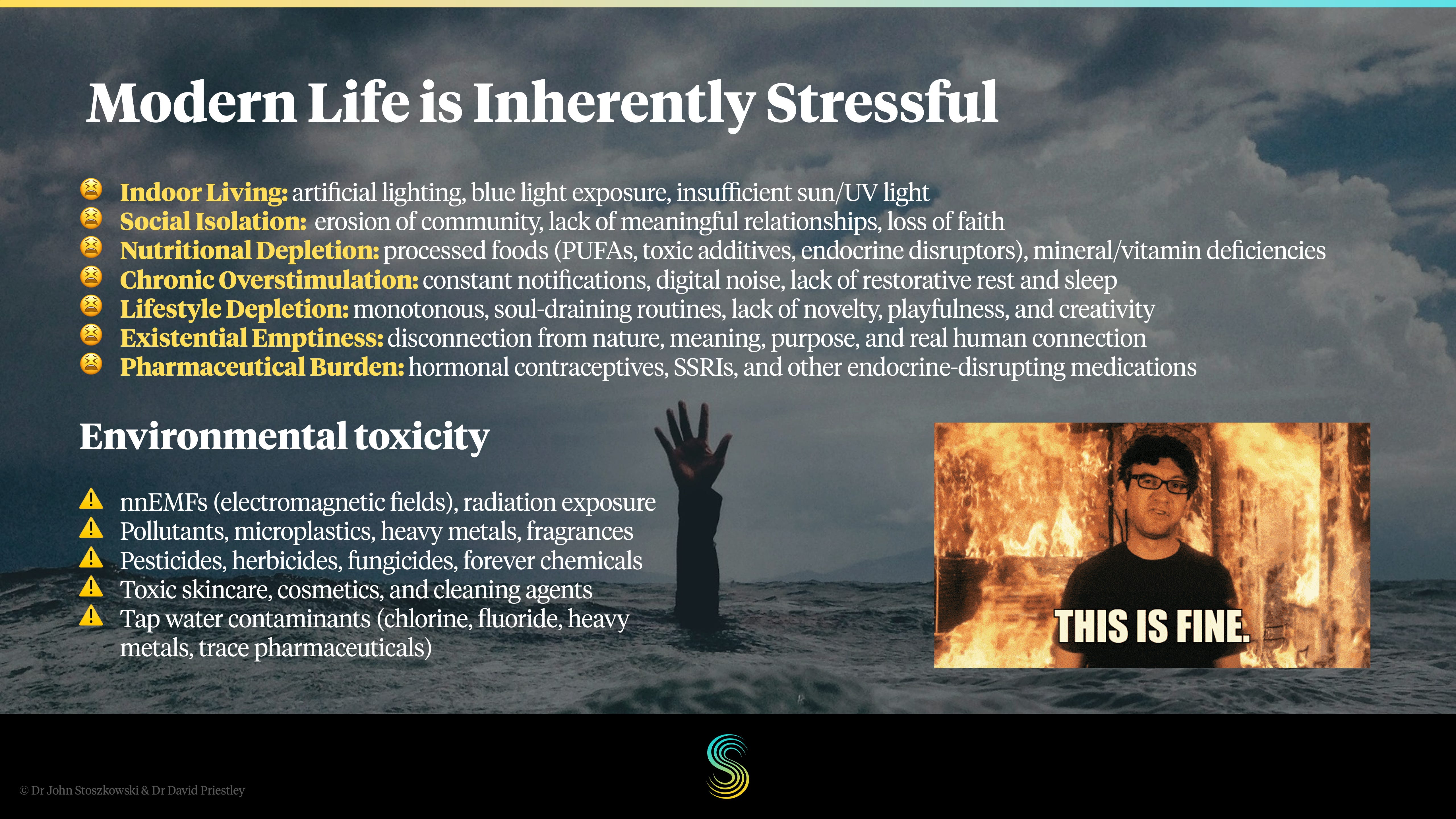
A bioenergetic framework, one that takes matter and energy seriously, offers a more radical thesis: Our subjective experience of time is not a psychological illusion but a direct, physical perception of biological reality. Chronic stress, for instance, can compress subjective time even in youth, as seen in shift workers and the overworked, whose “blurred” days stem from energy deficits rather than mere routine.4
Our “internal clock” functions through and reflects our metabolic rate.5 We don’t simply perceive time; our very biological structure, energised by our metabolism, generates our temporal experience. The acceleration of time is the felt sense of metabolic decline: a slow, “progressive freezing.”
The Metabolic Clock and the Coherence of Consciousness
The idea that biology dictates time perception has a firm, if often ignored, scientific footing. Cross-species studies use “Critical Flicker Fusion Frequency” (CFF) to measure the “temporal granularity” at which an organism perceives the world. This is the speed at which a flickering light blurs into a steady, constant glow.
A hummingbird, with its ferociously fast metabolism, has an incredibly high CFF, processing more visual “frames” per second than we do and perceiving the world in what amounts to slow motion. This isn’t some sort of hummingbird superpower, but a metabolic necessity for its high-speed life.67
A tortoise, with its slow metabolism, has a very low CFF, sampling reality at a much lower frame rate.
This principle applies within our own human species. Children, with their higher metabolic rates (per unit of mass), consistently perceive time as passing more slowly than adults. This is the biological basis for the psychological experience.89
But metabolism isn’t just a vague term for burning calories. In the bioenergetic view, it’s the process of efficient oxidative phosphorylation: converting glucose into ATP, water, and, crucially, carbon dioxide (CO2). Governed by the thyroid, this process builds and maintains complex structure and coherence in the organism.
Hypothyroidism, increasingly common thanks to modern diets and chronic stress, slows metabolism and dulls experience. It affects cognition and can distort time perception by reducing neural speed and shifting speech frequencies.10 Restoring thyroid function, whether through nutrition or carefully supervised hormonal supplementation, can restore this “spaciousness” by enhancing metabolic rate.11
This leads to what Ray Peat called “calm alertness”—the subjective feeling of a high, stable, and efficient metabolism. It isn’t the wired, jittery energy produced by stress hormones like adrenaline and cortisol, nor the inefficient energy from glycolytic metabolism. Instead, it’s a state of abundant energy reserves, where the brain is so well-fuelled that it can process the world in high-definition, with depth and sharp focus. Athletes in “the zone” sometimes describe this: the ball slows down, the crowd noise fades, and the field becomes spacious.12 This sensation, often treated as mystical, is simply the body working at full coherence, supported by CO2’s role in dilating cerebral blood vessels, enhancing oxygenation and perceptual resolution.13
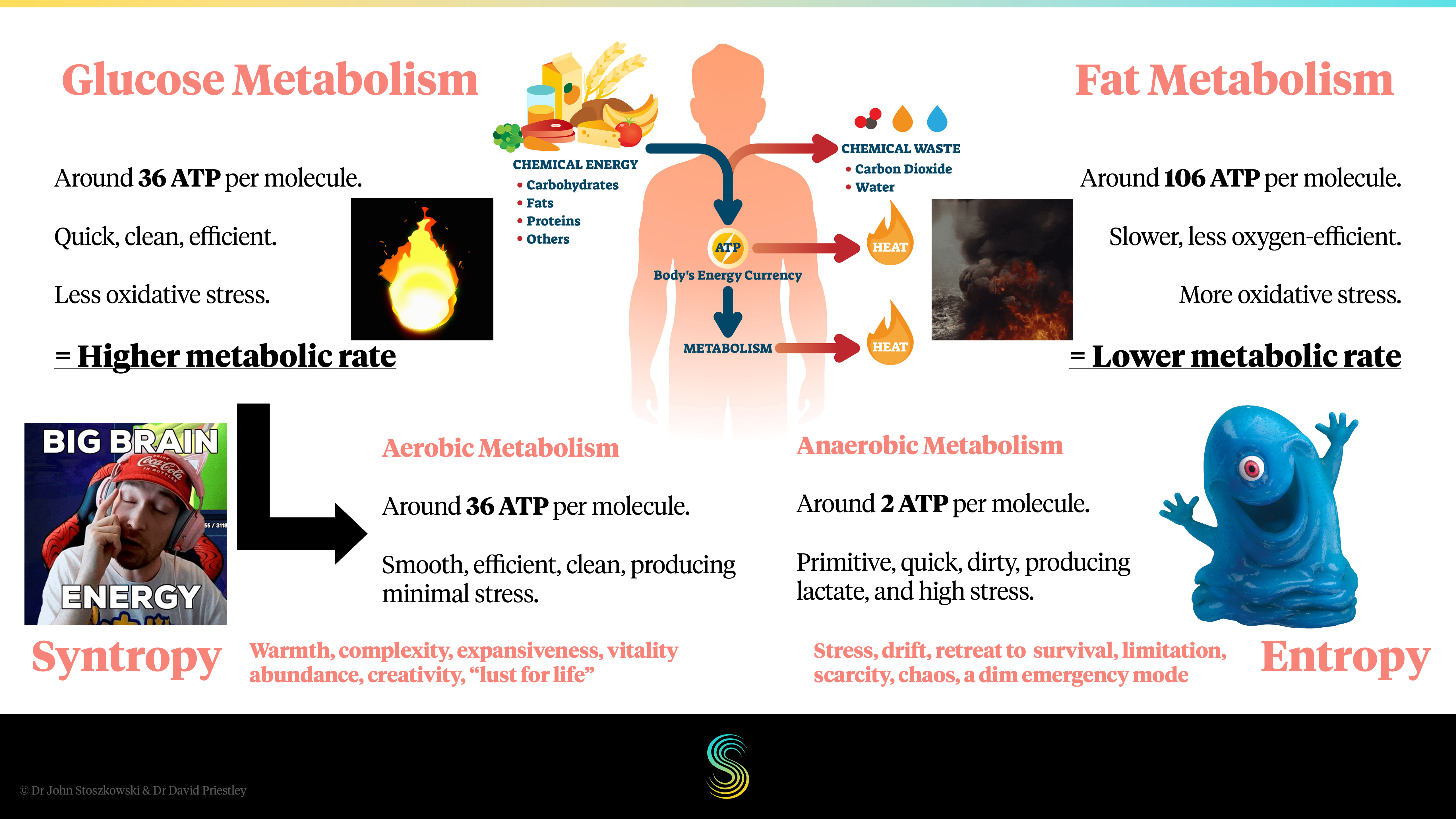
As we age, or are worn down by chronic stress, inflammation, hypothyroidism, and the consumption of polyunsaturated fats (PUFAs) that disrupt oxidative metabolism, our metabolic rate falls.14 We shift from efficient, CO2-producing respiration toward inefficient lactic-acid-producing glycolysis. Our energy reserves dwindle, and our biological structure loses its dynamic coherence.
The brain, starved of efficient energy, can no longer afford to “render” the world in high-definition. It lowers its “frame rate” to survive. The objective world, still ticking by at the same pace, now feels like it’s rushing past.
Syntropy and the “Progressive Freezing” of Age
Mainstream physics explains aging through the Second Law of Thermodynamics (Entropy). We’re told that life is a temporary, uphill struggle against an inevitable, universal tendency toward disorder and “heat death.” Aging, in this view, is the final victory of entropy, a chaotic breakdown of the system.
This view is profoundly pessimistic and, according to the bioenergetic model, incorrect. Life is not an anti-entropic fluke.15 Life literally is the expression of Syntropy—an inherent, active, and creative force in the universe that drives energy to build order, complexity, and coherence. As Albert Szent-Györgyi said, “Putting things together in a meaningful way ... is one of the basic features of nature.”
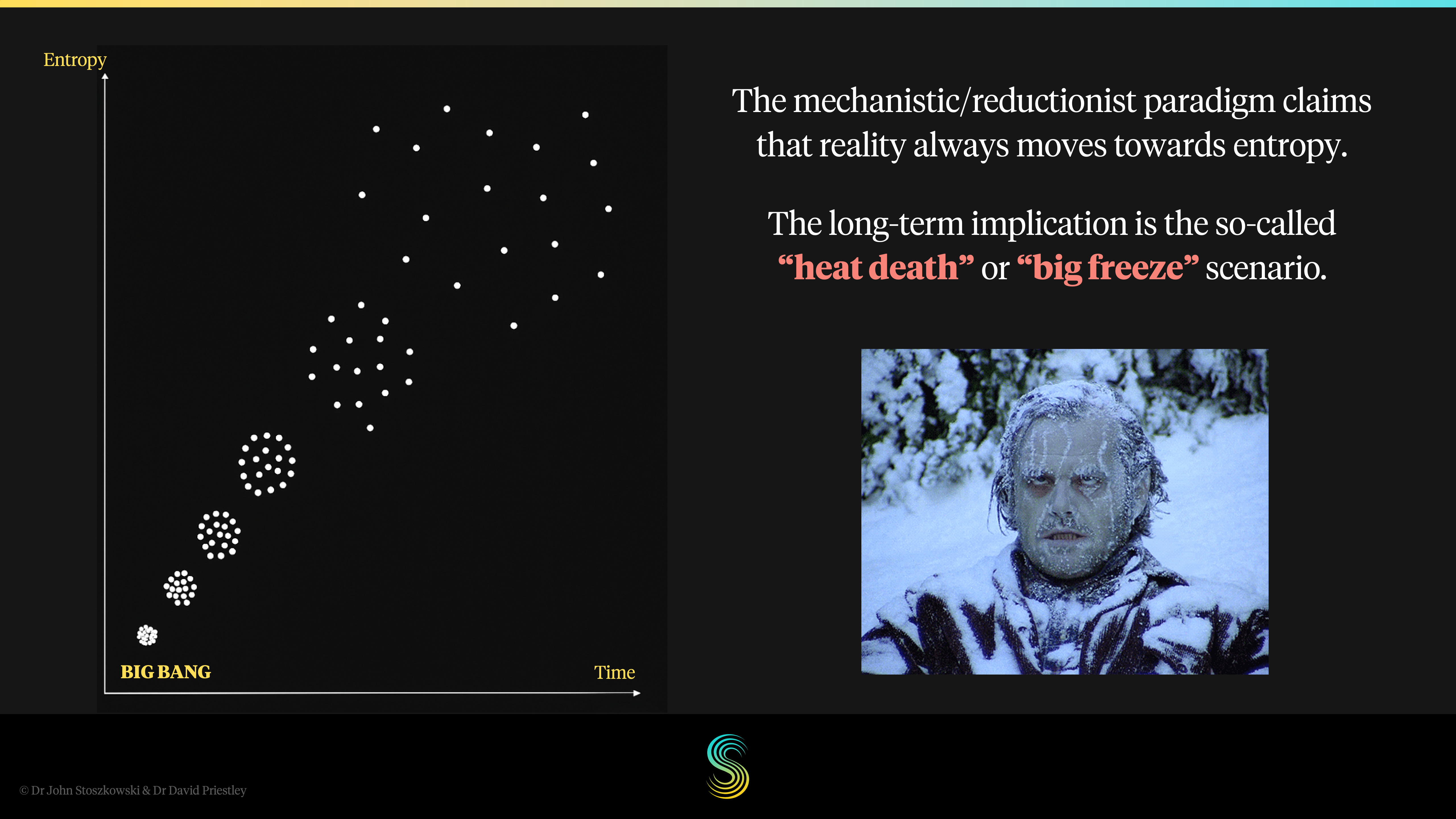
Drawing on the work of Russian biophysicist Alexander Zotin, who measured metabolic rates in aging tissues, Peat challenges this view: aging is not simply an increase in entropy or chaotic disorder. Instead, aging is characterised by a decrease in entropy, akin to a kind of progressive crystallisation or “freezing.” As metabolism slows, flexibility and dynamism are lost, and our biological structures harden into a simpler, low-energy order. We don’t merely fall into chaos; rather, we lose creative flux and become rigid and static, much like liquid water becoming ice.
However, localised spikes of entropy—bursts of degenerative chaos and disorder—do occur within the aging process, often triggered by inflammation, estrogen excess, or iron overload.16 These appear as secondary effects or points of failure within this broader trend toward rigidity.
High-energy cells maintain a gel-like state through structured water, resisting this “freezing.”17 PUFAs destabilise cell membranes and promote rigidity, while saturated fats and sugars help maintain fluidity.18 Progesterone supports this syntropic coherence by raising temperature and opposing inflammation, whereas estrogen fosters entropic breakdown and lowers the brain’s temperature regulator.19
This “freezing” is the material cause of our accelerated time perception. As our internal, dynamic, syntropic processes slow to a crawl, the energetic, flowing world outside seems to fly by at an impossible speed. It’s as if we’re stuck in quicksand while everyone else struts around effortlessly.
Time as Active, Physical Energy
If metabolism “interacts” with time, what is this “time” we’re interacting with? The Newtonian view of time as a passive, empty “container” that events “happen in” is insufficient. The Einsteinian view of time as relative and inseparable from space and matter (process over static essence) is closer.20
But a more radical, and far more fruitful, line of inquiry was pursued by physicists who were, as Peat noted, isolated from the “establishment” for their rejection of randomness and their desire for a knowable, lawful, material reality.
Nikolai Kozyrev, a Soviet astrophysicist, proposed one of the most comprehensive theories. He viewed time not as a passive dimension, but as a dynamic, physical energy with its own density, direction (“arrow”), and ability to interact with matter.21 For Kozyrev, time itself was a source of “neg-entropy” (or syntropy) that fuelled the stars and drove the processes of life.
He believed this “arrow of time” was physically linked to the asymmetry we see in living systems (e.g., the leftward placement of the heart and the spiral structures in shells and DNA).2223 Life, by being metabolically active and structurally asymmetric, was able to tap into or “consume” this flow of time-energy. Kozyrev’s controversial experiments with rotating gyroscopes and torsion balances were attempts to measure the physical effects of this “time-energy density.”
It gets a bit woo here, but building on these ideas, Kozyrev speculated that manipulating the density of time could open the door to phenomena like telepathy, remote viewing, or even time travel.24 Inspired by his theories, researchers developed “Kozyrev mirrors,” spiral or concave reflective structures designed to focus or amplify time-related energies.25 While Kozyrev himself didn’t directly build or use these devices, many anecdotal reports and experiments describe altered time perception and enhanced extrasensory experiences inside these mirrors.26 Though his theories remain outside mainstream physics, they fit Peat’s view that metabolism and asymmetry enable life to interact with time’s energy.27
So if time is a flowing energy, what medium does it flow through? This is where the work of Horace Dudley and David Bohm can contribute.28 29They revived the concept of an “ether,” not as a 19th-century “luminiferous” jelly, but as a “sub-quantic medium” or “neutrino sea”—a vast, unmeasurable energy that supports all of reality.30 This “implicate order,” as Bohm called it, is not empty space but a seething, energetic field from which all matter and structure “unfold.” Note that Bohm’s framework is more holistic and quantum-oriented than a classical ether.31
This “neutrino sea” provides the material basis for Kozyrev’s theory. It’s the medium through which the energy of time flows.32
The Metabolic Antenna and the Coherence of Structure
Pulling these threads together provides us with a hypothetical framework:
There is a physical, energetic, and directional “flow of time” (Kozyrev) transmitted through a subtle, universal medium (Dudley/Bohm).
This flow is syntropic, building order and fuelling life.
Living organisms build and maintain complex, asymmetric structures through metabolism.
These energised, coherent biological structures—our brain and body—act as “antennas” or “resonators.”
Our ability to perceive time, and the richness of that perception, is determined by the quality of this “antenna.”
J.L. Anderson (who suggested that structured materials could alter radioactive decay rates)33 and Rupert Sheldrake (whose “morphic resonance” posits that patterns persist via a shared field) support the importance of structure.34 It isn’t just inert “stuff.” A highly-structured, high-energy brain (i.e., high metabolism) can resonate more deeply and coherently with the temporal field. It “catches” more of time’s flow.
Efficient respiration, producing CO2, maintains cellular asymmetry, potentially enhancing this resonance. Red and near-infrared light therapy energises mitochondria, improving metabolic function and possibly influencing perceptual depth through increased ATP and membrane potentials. Experiments show light’s effects on glucose metabolism and decay rates, grounding this idea.35
This explains the experience of “calm alertness” and the “zone:” metabolic coherence is allowing the brain to resonate with the temporal field so profoundly that it gains access to more information and “frames” of reality. Time literally slows down for it.
Conversely, the “progressive freezing” of aging and metabolic decline dampens this resonance. Our antenna “de-tunes.” We lose our connection to the deep, syntropic flow of time. Our consciousness, now sustained by a “thinner” stream of this energy, experiences a reality that is flat, routine, and rapid.

Rescuing Time Through the Bioenergetic Imperative
When people say time speeds up as they age, they may be describing more than an inevitable psychological feature of aging. It could be the lived effect of underlying metabolic slowdown, a kind of “biological freezing” that uncouples us from the energetic flow of reality.
This is a grim diagnosis, but the good news is it isn’t fate. It also contains a radical and hopeful prognosis. Unlike the fatalism of genetic determinism or the nihilism of pure randomness, a material, bioenergetic model restores agency.36 If the problem is metabolic, the solution is metabolic.
While we can’t stop time, we can change our relationship to it by “un-freezing” our biology and re-tuning our antenna. By restoring energy flow we can recover depth and spaciousness in experience. The practical steps aren’t exotic:
Fuel Well: Eat enough sugar, protein, and saturated fats to maintain warmth and steady energy. Avoid the metabolic poisons that “freeze” us like PUFAs, excessive stress hormones, and inflammation. Practices like a daily carrot salad can help detoxify PUFAs and estrogens.
Keep Energy Flowing: Support the thyroid and mitochondrial respiration, which are the engines of metabolism. Low-dose aspirin may help by uncoupling inefficient metabolism.37
Shape the Environment: Embrace the environmental signals that promote and reinforce coherence like red/infrared light, sufficient CO2, and the avoidance of chronic stress.
Experiment: Track pulse and temperature as metabolic proxies alongside subjective time perception. Improvement often correlates: the warmer and more energetic you feel, the slower time will pass.
Health, in this sense, isn’t just about living longer but about maintaining the metabolic vitality that supports a rich, clear, and spacious experience of reality. When energy flows efficiently, our perception of time remains balanced and stable, and we can recreate a childlike summer. To live well, therefore, means staying metabolically awake, keeping our inner clock bright enough to meet each passing second in high definition.
You can listen to Ray Peat discussing some of these ideas on episode 19 of the Generative Energy Stream, here:
Yes, time speeds up as we get older — it’s called “the proportional theory” (Aleteia article)
How The Psychology of Time is Warped by Media and Novelty (Article by Matt Johnson)
Aspects of Wholeness (Article by Ray Peat)
Peat critiques reductionist science and argues that living systems are best understood as dynamic, integrated wholes rather than as collections of isolated parts. Drawing on examples from physiology, psychology, and physics, he emphasises the importance of energy flow, coherence, and adaptability in maintaining health and consciousness. Peat also discusses how social and environmental factors influence biological wholeness, advocating for a holistic, open-system approach to science and well-being.
Gerber et al. (2010). The relationship between shift work, perceived stress, sleep and health in Swiss police officers, Journal of Criminal Justice, 38(6), 1167-1175. https://doi.org/10.1016/j.jcrimjus.2010.09.005
“Internal time” refers to the brain’s ability to integrate processes operating across multiple temporal scales, from milliseconds to days, into a unified conscious experience. This framework challenges the classical “internal clock” model, which posited a single neural pacemaker tracking time. Instead, modern neuroscience’s theories emphasise distributed networks and dynamic synchronisation mechanisms.
Hummingbirds have an extremely rapid metabolism—up to 77 times faster than humans—and can process energy at rates far exceeding those of even elite human athletes. Their fast metabolism supports their high-energy activities, such as rapid wingbeats and agile flight, and is matched by equally fast physiological processes, including high heart and breathing rates. This high metabolic rate also means that hummingbirds process sensory information and react quickly to their environment, allowing them to perceive and respond to changes much faster than larger animals like humans. While we can’t directly measure a hummingbird’s subjective experience of time, research supports the idea that animals with faster metabolisms and neural processing rates can perceive more events per second, making their experience of time seem more “stretched out” or vivid compared to slower animals.
Hummingbirds in the Real World: evolution, physiology and relationship (Blog Post).
Healy et al. (2013). Metabolic rate and body size are linked with perception of temporal information. Animal Behaviour, 86(4), 685–696. DOI: 10.1016/j.anbehav.2013.06.018
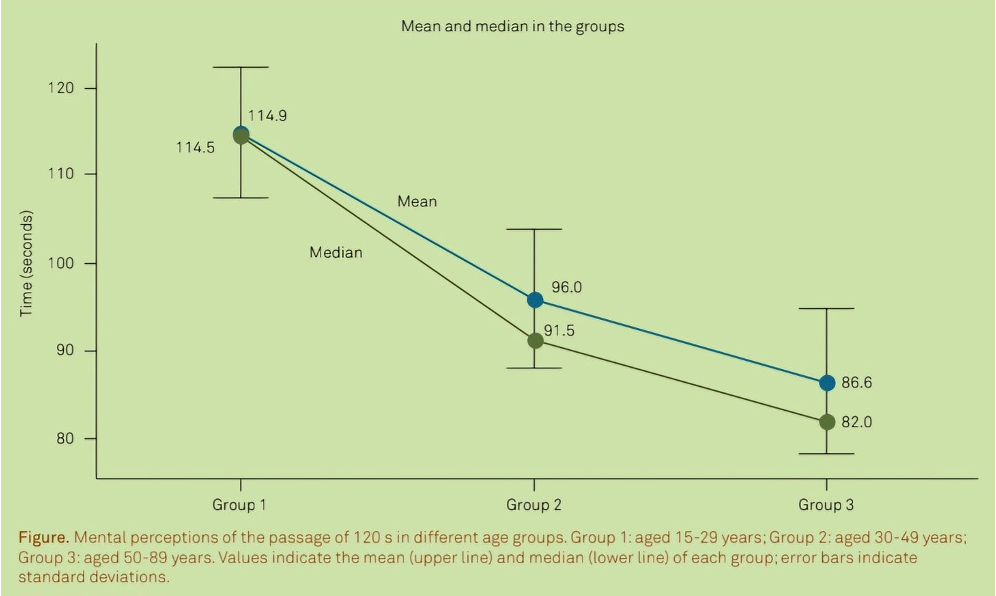
Metabolism generally declines with age. 233 subjects were asked to close their eyes and mentally count the passing of 120 seconds. Mental calculations of 120s were shortened by an average of 24.6% (28.3 s) in individuals over age 50 years compared to individuals under age 30 years.
Ferreira, V. F., Paiva, G. P., Prando, N., Graça, C. R., & Kouyoumdjian, J. A. (2016). Time perception and age. Arquivos de neuro-psiquiatria, 74(4), 299–302. https://pubmed.ncbi.nlm.nih.gov/27097002/
When asked to estimate duration of time elapsed, studies show that in almost all cases, rate of subjective time increased when body temperature increased above normal (a sign of higher energy metabolism), and decreased when body temperature was lowered below normal.
Wearden, J. H., & Penton-Voak, I. S. (1995). Feeling the heat: body temperature and the rate of subjective time, revisited. The Quarterly journal of experimental psychology. B, Comparative and physiological psychology, 48(2), 129–141. https://pubmed.ncbi.nlm.nih.gov/7597195/
Alkhatib, D., Shi, Z., & Ganji, V. (2024). Dietary Patterns and Hypothyroidism in U.S. Adult Population. Nutrients, 16(3), 382. https://doi.org/10.3390/nu16030382
Mohanasundaram et al. (2012). Thyroid Hormone Effects on Sensory Perception, Mental Speed, Neuronal Excitability and Ion Channel Regulation. InTech. doi: 10.5772/48310
Dugbartey, A. T. (1998). Neurocognitive Aspects of Hypothyroidism, JAMA Internal Medicine, 158(13), 1413-1418. doi:10.1001/archinte.158.13.1413
Bellastella et al. (2021). Chronothyroidology: Chronobiological Aspects in Thyroid Function and Diseases. Life (Basel, Switzerland), 11(5), 426. https://doi.org/10.3390/life11050426
Hagura et al. (2012). Ready steady slow: Action preparation slows the subjective passage of time. Proceedings of the Royal Society B: Biological Sciences, 279(1746), 4399–4406. DOI: 10.1098/rspb.2012.1339
Battisti-Charbonney et al. (2011). The cerebrovascular response to carbon dioxide in humans. The Journal of physiology, 589(Pt 12), 3039–3048. https://doi.org/10.1113/jphysiol.2011.206052
Yoon, S., Zuccarello, M., & Rapoport, R. M. (2012). pCO(2) and pH regulation of cerebral blood flow. Frontiers in physiology, 3, 365. https://doi.org/10.3389/fphys.2012.00365
Think of stress as anything that raises energy demand beyond what the body can supply. When those demands aren’t met, the metabolic rate slows through effects on thyroid hormones.
Contrary to the classical view that entropy and irreversibility only lead to disorder, Ilya Prigogine showed that when a system is pushed far from equilibrium, such as in certain chemical reactions or living systems, new, highly organised structures and patterns can arise. These “dissipative structures” (like convection cells, chemical oscillations, or biological order) maintain themselves by exporting entropy to their environment, thus remaining stable only as long as energy flows through them. Prigogine’s work, for which he won the Nobel Prize in Chemistry in 1977, fundamentally changed the understanding of thermodynamics by demonstrating that irreversibility and dissipation can play a constructive role in the formation of order and complexity, especially in living systems and other open systems far from equilibrium. His ideas have influenced fields ranging from chemistry and physics to biology, ecology, and the study of self-organising systems.
Fatigue, aging, and recuperation (Article by Ray Peat)
Gilbert Ling: Structure and Function (Substack Post) by Just Another Peater
Fats, functions & malfunctions (Article by Ray Peat)
Unsaturated fatty acids: Nutritionally essential, or toxic? (Article by Ray Peat)
Aging, estrogen, and progesterone (Article by Ray Peat)
Einstein’s theory of relativity unifies space and time into a single continuum (spacetime), showing that both are relative—shaped by motion, mass, and energy. It redefines gravity as the curvature of spacetime, not a force, and reveals that time can pass at different rates depending on speed and gravitational field strength.
Time irreversibility refers to the principle that certain physical processes, particularly those involving entropy and the second law of thermodynamics, proceed in one direction only, from past to future, and cannot be exactly reversed. This gives rise to the “arrow of time,” distinguishing the irreversible flow of events and the unidirectional progression of phenomena such as aging, decay, and the spreading of heat, despite the underlying time-symmetry of most fundamental physical laws.
Maccini, A. (2022). On the Nature of Time and Energy, International Journal of Scientific Advances, 3(4), Jul - Aug 2022, DOI: 10.51542/ijscia.v3i4.5
Nikolai Kozyrev and the Subtle Energetic Science of Time (Web page and video)
Revisiting Psychokinesis: Time, Ether, and Kozyrev (The Fountain Magazine article)
Kozyrev’s Mirror: reflections on ‘Cosmic Consciousness’ (Medium article)
Kozyrev’s Mirror: reflections on ‘Cosmic Consciousness’ (Medium article)
Peat drew on Kozyrev’s discoveries to illute the idea that time’s flow is not fixed, but can be influenced by energetic events. Reflecting on planetary phenomena, he noted:
“When the Sun gives off a burst of energy, the earth’s rotation slows down. The rotation of the Sun’s inner core changes the speed of radioactive decay rates. These effects may be caused by a change in the flow of time. What if we used a spinning gyroscope to give us a much smaller model of the earth’s rotation in the laboratory? If we could change the flow of time in a small local area, wouldn’t the speed of the gyroscope also change in that same spot? This is exactly what Dr. Nikolai Kozyrev discovered in the 1950s.”
Dudley, H.C. (1972). Phenomenological causal model of nuclear decay, assuming interaction with neutrino sea. Lettere al Nuovo Cimento (1971-1985), 5, 231–232. https://doi.org/10.1007/BF02752615
A Revolution in Physics (Article by Ray Peat)
In the 19th century, physicists believed that light, as a wave, required a medium—called the luminiferous ether—to travel through space, much like sound waves need air. The ether was thought to fill all of space and be undetectable by ordinary means. However, the famous Michelson–Morley experiment of 1887 was designed to detect the Earth’s motion through this ether but found no such effect, delivering a “null result.” This outcome strongly suggested that the ether did not exist. Albert Einstein’s special theory of relativity (1905) subsequently explained that light does not need a medium to propagate and that its speed is constant for all observers, eliminating the need for the ether concept and fundamentally changing our understanding of space and time.
David Bohm’s “implicate order” is a theoretical framework proposing that the fundamental nature of reality is an interconnected, enfolded whole, where all parts contain information about the entire system. This deeper order underlies the manifest, “explicate” world of separate objects and events, with reality continuously unfolding and enfolding through a dynamic process called the “holomovement.” Bohm used this concept to explain quantum phenomena like nonlocality and to bridge mind and matter within a unified framework.
Neutrinos and Long-Range Interactions (Article by Ray Peat)
Radioactive Decay Rates May Change (Article by David Plaisted)
In standard nuclear physics, radioactive decay is understood to occur at fixed rates characterised by half-lives that are constant and independent of external conditions. This assumption forms a cornerstone of nuclear physics and radiometric dating techniques. The decay constant of a particular isotope is traditionally viewed as an intrinsic property that remains unchanged regardless of temperature, pressure, chemical environment, or other external factors.
Rupert Sheldrake’s controversial theory of morphic resonance proposes that organisms inherit a collective memory from previous members of their species through non-physical “morphic fields.” According to this idea, the more often a particular form, behavior, or pattern occurs, the easier it becomes for similar patterns to emerge in the future, as if nature develops habits over time. Sheldrake suggests this process underlies phenomena such as instinct, learning, and even the development of biological forms, and posits that memory is inherent in nature rather than stored solely in brains.
Waisberg et al. (2024) Near infrared/red light therapy a potential countermeasure for mitochondrial dysfunction in spaceflight associated neuro-ocular syndrome (SANS). Eye 38, 2499–2501. https://doi.org/10.1038/s41433-024-03091-4
Tafur, J., & Mills, P. J. (2008). Low-intensity light therapy: exploring the role of redox mechanisms. Photomedicine and laser surgery, 26(4), 323–328. https://doi.org/10.1089/pho.2007.2184
The Neo-Darwinian assumption is that genetic mutations occur randomly without direction, serving as the primary driver of evolutionary change. This framework treats biological complexity as arising from chance variations filtered by natural selection, disregarding intrinsic pattern-forming processes. Critics like Ray Peat argue that such reductionist models prioritise statistical randomness over observable self-organising tendencies in nature, which suggest that order emerges through energetic and contextual interactions rather than mere chance.
Aspirin, brain, and cancer (Article by Ray Peat)