


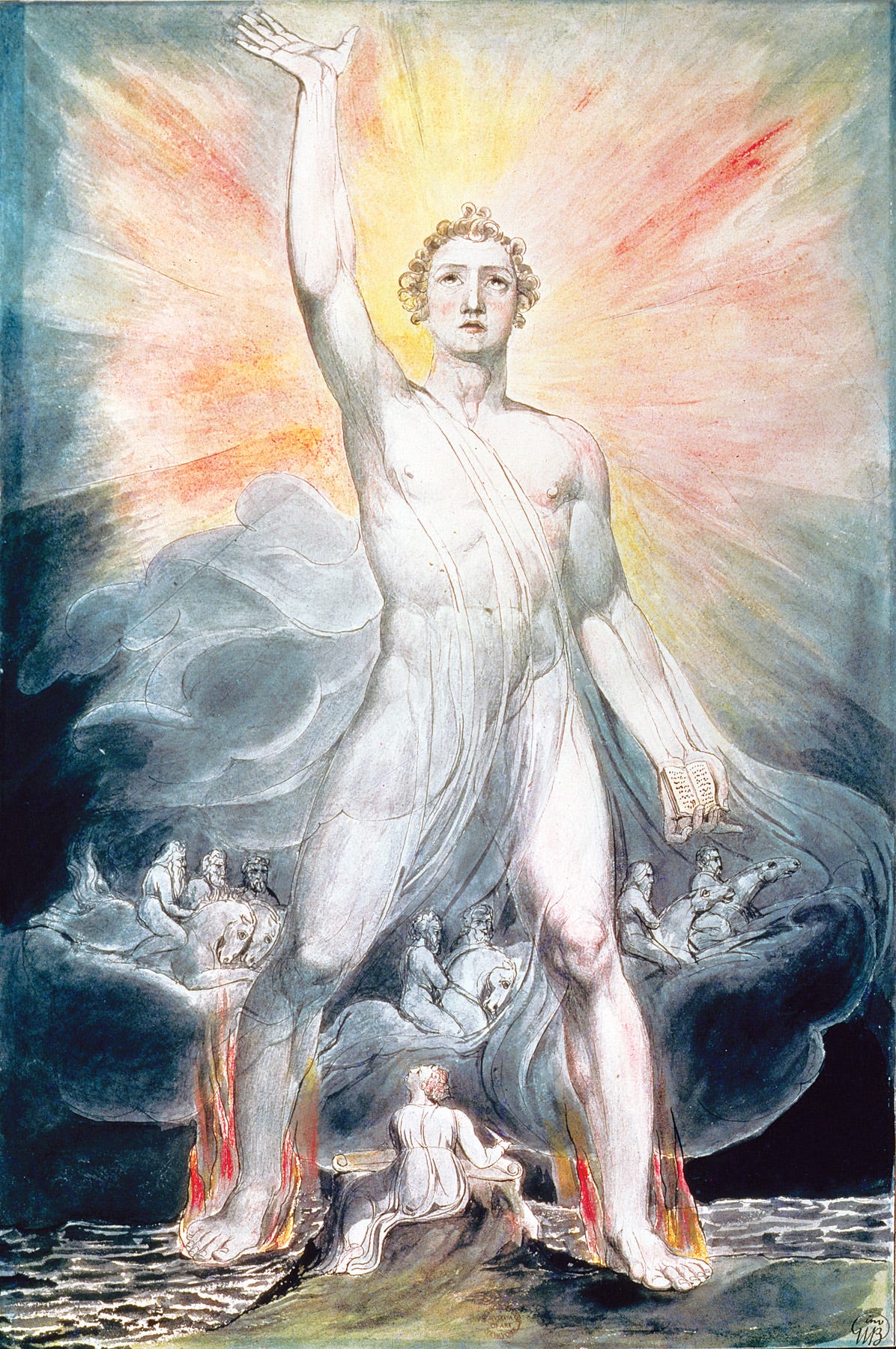
William Blake (1757–1827) was an English poet, painter, and printmaker, who broke with the conventions of his time to pursue a radical vision of human potential. Living through the upheavals of the Industrial Revolution and the American and French revolutions, Blake was acutely attuned to the “dark Satanic mills” of disumanising society. He openly rejected rigid institutional authority, the cold rationalism of Enlightenment thought, and a church he believed no longer embodied Christ’s spirit of liberation. Instead, Blake elevated imagination to a divine force, embracing mysticism, reimagining Christianity, and insisting that true freedom is inward and spiritual. His poetry and imagery crackle with contradiction, rebellion, and ambiguity, inviting us to a richer, riskier, and ultimately more alive encounter with the world.
Imagination as the Divine Within
Blake’s training as an engraver, illustrating books and reproductions of gothic church art around London, set the stage for his illuminated books, created alongside his wife, Catherine.1 He melded poetry, painting, and print, dissolving the conventional boundaries between disciplines. This creative unity reflected his conviction that mind and body, thought and feeling, are indivisible. Inspiration, for Blake, found its fullest expression through the act of making: imagination brought vividly into physical form.
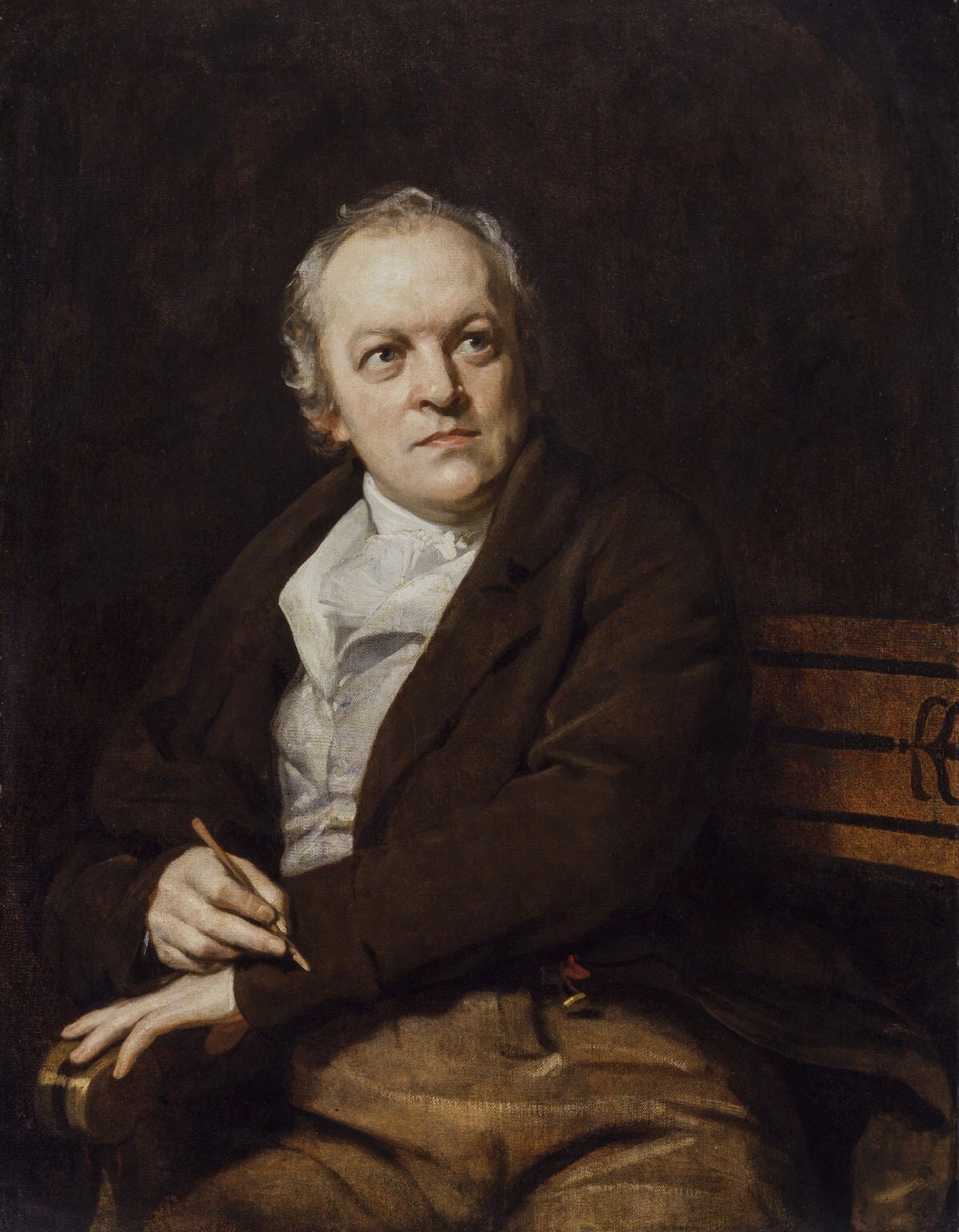
For Blake, imagination was not idle fantasy, but the essence of being, the faculty by which we apprehend and co-create reality. “The Imagination is not a State: it is the Human Existence itself,” he declared. Knowledge, to Blake, came from vivid, lived experience, not from abstract reasoning. As Ray Peat, who founded a liberal arts college in Mexico named after Blake, noted, Blake believed “the true method of knowledge is experiment.”2 Not only in the sense of scientific trial, but as lived, firsthand engagament through art, intuition, and inner vision. By resisting the deadening effects of convention and analytical logic, Blake anticipated modern critiques, like Iain McGilchrist’s warnings about the dominance of analytical, “left-hemisphere” thinking, and the growing recognition of creativity’s role in resilience and mental well-being.3
Blake saw the divine not in distant heavens but in humanity’s creative powers. As he wrote in The Marriage of Heaven and Hell (1790-1793) “All deities reside in the human breast.” This vision cuts against both Enlightenment skepticism and religious dogma. To Blake, angels, demons, and gods were symbols of inner spiritual energies rather than literal beings. Long before psychology began mapping the unconscious, Blake was exploring it through his art and poetry, foreshadowing thinkers like Sigmund Freud and Carl Jung. Jung saw “active imagination” as key for bridging the conscious and unconscious minds, yet Blake took the riskier stance of seeing imagination as fundamentally sacred and embattled at the heart of life.4 Contemporary art therapies build on this, using creative expression to help people process suffering and find strength.5
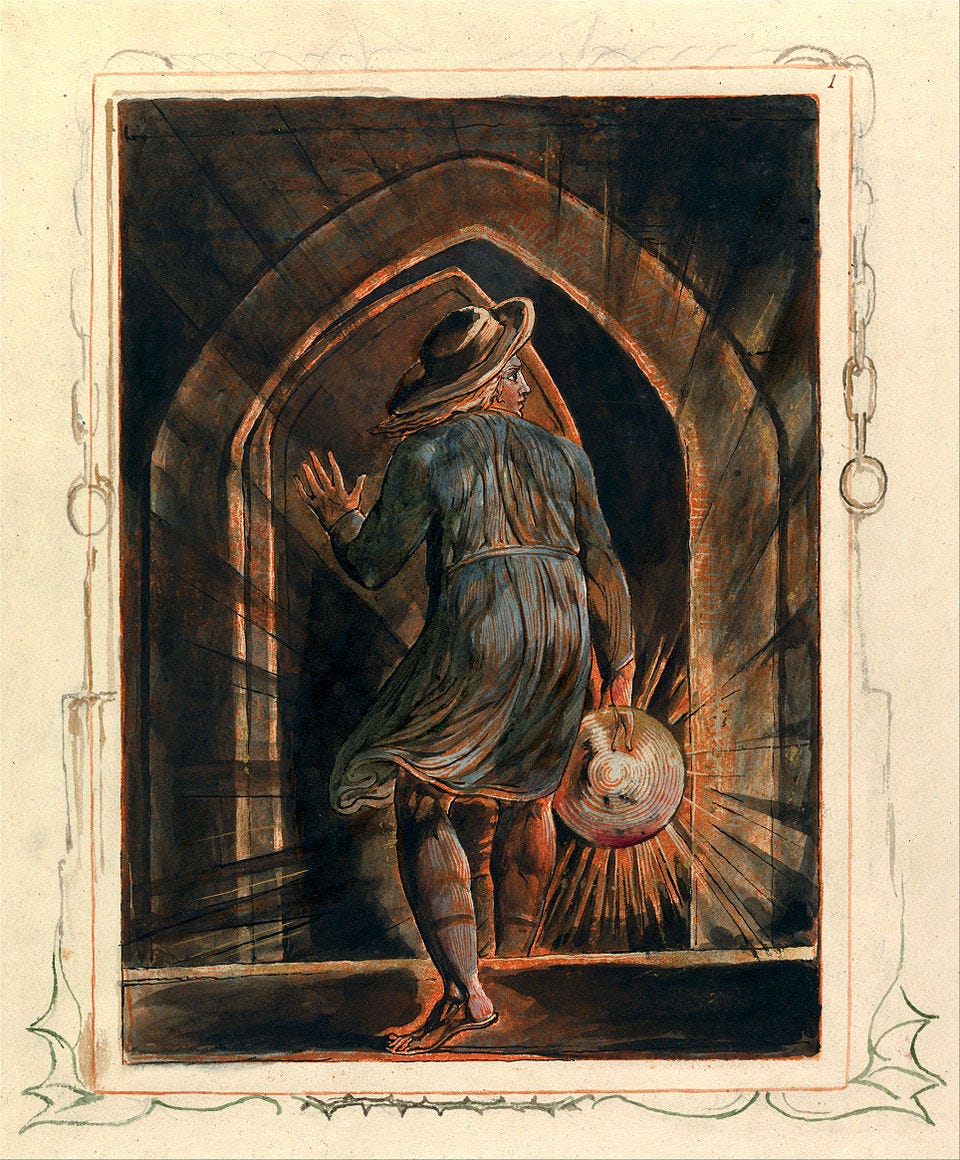
Modern research on hyperphantasia, a form of neurodiversity marked by the ability to generate vivid mental imagery in our “mind’s eye,” reminds us how rich and varied our inner lives can be.6 Blake’s own visionary experiences began in childhood. At around eight, he claimed to see “a tree filled with angels, bright angelic wings bespangling every bough like stars” over Peckham Rye and was surprised others couldn’t see what he did. For Blake, these weren’t fantasies but glimpses into a deeper layer of reality. Such early visions marked his belief in the soul’s participatory “ecology,” where anyone could access greater meaning. He described receiving guidance from Archangels in creating his major works. In Jerusalem (1804-1820), his longest and most mysterious book, he invites us:
“I give you the end of a golden string;
Only wind it into a ball,
It will lead you in at Heaven’s gate,
Built in Jerusalem’s wall.”
For Blake, imagination was the golden thread, guiding us toward meaning, hope, and spiritual purpose.
Against Plato and Locke
Blake’s understanding of imagination set him against some of history’s greatest thinkers. Plato, for example, famously cast poets out of his Republic, believing art to be a mere imitation of physical things, themselves already shadows of ideal forms. For Plato, artists distracted from truth.7 Blake turned this logic on its head. Art, he argued, is not a copy of a copy, but a generative act; “It is the poet who is the maker, the creator.” This marked a decisive shift, one that would seed future revolutions in artistic expression and philosophy of mind.
A central theme in Blake’s work is the unity of mind and body. While others split reason from emotion or soul from flesh, Blake insisted we are whole beings. Unlike Plato’s dualism, Blake was a radical monist. In The Marriage of Heaven and Hell, he wrote: “Man has no Body distinct from his Soul; for that called Body is a portion of Soul discerned by the five senses.” Our task, then, is to perceive the world as alive with spirit, genius, meaning, and myth, not merely as inert matter. For Blake, to perceive is to create.
He also challenged John Locke’s “tabula rasa” theory.8 Where Locke described the mind as a blank slate, passively receiving sensory data, Blake saw the mind as active, poetic, a fiery furnace of vision. He criticised Locke’s empiricism for “mocking Inspiration & Vision,” asserting that “Innate Ideas are in Every Man, Born with him; they are truly Himself.” To Blake, perception is generative and the world is participatory; everything that lives is holy, not for moral reasons, but because all life joins in creation. We are not passive observers that reflect reality, but god-makers, constantly shaping and sanctifying our world through symbols, stories, and vision.
A Revolutionary Christianity
Blake was born amidst the Enlightenment, an era that venerated reason, but he insisted that reason is a tool of imagination, not its master. His line, “What is now proved was once only imagin’d,” champions imagination as the foundation of all knowledge. In Jerusalem, he declared:
“…in your own Bosom you bear your Heaven
And Earth, & all you behold; tho’ it appears Without it is Within,
In your imagination, of which this World of Mortality is but a Shadow.”
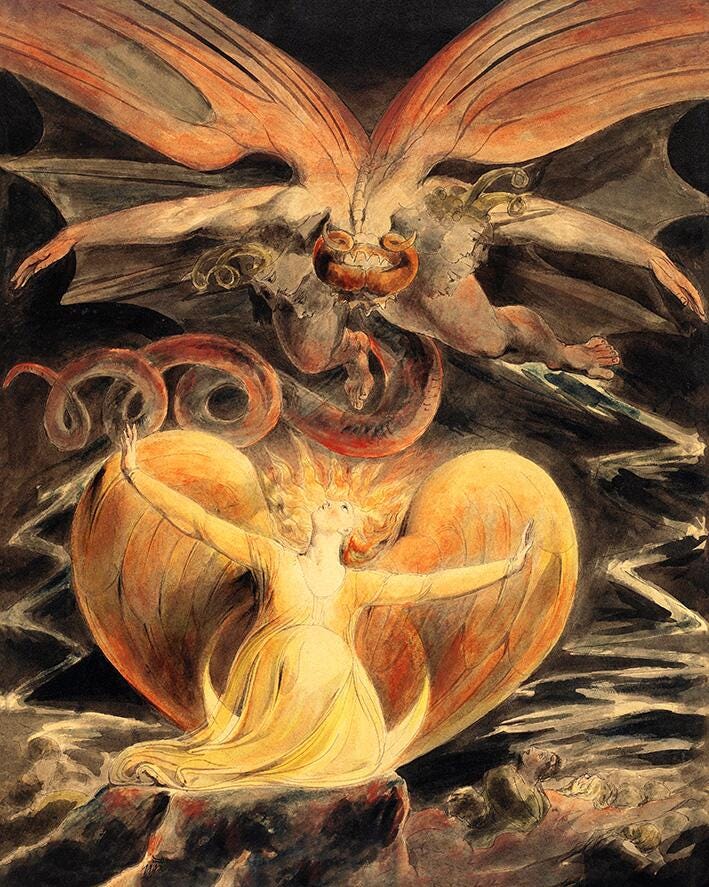
Blake’s Christianity was fiercely independent. He rejected the Church of England’s top-down authority, viewing Christ not as a remote king or distant ruler, but as a symbol of divine love and resistance to tyranny. For Blake, Christ embodied humanity’s potential for imagination. Art was prophetic, awakening people to their inner spiritual promise.
He also celebrated sexual energy as sacred, vibrant, and generative—a radical stance that prefigured later psychoanalytic and feminist ideas. In works like Visions of the Daughters of Albion (1793), he condemned sexual repression and affirmed desire as a vital, humanising force.9
Radical Psychology and Myth
Laura Quinny, in her book “William Blake on Self and Soul,” argues that Blake wasn’t only a political radical but a pioneering psychologist.10 Where Enlightenment thinkers replaced the soul with the self, and the self with the idea of a subject, Blake held fast to the soul as the living foundation of experience: inseperable from, and woven into, the world. Soul, for Blake, was participatory: a way of seeing and connecting, not an abstraction.
This inner landscape became the stage for his mythic dramas. In books such as The Book of Urizen (1794) and Milton (1804-1810), cosmic battles play out between inner and outer forces.
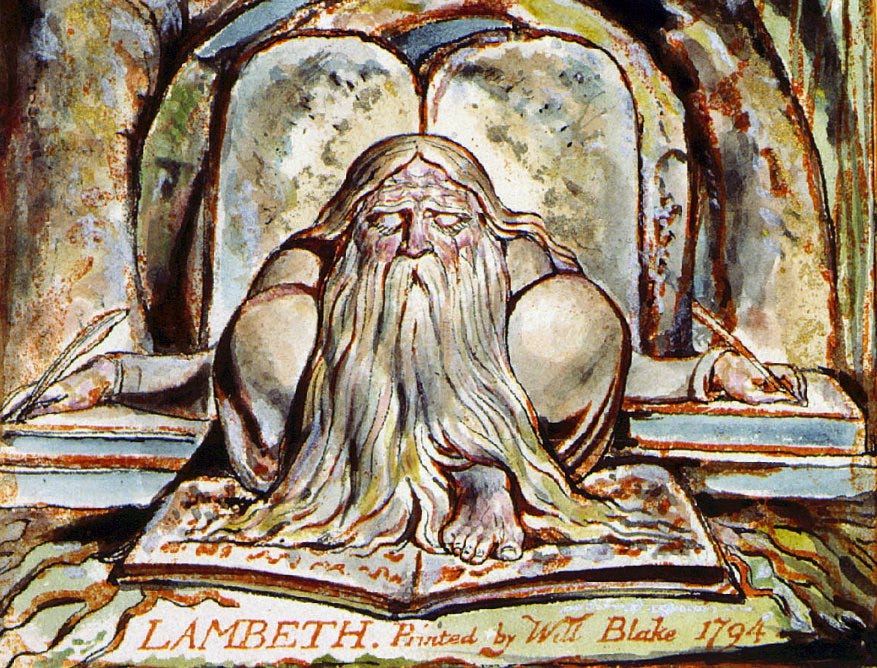
Urizen represents tradition, conventional reason, and law, not as pure rational clarity, but as repressive control. Always shown as a bearded old man, he forges “mind-forg’d manacles” that confine the soul.
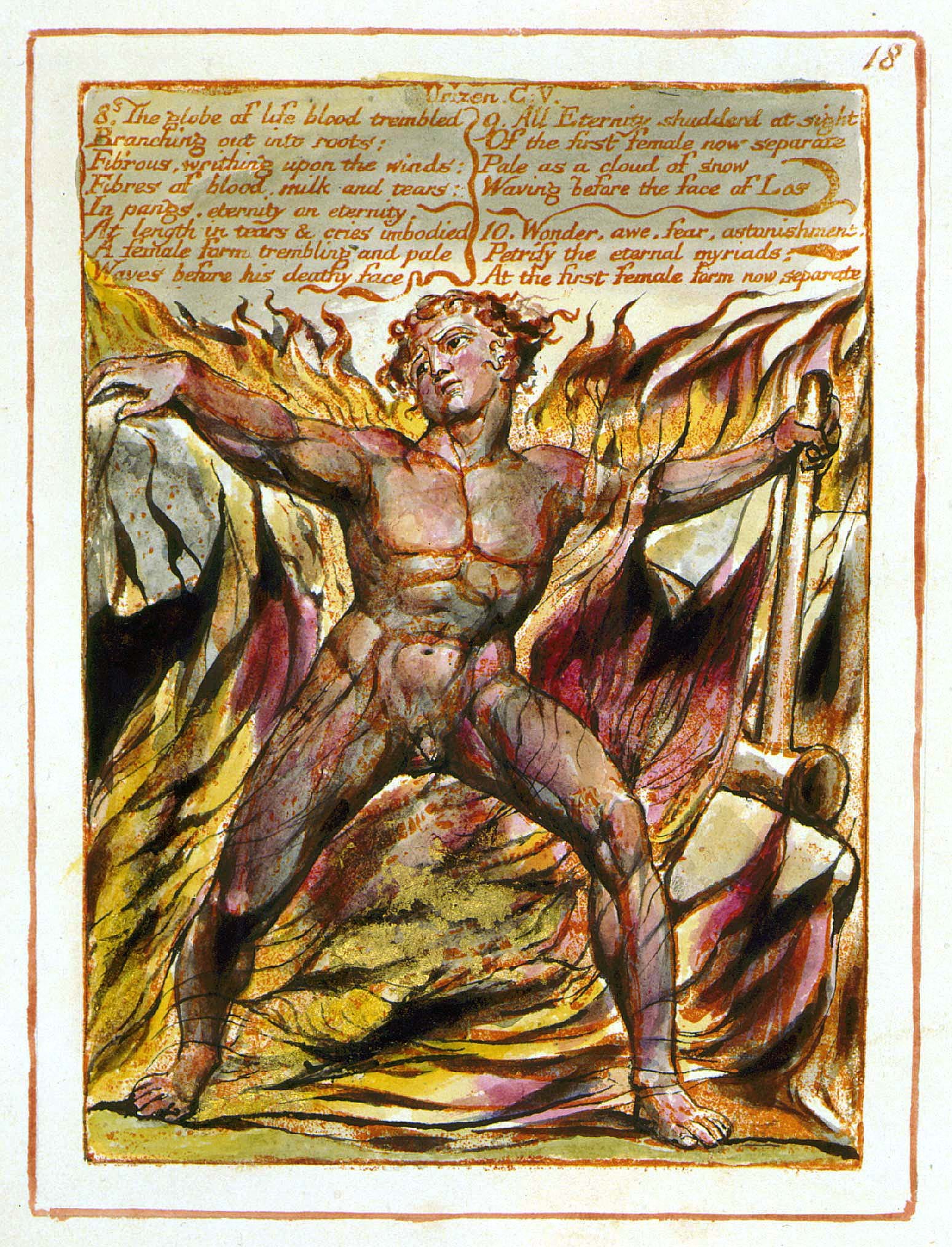
Los stands for creative imagination: the artist and prophet working to counter Urizen’s tyranny. Los is transformation itself, always making and re-making meaning through struggle. He’s often shown as a smith beating a forge with a hammer, a metaphor Blake likens to the beating of the human heart.
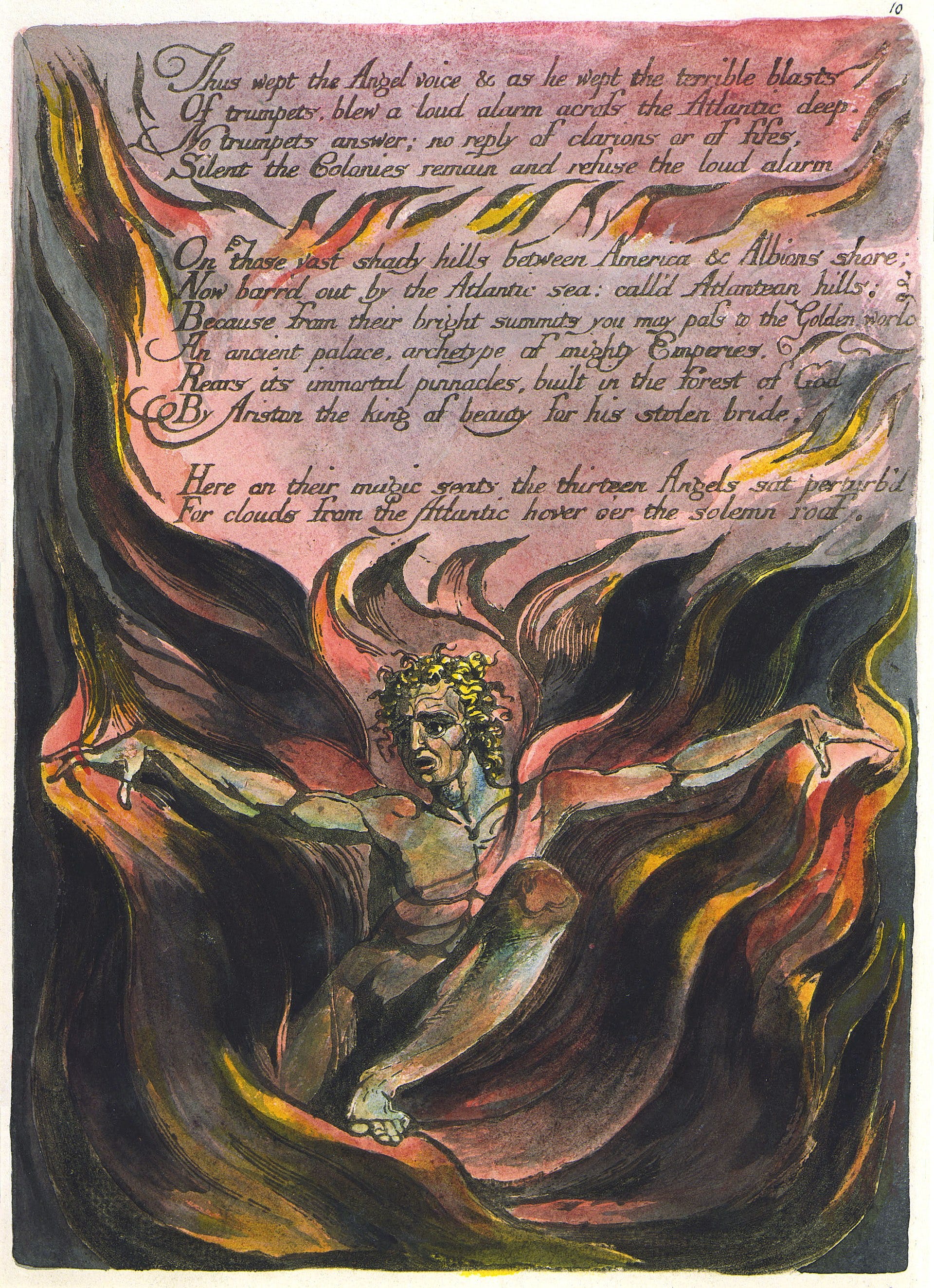
Orc, born from Los, embodies the spirit of freedom and revolution, Urizen’s polar opposite. He resists oppression but, without imagination and love, risks becoming destructive. Blake warned that revolt without vision risks becoming what it opposes.
These figures map psychological and spiritual dynamics. For Blake, engaging with them through imagination was a way to resolve inner tension and renew the self. Even his artistic technique of etching, which involves burning away what’s not needed with acid, became a metaphor for personal and artistic transformation.
Embracing Contraries
“Without contraries is no progression.” This maxim underlies all of Blake’s work. He believed wisdom comes not from erasing opposition but from living fully in its creative tension. Works like Songs of Innocence and of Experience (1794) are experiments with this idea, pairing poems that respond to and unsettle each other. Good and evil, joy and suffering, reason and energy, nurture and challenge: these were not problems to solve but energies that fuel growth.
Dynamic pairs like heaven and hell, lamb and tyger, angel and devil challenge readers to stay open-minded and curious.11 Blake’s art is at once playful and profound, resisting fixed meanings and easy conclusions. As he wrote, “The road of excess leads to the palace of wisdom.” It’s an argument for living and thinking spaciously, learning from the fullness of contrary experience.
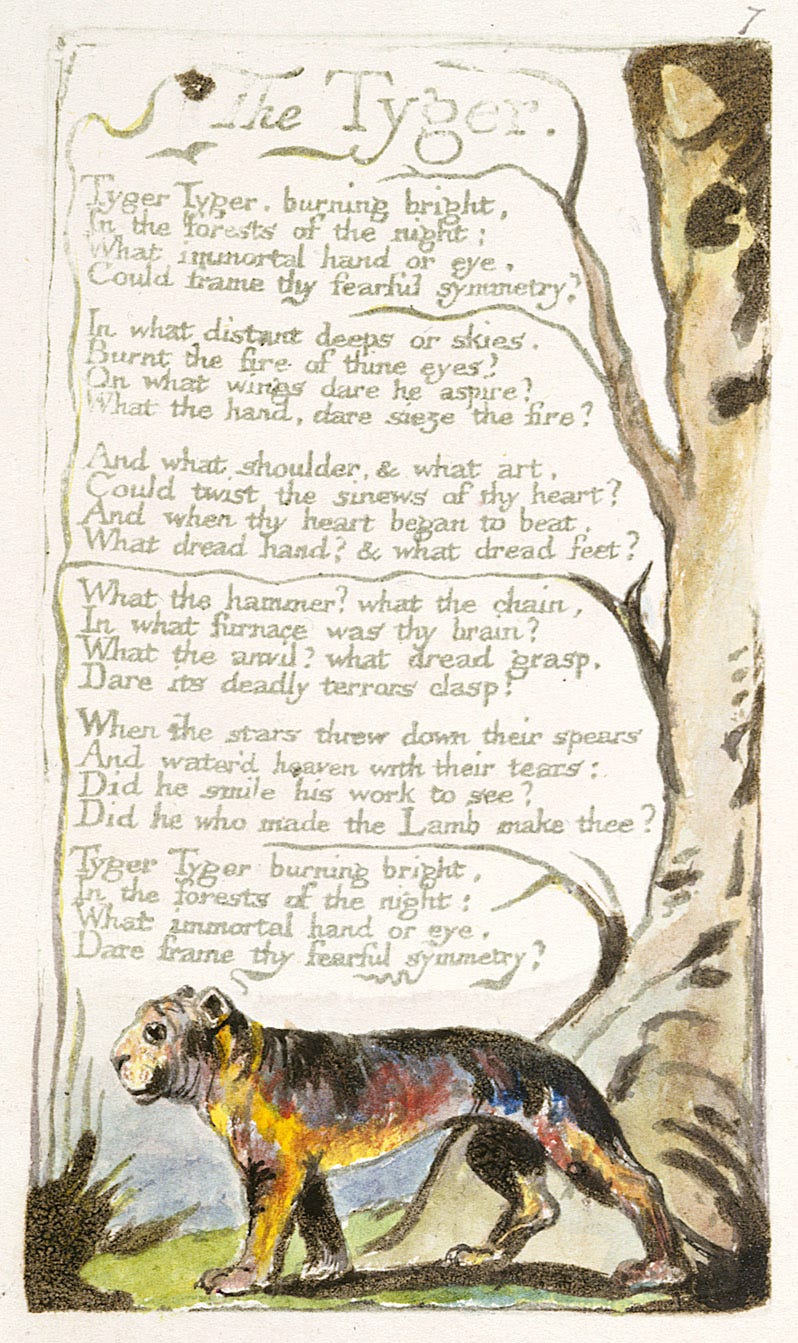
Blake extended this idea with another memorable line: “The tygers of wrath are wiser than the horses of instruction.” Here, he evokes the fierce, intuitive energy of wrath—not blind rage, but impassioned resistance to constraint—as a deeper form of wisdom than obedient, institutional instruction. The “tygers” stand for visionary passion, the boldness to challenge authority and complacency. In contrast, the “horses of instruction” trot along well-worn paths, disciplined but disengaged. For Blake, vital knowledge doesn’t come from passivity or parroted learning, but from the imaginative courage to disrupt and reimagine. His poetry urges us not just to understand contraries, but to feel the heat between them.
Politics and the Power of Fourfold Vision
Blake’s radical vision extended beyond religion and psychology. He was a fierce critic of monarchy, colonialism, slavery, senseless wars, and the rise of exploitative capitalism. He saw the modern city as a place that crushed the “divine spark” in each person. In his poem London, “mind-forg’d manacles” symbolise not just social but psychic imprisonment. Innocence is sold, voices are muted, and the spirit is “charter’d” by invisible systems of power.
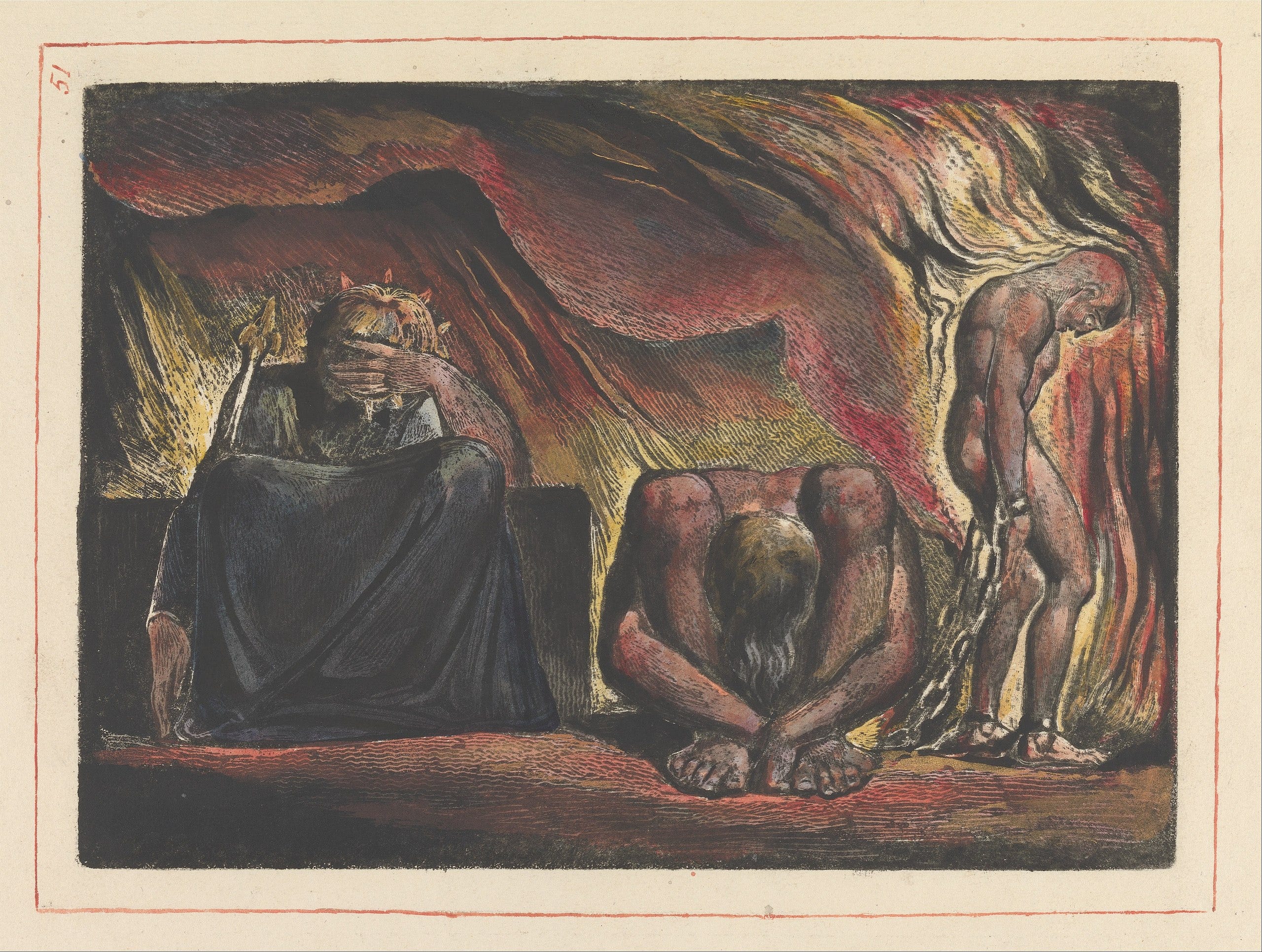
Ironically, Jerusalem is now pretty much a national anthem, performed at royal and state occasions, as well as sporting events and the Last Night of the Proms.12 But its original spirit was a sharp critique of establishment England; missing that radical edge means missing the point.
Blake’s “fourfold vision” describes escalating levels of perception, each offering a deeper, more expansive understanding of existence:
Single Vision is the lowest level, akin to a materialistic, rationalist view of the world. It’s the perception of those who see only the physical, surface reality: what Blake associated with the limited, mechanistic mindset of figures like Locke. Single vision is narrow, bound by sensory data and empirical reasoning, devoid of imagination or spiritual insight. It’s a “sleeping” state, where people miss the deeper truths of existence. Blake saw this as a kind of spiritual blindness, epitomised by his character Urizen.
Twofold Vision introduces imagination and empathy, allowing one to see beyond the merely physical. It’s the ability to perceive the world poetically or symbolically, recognising beauty, emotion, and interconnectedness. Twofold vision involves seeing through the material world to its inner life, like appreciating a flower not just as a botanical object but as a living symbol of joy or divinity. Blake linked this to artistic perception, where one begins to engage with the “divine spark” in creation. It’s a step toward awakening but still limited, as it toggles between physical and imaginative realms.
Threefold Vision deepens perception into a mystical, almost visionary state. Threefold vision involves a synthesis of reason, imagination, and spiritual intuition, where one sees the eternal in the temporal. It’s associated with Blake’s concept of “Beulah,” a dreamlike realm of love, inspiration, and harmony. This level allows one to perceive the world as infused with divine presence, where opposites (like male/female or human/divine) begin to reconcile. It’s a state of prophetic insight, though not yet fully transcendent, as it remains tied to earthly forms and dualities.
Fourfold Vision: The highest level is a state of complete spiritual awakening, where one perceives reality in its infinite, divine entirety. It’s the vision of “Jerusalem,” Blake’s symbol of the fully realised human and cosmic unity. Here, all contradictions are resolved all faculties—reason, imagination, emotion, and spirit—are integrated into a holistic perception of the eternal. It’s the state of the “Divine Imagination,” where one co-creates with God, seeing all things as interconnected and infinite. For Blake, this was the ultimate goal of human consciousness, a return to the divine state before the “fall” into material division.
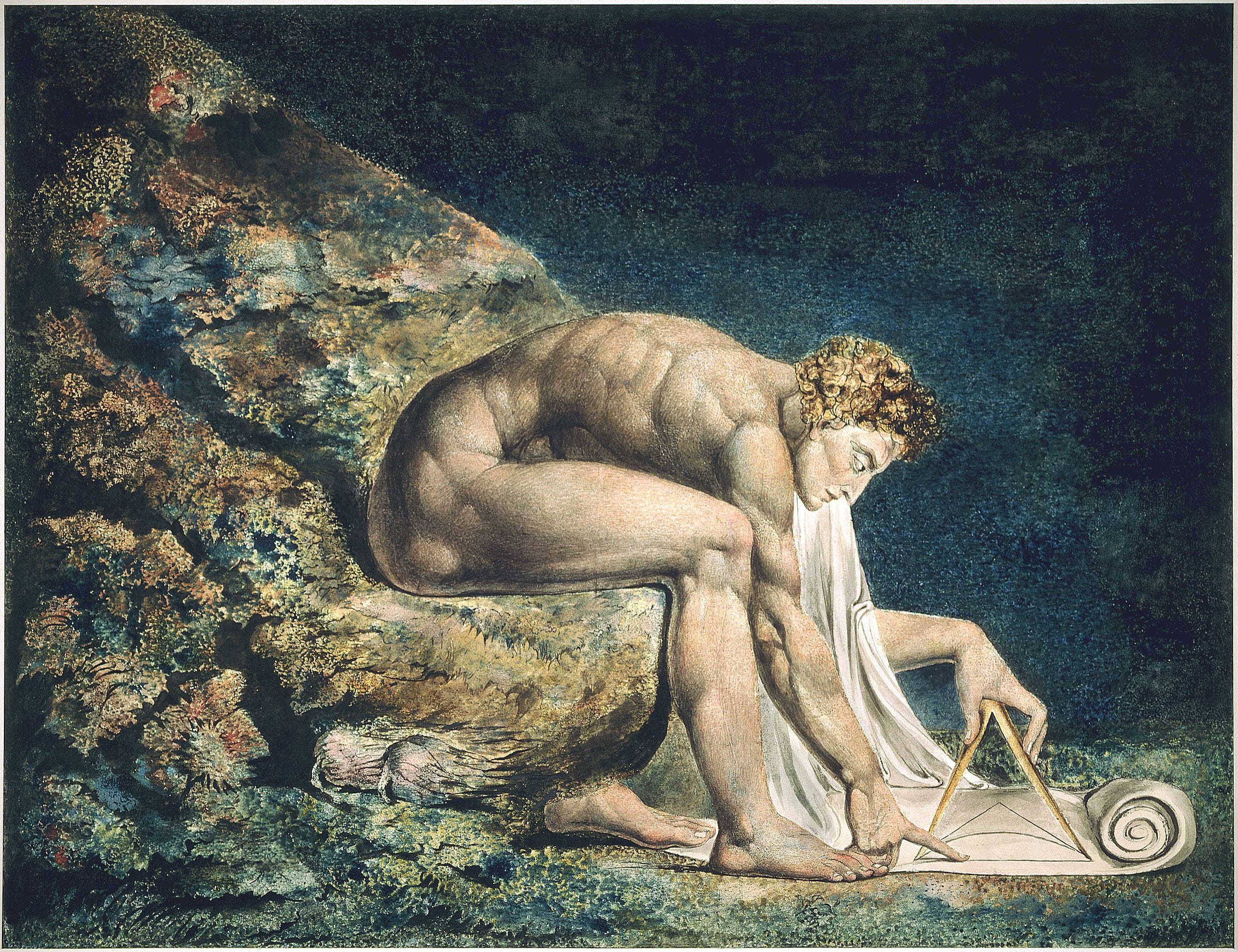
Blake believed most people were stuck in single vision, enslaved by materialism, and his art and poetry aimed to guide them toward higher levels of perception. His famous engraving of Isaac Newton, who he regarded with contempt, criticises the narrowing vision of scientific reductionism. The figure is shown naked and hunched over, absorbed in geometric measurement and abstraction, blind to the living world around him.13 For Blake, imagination was sacred perception: the key to seeing the world as interconnected and alive. Every grain of sand and every leaf was a universe in miniature. Blake’s worldview was holistic before the word existed; how we see the world shapes how we live in it.
A Vision Still Relevant
In his day, Blake was dismissed as mad and eccentric, his work considered obscure by a rational Britain that distrusted the visionary and favoured reason. He died poor, buried in an unmarked grave.
Yet his influence has only grown, shaping the Romantics, inspiring the Beat poets and 1960s counterculture, and urging new generations to unite creativity with social conscience. The Doors took their name from his line: “If the doors of perception were cleansed, everything would appear to man as it is, Infinite.”14 His call to “Rouze up, O Young Men of the New Age!” still rings out against conformity and apathy.
With renewed focus on creativity, neurodiversity, and the healing power of imagination, Blake’s work feels uncannily modern. Philosophers like Ernst Bloch, Gabriel Marcel, and Byung-Chul Han have all explored the ties between hope and imagination; Blake remains their poetic forerunner, understanding hope as lived vision, not passive longing.15
Blake’s Call to Imagination
For Blake, imagination was never escapist; it was the means to perceive, and shape, reality. He lived in tension between hardship and vision, teaching that renewal begins with perception. His poetry and art urge us rediscover our spiritual, imaginative selves and awaken to deeper truths. As he wrote in Auguries of Innocence (1803):
“To see a World in a Grain of Sand
And a Heaven in a Wild Flower
Hold Infinity in the palm of your hand
And Eternity in an hour.”
Blake’s work refuses simple answers. He challenges us to look deeper, question further, and reclaim wonder. In an anxious age of routine crisis and conformity, his provocation remains timely: break the chains of habit, renew our vision, and live more fully. The golden string Blake spoke of is still waiting to be picked up.
Some Blakean Tips:
Question the “mind-forg’d manacles”: Notice and challenge inherited beliefs, routines, and rigid systems. Ask: Who does this serve? Is there another way to see this?
Engage your senses and symbols: Use poetry, music, dreams, or drawing to explore your inner world and what resonates with your spirit.
Create something daily: Imagination thrives through practice. Make art, write, or reimagine your work and relationships.
Embrace contradiction: Growth emerges from tension. Hold paradox gently: be fierce and tender, sceptical and open, flawed and worthy.
See the world as alive: Whether you call it spirit, nature, or energy, try sensing your world as interconnected and sacred.
Act from vision: Don’t wait for permission. Let imagination drive change, in habits, thinking, and politics. Renewal starts in perception, but must live in action.
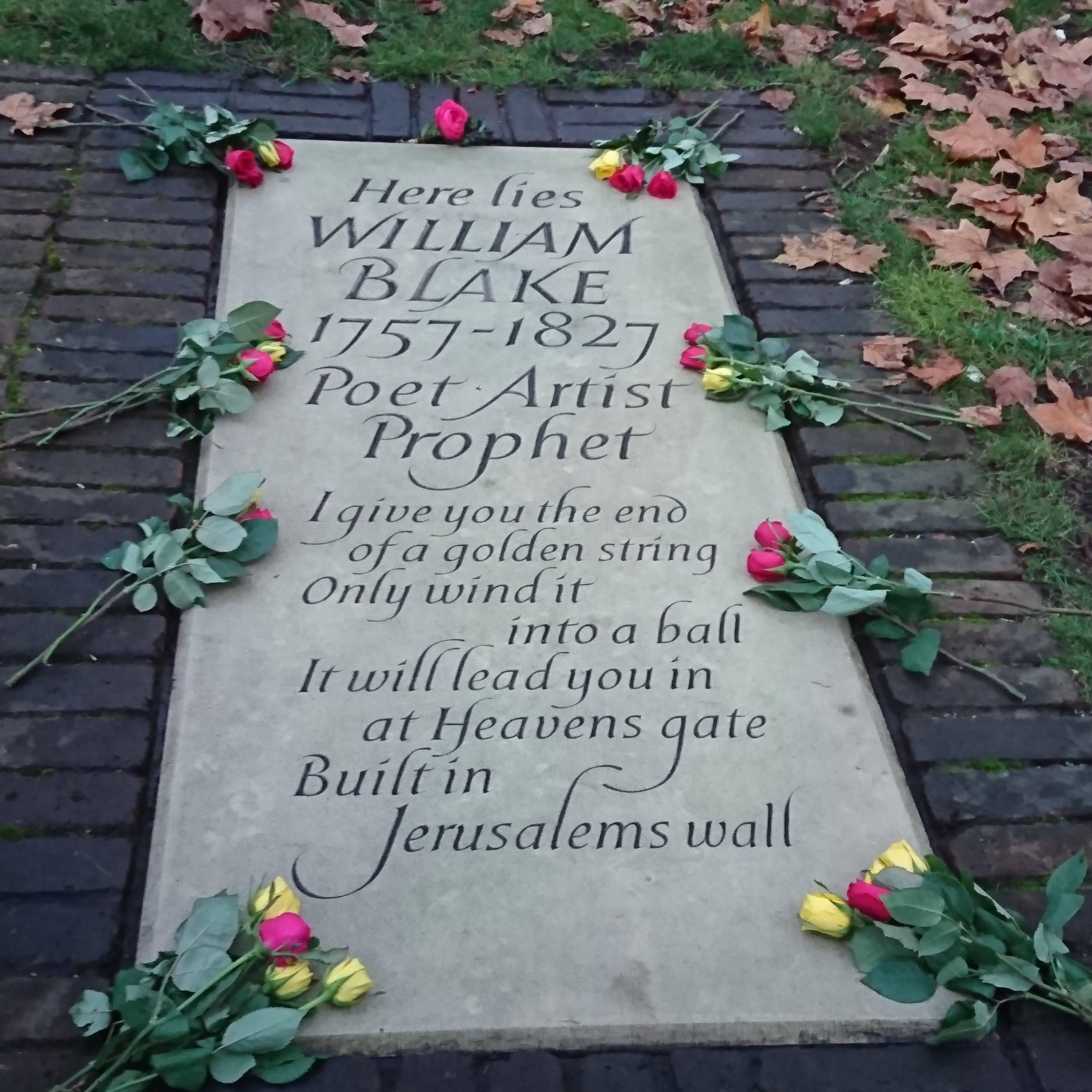
For almost a century, Blake’s grave in Bunhill Fields was unmarked. Today, his memorial, shared with Catherine, is a touchstone for visitors reflecting on his visionary spirit. People still leave tokens referencing his childhood visions, like angels, at his resting place. The original gravestone was inscribed “near by,” as the exact burial spot had been lost. In 2006, after years of research by Carol and Luís Garrido, Blake’s precise resting place was finally identified. With support from the Blake Society and public donations, a new memorial was unveiled in 2018 on the 191st anniversary of his death, a testament to a legacy that continues to inspire:
In Our Time did an episode recently discussing Blake’s collection of poems “Songs of Innocence and Experience.”
A chronology of Blake’s life (William Blake Society)
Can art instruct science? William Blake as biological visionary (Article by Ray Peat)
Iain McGilchrist, a psychiatrist and philosopher, argues in The Master and His Emissary (2009) that modern culture is increasingly dominated by left-hemisphere thinking, characterised by analysis, abstraction, and control, at the expense of the more intuitive, relational, and holistic insights of the right hemisphere. He suggests this imbalance has led to a fragmented worldview and diminished sense of meaning. Blake’s critique of “single vision” and mechanistic rationalism eerily anticipates this concern, championing instead the imaginative, integrative capacities that McGilchrist sees as vital for individual and cultural flourishing.
Carl Jung viewed imagination, not as fantasy or escapism, but as a vital tool for psychological healing and self-discovery. His method of “active imagination” encouraged dialogue with inner figures and images from the unconscious, much like Blake’s visionary encounters with archetypal beings. Jung admired Blake’s symbolic depth, even calling him a “visionary” who perceived the collective unconscious long before psychology had a name for it. For Jung, imagination was a bridge between the conscious and unconscious mind: a path toward “individuation” and wholeness.
For example, veterans with PTSD have found relief through programs like The Combat Paper Project, where old military uniforms are turned into paper and used as canvases for personal stories, turning pain into art, and art into healing. See www.combatpaper.org.
‘Like a film in my mind’: hyperphantasia and the quest to understand vivid imaginations (Guardian Article)
Plato’s expulsion of the poets is detailed in Book X of the Republic, where he argues that poetry is an imitation (mimesis) of physical things, which are themselves copies of ideal forms, thus placing art at a third remove from truth. Plato was deeply concerned that imitative poetry appeals to the emotions rather than reason, and can corrupt citizens’ understanding of virtue and reality. Consequently, he concludes that in the ideal city, only poetry that praises the gods and virtuous people should be allowed, while most traditional poets—such as Homer and the tragedians—would be excluded.
Locke’s (1632-1704) tabula rasa theory, elaborated in his Essay Concerning Human Understanding (1690), argues that at birth the human mind is a “blank slate,” empty of innate ideas or knowledge, and that all of our concepts and understanding come entirely from sensory experiences and reflection. In Locke’s view, the mind passively receives impressions from the outside world, organising these experiences into increasingly complex ideas. This was a direct challenge to philosophical traditions that posited humans are born with innate ideas or predetermined knowledge, and it laid the foundation for modern empiricism, emphasising experience, environment, and education as the sources of what and how we think.
In Visions of the Daughters of Albion (1793), Blake critiques the sexual repression and moral hypocrisy of his time through the character of “Oothoon,” a woman who suffers assault yet dares to assert her sexual and spiritual agency. The poem challenges patriarchal control, guilt-based morality, and the denial of embodied joy, issues still relevant today. Blake often linked creative, erotic, and spiritual energy, seeing desire not as sinful but as sacred and life-affirming. This countercultural stance, especially in a religious poet, has led some to call him a proto-feminist or even a visionary of sexual liberation.
Blake’s vision of the soul aligns more closely with pre-modern and mystical traditions than with the atomised, autonomous self of Enlightenment liberalism. As Quinney argues, Blake refused the prevalent disenchanted vision of human identity, in which the soul is reduced to psychological mechanisms or rational subjectivity. For him, soul is not housed within the individual but unfolds through relation, perception, and symbolic depth. This anticipates later critiques by thinkers like Charles Taylor and James Hillman, who similarly questioned the decline of the soul in modern philosophical and psychological thought. In Blake, soul re-emerges not as essence but as an active force: a way of seeing, creating, and connecting that resists isolation and affirms interdependence.
Quinney, L. (2009). William Blake on Self and Soul. Harvard University Press.
“The Tyger” is the sister poem to “The Lamb” (from “Songs of Innocence”), a reflection of similar ideas from a different perspective. In “The Tyger,” there is a duality between beauty and ferocity, through which Blake suggests that understanding one requires an understanding of the other.
The poem And did those feet in ancient time, commonly known as Jerusalem, was set to music in 1916 by British composer Sir Hubert Parry. Amid the darkness of World War I, Parry’s rousing composition transformed Blake’s mystical verses into a patriotic hymn. Later orchestrated by Sir Edward Elgar, Jerusalem became an unofficial national anthem for England.
Blake saw Isaac Newton not merely as a scientist, but as a symbol of a worldview he vehemently opposed: one that elevated reason, measurement, and materialism above imagination, spirit, and holistic perception. For Blake, Newtonian science reduced the cosmos to dead mechanism, stripping it of soul and meaning. He grouped Newton with figures like Francis Bacon and John Locke, “the three great teachers of atheism,” in his words, who, in his view, enslaved the human mind by exalting empirical reason over visionary insight. Blake’s was not an anti-science stance per se, but a critique of reductive rationalism that ignored the inner life.
See Alan Moore on William Blake’s contempt for Newton (Royal Academy Article)
A key idea that Huxley took from Blake was that the brain normally acts as a type of “reducing valve,” which limits how much of reality we perceive, and that certain drugs or mystical experiences could allow people to experience reality more fully.
Ernst Bloch, in The Principle of Hope (1954–59), argued that hope is a forward-dreaming force rooted in the human imagination, what he called “anticipatory consciousness.” For Bloch, imagining better futures is a vital part of human existence and political transformation. Gabriel Marcel, a Christian existentialist, saw hope not as naive optimism but as a spiritual act grounded in fidelity and openness to being. More recently, Byung-Chul Han critiques modern culture’s erosion of deep, contemplative experience and argues that imagination and poetic thought are essential for resisting the burnout of hyper-productivity. For all three thinkers, imagination is not escapism but an active, generative response to suffering and uncertainty.
See Ernst Bloch and the Philosophy of Hope: The Power of the “Not-Yet” (Substack Post)
Thank you for this gift.