


“Everywhere we remain unfree and chained to technology, whether we passionately affirm or deny it. But we are delivered over to it in the worst possible way when we regard it as something neutral; for this conception of it, to which today we particularly pay homage, makes us utterly blind to the essence of technology.”
—Martin Heidegger, The Question Concerning Technology1
A few months ago, I had a go at producing music. I’d been bedroom DJing for a while, and making a tune of my own seemed like the obvious next step. Call me a quitter, but I lasted about three hours.
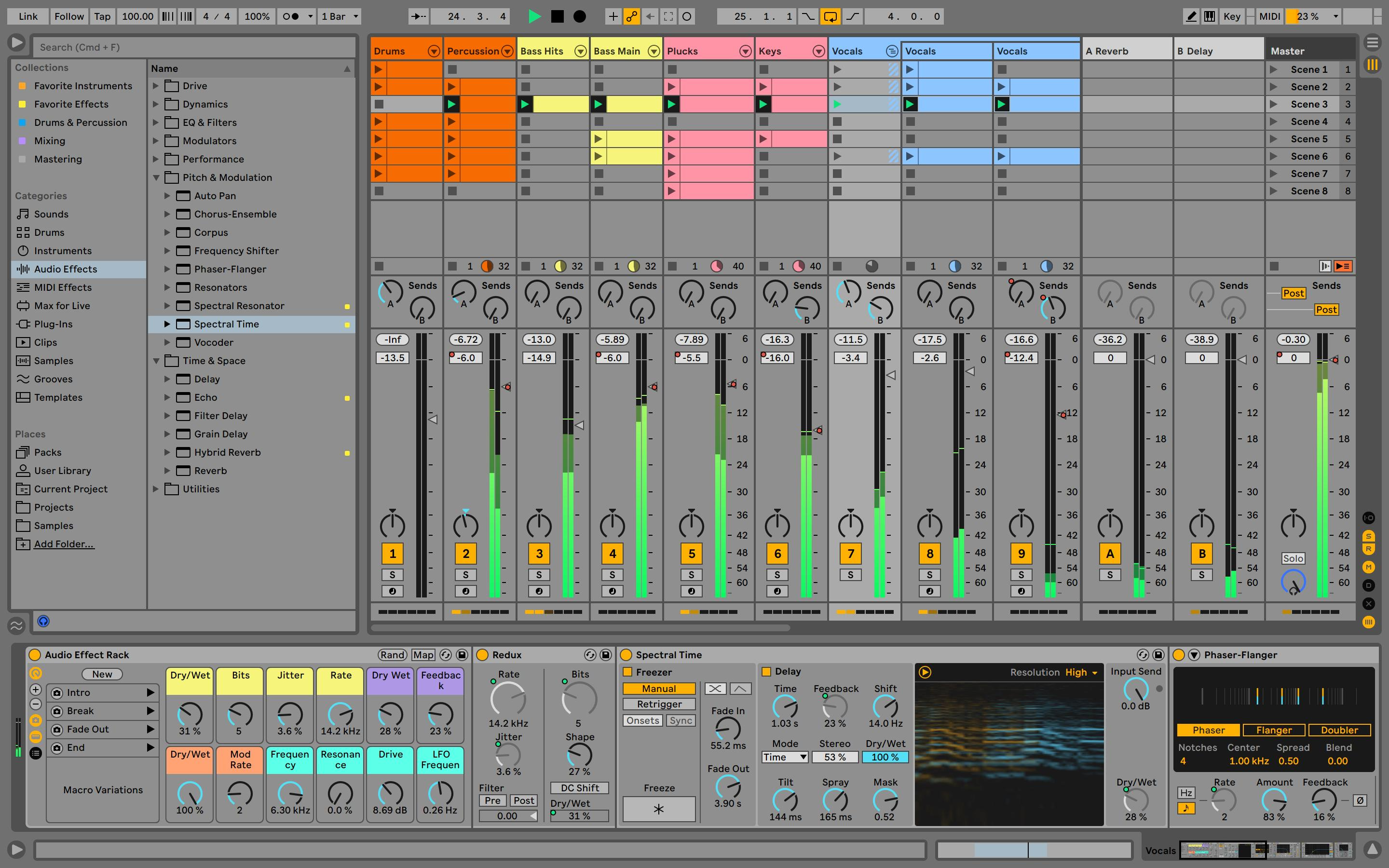
What put me off almost straight away was the way the software made me see music. Open up a Digital Audio Workstation (DAW) like Ableton or Logic and a tune you love turns into a grid of data. BPM, key, waveform, MIDI notes, automation curves. You can zoom in on a single snare hit until it takes up the whole screen. You can chop it, isolate it, rearrange it, stretch it over four bars. You can see the bones of the thing.
And once you’ve seen the bones, something dies a death. At least it did for me. The track stops being a track. It becomes a set of inputs arranged in a particular order. The next time I put it on in the kitchen, part of me was still seeing the grid.
It might just be cope, but I think Martin Heidegger’s idea of “gathering” helps explain why it bothered me so much. And, as I’ll come on to, why it sits right at the heart of the entropy/syntropy drum I keep banging.
What Gathering Means
In Martin Heidegger’s (1889-1976) later work, like his essays on technology, his readings of the pre-Socratics, and his obsession with the poet Friedrich Hölderlin,2 “gathering” keeps cropping up.
The basic idea is simple enough: to gather is to bring things together into a meaningful whole, where they can show up properly. It’s the opposite of scattering, breaking apart, and reducing something to bits so you can see what it’s made of.
Heidegger gets at this through the Greek word logos, though he reads it in a pretty unorthodox way.3 Most people hear “logos” and think logic, reason, argument. He hears something more Heraclitean, closer to “a laying-together,” or a “bringing-into-relation.” So rather than a pile of objects sitting there while you wander around them, a world, in this sense, is a gathered field of meaning. Things show up together, already entangled, and what each thing is shifts with what’s around them.
That might sound a bit abstract, but it’s really not.
A Table
Take something really ordinary. Heidegger used examples like a jug and a bridge, but we’ll go with a dinner table.
Look at it one way and the table is wood. A flat surface at a certain height, built to hold a certain weight. It cost a certain amount of money. It does the job of holding plates while you eat. Swap it for a different table and not much would change.
Look at it another way and it’s the thing your grandma used to lean her hands on while she watched you eat the sandwich she’d made you. It’s where your kids did their homework. It’s where every Christmas dinner you can remember happened. It’s got that dark patch in the grain where someone always rests their elbow, and maybe there’s still a stain from a glass that didn’t have a coaster under it. The whole rhythm of the house passes across it every day.
Both descriptions are true. But only the second one tells you what the table is, properly. The first tells you it’s furniture while the second tells you it’s a thing that gathers a world.

This can sound sentimental, but Heidegger’s point is that the second description gets at something the first one misses. The table really does hold all of that. It’s not that you’re slapping meaning onto a lump of wood. You’re letting the table show up as what it already is: a place where people, habits, history, rituals, roles and shared life hold together long enough to be seen.
Enframing
Heidegger spends so much time on this because he thinks our age has a particular way of making that sort of seeing harder. He calls it “Gestell,” which is usually translated as “enframing.”4
Enframing is the kind of attention modern technology trains us into. Everything starts showing up as a “standing reserve”—a stockpile of resources waiting to be optimised, extracted, and put to use. The forest becomes timber. The river becomes hydroelectric potential. The athlete becomes a set of metrics. The employee becomes human capital.
It’s a way the world reveals itself once technology becomes the main lens. And it’s not exactly false. There really is timber in the forest. The problem is that it becomes “total.” Once enframing takes over, nothing gets to show up any other way. The forest can’t just be a forest anymore.
Gathering is the counter-movement, with the two modes pulling in opposite directions:
Enframing isolates. Each thing gets pulled out of the relations that gave it sense, and inspected on its own terms.
Enframing reduces. What’s left is whatever can be measured, optimised, and deployed.
Enframing flattens. Everything gets treated as the same sort of thing: standing reserve, ready for use.
Whereas:
Gathering connects. A thing is allowed to stand in the relations that make it what it is.
Gathering holds. Those relations stay together long enough to become legible as a whole.
Gathering reveals. What shows up is a presence, something that means, not just something useful.
You can probably feel the difference without me belabouring it. It’s the difference between cooking a meal and assembling macros. Between watching a football match and analysing the performance.
What Gets Lost
Heidegger’s worry is sometimes read as a bit of mood music: the grumpy German philosopher in his Black Forest hut, moaning about technology while everyone else gets on with the future. But that misses the sharper point. He thinks we’re losing the capacity to gather. Not just losing meaning, in the vague modern sense people like to talk about. More basically, losing the ability for things to hold together as meaningful in the first place.
So you can have all the right ingredients (family, work, place, friends, beauty, time), and still find they won’t add up to much. Nothing is missing and everything is in place, but it doesn’t come together. That, to me, is what people mean when they say modern life feels fragmented. Or entropic.

Language as Gathering
The other place this idea takes Heidegger—and fair warning, this is where a lot of people lose patience with him—is language.
He starts to treat language itself as a form of gathering. A place where a world gets called into being. When you name a thing, you call it forward into the company of other named things, where it can show up as what it is.
This is why he gets so interested in Hölderlin. Heidegger thought poetry, at its best, doesn’t describe a world already sitting there waiting to be described. It gathers a world into presence.
In the first stanza of Hölderlin’s Hälfte des Lebens (Half of Life, 1804), the lake, the swans, the pears, the kisses, the water are all held together in one suspended moment of summer.5 The second stanza is what happens when that gathering fails: the flowers and sunshine remembered as absences, the walls standing speechless, the weathervanes creaking in the wind:
With its yellow pears
And wild roses everywhere
The shore hangs into the lake,
O gracious swans,
And drunk with kisses
You dip your heads
Into the holy and sober water.
Ah, where will I find
Flowers, come winter,
And where the sunshine
And shade of the earth?
Walls stand cold
And speechless, in the wind
The weathervanes creak.
You don’t have to swallow the whole thing to feel the pull of it. Anyone who’s tried to write a eulogy for someone they love knows the difference between describing them and gathering them. One is a list while the other is something else entirely.
The Producing Thing Again
Which brings me back to the DAW.
I think what put me off producing wasn’t that it showed me how music is made, but the way the software framed music as nothing but its mechanics. The track became its parts. The vibe, the lift in the chorus, the way a synth line feels on a sunny day, none of that was in the grid. The grid could show me everything except the bit that made it worth listening to.
DJing, oddly enough, is fine. You can mix two tunes together for hours and never lose the sense that each one is a whole. You’re putting tracks into conversation. You’re gathering. Whereas producing, at least the way I came at it, felt like the opposite, with the song already split apart and laid out on the mortuary slab.
I’m not saying nobody should produce music. People do extraordinary things in DAWs, and if they didn’t I’d have nothing to play anyway! I’m just saying I kept walking away from the screen unable to listen properly for a few hours after. The mode of attention the software trained didn’t switch off when I put the computer to sleep.
Once you see that, it’s hard to unsee it, and you start noticing it everywhere. Your phone trains a kind of attention. Your inbox trains a kind of attention. AI Chatbots train a kind of attention. Each one is, in Heidegger’s sense, a little enframing engine. None of them is a problem on its own. The question is whether anything in your day is still gathering.
Entropy and Syntropy
There’s a way of saying all of this that fits the broader thread I keep tugging on.
Entropy is the drift toward dispersion. Things fall apart. Heat spreads out. Patterns dissolve. Coherence costs energy, and energy doesn’t come for free. Left alone, any complex arrangement tends toward the same featureless soup.
Syntropy is the counter-tendency. The pull, in living systems and meaningful lives, toward integration. Toward parts holding together as a whole that’s more than the sum of them. Toward order that’s alive rather than forced.
Gathering, in Heidegger’s sense, is what syntropy looks like at the level of human meaning. It’s the work, mostly invisible, by which a table becomes a hearth, a song becomes a wedding-day walk down the aisle, or a bunch of people become a life shared. Enframing is a bit like entropy with a slick user interface. It speeds the breakdown along, all in the name of clarity, optimisation, or throughput.
So, if the drift of modern life is toward fragmentation, what we need is less arguing about technology and more recovering the habits and practices that still let things gather.
What That Looks Like
I don’t want to land this in some neat little moral, because Heidegger himself doesn’t, and the people who try usually end up sounding like a wellness brand.
But the practical version is something like this. There are arrangements in your life that gather. The cafe you keep going back to. The Sunday lunch that’s been the same shape for twenty years. The workshop with your tools laid out. The garden you’ve tended long enough that it’s started tending you back.
What makes them gather is simple: they’ve been lived with long enough, and met with enough attention, to become more than the sum of their parts.
The same kitchen, the same walk, the same friend can scatter just as easily: eaten in a rush, walked while thinking about something else, met with half your mind. The form doesn’t decide it. Whether you let the thing stand together does.
I cross the line between gathering and scattering all the time. I’ll catch myself listening to a philosophy podcast on what was meant to be a quiet walk. I’ll have my phone out when my wife is telling me about her day. I’ll spend an evening half-reading a book and half-checking messages and then wonder why nothing’s landed. Each time I’m breaking the moment up a bit more, un-gathering and refusing to let what’s in front of me settle into place.
Heidegger’s point is that this is the deepest thing at stake in our age. It’s probably not going to end in some dramatic collapse with Skynet crushing humans once and for all. Just the slow fading of our ability to notice what was there all along.
Heidegger, M. (1977). The question concerning technology. In The question concerning technology and other essays (W. Lovitt, Trans., pp. 3–35). Harper & Row.
Friedrich Hölderlin (1770–1843) was a German lyric poet whose late, fragmentary work Heidegger treated as the deepest available thinking on what it means to dwell. Many of Heidegger’s late essays are essentially Hölderlin readings dressed as philosophy.
Heraclitus of Ephesus (c. 535–475 BC) survives only in fragments, but he was the pre-Socratic thinker Heidegger kept coming back to. His fragments use logos in a way that hadn’t yet been narrowed to “reason” or “argument”—closer to a fundamental gathering or laying-together that lets things show up at all. For Heidegger, this older sense was the buried truth that European philosophy spent two thousand years forgetting.
I’ve written about Heraclitus before here.
Gestell is one of Heidegger’s made-up technical words. The ordinary German “Gestell” just means a frame or rack, like the stand you put pots on. Heidegger uses it to name the way modern technology “frames” reality such that everything shows up as a stockpile of resources, ready to be deployed. Standing reserve (Bestand) is the corresponding word for what gets revealed under enframing, the world reduced to inventory.
Adapted from various English translations; the literal sense matters more here than any one translator’s voice.
I'm reading your article while in-sync with DJ i_o doing his kitchen set. Syntropy? I discovered your substack today and I'm hooked. Every philosophy beat resonates with my continental obsession, especially the great phenomenologist himself. And now you toss in the entropy effect. So rich, so on point. I'm an AI practitioner, living an inauthentic life, but distracted by the company's mandate to enframe every work practice. But its a bloody mess. The more structure, the more code the less system integrity. Where once stood trust, goodwill and optimistic pursuit of genuine creativity now chokes in a synthetic miasma. That "mad as hell moment" is not far off, but I can't wait; I stir the pot with colleagues and whisper about a great Neo-Romantic surge. If that doesn't land, I shift gears and spruik a Butlerian Jihad. So much to talk about. I'll be back.
Excellent insights. Thanks for sharing.