


“And just exactly as the people separate the lightning from its flash, and interpret the latter as a thing done, as the working of a subject which is called lightning, so also does the popular morality separate strength from the expression of strength…But there is no ‘being’ behind doing, effecting, becoming; ‘the doer’ is a mere fiction added to the deed—the deed is everything.”
—Friedrich Nietzsche, The Genealogy of Morals (1887)
I’ve had a couple of conversations lately with people about Nietzsche and Buddhism and whether they’re basically saying the same thing when it comes to whether we have a self or not. Then, in a nice bit of synchronicity, I saw this tweet making much the same point:
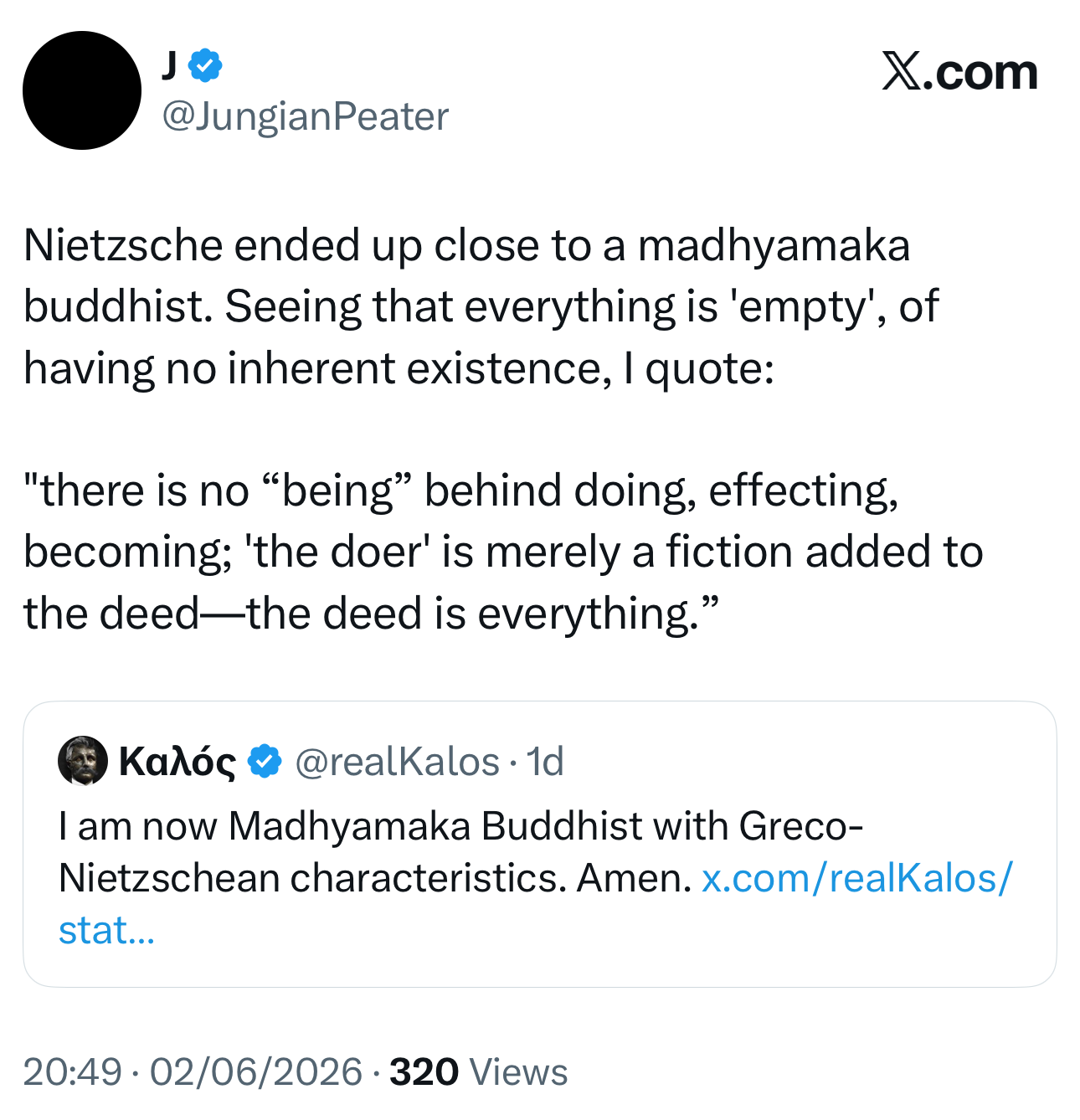
It’s an accurate comparison, I think, that tends to miss the interesting part.1 Yes, both reject the idea that there’s some fixed, permanent self behind everything you do. But they get there in very different ways, and what they do with the insight afterwards couldn’t be more different. On that point, the two are dead opposed, which is the most important thing when it comes to how you might live.
The Easy Agreement
Nietzsche’s attack on the self starts with language. When we say things like “I think,” “I act,” or “I choose,” the grammar quietly convinces us that there must be some solid “I” behind the verb, like a captain steering the ship of your life. Nietzsche thinks that’s a trick, reinforced by grammar, metaphysics, and morality all at once.2 The action comes first. The “doer” gets added afterwards so we’ve got someone to praise and someone to blame. Take the grammar away, and you don’t find a tiny commander inside choosing what to do and issuing orders. You find a mess of different drives, urges, instincts, and appetites, mostly unconscious, all jostling for position. And “you” is just the name we give to whichever arrangement happens to be on top at the time.
This means your personality isn’t a thing you possess but more like a temporary truce between competing forces. Nietzsche isn’t being edgy or nihilistic for the sake of it here. He’s adamant these fictions are a bad thing, making us weaker, more guilty, and less able to say yes to life.
Madhyamaka is a major school of Buddhist philosophy, usually translated as the “Middle Way” school.3 It goes back to Nāgārjuna (c. 150–250 CE), an Indian Buddhist philosopher and monk, widely revered as the “second Buddha” and best known for the idea that things are empty of any fixed, independent essence. Madhyamaka says that everything we take to be solid and self-contained turns out to depend on other things. So nothing has some inner permanent core of its own.
“Empty” here doesn’t mean nothing exists at all, but that things don’t exist in the way we usually assume: as independent, self-standing entities with their own permanent nature. A table exists, for example, but not as some ultimate, unchanging “table essence.” It exists dependently, on wood, form, name, use, context, and so on.
Madhyamaka is trying to avoid two extremes: eternalism, where things have a fixed essence, and nihilism, where nothing exists at all. So the “middle way” says things are real in a conventional sense, but not ultimately self-existing. The Madhyamaka bumper sticker might say something like, Reality is made of dependent, empty, interrelated phenomena, not fixed essences.
So the two traditions genuinely agree at that level. Both throw out the idea of a fixed essence. Both look at the apparent solidity of the self and call it a fabrication. Nietzsche says it’s built out of grammar and need; the Buddhists say it’s built out of habit and misunderstanding. Both stop treating the self as a thing and start treating it more like an activity.
Now if the comparison stopped there, as in the tweet above, it would be technically correct, but the real question still hasn’t been asked.
The Fork Isn’t Where People Think
The temptation is to say the difference is in where they end up. The Buddhist path, the story goes, drifts toward calm, toward the quieting of all craving and attachment, toward a kind of stillness, while Nietzsche heads toward intensity, toward saying yes to life and creating something. Winding down versus winding up. The same insight with opposite endpoints.
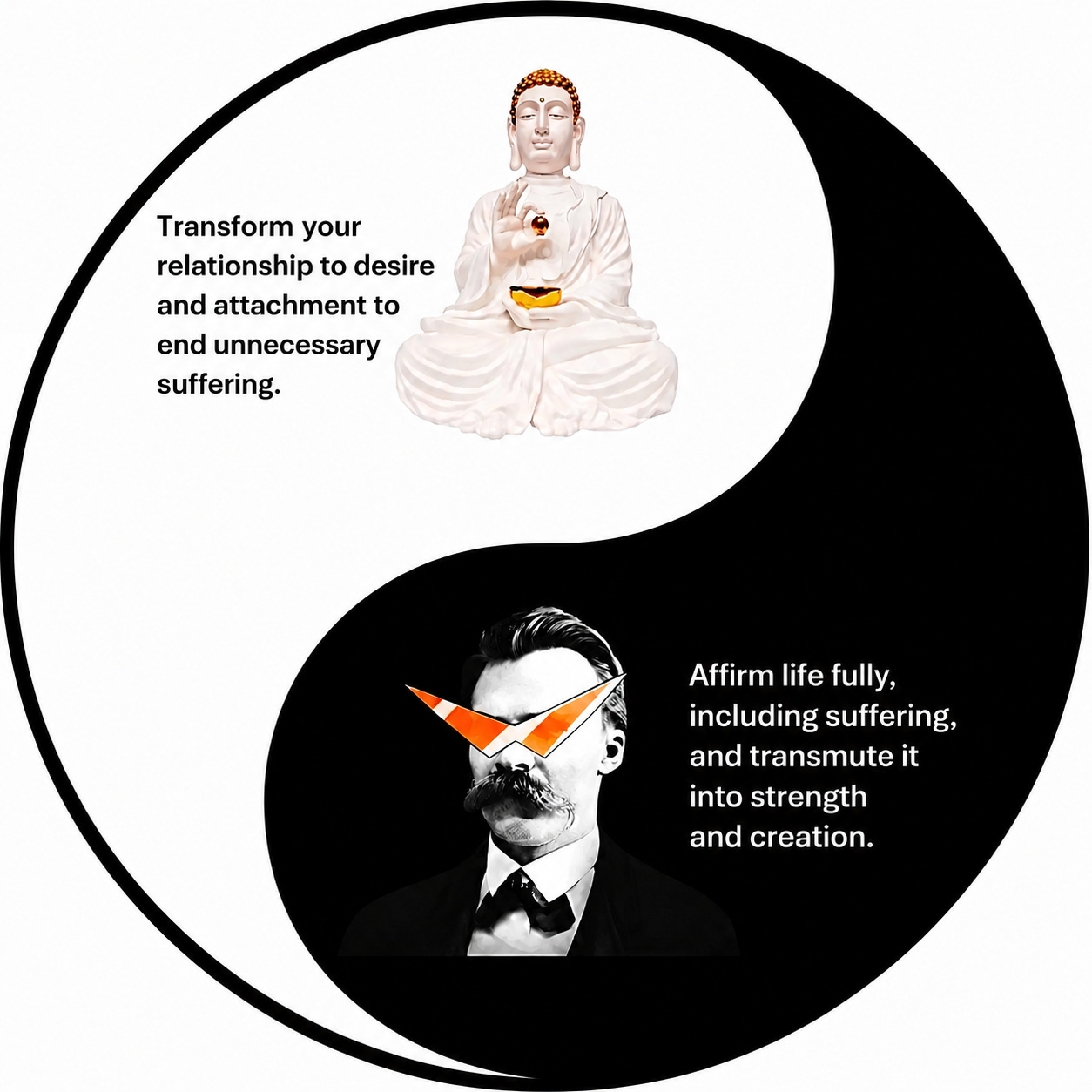
It’s a nice tale of contraries, but it’s not really fair to Madhyamaka. Saying this kind of Buddhism “aims at switching off” just gives you the cliched cartoon monk who wants to blow out the candle of existence and feel nothing forever, but Madhyamaka is basically built to refuse that cartoon.
One of Nāgārjuna’s central claims is that the world of suffering and the state of liberation aren’t two separate realities. There’s nowhere else to go.4 Enlightenment isn’t a quieter room you escape into but this very world, seen without the illusion of solidity laid over it. To read the tradition as a longing to switch off is to accuse it of exactly what Nietzsche accused Buddhism of being: a tired wish for nothingness and turning against life.
The honest contrast is harder to pin down, but I think it’s more useful.
Madhyamaka worries that the moment you turn emptiness into a project of self-creation, you’ve missed the point. The insight isn’t supposed to become a new identity, worldview, or a new foundation to build on. You’re not supposed to discover emptiness and then make it the basis of some grand personal plan. The calm it speaks of isn’t just a nice feeling that turns up after realisation but a disciplined refusal to turn realisation into another object of attachment.
You’re supposed to see there’s no fixed self, and that’s supposed to loosen your grip on things. The moment you take that insight and start putting it to work or making it serve a goal, you’ve grabbed hold again. You’ve turned the medicine back into the disease. Even clinging to not clinging is still clinging. And clinging to becoming something, to the will, to the great project of affirming life, that’s the most cunning grip of all.
Which is exactly what Nietzsche does.
Nietzsche Does the Forbidden Thing
It’s worth being careful here. A Madhyamika doesn’t become passive. The tradition’s central practical text, Śāntideva’s Way of the Bodhisattva, is a training manual of the most demanding kind: an ascending discipline of patience, effort, and meditative cultivation, sustained in principle across lifetimes. Nobody who’s read it could call the path slack. So the disagreement can’t be about effort, or even about self-cultivation as such.5
The disagreement is about which way all that effort points. The bodhisattva’s discipline, for all its intensity, is aimed at release: at transforming self-cherishing into other-cherishing, uprooting craving, and dissolving the very self-clinging that makes us suffer. It’s hard work, but all of it’s spent in the service of letting go. The direction is subtractive. Which is exactly the move Nietzsche refuses.
Nietzsche takes the very thing Madhyamaka tells you to see and then leave alone (i.e., the discovery that there’s no fixed self underneath you), and he puts it to work.
Oh, there’s no fixed self, just a pecking order of drives? Fine, he says. Then organise the pecking order.
Personality is just a truce between forces, is it? Fine. Then get cracking and make it a better, stronger one, a shape you impose on the chaos instead of just suffering it.
He called this “giving style to your character.”6 For him, the absence of a fixed self is the cleared ground for an artistic process. You survey your competing drives, strengths, and weaknesses, then shape them into a coherent (but never permanent) whole, like an artist imposing form on chaos. This isn’t about forging some rigid new ego or “building harder” in a crude sense; Nietzsche has nothing but contempt for fixed identities and celebrates flux and self-overcoming. The “self” you make stays a temporary, dynamic achievement, held together by effort and will, in full knowledge that it too will one day be overcome. And yet, for Nietzsche, that very lack of foundation is precisely what makes genuine creation possible in the first place.
From the Buddhist side, that’s a disaster. Or at least from one influential Buddhist angle on it. It’s the exact mistake the whole discipline is trying to prevent. You were shown there’s no solid ground, and instead of letting go, you started pouring foundations. FFS! You took the deepest available insight into how the self is constructed and used it to construct harder.
Nietzsche wouldn’t have blinked at the accusation. Even though he much preferred Buddhism to Christianity, for all his admiration, he baulked at what he saw as the resignation in it, calling it a religion of decadence, a passive nihilism for the weary.7 There was too much energy in him, too much appetite, to settle for a wisdom whose highest point was wanting nothing.
Now we get to the real disagreement: is doing nothing with the insight actually neutral?
The Syntropic Claim
Madhyamaka presents its calm as if it’s just what’s left when you stop pushing the insight around. But there’s no such thing as a lack of direction. At least, that’s where I part company with Madhyamaka.
Choosing not to organise something is still a choice. Refusing to push the insight toward making a form means refusing to make self-creation a goal, and drifting toward no form isn’t neutral (the tradition does reintroduce enormous discipline through the bodhisattva path, but that discipline, as I said, points back toward release, not away from it). It’s the entropic direction things take when nobody’s tending them.
What presents itself as non-goal-directed can still look, from a syntropic perspective, like a directional preference: it’s the goal that water has when it finds its level, or the goal a fire has when it goes out. It’s the state that needs no more effort because there’s nothing left in it to keep going.
I think the diagnosis is correct: there’s no fixed self, no essence or doer behind the deed. Both traditions see that clearly. But once the false solidity is gone, the insight doesn’t come with an instruction manual. You can let it spread you out and call the spreading-out “peace.” We’ve all met the person who reads enough airport books about non-attachment and stops chasing the hard thing they actually wanted. They walk away from the difficult project or the difficult person and file the retreat under serenity. The letting go is genuine, but so is the quiet relief of not having to try anymore.
Or you can use it: take the absence of a fixed self as your licence to make one, over and over, with more organisation and more intensity each time, knowing full well that whatever you make is temporary, and building it anyway because its being temporary is no longer a reason not to.
Nietzsche’s “mistake,” from the Buddhist point of view—his refusal to just rest in what he’d seen and his insistence on doing something with the nothing—is the attitude I’d call syntropic and alive. It’s life refusing to take the easy downhill path even after being shown, with complete rigour, that downhill was always the only natural option. The drives pull themselves into order against the slope. Form gets imposed and held up by effort alone. And that’s what a living thing actually is. Not a solid object lasting through time (on that I agree the Buddhists are right), but a process that takes its own lack of foundation and drives it uphill, toward intensity, instead of letting it slide down toward rest.
That perfect calm is just what happens to a system when it stops doing this. We’ve got a word for the state where every gradient has flattened, every difference has evened out, and nothing needs maintaining anymore. A Buddhist would reject the comparison entirely, but from a syntropic point of view the resemblance is hard to ignore. In every other corner of the universe, the state where gradients vanish, differences dissolve, and nothing further needs maintaining has a familiar name: death.
Get Busy Living or Get Lazy Dying
You essentially have a choice: emptiness can be put to work, or it can be dissolved into. Only one of those directions is alive. The self gets taken apart either way. The question is what happens next. Do you treat emptiness as something to rest in, or something to build from?
Nietzsche and Madhyamaka give opposite answers. One says the absence of ground is finally a reason to let go. The other says it’s the only place anything worth building has ever begun.
I had this on repeat while writing this one:
My philosophical novel, The Syntropist, is available worldwide on Amazon. All royalties go to Hospice at Home.

Nietzsche argues that the fiction of a stable “self” is reinforced not only by grammar and metaphysics but also by Christian morality and slave morality, which recast weakness, obedience, and self-denial as virtues and so harden a distorted picture of human agency and value.
Madhyamaka began in India as a Mahāyāna Buddhist philosophical school, usually traced to the second-century thinker Nāgārjuna, who developed earlier Buddhist ideas such as dependent origination and the Middle Way into a systematic critique of intrinsic existence.
Nietzsche would have found this aspect of Madhyamaka surprisingly congenial. One of his recurring targets is what he calls the “true world” tradition: the Platonic and Christian tendency to divide reality into a lesser world of appearances and a higher, more real realm beyond it. Although he remained deeply critical of Buddhism, Nāgārjuna’s refusal to locate liberation in a separate metaphysical realm places him much closer to Nietzsche on this issue than Plato or Christianity. I wrote about this recently here.
A Mādhyamika will rightly object that the bodhisattva path is anything but inert: it’s one of the most rigorous programmes of self-cultivation any tradition has produced, and it's grounded squarely in emptiness. I accept that completely. My claim isn’t that Buddhism lacks effort or even discipline of the self but that the effort is recruited toward release rather than intensification, toward the quieting of craving rather than the building of ever more demanding form. Same energy, opposite vector. The bodhisattva builds in order to let go while Nietzsche lets go in order to build.
Nietzsche, Friedrich. The Gay Science: With a Prelude in Rhymes and an Appendix of Songs. Translated by Walter Kaufmann. New York: Vintage Books, 1974. The phrase appears in §290.
In The Antichrist, he noted that Buddhism is “a hundred times more realistic than Christianity,” praising its coolness, its honesty about suffering, and its freedom from ressentiment, even as he classes both, in §20, as “nihilistic religions… religions of decadence.”
It doesn’t have to be either, or. The dynamism of relationality is just that, the discernment of when to let go and when to construct.
Fair point—I agree that the essay explicitly rejects the crude “Madhyamaka = passivity” dichotomy and acknowledges the demanding discipline of the bodhisattva path. My criticism is aimed at the deeper dichotomy that the essay introduces after making that qualification.
The essay says the real difference is “which way” the effort points: Buddhist effort ultimately points toward release, while Nietzschean effort points toward self-creation and intensification. But I think this still presupposes a particular understanding of what the self is.
My point isn't that Madhyamaka leaves no room for action, effort, cultivation or creation. It obviously does. The question is what is being cultivated or created. If it is a conventional configuration of drives, habits, dispositions and capacities, then we can describe that process without positing an independently existing self. But calling it “self-creation” risks retaining precisely the reification that Madhyamaka is trying to see through.
So I don't think the issue is whether someone exists who can “do something” after seeing through the self. Conventional persons act; Madhyamaka doesn't deny that. The issue is whether the absence of intrinsic selfhood becomes a licence to construct a more organised or intense self.
That is where I think the essay still hasn't quite engaged the Madhyamaka position I was pointing to. It moves from “there is no fixed self” to “therefore one can construct the self,” whereas Madhyamaka questions the assumption that there is a self there to be constructed in the first place.
So yes, the essay addresses the passivity objection. My objection is slightly deeper: I don't think it has yet resolved the question of what “self” means.