


Plato is often seen as the top dog in Western philosophy. Indeed, Alfred North Whitehead famously quipped European philosophy “consists of a series of footnotes to Plato.” But Friedrich Nietzsche (1844-1900) disagreed. He thought we’d made a huge mistake two and a half thousand years ago, and we were still living with the consequences. He thought Plato was a coward because he couldn’t bear reality as it was.
This essay is about why Nietzsche thought that, and the three thinkers he reached for whenever the Platonic infection started flaring up again: Heraclitus, Thucydides, and Machiavelli.
It’s also about why I think his perspective matters for the broader syntropic thread I keep tugging on. Because Plato’s ancient metaphysics is more than a bit of philosophical background noise. It may even be the original entropy of Western thought. And the cure Nietzsche found in three of his favourites is, at its core, syntropic.
The Original Error
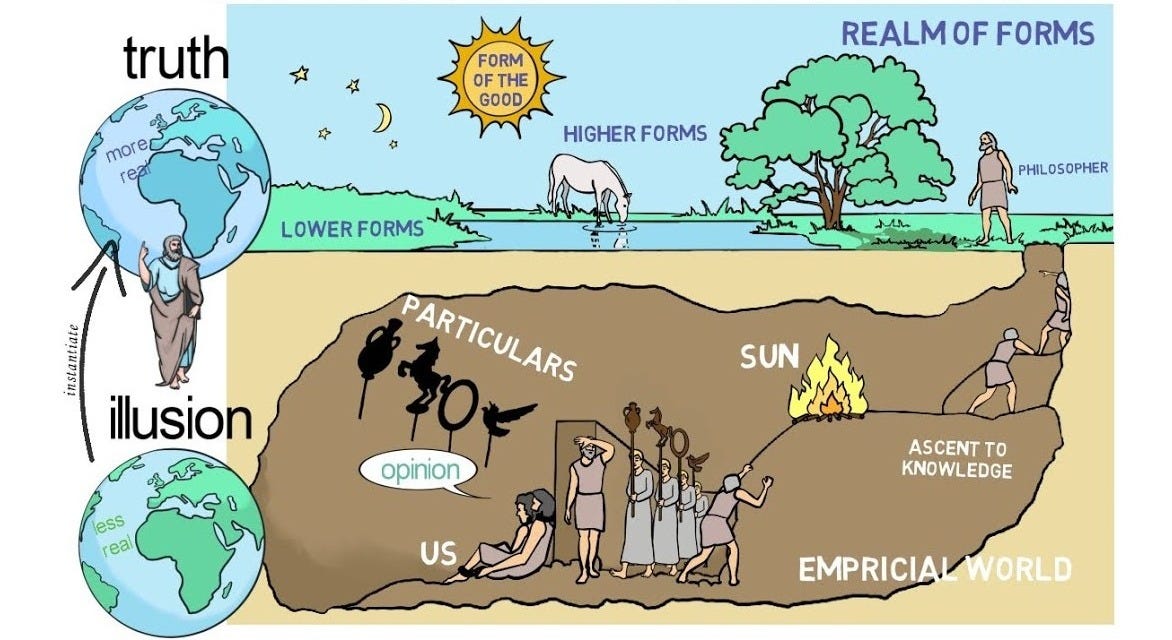
Most people first meet Plato (c. 428–348 BC) through the Allegory of the Cave: prisoners chained facing a wall, watching shadows on it, mistaking the shadows for reality, until one escapes and sees the “real” world outside in sunlight.
Read one way, it sounds like a hopeful little story. The brave escapee. The light of understanding. Education and critical thinking as liberation. Very flattering to anyone holding a book. But the structure of it also does something a bit darker.
What Plato is saying is that there are two worlds. The apparent world we live in is the one of bodies, weather, hunger, and mess. But it’s a copy. A shadow on a cave wall. The real world is somewhere else: eternal Forms, perfect circles, and pure Goodness, the sort of thing you can only get at by thinking very hard while sitting very still.1 The blueberry bush outside my window is a shabby imitation of the True Blueberry Bush, which lives in the realm of ideas and has never had to deal with aphids.
On the face of it, that sounds like a bit of harmless metaphysics. Who cares. But Nietzsche saw the trick that was being played.
Plato’s whole structure exists to put the world we actually live in below the one we don’t. To say that thing you’re walking around in, the one with the body and the moods and the hunger and the aging, isn’t the real one. The real one is somewhere else, and it’s cleaner, purified, rational, and above all this.
Life as it is gets demoted, and something better is dangled in front of you in exchange for the betrayal. This, for Nietzsche, was the original mistake of Western thought: the decision to turn away from the messy, Dionysian chaos of existence and look towards some higher, tidier, more rational realm.2
It’s worth saying upfront that this is Nietzsche’s Plato, not the whole man. Plato wrote about politics, education, friendship, the soul, and erotic life in ways that don’t reduce to “this world is fake.” What Nietzsche is doing is reading Plato for the structural move at the bottom of the whole edifice. He isn’t entirely fair to Plato, and a careful reader of the dialogues would have plenty to push back with. But the structural move is the thing that got inherited downstream, and that’s what we’re tracking here.
Plato Becomes God
Fast forward a few centuries and Christianity inherited the Platonic perspective.3 Plotinus read Plato. Augustine read Plotinus.4 By the time you reach the Middle Ages the eternal Forms have morphed into God, the realm of pure Goodness is Heaven, the immortal soul has replaced the philosopher’s intellect, and the messy visible world is the fallen world of sin and flesh.
This was Platonism for the masses. But instead of reading the philosophy, most people got the Sunday-school version of it: that this life is a vale of tears. Suffer now, be meek, deny your instincts, and wait for the proper world after death.
Nietzsche saw this as “life-denying” and the ground for passive nihilism, as it turns strength into sin, calls instinct wicked, and convinces a healthy animal that the real prize is the world it can’t see. It was “ressentiment” dressed up as humility. An ethic sold to people too tired to notice what it was costing them.
For long stretches of Western culture, this became the dominant moral atmosphere.
Plato Becomes the Scientist
Then the Enlightenment came along, and lots of people decided they were sick of God. Fair enough. Off he pops. Except the structure stayed behind.
Immanuel Kant (1724–1804) kept it in a new form, with his unknowable “thing-in-itself.”5 He was trying to mark the limits of what minds like ours can actually know, making us humble about the reach of human cognition. But Nietzsche read the limit-marking as the dodge itself. By saying we can’t know things-in-themselves, Kant preserves the assumption that there are things-in-themselves to not know. The True World is still assumed. It’s just shielded from anyone who might check on it.
Then the positivists came along in the nineteenth century and said, “Nah, we know exactly where the True World is, and we’ve got the instruments to find it.” The True World is whatever science discovers. Objective laws. Mathematical order. The view from nowhere. What the data is really telling us, underneath all our messy human perspectives.
Nietzsche called this Platonism without the myths. Same shit, different day. The sensory world is still suspect and in need of correction by something purer. There’s still one objective reality behind appearances. Reason still gets you there. Life is still wrong about itself, and somewhere outside life there’s a court of appeal.
You don’t get heaven anymore. Instead, you get progress, objectivity, and evidence-based truth. The lab coat replaces the priest’s robe. But you’re still being told that the real party is somewhere else, that what you see and feel and want is just a distortion, and that the real picture is waiting for the right people, with the right methods, to find it and tell you what’s what.
Now it’s important to note here that Nietzsche wasn’t totally against science per se but the dogma about science. The version that mistakes itself for the True World and the final court that every other way of seeing must answer to. Plenty of actual modern science has moved a long way from this. For example, quantum mechanics is probabilistic, while complex systems theory, ecology, embodied cognition, and emergence are all concerned with flow and process rather than fixed, timeless order.6 Much of what’s most interesting in contemporary science actually looks more Heraclitean than Platonic. Nietzsche’s target is the metaphysics that gets smuggled in when science forgets it’s an interpretation. The practice of it, the actual looking, he’d have admired.
That’s why Nietzsche could see modern scientism (the dogma, not the practice) as continuous with Christianity. Both are versions of the ascetic ideal.7 Life saying no to itself in the hope that the “no” will be rewarded. One promises God, the other promises Truth, and both ask you to look away from where you actually live.
The Antidote
A disease this deep doesn’t yield to arguments alone. You can’t out-think it, because the act of out-thinking it is part of how it spreads.
What you need is examples. You need to read writers who never caught the infection, or who recovered from it. People you can sit with for long enough that your own thinking quietly recalibrates around how they pay attention.
Nietzsche had three favourites who each gave him a way of thinking that started in the world and stayed there.
Heraclitus and the world as flow
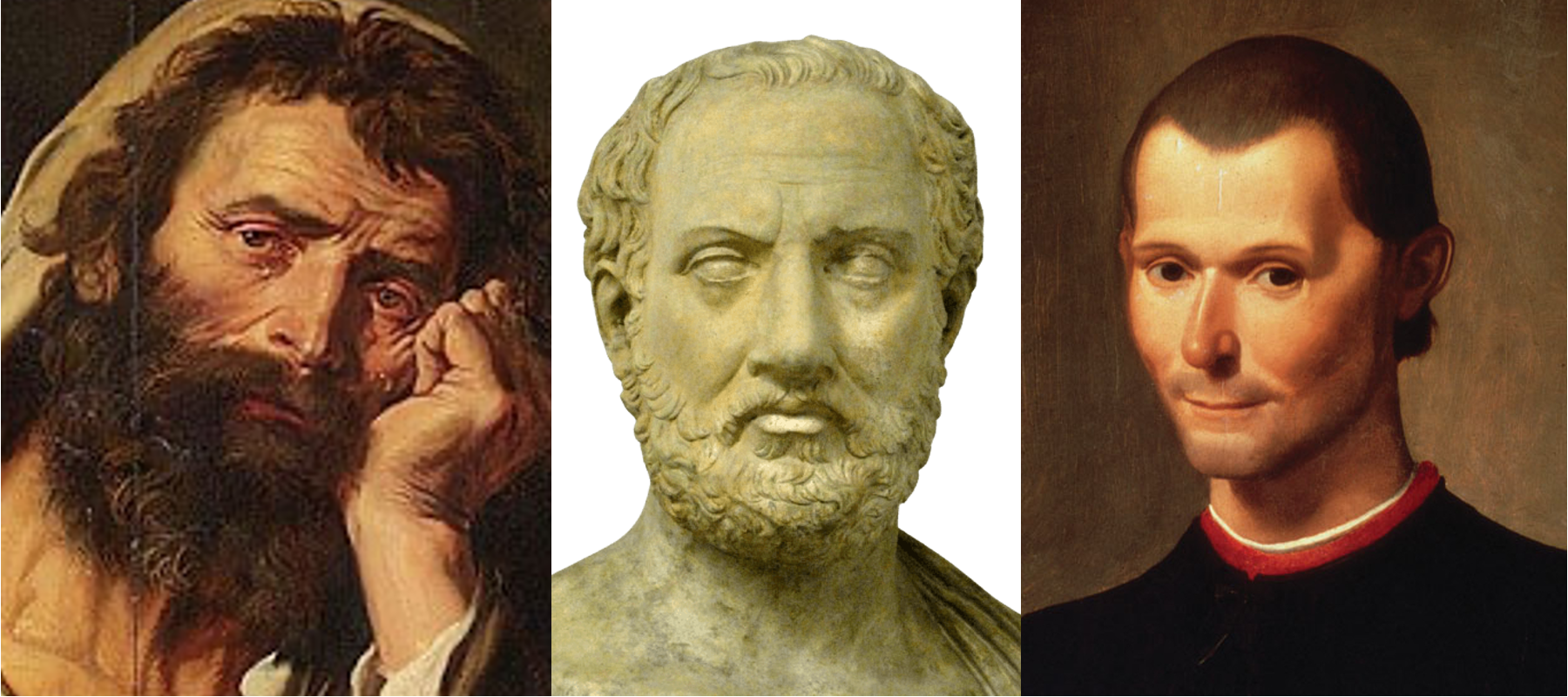
Heraclitus of Ephesus (c. 535–475 BC) is the philosopher of becoming I’ve written about before.8 His basic move is that everything flows. Reality is tension, struggle, and opposites locked together. Fire turning into water, water into earth, and earth back into fire. War and strife are the father of all things. The bow and the lyre working by the same principle.
What Nietzsche liked about him is that he doesn’t flinch from change.
The Platonic tradition treats change as a problem. Something to be explained away, anchored in something more stable, or redeemed by reference to the eternal. Heraclitus treats change as the thing itself. There’s no hidden stability behind the flux. The flux is what there is.
Once you stop treating becoming as a defect, you stop needing a True world to prop it up. The world is just doing what it does, and your job is to look at it properly.
There’s also a tragic clarity in Heraclitus that Nietzsche loved. The world makes sense, but not the comforting or moral sort of sense. His style matches his thought: aphoristic, energetic, paradoxical, and full of short, cryptic fragments. He hands the reader a challenge, not a system. That makes him feel closer to life than abstraction does, because life doesn’t sit still long enough to be captured in a system.
When Nietzsche later writes about eternal recurrence, amor fati, and will to power as the inner principle of becoming, Heraclitus is already there, two and a half thousand years earlier, pointing at the same thing without the German.9
Thucydides and the world as fact
Thucydides (c. 460–400 BC) is where Nietzsche really comes alive. The praise he gives him in Twilight of the Idols (1889) is unusually warm for a man who tended to greet most of his intellectual ancestors with a brick through the window.10 He wrote, “My recreation, my predilection, my cure, after all Platonism, has always been Thucydides.”
Thucydides made Nietzsche feel better because he was telling the truth about a war. Twenty-seven years of it: Athens vs. Sparta, the Peloponnesian War (431–404 BC). And he told it as if no gods existed, no providence was guiding events, no moral law was being vindicated, and no philosopher’s neat little scheme was hovering above the whole thing, making it all meaningful.
People did things. Other people responded. Power, fear, and self-interest moved. “The strong did what they could, and the weak suffered what they must.”
That line, from the Melian Dialogue, is the centre of it.11 The Athenians rock up to the small island of Melos and tell the Melians to submit. The Melians tried to argue and appeal to justice. The Athenians don’t bother pretending. We’re stronger; you’re weaker. You’ll do what we say or we’ll destroy you. The Melians refuse. So the Athenians destroy them.
Thucydides records all this without trying to make it a pretty story. No god turns up to punish the Athenians. No moral framework applies. He shows you what happened, and the “why” is simply human nature doing what human nature does when there’s nothing to hold it back. He doesn’t need to be reassured that the world is just. He can face what’s there. Nietzsche puts it like this:
“Courage in the face of reality ultimately distinguishes such natures as Thucydides and Plato: Plato is a coward in the face of reality—consequently he flees into the ideal; Thucydides has himself under control—consequently he retains control over things.”
There’s a phrase in Thucydides that captures the whole vibe: “kata to anthrōpinon.” Roughly meaning “according to the human thing“ or “because of how humans are.” Because humans are the way they are, events recur in roughly similar patterns. You don’t need divine causes or eternal Forms. You just need to observe people properly, and you can work out quite a lot.
That’s a kind of positivism, but not the lab-coat sort that ends up sneaking Plato back in through the back door. It’s a positivism that stays in the world. There’s no higher court. There’s just what happened, why it happened, and what that tells you about what will happen.
Thucydides also strips out the myth-making and propaganda. He’s deeply wary of how people invent and believe any old story about the past. So he tries to get past the Athenian version and the Spartan version and reach something closer to what actually happened. And, to Nietzsche’s eye, he treats greatness without resentment. He can describe Pericles and the Athenian leadership as they are, without needing to diminish them. The eye of the artist and the discipline of the historian, working together.
For Nietzsche, this is peak Greek instinct before Socratic decay set in: severe, unsentimental, alive to human types, and refusing the consolations the philosophers would spend the next couple of thousand years chasing.12
Machiavelli and the World as Power
Niccolò Machiavelli (1469–1527) is the third thinker in Nietzsche’s squad.
The Prince is what happens when a clever man stops pretending political life works the way Christian moralists say it does.13 Princes who try to be good in every respect will be beaten by men who aren’t. Fortune favours the bold. It’s better to be feared than loved if you can’t manage both. Founding a state is a violent act, dressed up afterwards in noble language. This is simply observation as opposed to cynicism.
Nietzsche put Machiavelli in the same bracket as Thucydides for exactly that reason.
“Thucydides and perhaps Machiavelli’s The Prince are most closely related to me, owing to the absolute determination which they show of refusing to deceive themselves and of seeing reason in reality—not in ‘rationality’, and still less in ‘morality’.”
“Rationality,” in the Platonic tradition, is something you apply to the world from outside it, as if the world ought to conform to your rules. “Reason in reality” is what you find by paying attention to what’s actually going on. The world has its own intelligibility. It runs on causes. And those causes are mostly things like power, fear, ambition, and necessity. You understand the world by watching what it does, not by importing better principles into it.
Machiavelli’s prince doesn’t try to be good. He tries to be effective. And the effectiveness Machiavelli admires is the kind that builds, founds, and holds things together. There’s nothing nihilistic about this perspective. Just very unsentimental.
What Links Them
Each of these three gave Nietzsche something the Platonic tradition couldn’t.
Heraclitus gave him becoming. The world as flow.
Thucydides gave him historical realism. The world as fact.
Machiavelli gave him political realism. The world as power.
None of them needed a True World to make sense of this one, or a moral framework imported from elsewhere to know what was worth saying. They all started in the world and they all stayed in it.
That’s what Nietzsche meant by “life-affirmation.” Saying yes to this place, this life, this body, and these conditions, without insisting that something else has to stand behind them to make them respectable. A resounding “Yes!” to becoming, to power, and to the human condition.
You can hear in Nietzsche’s praise of these three what he thinks philosophy is actually for: cultivating the kind of attention that can stay with this world. The business of building nicer worlds in the head is the disease.

The Syntropic Alternative
Once you’ve clocked the structure of the two-world Platonic move, you can see what Nietzsche’s own philosophy is up to. It isn’t just another metaphysics with different content in the same old shape but an attack on the shape itself.
Perspectivism is his direct answer to Platonism. There’s no True World standing above the interpretations. There are only the interpretations themselves, each one somebody knowing, from somewhere, with a body and a history and a set of interests and desires. The dream of the view from nowhere, whether it’s God’s view, science’s, or pure reason’s, is exactly the dream that has to go. There’s no nowhere. There are only the somewheres, and that’s where life happens.14
Will to power replaces the static Forms. The world isn’t an order of eternal essences imperfectly reflected in matter but a field of forces growing, struggling, organising, and intensifying. Life isn’t rational order but creative struggle. Mastery is something you build, not something you discover sitting in the realm of ideas waiting to be approximated.
This is where it all links up with the syntropic thread. As ever, I’m using syntropy here as a metaphor more than a tightly defined scientific concept. It points at something I see across living systems, healthy thinking, and good lives: the pull against entropy toward integration and working with this world rather than appealing to another one. I’ve tried to pin it down more carefully in earlier pieces.15 For now, treat it as Nietzsche’s life-affirmation given a name that travels beyond him.
Plato’s move is the original entropy of Western thought. It’s the draining of vitality out of the living world into a static beyond. The exchange of life for an ideal. A court of appeal set up outside reality so the world could be perpetually judged and found wanting.
Syntropy pulls the other way. It’s the tendency of living systems to organise, intensify, complexify, and move in this world under these conditions. It works with what’s there and doesn’t ask the world to be elsewhere before it gets going.
Heraclitus, Thucydides, and Machiavelli are syntropic thinkers in that sense. They don’t drain the world to fill a container outside it. They look at the world hard enough to see how it actually moves, and they trust that what they find there is worth knowing. The currents, the conflicts, and the human things are the material life works with.
The philosophers Nietzsche admires aren’t the ones who’ve worked out where the True World is, but the ones who have the nerve to think and live without one.
The Cure as Company
That’s the cure, in the end. You spend time with people who never caught the disease. After a while, you notice you’ve stopped reaching for the second world because the first one is enough. And it was always enough. The whole long detour through Forms, heavens, laws of nature, and evidence-based True Pictures was the symptom you needed to recover from, rather than the destination you were meant to reach.
I think this is the deeper reason many of us go back to the old books. We go for the company. For nerves. For models of how to keep yourself together while looking at hard things, and not making up nicer versions of them in your head.
Nietzsche’s verdict on these three thinkers was that they embodied life-affirmation through unflinching amor fati toward reality’s brutality and beauty. They could love what was, because what was was the only thing there.
That’s what philosophy is for. Practically cultivating nerves steady enough to stay with this world. And, if you stay with it long enough, finding that it has more to give than the True World ever promised.
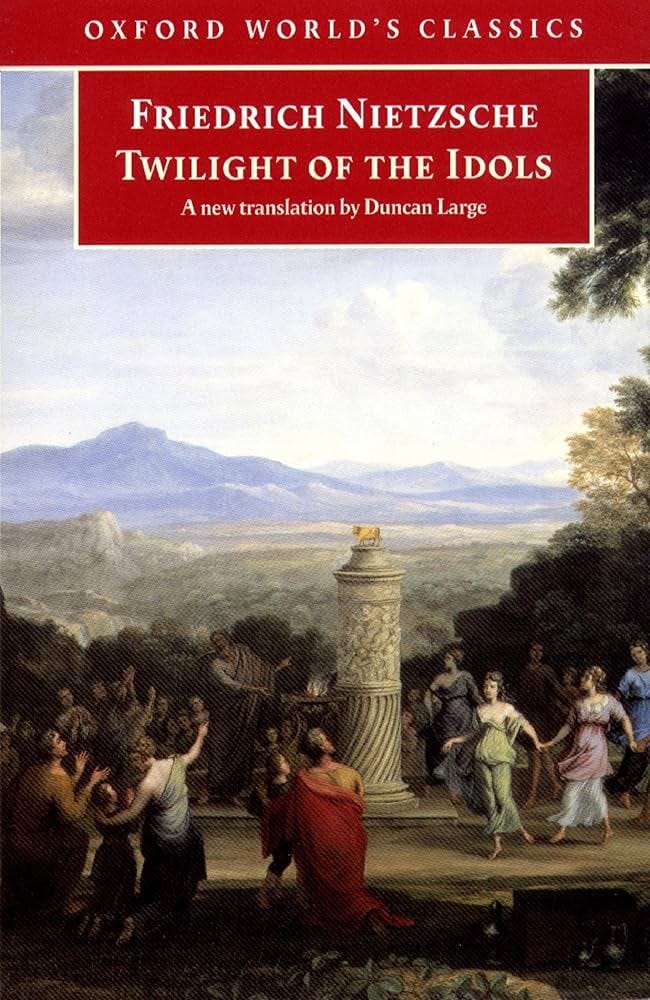
Nietzsche’s Twilight of the Idols (1889) is a fierce attack on Socrates, Plato, Christianity, German nationalism, Wagner, and “free will,” all of which he reads as symptoms of decadence: life‑denying, life‑turning‑away‑from‑itself. It’s a defence of the body, the senses, and the tragic acceptance of life as it is, not as it should be according to moral or religious ideals. In it, he was trying to clear the ground for a philosophy that stays firmly in this world and says “Yes” to it.
Plato’s Forms (or Ideas) are perfect, eternal, non-physical templates of the things we experience. The particular tree outside your window is an imperfect instance of the Form of Tree. The Form is more real than the tree. The tree is a pale copy of the Form. A great deal of Western metaphysics runs on what you do with this move.
Dionysian, after Dionysus, Greek god of wine, ecstasy, fertility, and irrational excess. Nietzsche pairs it with Apollonian, after Apollo: order, form, restraint. His first book, The Birth of Tragedy (1872), argued great art needs both, and that Western thought since Socrates had basically spent two thousand years stamping out the Dionysian half.
More than just inherited it, to be fair. Christianity also absorbed Jewish ethics, Stoic discipline, Roman administrative habits, and later, through Aquinas and the scholastics, a hefty dose of Aristotle. Calling it “Platonism for the masses,” as Nietzsche does, is shorthand for the structural move he cared about—this world a copy, the real one elsewhere, salvation through denial—and not a full account of where the religion came from.
Plotinus (c. 204–270 AD) founded Neoplatonism, a mystical, hierarchical reworking of Plato in which all reality emanates from a single transcendent source called the One. Augustine (354–430 AD) baptised the structure into Christian theology. The straight line from Plato to Plotinus to Augustine to most of Christendom is one of those bits of intellectual history that, once you see it, you can’t quite unsee.
Immanuel Kant argued we can only ever know how things appear to us (phenomena), never things as they are in themselves (the Ding an sich). It looks like a humility move. Nietzsche thought it was Platonism with the True World moved out of reach so it couldn’t be checked.
It’s worth flagging that bits of contemporary science are themselves still quietly Platonic. Mathematical realism in physics, certain strong reductionisms in cognitive science, and the appeal to “fundamental laws” underneath the appearances all carry the old shape. The point is that the Heraclitean tendencies in modern science (contingency, emergence, process) are real and growing, not that the battle has been won.
Nietzsche develops the ascetic ideal properly in On the Genealogy of Morality (1887). It’s the idea that life is to be denied, disciplined, or transcended in the name of something higher: God, Truth, the Good, science, art done “for art’s sake,” whatever. The form changes; the move is the same.
Heraclitus and the Hidden Harmony of Change (Substack Post)
“Amor fati” is Latin for “love of fate.” Nietzsche’s term for the affirmative stance toward everything that has happened and is happening. Not resignation. Not acceptance through gritted teeth. Active love of what is, including the bits that hurt.
Nietzsche’s Twilight of the Idols (1888) is a short, sharp, mostly polemical book in which he hammers at the “idols” of Western thought: those ideas people treat as unquestionable, sacred, or “obviously true.” Think of it as Nietzsche’s last‑sane‑year manifesto: a concentrated hit list of the idols he thinks poison life and philosophy.
The Melian Dialogue sits in Book V of Thucydides’ History of the Peloponnesian War. The Athenian assault on Melos took place in 416 BC. It is the most morally exposed moment in the whole History, and Thucydides, true to form, offers no editorial verdict on it. He doesn’t have to.
For Nietzsche, Socratic decay was the shift in Greek culture away from tragic, instinctive, life-affirming wisdom and toward overconfidence in reason, argument, and moralising. In The Birth of Tragedy, he treats Socrates as the turning point where Greek culture starts to lose its noble, Dionysian vitality and replaces it with a belief that life can be fixed by thinking it through properly.
The Prince is a short, punchy political handbook by Niccolò Machiavelli, written in 1513 and published after his death in 1532. At its heart, it’s a practical guide on how to get power, create a state, and keep it—not how rulers should act in moral theory, but how they actually succeed in real, messy politics. What made it shocking at the time, and still gives “Machiavellian” its edge, is that he treats politics as a field with its own rules. A prince doesn’t have to be “good” in the Christian‑moral sense; he has to be effective, and that sometimes means deception, cruelty, and realpolitik. Nietzsche admired it because it cuts through moralising and looks at power straight‑on, which is why he brackets it with Thucydides as a kind of life‑affirming political realism.
For Nietzsche, perspectivism is both a criticism of the old idea of “objective truth” and a way of living with multiplicity: you don’t escape your perspective, you learn to use it more clearly and honestly. Whether Nietzsche is a full-on relativist and “anything goes” is debated by scholars. Probably not. He clearly thinks some perspectives (Thucydides, Heraclitus) are better than others (Plato, Christian moralists), and life-affirmation is itself a standard he holds the others to. What he rejects is the dream of a single, view-from-nowhere truth that all interpretations must defer to. He’s gesturing at something more like pluralism, with some perspectives genuinely richer than others, and none of them entitled to call itself the view from nowhere.
Syntropology as a Philosophy of Coherence (Substack Post)
Note 6 is the kicker. Choose your weapon wisely. The materialist, the system thinkers and neo-platonists define a current clique of powerful uber technologists who have abandoned all rational investment precedents (the irony) to see through their post human project come hell or high water. I'm not super confident that these "Heraclitean tendencies" have the tenacity to hold the line. We need a philosopher warrior class marching under the Amor Fati standard.
Hi friend! Just came across you today. You're working on Syntropic, and I on Centropic! I think we might be speaking the same language! I look forward to learning more about your work!
Hawkeye