



“I have done that,” says my memory. “I cannot have done that,” says my pride, and remains inexorable. Eventually—memory yields.
—Friedrich Nietzsche, Beyond Good and Evil (1886)1
In the TV series The Affair (2014), Noah Solloway puts a question to his therapist: Is it possible to be both a good man and a great man?
You can watch the scene from Season 2, episode 10 below (6 mins), but in it he points to Hemingway, Picasso, Jefferson, and Hamilton—and to Omar Bradley, the Second World War general he’s planning to write his next book about. Figures remembered for what they achieved, but whose personal lives were often marked by infidelity, selfishness, or neglect. The implication is that history seems full of people who accomplished extraordinary things while failing to live up to ordinary moral standards.
Noah’s question gets at something lots of people feel, even if they rarely say it out loud. Can you devote yourself fully to your family, your spouse, or your community and still produce something remarkable? Can you be virtuous and ambitious? Or do the qualities that drive greatness inevitably clash with the qualities that make someone good?
Long before Noah Solloway wondered this, Friedrich Nietzsche spent much of his philosophical career exploring a similar tension. But Nietzsche’s answer is far more nuanced than a simple yes or no. In fact, he would challenge the question itself because he thought most people have never really stopped to ask what they even mean by “good” or “great” in the first place.
The Good Man
At the beginning of The Affair, Noah (played by Dominic West, who’ll always be McNulty in The Wire to me) appears to have it all. He’s a husband, a father, a teacher, and an aspiring novelist. By conventional standards, he’s a good man.
But underneath that picture, there’s a growing sense of unease. He feels boxed in by obligations. He feels restless and unfulfilled. There’s a gap between the life he’s living and the person he thinks he’s becoming. He ends up having an affair with Alison (played by Ruth Wilson), a waitress he meets while on holiday with his family in Montauk.
Most viewers see that affair as the central event of the story, but Nietzsche probably wouldn’t. For him, it’s more like a symptom. He’d want to know what made it possible in the first place: why a man with a loving family risks everything, why someone who seems to have enough keeps reaching for more, and why stability can start to feel like a kind of suffocation.
Nietzsche never takes moral labels at face value. When someone appears virtuous, he asks what’s underneath the virtue. Is this kindness the expression of strength or weakness? Is this humility the result of confidence or insecurity? Is this self-sacrifice freely chosen or just something social pressure has trained into a person?
Most moral systems judge actions. Nietzsche looks at the forces that produce them. Which is why he can feel so provocative. He doesn’t really care whether something looks moral on the surface. He cares whether it comes from strength, vitality, creativity, and self-mastery or from fear, resentment, exhaustion, and conformity.
The uncomfortable possibility he raises is that what we call “goodness” isn’t always life-affirming. Sometimes it is. Often it’s not. And the challenge for us is learning to tell the difference.
The Self as Fiction
In my last essay, I looked at the similarities between Nietzsche’s thought and Madhyamaka Buddhism.2 That piece centred on one of Nietzsche’s most radical claims, from On the Genealogy of Morality:
“The ‘doer’ is merely a fiction added to the deed—the deed is everything.”
At first glance, that sounds absurd. Of course people act. But Nietzsche is pushing against a much deeper assumption. Most of us imagine ourselves as a stable self sitting behind our thoughts and actions, like an inner commander giving orders to the rest of the personality.
Nietzsche thinks that picture is mostly an illusion. Instead, he sees human beings as collections of competing drives, instincts, desires, habits, fears, and ambitions. The self is less a ruler than a battlefield, with different forces struggling for control. Whatever force wins in a given moment comes out as action. The action shows which part of the self is currently in charge, nothing more.
That changes how we view Noah’s choices. Instead of asking whether he’s basically good or bad, Nietzsche would ask: What forces are pressing to the surface? What desires have become too strong to suppress? What ambitions have been denied expression? What instincts have been buried under years of responsibility?
As he puts it in Beyond Good and Evil:
“To our strongest drive, the tyrant in us, not only our reason bows but also our conscience.”
Seen that way, the affair looks like a revelation. Something hidden has broken through, and the tidy identity Noah has built for himself starts to crack.
Perspectives and Perspectivism
One of the most interesting things about The Affair is its narrative structure.
Each episode shows events from different perspectives, and each version differs, with details and motivations shifting. Memory proves unreliable, and nobody seems to hold the whole truth. Which is very close to Nietzsche’s idea of perspectivism.
Nietzsche never claims truth doesn’t exist. His point is that every truth is seen from somewhere. There’s no God’s-eye view available to human beings. Every interpretation comes shaped by particular interests, experiences, values, and desires.
The Affair effectively dramatises that idea. Each character builds a story about themselves, explaining their actions in ways that protect their self-image. In effect, they become both narrator and defence lawyer, which is exactly what Nietzsche thinks we all do.
We’re always revising ourselves, editing our memories, and building narratives that let us live with what we’ve done. The result is that morality is a lot less tidy than it first appears.
Heroes become villains. Villains become victims. Victims become perpetrators. The lines blur into shades of grey, and that blurring is exactly where Nietzsche wants us to look. Because once moral certainty starts to fall away, deeper questions come into view. In Beyond Good and Evil, he writes:
“There are no moral phenomena at all, but only a moral interpretation of phenomena.”
Few TV shows illustrate that insight more vividly than The Affair.
Good and Great
Noah speaks about greatness as though it were a clearly identifiable quality. Nietzsche was less certain. Again in Beyond Good and Evil, he writes:
“What? A great man? I always see only the actor of his own ideal.”
The remark is characteristic. Nietzsche is constantly pulling us away from simplistic hero worship and back toward the physiological and psychological forces operating beneath it.3
Today, we usually link greatness with fame, wealth, status, or influence, but Nietzsche means something different. For him, greatness is about an exceptional power to create. The great person expands what’s possible, shapes culture, and brings new values into the world. They change both themselves and the people around them.
That’s part of why Nietzsche admired people like Goethe and Napoleon. They weren’t morally perfect, but they showed an unusual mix of creative force, discipline, intellectual depth, and energy. Greatness, in this sense, isn’t just success but the expression of a powerful and integrated life.
But that brings up a difficult point.
Many of the forces that produce greatness are morally messy. Forces like ambition, pride, rivalry, the hunger to stand out, and the refusal to settle for average. Traditional morality often treats these impulses with suspicion, while Nietzsche sees them as potential sources of human flourishing.
Noah assumes greatness and flourishing belong together. But as you might have noticed in the clip we started with, his therapist throws in some doubt. Hemingway may have produced great work, but, she says, “he blew his brains out at 60.”4 Is that an example of a life well lived?
Nietzsche wouldn’t automatically answer yes. Which is why Noah’s examples are so revealing—and why the pattern keeps repeating long after Hemingway and Picasso. We see it in countless artists, leaders, entrepreneurs, innovators, and athletes.
Take Tiger Woods, maybe the cleanest modern case. From the outside, the discipline that built the most dominant career in golf and the compulsions that wrecked his marriage looked like separate compartments. Nietzsche would doubt the wall between them was ever real. The same ferocious drive ran through both, and his collapse, like Noah’s affair, showed which drives had been running the show all along.
Then there’s Paul Gascoigne, who cuts the other way. Prodigious raw talent that never became self-mastery. By Nietzsche’s measure of greatness as a powerful and integrated life, he may be something sadder than a great man with flaws: enormous power that never found integration. Which tells you more about what greatness actually requires than any trophy cabinet does.
History keeps giving us people whose creative achievements sit alongside personal failings.
Whether the failings should be excused is a separate matter. What Nietzsche doubts is that greatness and moral goodness are always aligned. And that doubt lies at the centre of his critique of modern morality.
Dionysus and the Crucified
In his later work, Nietzsche condensed much of his thinking into a single contrast: Dionysus versus the Crucified.5
It’s tempting to read it as a simple opposition between pagan Greece and Christianity. But Nietzsche means something deeper. For him, Dionysus and the Crucified stand for two very different ways of relating to existence itself. The Crucified represents a worldview that looks for redemption from life, where suffering is bearable because it leads somewhere else (i.e., heaven). The highest virtues become obedience, humility, sacrifice, and self-denial, and life is measured against an ideal that transcends life in the here and now.
Dionysus stands for the opposite impulse. Not just pleasure or hedonism, or simply doing whatever the hell you want, but the ability to affirm existence in all its messiness. Joy and suffering. Creation and destruction. Success and failure. Love and loss. The Dionysian person doesn’t want to escape life; they say yes to it, even when it hurts and disappoints or refuses to fit moral expectations.
That helps clarify Noah’s situation.
Across the series, he seems torn between two competing visions of himself. One wants stability, duty, and moral respectability. The other wants passion, risk, creation, and transformation.
It would be a mistake to reduce that tension to family values versus selfish desire. A devoted husband can be Dionysian if his commitment comes from strength, abundance, and affirmation. An artist can be deeply Christian in Nietzsche’s sense if his creativity is driven by resentment, guilt, or self-hatred. What matters is the spirit a person acts from.
Does this way of life affirm existence, or does it seek shelter from it? That’s what Nietzsche is always asking. His criterion was neither duty nor desire but life itself. As he writes in Twilight of the Idols:
“To have to fight against the instincts—this is the formula for décadence: as long as life is ascending, happiness equals instinct.”
He isn’t telling us to obey every impulse. Rather, his target is a moral worldview that treats instinct itself as suspect and demands that life be lived in permanent opposition to its own deepest energies.
The issue, then, is whether Noah’s instincts are expressions of a fuller life or symptoms of decline. And that’s why his question is so hard.
Necessary Destruction
Which brings us to nihilism.
These days, nihilism usually means believing nothing matters. Nietzsche’s version is more sophisticated than that. For him, nihilism is a historical condition that appears when inherited values lose their power. The old certainties collapse, and the beliefs that once gave life meaning no longer convince.
One of Nietzsche’s most famous lines, “God is dead,” captures this moment. It was a diagnosis as opposed to a victory cry. He’d seen that the old foundations of religion had broken down, which left a new question hanging in the air: What now?
A lot of people think nihilism is simply the end. Nietzsche disagrees, believing it can be a stepping stone toward something better. But in his notebooks, he distinguishes between two kinds of nihilism.6
Passive nihilism responds to the collapse of meaning with resignation. Here, nothing matters, so nothing is worth the effort. Comfort becomes the highest value, and security replaces aspiration. This is the psychology of what Nietzsche calls the Last Man: someone who no longer believes in anything higher than safety and ease.7
Active nihilism is different. It recognises that inherited values have become hollow and starts tearing them down. There’s energy in it. Courage. Aggression. A willingness to question sacred assumptions. But it still remains negative because it defines itself by what it opposes. It destroys, but it doesn’t yet create.
This helps explain why Nietzsche can speak positively about nihilism.
Sometimes destruction is necessary. Old structures have to collapse before new possibilities can appear. The danger is getting stuck there. So active nihilism is a stage to pass through, and the goal is what comes after it. And that’s where Dionysus comes in, because Dionysus is what becomes possible once nihilism has done its work: the creation of values where before there was only their destruction.
Why Hegel Matters
At this point, it’s worth saying that Nietzsche parts ways with Hegel.
For Hegel, history advances through contradiction, which I’ve written about before from a Peatian perspective.8 An opposition arises to the way things currently are, the contradiction gets worked through, and a higher synthesis emerges. That new synthesis creates fresh contradictions, and the cycle continues.9
Nietzsche is suspicious of that model. Again and again, he dissolves apparent oppositions that seem solid (e.g., truth and falsehood, selfishness and selflessness, and reason and instinct) and shows how intertwined they really are.
But there’s one distinction he refuses to dissolve: the distinction between ascending life and descending life.
For Nietzsche, the difference between them is a matter of direction. Here, he’s deeply indebted to Heraclitus: life is movement, everything is a process, and nothing stays fixed. Noah keeps asking whether he’s a good man or a great man. Nietzsche would likely reply that he’s neither. He’s becoming.
The question that matters is which direction a thing is moving in. There’s no synthesis between ascent and decline. No higher reconciliation between saying yes to life and saying no to life. For Nietzsche, those are genuinely opposed tendencies.
Yet he was equally suspicious of philosophies that sought to eliminate tension altogether. As he writes in Twilight of the Idols, sounding very Blakean:10
“One is fruitful only at the price of being rich in opposites.”
The strongest lives aren’t free of conflict. They contain competing drives, ambitions, loyalties, and desires that generate creative tension. The goal is the capacity to transform opposition into vitality rather than resentment.
This is why Noah’s predicament is so difficult. He contains contradictions (everyone does). The question is whether he can live them in a way that leads toward growth rather than decline.
Noah’s New Religion
What stands out most about Noah’s conversation with his therapist is that he’s not really talking about Omar Bradley at all. He’s trying to answer a question that’s already taken hold of him: What if I have it in me to be great?
The names he drops aren’t really examples. They’re justifications. Noah is searching for a story that can make sense of the sacrifices he’s contemplating. At first, it looks like he’s rebelling against conventional morality. He leaves his marriage, abandons the identity of the dependable husband and father, and rejects the script that had structured his life.
From a Nietzschean angle, that can look like a kind of active nihilism. He tears down a value system that no longer feels alive to him. He refuses to keep living inside a role that feels suffocating.
But did Noah actually abandon meaning? Or did he just transfer it somewhere else?
The more closely we look, the more the latter seems true. The marriage gave him one story: sacrifice now and meaning will come later. The affair gives him another: the pain was worth it because this love is real.
Noah seems to have rejected one faith only to take up another. The difference is that his new faith centres on passion, authenticity, and true love rather than marriage, family, and duty. Psychologically, however, the structure is remarkably similar. He still needs a story that explains why the destruction was necessary, and he still needs to believe that everything happened for a reason.
The Collapse
That becomes painfully clear in one of the more revealing scenes in the season 2 finale (2 mins):
After finding out that Alison has betrayed him by sleeping with the very man she left when she began her affair with Noah—and that the child he believed was his isn’t—Noah says the following:
“I had this stupid idea that you and I could make a new start together and all the pain we caused everybody else... it was for a reason.”
Then:
“I wanted to be brave and make a choice and be happy.”
And finally:
“I never thought it would be all pointless.”
Now we’re beyond the language of heartbreak and into existential collapse. What breaks him isn’t that Alison has left him, or even that she betrayed him. It’s the thought that it was pointless.
The relationship might have survived conflict. It might even have survived guilt or social disapproval. But what it can’t survive is meaninglessness. Because if Alison cheats, maybe they were never destined to be together. Maybe they weren’t soulmates or special after all. Maybe all that suffering was never redeemed. So the affair stops being the main issue.
The story which gave the affair meaning is falling apart, and what follows is one of the most Nietzschean moments in the whole series. Noah says:
“Maybe this was the mistake.”
Then:
“Maybe nothing’s a mistake.”
Then:
“Maybe it’s all just fucking meaningless.”
That progression is crucial. He goes from questioning one choice to questioning the meaning of choice itself. One belief loses credibility, the justification drops away, and the second faith crumbles like the first. He ends up staring straight into the abyss Nietzsche thought modern life would eventually face.
The Real Test
At this point you might expect Nietzsche to approve of Noah’s original decision. After all, Noah rejected conformity. He chased passion and risked everything for a life that seemed more fully his own.
But Nietzsche’s challenge cuts in a different direction. Following your desire is easy to admire. The harder thing is affirming the life that desire produced once the justification disappears.
That’s where Nietzsche’s idea of eternal recurrence comes in.11
The ultimate test isn’t whether you’d make the same choice again if it all worked out. Almost anyone would. But would you make the same choice again even if it failed? Even if the relationship ended, the dream collapsed, and the meaning vanished? If the story turned out differently than you hoped, could you still say yes to it? Could you affirm the experience without appealing to destiny, soulmates, providence, or a happy ending?
Nietzsche had a name for the disposition that passes this test: amor fati, the love of fate, wanting nothing about your life to be different, not even the parts that broke you.12
Noah can’t. At least not yet.
Dionysus and the Abyss
That’s what makes The Affair more than a story about infidelity. It becomes a tragedy in the Ancient Greek sense Nietzsche loved.
Bad behaviour has nothing to do with it. Tragedy is older than morality. Its deepest conflicts pit one good against another. Family, love, responsibility, creation, growth, and vitality all matter. There’s no simple villain forcing Noah into the wrong choice. The tragedy comes from the clash of values, where every choice hurts something else. A lot of the best TV and film works this way: partial self-awareness, repetition, inevitability, and the sense that you can never fully reconcile competing parts of life.
Noah isn’t just a selfish monster. Nor is he a misunderstood hero. He’s both creator and destroyer. The same drives that push him forward also help cause other people’s pain. The qualities we admire in one context can become dangerous in another.
That ambiguity is deeply Nietzschean. But Nietzsche might still feel uneasy watching The Affair because the show often seems unable to escape the moral framework it reveals. Desire keeps ending up in the dock, vitality keeps being put on trial, and transgression keeps leading to guilt.
That’s where Nietzsche would probably sense the influence of Christianity still at work, not so much theologically but psychologically: the idea that desire has to justify itself, that self-assertion needs atonement, and that vitality must eventually answer to a moral court.
Nietzsche wouldn’t just ask whether Noah was right or wrong. He’d ask: What did Noah become?
Did his choices lead toward a richer, stronger, more integrated life? Or toward fragmentation, resentment, and decline? Did destruction clear the ground for creation? Or was it just destruction?
Beyond Good and Great
By now Noah’s original question has changed. What began as a question about goodness and greatness has become a question about meaning itself.
Nietzsche would probably reject the terms as Noah uses them: by now we’ve seen what he does to both. Underneath, it’s a question about the relationship between morality and life. Can you stay loyal to ordinary obligations while still reaching for extraordinary possibilities? Can you create without destroying? Can you become more without betraying what you already love?
Nietzsche gives no easy answer. But he does leave us with a harder question: Can you affirm your life without needing it to be redeemed by the story you tell about it?
That’s what ultimately separates Dionysus from the Crucified. The Crucified needs suffering to be justified by where it leads. Dionysus asks something tougher. Can you affirm life without demanding redemption? Can you say yes to love, mistakes, joy, suffering, creation, and destruction without insisting that the universe explain itself to you?
Nietzsche’s ideal was never comfort or inner peace. In Twilight of the Idols he writes in true Heraclitean style:
“One has renounced the great life when one renounces war.”
He saw the struggle between ambition and responsibility, love and freedom, belonging and becoming not as something to be eliminated but as part of what makes a life substantial. In Beyond Good and Evil, he writes:
“Whatever is done from love always occurs beyond good and evil.”
This isn’t a defence of every action committed in the name of love. Rather, it’s a reminder that some of life’s most significant experiences resist neat moral classification.
The Crucified asks: What was it all for?
Dionysus asks: Could you say yes to it anyway?
Maybe that’s the real question behind The Affair. Not whether Noah was good or great, or even whether he made the right choice. But whether any of us can bear the possibility that our most important decisions may never be justified by how the story ends.
Most of us aren’t only looking for happiness. We’re searching for a story that makes our suffering worthwhile. Nietzsche’s challenge is that life may not give us one. Or rather, it may give us something harder: the chance to create meaning without pretending it was guaranteed in advance.
Perhaps greatness lies less in arriving at a final identity—good man, great man, husband, artist—than in the capacity to keep becoming. Maturity begins where the need for cosmic justification ends.
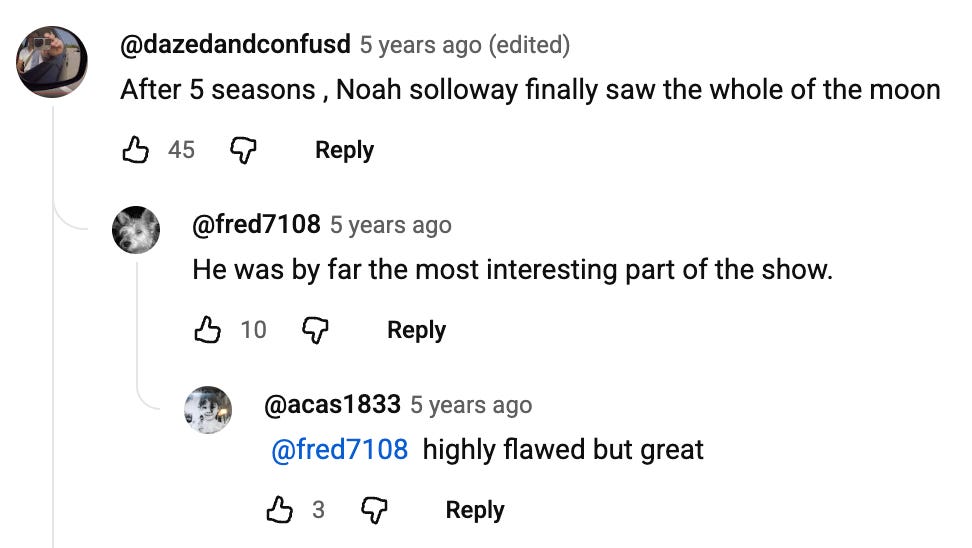
The show itself seems to reach the same conclusion. The final scene of the final season finds Noah, now an old man, dancing alone on a clifftop in Montauk while Fiona Apple’s cover of The Waterboys’ “The Whole of the Moon” plays over him. Underneath the clip on YouTube, one commenter said it better than I’ve managed in four thousand words:
The Affair ran for five seasons on Showtime from 2014 to 2019 and first aired in the UK on Sky Atlantic. At the time of writing, all five seasons are streaming on Paramount+ and free (with ads) on ITVX.
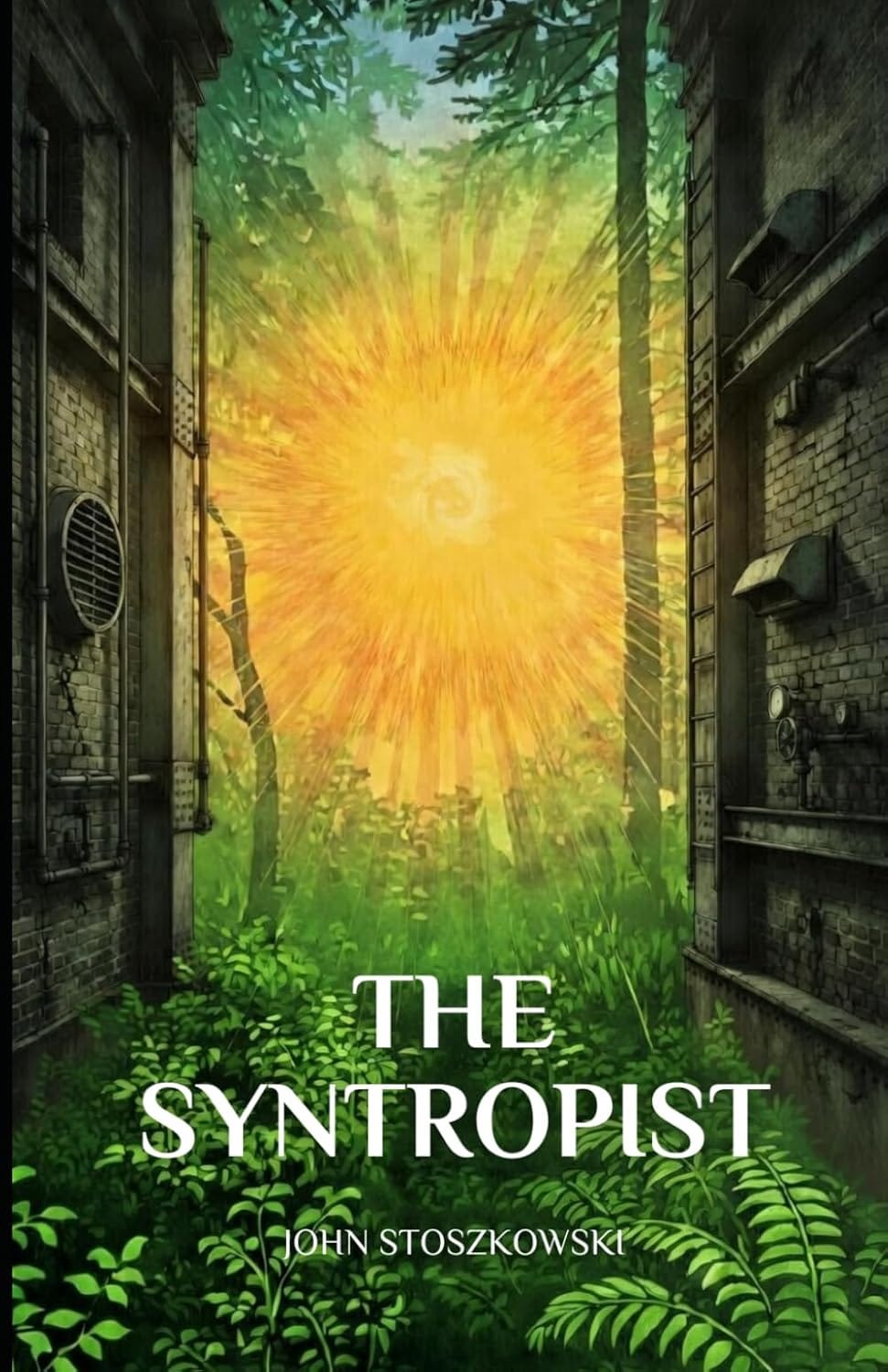
My philosophical novel, The Syntropist, is available worldwide on Amazon. All royalties go to Hospice at Home.
Nietzsche quotations follow Walter Kaufmann’s translations (Beyond Good and Evil; On the Genealogy of Morality; Twilight of the Idols, in The Portable Nietzsche), with occasional minor adjustments.
Nietzsche, Madhyamaka Buddhism, and Whether Emptiness Is an Ending or a Beginning (Substack Post)
Physiology isn’t a side interest for Nietzsche but close to his whole method. He reads moralities as symptoms of the bodies that produce them (“mere sign-language, mere symptomatology,” as he puts it in Twilight of the Idols) and treats décadence as a physiological condition before it’s a cultural one. In Ecce Homo he declares the “small things” (nutrition, place, climate, recreation) “inconceivably more important than everything one has taken to be important so far,” and in the 1886 preface to The Gay Science he suggests that most philosophy to date has been an unwitting “misunderstanding of the body.” Even his quarrel with Wagner he calls physiological: the music made him ill. Digestion and metabolism supply his most persistent metaphors, and often they're more than metaphors.
Hemingway was actually 61 when he died (less than three weeks short of 62).
“Dionysus versus the Crucified” is the final line of Ecce Homo, written in 1888 and published posthumously in 1908. The fullest elaboration of the contrast appears in the late notebooks (the note catalogued as §1052 in The Will to Power). In the letters Nietzsche sent from Turin in early January 1889, as his sanity collapsed, he signed himself alternately “Dionysus” and “The Crucified.”
The distinction between active and passive nihilism comes from Nietzsche’s unpublished notebooks of the late 1880s, assembled posthumously in The Will to Power, rather than from anything he published himself. The characterisation here follows those notes.
The Last Man (der letzte Mensch) appears in the Prologue to Thus Spoke Zarathustra (1883). When Zarathustra describes him to the crowd, expecting horror, they cheerfully ask to be turned into him.
Ray Peat and the Dialectic of Life (Substack Post)
Two caveats for the careful reader. The thesis–antithesis–synthesis triad is a textbook shorthand that Hegel himself barely used; the schema owes more to Fichte and to later popularisers. And Nietzsche’s direct engagement with Hegel was thin: his Hegel arrived largely second-hand, filtered through Schopenhauer’s hostility. The reading of Nietzsche as a systematic anti-Hegelian was developed most influentially by Gilles Deleuze in Nietzsche and Philosophy (1962), which is the source for the claim that Nietzsche’s habit of dissolving oppositions amounts to a resistance to dialectical thinking.
The echo is of The Marriage of Heaven and Hell (c. 1790–93), where Blake writes: “Without Contraries is no progression. Attraction and Repulsion, Reason and Energy, Love and Hate, are necessary to Human existence.” There’s no evidence Nietzsche ever read Blake, who was barely known outside England in the nineteenth century. The affinity is convergence rather than influence. But it runs deep. Blake’s “Energy is Eternal Delight,” and his suspicion of any morality that exists only to restrain it, anticipates the Dionysian by nearly a century.
The thought first appears in The Gay Science §341 (“The greatest weight”), where a demon asks whether you could bear to live your life again, unchanged, innumerable times. Scholars dispute whether Nietzsche intended eternal recurrence as a cosmological doctrine or an existential test; in this essay I’m using it in the latter sense, which is how he frames it there.
“Amor fati” gets its fullest statements in The Gay Science §276 and Ecce Homo (“Why I Am So Clever” §10), where Nietzsche calls it his “formula for greatness in a human being.”
Your writing really helps me synthesise/consolidate my learning from the group discussions and further reading, John. Love this one 😍