


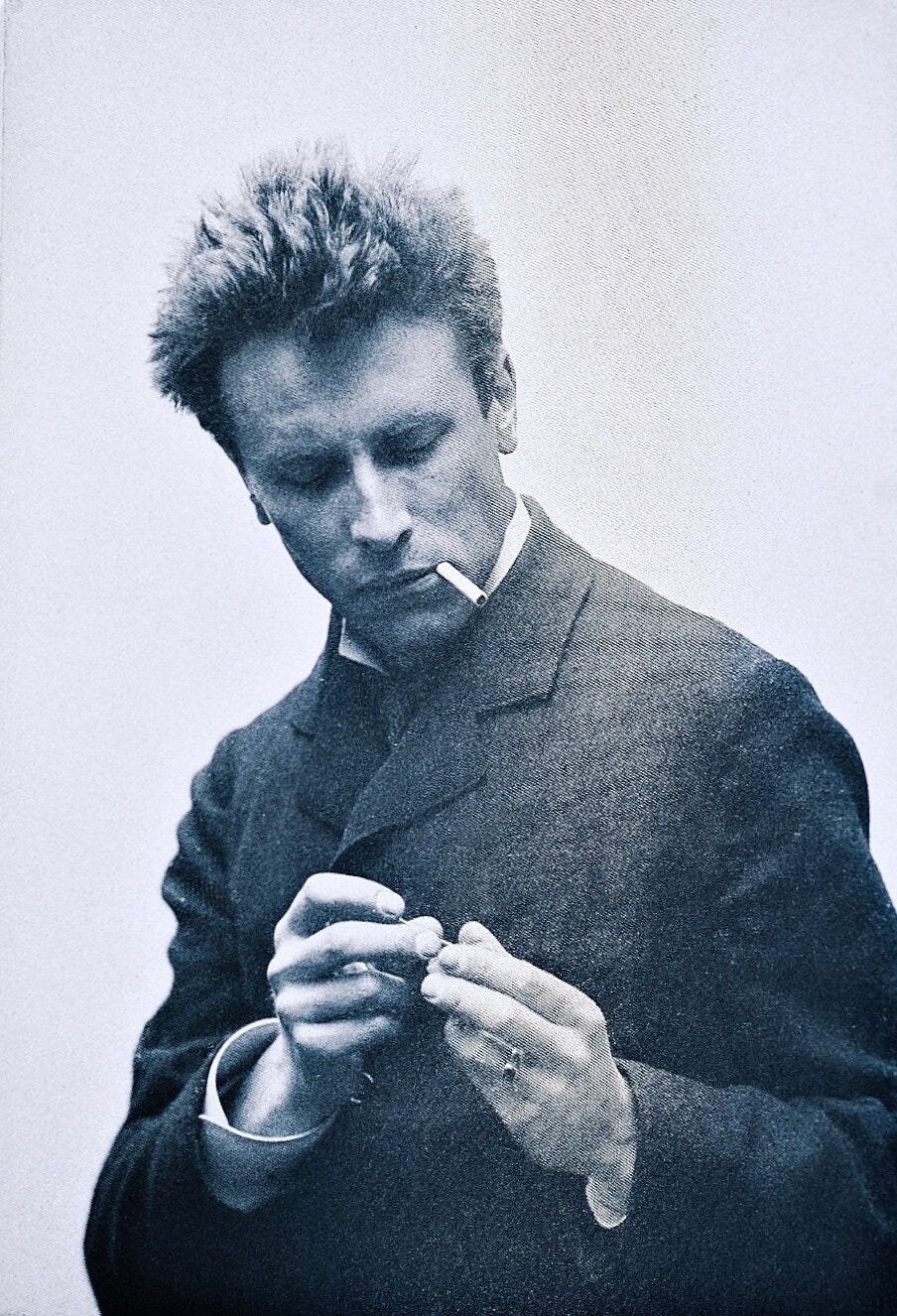
In 1913, while most of Europe was sleepwalking toward disaster, the philosopher-psychologist Ludwig Klages (1872-1956) stood on a German hillside talking to a crowd of young people. He delivered a speech called Mensch und Erde (Humankind and Earth) that now sounds like terrifying forward planning:
“Like an all-devouring conflagration, ‘progress’ scours the Earth, and the place that has fallen to its flames will flourish nevermore, so long as man still survives. The animal and plant species cannot renew themselves, man’s innate warmth of heart has gone, the inner springs that once nurtured the flourishing songs and sacred festivals are blocked, and there remains only a wretched and cold working day and the hollow show of noisy ‘entertainment.’ There can be no doubt: we are living in the era of the decline of the soul.”
This was before the World Wars. Before the atom bomb. Before smartphones, social media, and all the algorithms. Klages had already seen the trend: life getting flatter, more managed, and more cut off from anything that feels properly alive.1
If you’re wondering why modern life often feels so depleted—and what a more syntropic, life-first orientation might look like—Klages gives you a solid guide. His major work, Der Geist als Widersacher der Seele (The Spirit as Adversary of the Soul), published in 1932, is a 1,500-page beast that still hasn’t been fully translated into English.2 But the title alone captures his central point: “spirit” is the enemy of life.
The Great Split of Soul vs Spirit
To understand Klages, you have to grasp his central distinction between life-affirming Seele (soul) and life-destroying Geist (spirit/mind/intellect/rational will).
Like many of the thinkers I write about, Klages had no time for Cartesian dualism, where mind and body are separate substances. Body and soul, for him, are two poles of a single living reality. The body manifests soul; the soul is the meaning of the body. You can’t have one without the other. A living being is body-soul through and through: “wherever there is living body, there is soul; wherever soul, there is living body.”
He calls this basic unit of life the “life-cell” (Lebenszelle): a dynamic unity in which body and soul are inseparable poles of one living process, not two substances pushed together. When that life-cell is in tact, experience has depth and feeling.
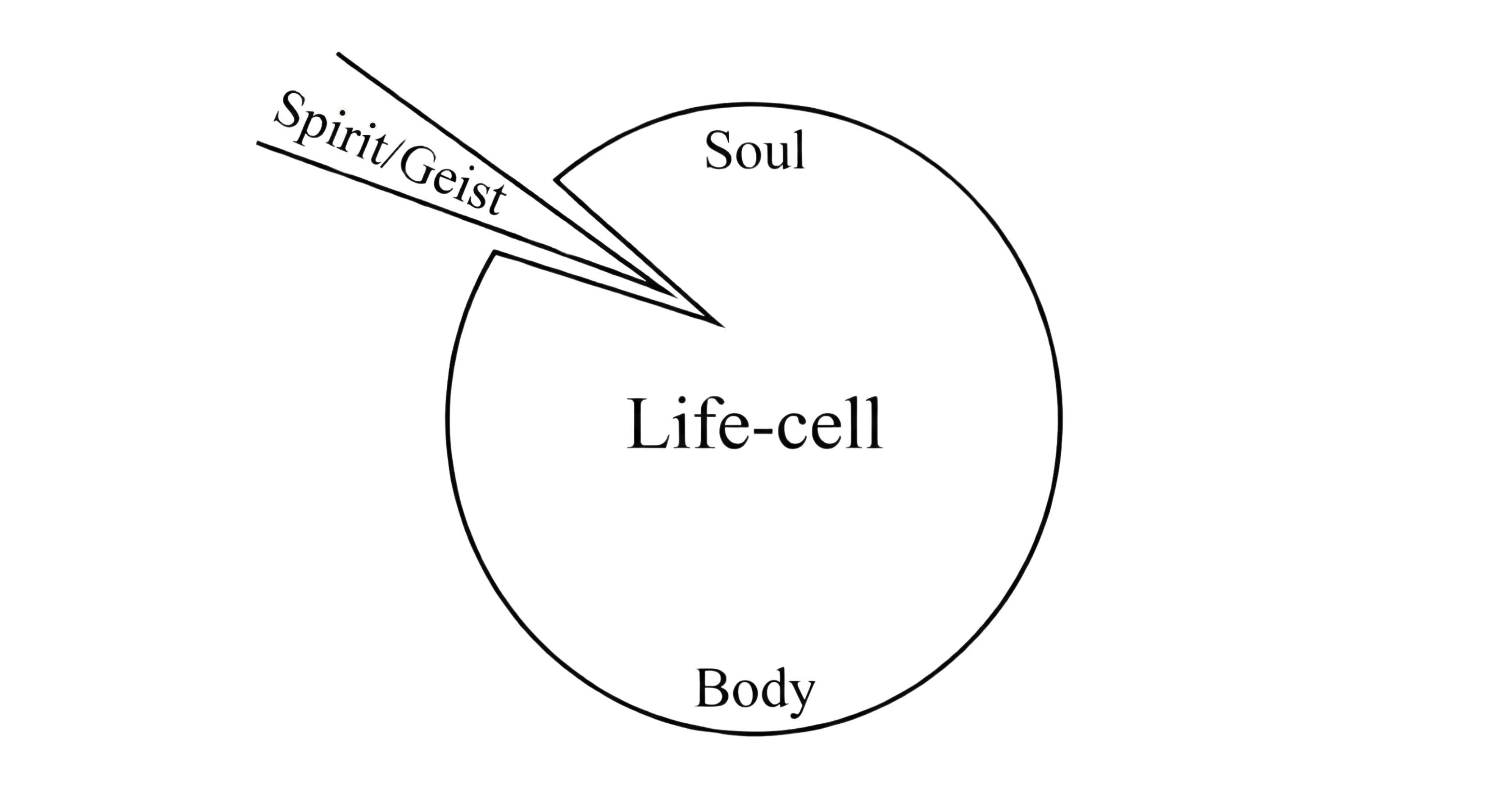
Geist is the external intruder crashing the party. It comes in from “outside” (metaphysically speaking) and drives a wedge between body and soul. It splits what was unified. It abstracts and categorises, calculates, plans, and controls, and in the end tries to dominate life instead of participating in it.
For Klages, this is a world-historical disaster. He sees modern history as a “war to the knife” between all-embracing life and a power “outside space and time” that wants to break body and soul apart:
“Body and soul are poles of the life cell, which belong inseparably together, into which, from outside, the spirit, like a wedge, inserts itself, in the endeavor to split them apart, to de-soul the body, to disembody the soul, and in this way, finally, to kill all the life it can reach.”
If that reminds you of Iain McGilchrist’s ideas on the brain hemispheres, it should. The right hemisphere deals in the living whole, context, and embodiment. The left is abstract, categorical, good at grabbing and using. Klages was onto this nearly a century earlier.
Soul is receptive, rhythmic, and relational; spirit is grasping, conceptual, and obsessed with practical application. Spirit asks about causes; soul asks about meaning. Klages loved Goethe, who said it plainly: “The point of life is life itself.” Spirit always wants life to be for something.
Our “objectivizing intellect” has alienated us from the intuitive and emotional side of ourselves. We’ve got better tools for precision and efficiency, but at the cost of feeling disconnected from something essential:
“As souls we are inescapably intertwined in what is essentially a fleeting reality, but as spirits we are based literally outside this reality, unable, even for the briefest moment, to merge with it.”
A modern cartoon of Geist—and I feel like I’m bullying him at this point as I’ve previously compared him to Rudolf Steiner’s Ahriman—is someone like Bryan Johnson.3 Instead of living in a mortal, “earth rooted” body, his project is to transcend it. To become data. To be immortal, perfectly managed, a system that never fails. The ultimate machine man.
In that mode, people live as if they literally won’t die.4 They hand themselves over to something abstract and external—dead logical concepts, rigid diets, quantified protocols, dashboards of statistics—and drift away from the actual energy of life those numbers were supposed to serve.
Three Stages of Spirit Taking Over
Klages didn’t think spirit was always the enemy, just that the balance shifted:
“At the dawn of history, and for many subsequent generations, spirit existed in a creative symbiosis with the soul. In the course of time, the balance of the poles shifted more and more towards the dominance of spirit over the soul. That development has continued all the way down to the present age. Among every people that we consider to be civilized, spirit eventually severs its ties with the soul.”
He maps this shift through three big historical phases.
First, the good old days of the Pelasgians: the pre‑Greek Mediterranean peoples he romanticises as living out of a symbolic, image-soaked consciousness.5 Their festivals, myths, and erotic bond with the land show what it looks like when human life is knit into the rhythms of earth and cosmos instead of trying to stand outside and manage them.
Then, the Promethean age, running from Plato and classical Athens through Christianity into the Renaissance. Prometheus embodies the rise of willpower and technical knowledge, the move that “made men masters of their minds” and started to pull soul and world apart.
Finally, our own Heraclean age, where we go all-in on hard work, purpose, and production. Hercules chooses effort over ease, and we end up with a civilisation that treats the pleasure of the moment, and the life of the soul, as collateral damage.
Just open your calendar and you can see spirit running the show.
It’s a neat grid of time-blocks, colour-coded, and synced across devices. It doesn’t care whether you’re buzzing with energy or knackered. 2pm means this meeting; 3pm means that one. End of story. If you’re reading this via email, it’s probably underlined those times already so you can add them nice and easily.
Work gets described the same way: KPIs, productivity metrics, performance reviews. Human effort gets flattened into cold digits. The chart never asks if the work was meaningful, just whether the line went up or down.
Klages saw this coming in 1913:
“Most people do not live, they merely exist, wearing themselves out as slaves of ‘work’ like machines in the service of big factories, blindly relying on the numerical delirium of stocks and foundations as slaves of money, to end up as slaves to the intoxicating distractions of the city.”
He’s not saying we’re morally worse. Just that once you decide reality is what can be captured in concepts, measured in numbers, and controlled by plans, the rest follows. The soul becomes awkward and something to medicate or manage.
In Klages’ view, pen-pushing bureaucrats and petty administrators have seized hold of everything with their cold, “instrumental rationality.” That’s the same spirit in the hypothyroid organisations I’ve written about before.6 They’re obsessed with rules, policies, and targets; the human being is just a customer, a client, a case number on a spreadsheet.
But spirit hasn’t won completely.

When the Soul Sneaks Back In
Soul, for Klages, is the living, meaningful, creative essence that connects us to nature, myth, and the cosmos. It’s how we feel alive and sense the life of other beings as more than objects.
Authentic experiences—such as in art, poetry, love, ritual, true friendship, certain kinds of work—are moments when the life-cell lights up and we reconnect with the deep flows that make the world feel whole and alive.
You’ve felt these moments when spirit backs off:
Last time you were genuinely moved by music and transported somewhere else. Your boundaries dissolved into the tune. Your ears were in it, not hearing.
A hike on the fells, where you forgot to check the map, count your steps, or take a photo. You just stood, letting the view sink in.
A proper chat where the time flies, and ideas pop up that neither of you could have had alone.
Real play where you get lost in something for its own sake, not to tick a box or optimise anything. Kids nail this instinctively, full of wonderment and magic.
In those moments you stop grabbing and managing and start receiving. Spirit quietens for a bit, and soul can breathe.
Feeling, in the sense of a profound engagement that draws on all our intellectual and physiological resources, is the key to understanding ourselves and the world. In his essay Consciousness and Life (1915), Klages writes:
“Life is not perceived, but it is felt with a strength that obscures everything. And we need only reflect on this feeling to become aware, with a certainty beyond which there can be none more certain, of the reality of being alive. Whether we judge, think, will or wish, dream, phantasize, all of these are sustained and shot through by one and the same torrent of an elementary feeling of life, which can be compared to nothing, traced back to nothing, that cannot be thought through and analysed, and also of course never ‘understood’. And because we feel ourselves as being alive, what is vital meets us in the image of the world.”
The Reality of Images
One of Klages’ key ideas starts from a simple claim: the world shows up first as living images (Bild) before we turn it into objects.
An image, in the Klagesian sense, is the way reality presents itself to the soul before the intellect chops it up into things with properties. Not a picture in your head, more like the world arriving before you’ve had time to label it. His whole take essentially boils down to two lines from On the Essence of Consciousness (1921):
“The image that falls into the senses,
That and nothing else is the sense of the world.”
He talks about “intuitive images” (Anschauungsbilder) or “primordial images” (Urbilder). The oak tree outside your house isn’t just another pile of wood and leaves; it taps into something deeper—the image of “oak‑ness” running through every oak. Same for mum, river, mountain, birth, death, transformation. We don’t invent these patterns. We receive and live in them.
“The image of the oak, the image of the pine-tree, the image of the fish, the image of the dog, the image of the human being recurs in every single individual carrier of the species. ‘Reproduction’ means the physically eternally inaccessible process of the handing-on of the primordial image of the species from place to place and from time to time.”
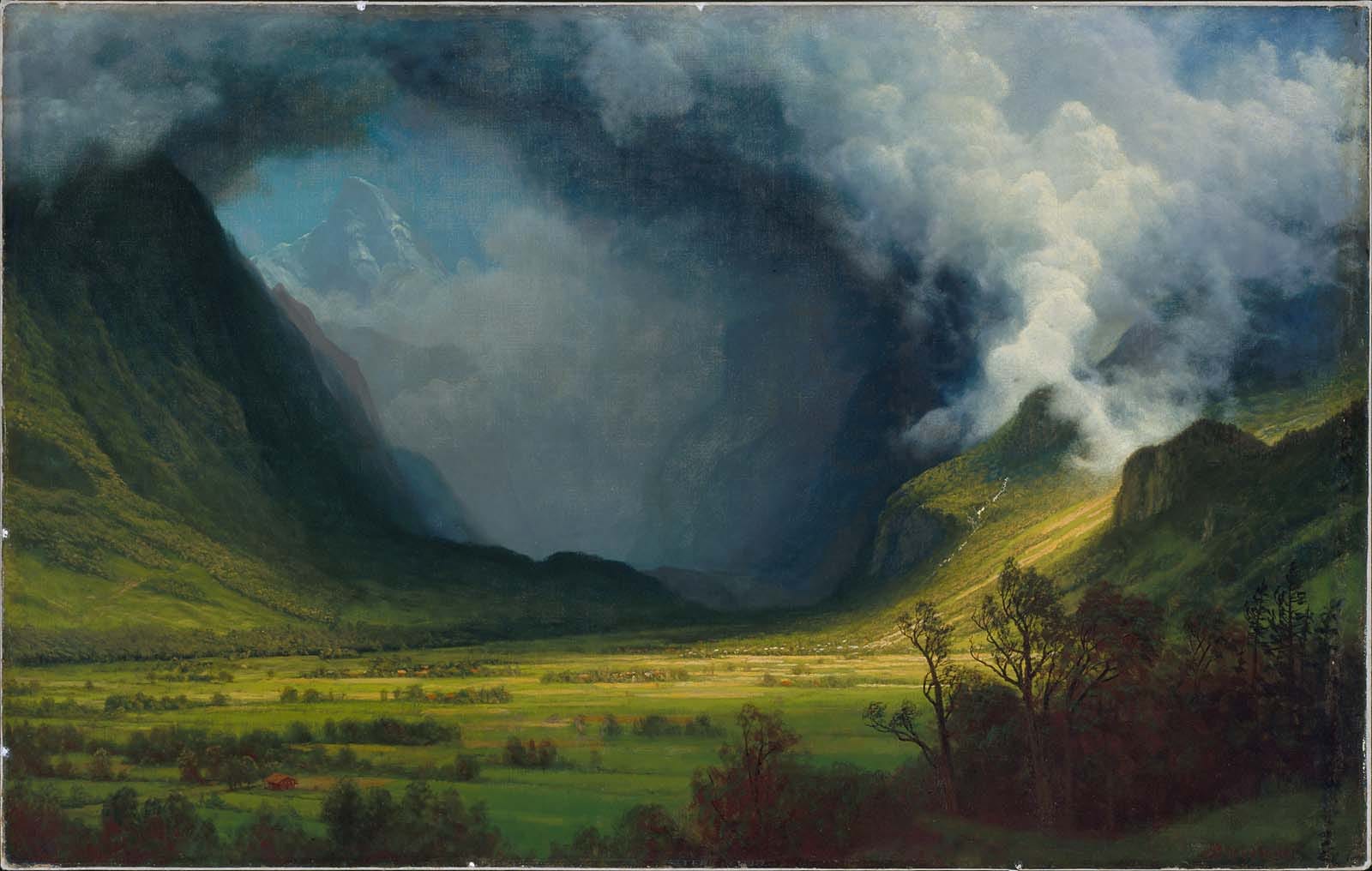
When you see a storm gathering, you encounter a looming, charged presence that means something. “Barometric air pressure and moisture content” comes later, if at all. The weather app’s handy but dead next to it.
For Klages, the only reality is the present moment:
“An image has presence only in the moment of being experienced; a thing is ‘determined’ once and for all - an image flows along with ever-flowing experience; a thing persists…an image is only there in the experience of the person who experiences.”
Spirit’s trick is freezing these living images into static objects it can use. Think of snapping a photo of a beautiful moment instead of actually living it. The camera converts the living scene into pixels. You gain a record and lose the event.
Perhaps the below video is a good example of this, where the lad is looking at his phone instead of experiencing the moment itself.
Modern visual culture is full of what Klages would call drained images: stock and AI generated photos, backgroundable TV, memes, corporate slides, endless scrollable “content” optimised for clicks. Visually, we’re drowning. Soul-wise, we’re starving.
The real images go underground, but they don’t disappear. They turn up in dreams, in art and poetry that stay with you, in a face across the room. They’re why certain stories hit you hard even when you can’t say exactly why. Something deeper is being recognised.
Rhythm vs. Beat
One of Klages’ most helpful ideas for naming our cultural weirdness is his contrast between rhythm and beat.
Picture a hummingbird’s wings versus a steam engine’s pistons. The hummingbird has rhythm: always similar, never exact or identical, tweaking as it goes. The piston has repetition: the same exact stroke, the same interval, over and over.

Rhythm is the language of the soul. Warm, alive, supple, off-the-cuff, pulsing. Klages traces it back to the Greek rheein, “to flow”—the same root as “Rhine.” Rhythm flows like a river, always moving, never exactly the same:
“No wave of water has precisely the same shape and duration as the previous one, no breath and pulse exactly the same length as the following one, no left side of a leaf, an animal, or a human being exactly mirrors the right side.”
Beat is the language of the spirit. Mechanical. It wants what’s predictable, controllable, and copyable. In Foundations of the Science of Expression (1936), Klages writes:
“Steam engines, drop-hammers, pendulum clocks function to a beat, but not in a rhythm; a piece of perfect prose has a perfect rhythm, but certainly not a beat. Life expresses and manifests itself in rhythms’ by contrast, in a beat the spirit compels the rhythmic life-pulse to submit to its own peculiar law.”
As he puts it more succinctly in On the Essence of Rhythm (1934): “the beat repeats, but rhythm renews.”
We’ve built a world on repetition. School bells, 9am starts, Slack alerts, train timetables, notification pings, workouts counted in reps, “productivity” sliced into identical chunks of time.
The soul doesn’t thrive on that. It needs the unevenness of a walk in the woods where no two footsteps land quite the same, work that follows its own internal timing, conversations that wander. Klages’ favourite example of living in a rhythmical way is dance. In real dancing, you get swallowed by the movement:
“The more the dancer is granted the grace of becoming completely absorbed in the dance, the more it is not about movements, not about a change of locations and a measuring of line segments, but about the will-less, indeed almost impulse-less, resonance in the element of a wave-creating motion, which henceforth experiences and, while it is experiencing, at the same time is ‘worked and woven.’”
The ideal is a life that feels more like that dance and less like a clocking‑in machine. By losing yourself in the rhythm, you paradoxically find yourself through becoming one with it. This opens up a different quality of perception, one spirit can’t grasp. The soul “receives the world as ‘images’ as discrete, rhythmically pulsating intermittences.”
A Universe That’s Buzzing
Klages is often labelled a “biocentrist” or “panvitalist,” but it might be better to call his view an “erotic cosmology.” He sees a universe that’s a living, harmonious whole in which beings pull, push, seek, and transform one another.7
Spirit wants a universe built out of contracts, contacts, and control. Eros gives you a universe of encounters and entanglements, where to know something is always, in some measure, to be moved and changed by it.
Eros, for Klages, goes far beyond romance or sex. It’s a primordial, world-creating force—what he calls “Cosmogonic Eros.” It shatters everyday consciousness and dissolves the boundaries of the self, opening you up to a living, breathing, “ensouled” cosmos.
Here he’s close to Ray Peat. The British academic Paul Bishop says that Klages was aiming to “provide a new foundation for psychology on a biological basis.” In Peat’s bioenergetics, energy and structure are inseparable. How much energy a system can process shapes what it can be and do. Life is ordered flow, something way more than just fuel‑burning. That logic scales up: from cells all the way to the cosmos.8
Klages says much the same in different language:
“The doctrine of life states: the universe is alive, the earth is alive, the creatures of the earth—plants, animals, human beings—are alive. Correspondingly, there are cosmic, planetary, and organismic individual life forms.”
On that view, a forest or a river isn’t just “resources” or “infrastructure.” They’re participants in cosmic life. Modern environmentalism tends to say, “We should save the rainforest because it’s useful,” for oxygen, medicines, carbon, tourism. Klages points out the older attitude: when you build a bridge over a river, you apologise to the river‑god; when you chop down an ancient tree, you expect consequences. This goes way beyond superstition to treating the river or tree as a “Thou” rather than an “It.” Something closer to how those Pelasgians lived, before Prometheus handed us the tools to stand apart.
Like Peat, Klages was also thoroughly against the Darwinian notion of the “struggle for existence” and natural selection. In Humankind and Earth he says:
“Nature knows no ‘struggle for existence’, but only the one arising from care for life. Such little weight is placed by Nature on survival that many insects die after the act of procreation, as long as the tide of life sweeps on in similar forms. What makes one animal hunt and kill another is the need of hunger, not acquisitive desire, ambition, lust for power. Here lies a yawning abyss, which no logic of development will ever be able to bridge.”
The Trap of Words
Klages coined the term “logocentrism” to describe Western culture’s obsession with language, concepts, and neat systems over real life. It’s the habit of mistaking the menu for the meal.
You can hear it in corporate speak: “leveraging synergies to optimise the talent pipeline and deliver stakeholder value.” Functional, instrumental, humanly dead. Klages calls it “functional values devoid of living substance.”
He sits alongside Owen Barfield here, who I wrote about in my last essay.9 Barfield thought language starts as living participation in the world and gradually hardens into dead, technical labels. Klages is saying something similar from another angle: spirit turns words into tools.
Language is spirit’s main instrument. With it we carve up the flow of experience, tag the bits with names, and arrange them for use. That’s genuinely useful. But when we act as if what can be said is the whole of what’s real, big chunks of experience fall out of view: the exact taste of this orange juice in this light; the particular feel of this friendship; the vibe of this sunset.
Klages’ interest in handwriting fits here too.10 He believed the soul expresses itself through movement, not just content. A typed email strips the body out. A handwritten letter carries the trace of a person moving: timing, hesitations, pressure, flow. Body connecting to body.
The trick is using language in ways that carry soul. Vary rhythm instead of hammering the same sentence pattern. Use images as well as abstractions. Leave room for silence. Remember there’s a body reading whatever you're writing.
“The praxis by which the poet expresses his inner vision is magic,” Klages says. Good language brings life back into view rather than pushing it out.
What to Do With All This
Klages can seem pretty pessimistic. He thought we’re already living in a post-apocalyptic world and it’s too late to go back to a golden age. He also didn’t think we can manufacture happiness, still less a permanent state of fulfilment. What he wants is a positive, caring attitude towards life—one that emerges naturally, without commandments or compulsion. He wants us to “turn around” from brute will‑to‑power toward a quieter ambition: to do each thing we do “as perfectly as possible.”
When work, attention, and world line up, we get what he calls “moments of great experience”—true happiness that you didn’t engineer. The ego fades, the image of the world shines, and we feel ourselves alive in a way that’s both fragile and eternal. You can’t schedule these moments, and you can’t keep them, but you can live in such a way that they have somewhere to land.
His lens suggests some simple shifts:
Spot where repetition has replaced rhythm. Can you swap the rise and grind routine for things with more give: walking instead of gym machine, cooking by taste instead of macros, working to actual energy rather than the default time slot?
Make space for real images. Not more scrolling, but time where you actually let stuff hit: a landscape you stand in without photographing, a film you watch without a second screen, ideas you jot down before they disappear.
Catch spirit in the act. When you feel the urge to measure, optimise, and control, ask if that reflex is helping, or if you could let this one stay messy and alive.
Let expression carry soul. Whether it’s an email, a meeting, or a talk: can you put some rhythm, warmth, and image into it, rather than defaulting to sterile templates?
Treat yourself as body-soul, not brain-on-legs. Sleep, food, movement, warmth, touch—these aren’t “inputs” to optimise. They’re how your soul exists.
We live in a spirit‑dominated culture. But if Klages is right, life itself hasn’t gone anywhere. The cosmic current is still flowing beneath our habits and systems; we’ve just trained ourselves not to feel it. So the work now is simple and difficult at once: step back in.
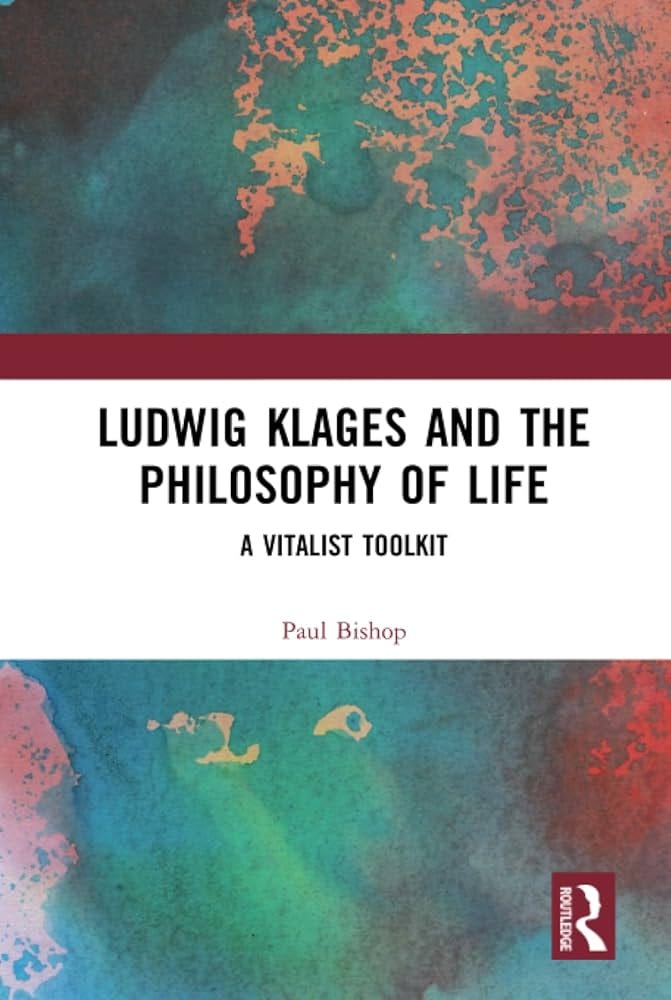
If you’d like to dig deeper into Klages, this book by the British academic Paul Bishop is a really good entry point.
This is a good interview with him on the Hermitix podcast too:
In his time, Klages was enormously influential in Germany—a philosopher-psychologist nominated twice for the Nobel Prize in Literature, whose work on character, expression, and the soul attracted serious attention across Europe. Today he’s largely forgotten, most of his major works untranslated into English, his reputation complicated by the politics of his era. Although he’s often painted as antisemitic and “right wing” by critics, during the Nazi era, the regime rejected Klages. His philosophy was too strange, too life-affirming in the wrong ways, too resistant to being turned into propaganda. After the war, under the new American-influenced order, he was largely ignored or treated as suspect. He spent his final years editing manuscripts in Switzerland, remarking near the end: “My teachings are buried.”
Klages is quite a touch read as much of his work makes noted use of highly precise philosophical German language as well as occasional esoteric terminology.
Rudolf Steiner and the Threefold Forces in Our Time (Substack Post)
Philosophers love playing “when did it all go wrong,” a kind of top trumps for civilisational decline. For Klages, the answer is the Pelasgians: an ancient, enigmatic people believed to be the earliest inhabitants of Greece and the Aegean, predating the Hellenic tribes. Classical authors like Homer and Herodotus mention them, though their exact origins and identity remain uncertain. The term served as a catch-all for pre-Greek indigenous populations, and modern scholarship views them as a mytho-historical construct rather than a single ethnic group—ancient Greeks trying to explain their own origins. For Klages, they represent an idealised image of human life before spirit drove its wedge between us and the world.
The Hypothyroid Organisation (Substack Post)
By erotic Klages means Eros in the broad, ancient sense: the responsive, attractive power through which beings seek, resonate with, and transform one another—not just sexual desire, but the connective tissue of the cosmos.
Ray Peat and the Dialectic of Life (Substack Post)
Owen Barfield and the Wisdom of the Silver Trumpet (Substack Post)
Klages became well known for his work in “graphology, ” which is the study of handwriting as an expression of character. He didn’t treat it as fortune‑telling, but as a way of reading the rhythm, pressure, and movement of the script as direct traces of the writer’s soul, not just a neutral vehicle for words.
“Never give a sword to a man who cannot dance.” - Confucius
Thank you for writing about Klages. I’ve never heard of him before.