


In my last essay, I tried to explain Ray Peat’s argument against Noam Chomsky’s idea of “universal grammar.” Peat said that when we see language as a closed-off, formal system, we lose touch with how it’s actually alive, shaped by our bodies, cultures, and relationships. That loss leads to speech that feels flat and empty. In this piece, the English philosopher, writer, and poet Owen Barfield (1898-1997) helps us see why language feels so shallow today—and how that shallowness mirrors the stage of consciousness we’re in right now.1
“We are well supplied with interesting writers, but Owen Barfield is not content to be merely interesting. His ambition is to set us free. Free from what? From the prison we have made for ourselves by our ways of knowing, our limited and false habits of thought, our ‘common sense’.”
— Saul Bellow, Nobel Prize–winning novelist
In another recent piece on “Netflix cringe,” I argued that much of today’s dialogue in films and TV is fine for sharing facts but lifeless as real human expression.2 It’s too literal and lacks energy. That flatness in speech points to a bigger issue: we’ve made our whole view of reality feel thinner. To understand why our language has become so empty, we need to see why the world itself started feeling empty.
Enter Big Owen Barfield.
Barfield, known as the “First Inkling” (an early member of a group of writers including C.S. Lewis and J.R.R. Tolkien), shaped their ideas from the start.3 He was also a dedicated follower of Rudolf Steiner’s anthroposophy—a spiritual philosophy about how human awareness grows over time. Barfield built on Steiner’s thoughts but turned them toward literature and language.4 He wasn’t just creating another clever theory to sit on a bookshelf. As Saul Bellow saw, Barfield’s goal was liberation: helping us escape a trap we don’t see, because it looks like “normal” reality and “common sense.”
If cringe dialogue in shows like Stranger Things is the sign of trouble, Barfield provides the explanation: we’re stuck in a particular way of thinking that’s tied to history. It’s an important and necessary step in our development, but it’s getting harder to live with. The good news is it’s not the end. It might be leading to a bolder, more challenging way of engaging with the world.
The History of Our Inner World
To get Barfield’s point, we have to let go of the comforting idea that the world has always been “out there,” a finished, neutral thing just waiting for better measuring tools to study it with. His take is more jarring: our awareness (what we call consciousness) and the cosmos grow and change together. The “inside” of the world and our own inner life aren’t two separate pieces that later came into contact. They’ve been unfolding side by side from the beginning.
Barfield maps this growth through three broad phases or epochs, based on historical evidence from ancient languages, myths, and philosophies: original participation, onlooker consciousness, and final participation. They’re overlapping tendencies rather than strict time periods, but they show how we got here and what it will take to move forward.
Running through this is his analysis of three modes of thinking: figuration, alpha-thinking, and beta-thinking. These are interwoven processes that shape how we perceive, explain, and then consciously reflect on the world.
At the heart of all this is language acting like a “fossil” of consciousness, a record of how minds and the world once connected. For example, the word “individual” once meant “undivided” or inseparable from the whole, hinting at how our thinking shifted toward feeling separate.
1. Original Participation and Figuration
Back in the day, early humans lived with blurry lines between themselves and the world around them. Things we’d now call “natural forces,” like wind, felt like living presences or powers. Wind wasn’t just moving air; in Greek it was “pneuma” or in Hebrew “ruach”—a single word blending breath, spirit, wind, and life-force. Those word origins show how ancient languages bundled up what we now separate into physical, mental, and spiritual categories, reflecting a consciousness where meaning grabbed you all at once.
Here, Barfield talks about “figuration,” the basic process by which the “unrepresented” world becomes a represented “world of appearances.” This activity is largely unconscious: our sensing and thinking work together to turn what we see, hear, and feel into organised pictures of things and beings—what Barfield called “collective representations.” These are shared patterns of how things show up in culture. Figuration is what makes a coherent world of appearances appear in the first place.
In that state, Barfield said, people “did not feel themselves isolated by their skin from the world outside” like we do. They were “less like an island” and “more like an embryo,” linked to everything by invisible threads. Language wasn’t something you picked up like a neutral tool. Rather, words were “concrete and unified” happenings, full of stories. Myths weren’t made-up tales or mere rules to follow but the air everyone breathed, a way to express real truths. Poetry today can momentarily restore this kind of “semantic unity,” as Barfield explains in his book Poetic Diction (1928). This vision shaped how Tolkien and Lewis built their own worlds like Middle-Earth and Narnia. They saw this “myth-making” (or “mythopoeia”) as humans creating tales that reflect how God might have made the real world, giving them a layer of deeper truth and magic.
Imagine a pigeon just knocking about, living it’s best pigeon life. It does it instinctively. There’s a natural biological flow, but no biographical inner voice narrating or self-reflecting. That’s similar to original participation: nature’s wisdom flowing through you rather than from you. An “originally-participating” human didn’t think of an “I” as separate. There was no hard split between a private inner self and an outside world.
It was a vibrant, magical way to live. But the downside was there was no real freedom or independence. So some separation was needed.
2. Onlooker Consciousness, Alpha Thinking, and Idolatry
Over time, consciousness pulled back—a shift Barfield linked to early Greek philosophers (like Plato, who split ideal forms from material) and saw speeding up during the Scientific Revolution and Enlightenment. What once felt alive and inward got pushed outward. Spirit left things like wind and water and ended up mostly in our heads. The world got quieter and flatter. A new focus emerged: the reflective “I.” The world stopped “talking” to us and became something to measure, predict, and control.
Here we move from pure figuration into “Alpha-thinking.” Alpha-thinking is our reflective, explanatory mode of thought about the already-given world of appearances. It’s when we step back from what shows up and start forming concepts, theories, laws, mechanisms, and models. Done well, it gives us science and philosophy. Done badly, it forgets that its concepts are abstractions drawn from a deeper, lived world.
In this phase, a familiar split becomes entrenched between:
1st Person view: your own “I” or consciousness.
2nd Person view: the relational “you,” and the world as a living “thou.”
3rd Person view: objects, facts, data, models.
Science brackets out the first two for the sake of objective facts. That move gives us immense technological advances and analytical clarity. But the trap—what Barfield calls “Idolatry”—is treating the 3rd-person, fact-based view as the the whole, as if the map created the territory. We start to see our abstractions as reality itself.

Idol vs. icon
Barfield draws a sharp line between a “lost appearance” and a “saved” one.5
The idol: If I stare at a tree and think, “There’s nothing there but cellulose and chlorophyll,” I’ve reduced it to its surface appearance.
The icon: If I see the same tree as a shadow, a symbol, or a hint of something greater—a phenomenon representing an unseen depth—then I’m able to look through the thing into real meaning.
Modern life trains us to see only idols. We live in what Barfield called the “real world” of particles and forces, but our everyday life experience is the “familiar world” full of colours, sounds, and meanings that science can’t fully capture. We have immense power without belonging, and information without deeper significance. As Byung-Chul Han says, we no longer “feel at home in the world.” That word, “feel,” is key for Barfield.
In The Silver Trumpet, which we’ll come to in a sec, he writes (with emphasis):
“The Dwarf spoke so fast and used such funny long words that the Prince understood a good deal less than half of what he said. And yet he somehow felt in his bones that this queer little creature was good and meant kindly by him. HE FELT IT IN HIS BONES.”
In an interview in 1984, Barfield said he wrote the story partly to highlight “the importance of the feeling element in life.”
Instead, we’ve fallen into what William Blake called “Single Vision” and “Newton’s Sleep”—accurate enough for machines and engineering, but not enough for a full human life.6
This is onlooker consciousness, our default mode: a self sealed off from the living world. We take it as obvious, like the fish unaware it swims in water. Barfield warns that we’re guilty of “logomorphism”—projecting our modern divide back onto ancient times, when people experienced things differently. Iain McGilchrist would call it the left hemisphere running amok: all mechanisms and models, no big picture or connections.
The Silver Trumpet
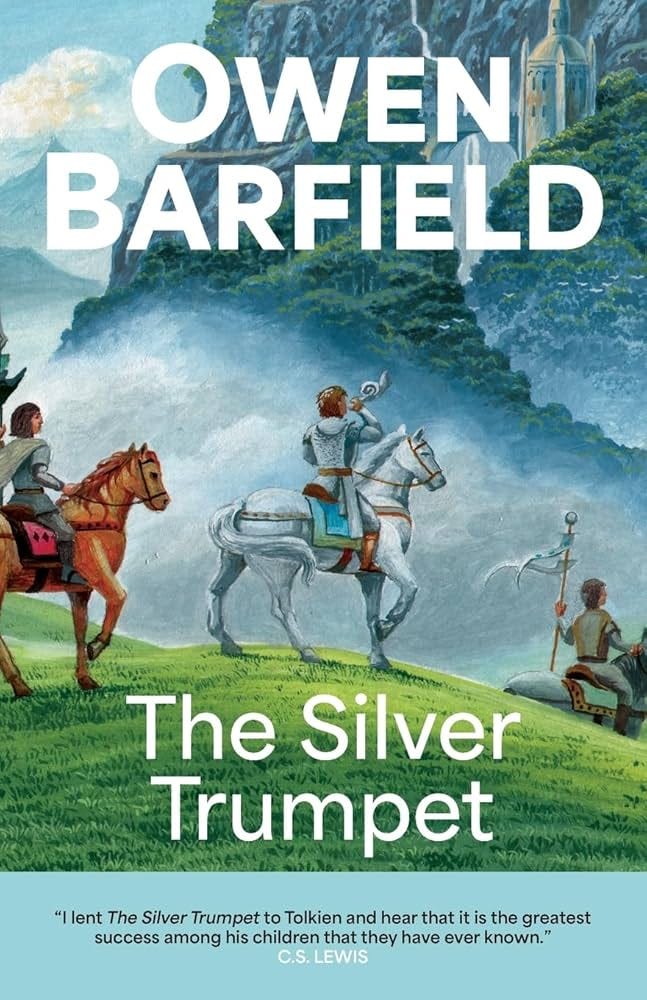
Barfield dramatised this cultural loss (and how to fix it) in his first book, The Silver Trumpet (1925). It’s a brilliant fairy tale for kids but also a preview of the ideas he later developed in Saving The Appearances (1957), his seminal work on the evolution of consciousness.
Two sisters anchor the story: Violetta, who’s truly beautiful and good, and Gambetta, her identical but hollow twin. Prince Courtesy loves Violetta; her dancing and movement give everyone around her a buzz. His father, the King, gives him a magical Silver Trumpet with one rule: never, ever part with it.
But the Prince wants Violetta’s love so desperately that when she asks to play with the Trumpet one day, he hands it over. She loses it, and Gambetta stashes it away. With the Trumpet gone, a “Fall” follows. Violetta slips into a deep sleep like death, and the Prince, unable to distinguish reality from appearance, ends up with Gambetta. He lives in a reign of inner falsity, devoted to an empty idol who looks like his beloved but contains none of her spirit. The whole kingdom slides into a dull, spiritual stupor.
Years later, a new prince, Peerio, falls in love with Princess Lily (Violetta’s daughter) after seeing her portrait. Crucially, he loves the real person behind the image, not the image itself. He recovers the lost Silver Trumpet and by blowing it, the curse is lifted. The “dead” world comes back to life, Gambetta’s hollowness is exposed and she’s eventually forgotten. Sanity returns.
The Silver Trumpet symbolises “Poetic Imagination”—our ability to “see through” appearances into the realm of meaning.
Violetta is a “participated image,” beauty transparent to a deeper spiritual reality.
Gambetta is the “idol,” the surface without depth, pure materialism.
The Loss: When Prince Courtesy parts with the Trumpet, he loses the ability to distinguish icon from idol. That’s us today: we’ve mislaid the Trumpet and dulled our imagination. We deify matter and ignore spirit.
The Recovery: Prince Peerio is a redemptive figure. He uses the Trumpet (imagination) to reverse the curse. The story hints that only a disciplined, poetic imagination can undo the “idolatry” of a purely left hemispheric, science-only view and bring a dead world back to life.
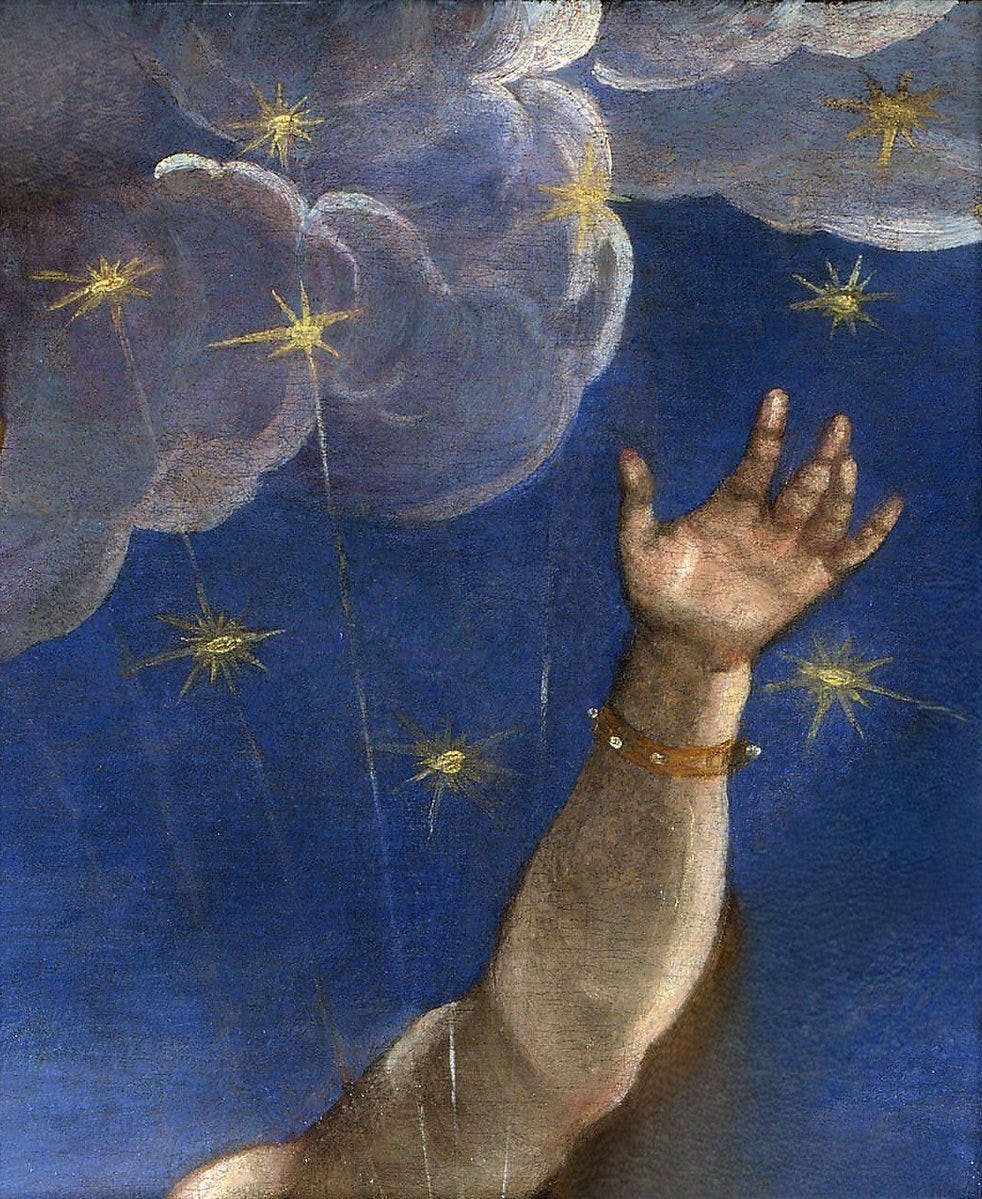
Violetta also represents Sophia (Divine Wisdom from the bible). The Book of Proverbs pictures Sophia dancing on the circle of the world before the face of God.7 That “Great Dance” shows up in C.S. Lewis (Aslan singing Narnia into being) and Tolkien (the Ainulindalë, the music of the Ainur).8 Etymologically, to “en-chant” is literally to sing into existence. When the Trumpet is lost, the song stops and we’re left with dead matter. When it’s found, the music resumes and the world lives again.
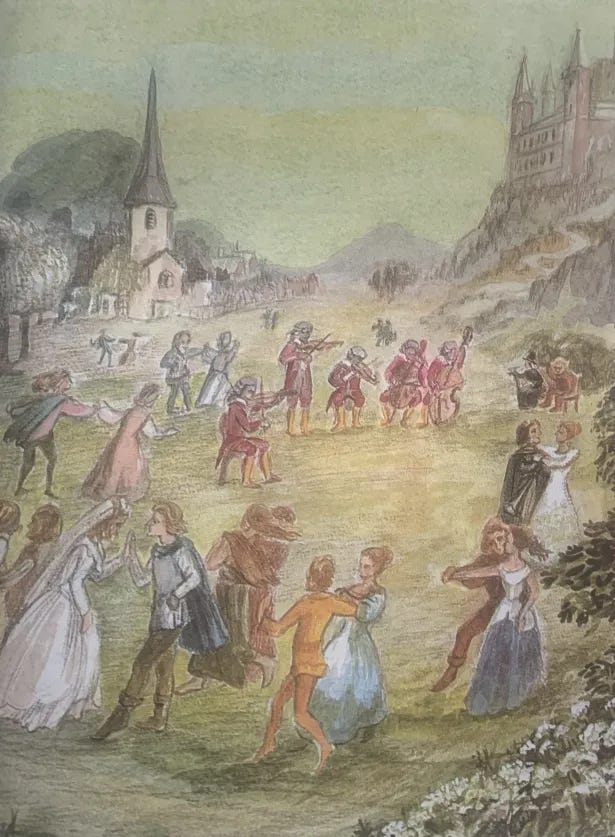
This plants the idea for Barfield’s later thoughts: imagination as the bridge between human consciousness and divine reality. As the dwarf in The Silver Trumpet says, “‘Music hath charms…Harmony, you know, harmony—Form versus Chaos—Light v. Darkness…It’s all one.’” That line echoes Heraclitus’ unity of opposites, Blake’s “without contraries is no progression,” and the Taoist yin-yang balance. Drawing on Samuel Taylor Coleridge’s concept of “polarity,” Barfield sees this tension—between wholeness and parts, spirit and matter, Luciferic (overly-spiritual) and Ahrimanic (overly-material) forces—as the engine of evolution.9 Barfield is another thinker who recognises harmony emerges from holding tension in balance, not by getting rid of it.
3. Final Participation, Beta-Thinking, and The Syntropic Turn
Most critiques of modern life stop with the diagnosis. Barfield offers a way forward. We can’t simply regress and go back to original participation. The alienation of modernity, for him, was needed to build a free, independent self. Only someone who’s stepped back from nature and reality can freely join in with it again.
Barfield calls this “Final Participation,” a phrase he develops out of Rudolf Steiner’s account of how human consciousness must pass through separation and return freely to a new kind of unity. His anthroposophical Christianity puts Christ at the centre as the balancer—holding opposites together, channeling the “Logos” through imagination, which reunites spirit and world again.
Original Participation: Meaning happens to us; figuration creates appearances unconsciously.
Onlooker Consciousness (Modernity): Meaning is denied or downgraded as illusion; alpha-thinking introduces analytical detachment.
Final Participation: Meaning is consciously carried; beta-thinking enables self-aware reflection and a more integrated relationship with reality.
“Beta-thinking,” is the highest level of reflection: thought that turns back not just on the world but on our own thinking. It’s metacognition in the deep sense: examining how our representations arise, how language shapes them, and how consciousness participates in what it knows. For Barfield, beta-thinking is what lets us see figuration and alpha-thinking for what they are, instead of being unconsciously driven by them. This is crucial for Final Participation. We’re not trying to slide back into the old, unconscious unity of original participation. Beta-thinking allows a conscious, freely chosen participation: we know that meaning arises between a human consciousness and a responsive world, and we take responsibility for that relationship.
For Barfield, imagination isn’t an escape from logic and reason, but a higher form of it—an organ of perception. Where intellect and analysis break stuff apart, imagination puts it back together again. It’s not silly daydreaming but joining in with what Blake called “the world of Imagination, which is the real and eternal world of which this vegetable universe is but a faint shadow.” In later works like Unancestral Voice (1965), Barfield explores prophetic intuition as a foretaste of this, while Rediscovery of Meaning (1977) refines participation as conscious co-creation.
Barfield saw the evolution of consciousness not as human invention but as the universe coming to know itself through human attention. Each stage has a purpose: instinctive togetherness, reflective detachment, and then the conscious reunion of spirit and world. That vision also resonates with contemporary ecological concerns, where seeing nature as a participatory “you,” not just a “resource,” helps resist treating it as an idol and eases some of our climate-era alientation.
He never used the word syntropy, but the concept fits. If entropy is drift toward disintegration, syntropy is movement toward higher coherence and integration. Ray Peat described health as “organised energy flow;” Barfield saw imagination as the same pattern at the level of consciousness. We’re now called to actively participate in the world’s meaning, as collaborators and co-creators rather than detached observers. Final Participation is a syntropic act in a living universe. It echoes Ernst Bloch’s idea of “anticipatory consciousness”—reading the world for its “Not-Yetness,” its unrealised potential.10 For Barfield, the Logos is like music deep down. Discord and harmony aren’t just moral categories of right/wrong but ways of knowing. When we truly listen, matter and meaning resound together.
The Problem with Plato
Here’s where some friction shows up for me. The Inklings—Lewis especially—leaned into a Platonic worldview, where the physical world is a “shadow,” a reflection of a higher, perfect realm. Nietzsche’s jab that Christianity is “Platonism for the masses” captures that suspicion: the real party is somewhere else, and this world is second-rate.
Regular readers know I’m way more drawn to becoming than to static being—a dynamic process we’re actively shaping, with the world as work-in-progress.
But Barfield’s ideas still work. In many ways, he’s already turning Platonism on its head. Instead of timeless perfect Forms reflected in matter, he sees living meanings unfolding through time. His world isn’t a static hierarchy of being but a story of becoming, with spirit expressing itself through matter.
Even if we strip away the more rigid Platonic parts, The Silver Trumpet still offers the same core lesson: the world is alive with potential and possibility, and our imagination helps it unfold. Final Participation isn’t about escaping to a world of ideal Forms but about co-creating this one. It refuses to see reality as finished.
Syntropy in Practice
Barfield said to think of Final Participation “as a direction in which we had all better be moving,” rather than a destination to tick off. We can start small, using his ideas as daily habits to push back against “shallow” language in media and AI. As a solicitor, Barfield valued practical steps, applying participatory ethics to law—treating contracts as living agreements instead of stiff idols. He warned against escapist fantasy, stressing balance between reason and imagination to avoid over-romanticism. You could even test these out empirically by keeping a journal of perceptual shifts and changes in things like empathy or creativity as you practice.
1. Being over having
Erich Fromm’s contrast fits here: “Being” mode vs. “Having” mode. Idolatry lives in “having”—treating the world as a possession, a resource, a dead noun. Final Participation lives in “being”—using living verbs. Try saying “I’m colding” rather than “I have a cold,” or “I’m deciding” rather than “I have a decision to make.” Life as process, not possession.
2. Dig out dead metaphors
Everyday craic is full of dead metaphors. “Make it grabbable” once meant a physical hand closing around something (“grasp an idea” hints at lost unity). “Focus attention” pointed to a burning point of light. “Inspire” meant to breathe in spirit. Stop and visualise them, maybe checking origins in a good dictionary or Barfield’s History in English Words (1926). He writes:
“In the common words we use every day the souls of past races, the thoughts and feelings of individual men stand around us, not dead, but frozen into their attitudes likes the courtiers in the garden of the Sleeping Beauty. The more common a word is and the simpler its meaning, the bolder very likely is the original thought which it contains and the more intense the intellectual or poetic efforts which went to its making.”
As you re-animate the images, the words feel fuller. Speech becomes more like sketching or painting than algebra, which is one way to counter cringe dialogue.
3. The double look
Look at a tree. First, with modern eyes: a biological machine, an object “out there.” Then, drop the label. See it as a verb—a slow, upward burst of growth. Feel the tension in its branches. If you keep going, your thinking changes. That shift is you moving from observation into participation. You can deepen this with Steiner-inspired practices Barfield liked: watching a plant’s growth over weeks, writing poems that “save” appearances, or even trying eurythmy (a movement art from anthroposophy) to feel language in your body.
Barfield’s own poem An Autumn Bicycle Ride (1919) shows the vibe:
The leaves, grown rusty overhead,
Dropped on the road and made it red.
The air that coldly wrapped me round,
Stained by the glowing of the ground,
Had bathed the world in the cosy gloom
Of a great, red-carpeted, firelit room;
It filled my lungs, as I rode along,
Till they overflowed in a flood of song,
And joy grew truculent in my throat,
Uttering a pompous trombone-note;
For this elegant modern soul of mine
Was warm with old Autumn’s rich red wine.
See how internal feelings (joy/song) blend with the external world (leaves/air)? Try the same with whatever’s near you: a cup, a plant, a lamp. First as a dead object (idol); then as active presence, a “saved appearance” (icon).
4. The “just” fast
For one week, drop the word “just” from your explanations. Don’t say “it’s just the wind” or “it was just a dream.” “Just” erases depth. Without it, reality starts to feel much weirder, richer, and more demanding of your attention.
Finding the Trumpet Again
Long story short, we’ve become a civilisation of surface-dwellers. Led by detached, logic-only thinking, we’ve deified the outer image—taking things at face value, not deeply. “There’s nothing more to it than what meets the eye,” we think. And we miss everything.
At the end of Saving the Appearances, Barfield offers a sobering reminder: In Hebrew, an idol isn’t only a “false god,” but something experienced as totally devoid of spirit. That’s the hollowness pushing down on us now. We’ve lost the Silver Trumpet—our creative imagination that lets us see through to meaning. Our task is to find it again: to stop worshipping the world’s empty shell and learn to play the tune that brings it back to life.
Language is where all of this plays out most intimately. Barfield saw words as fossils of consciousness—each one preserving an earlier way the world and mind once met. As meanings split and thin, so does our sense of participation. The modern mind treats language as a neutral code or engine for information, from Descartes to Chomsky’s “universal grammar.” But for syntropic thinkers like Barfield and Ray Peat, language is metabolically alive—an organ of relation, not a machine of syntax. Speech doesn’t just (😁) describe the world; it embodies the world’s becoming.
Our speech reveals our consciousness. Dead words shrink imagination. The recovery of participation begins in language itself: re‑learning to talk as if the world’s alive, because it is!
I was listening to this tune by Glassio a lot while finishing this piece off. It feels very Barfieldian as it builds. The album cover it’s from does too.
I'll keep on waiting and wishing through the dunes
And the nighttime will tear me away from the things you do
When you're trying your best to dance
Oh, you're trying you're best to dance
And I'm all in love again
Now I'm spreading my wings until someone holds my hand
The Silver Trumpet has just been republished by the Barfield Press. It’s available on Amazon here.
The Stranger Things We Watch When Low Energy (Substack Post)
The Inklings were an informal literary discussion group associated with J. R. R. Tolkien and C. S. Lewis at the University of Oxford for nearly two decades between the early 1930s and late 1949. The Inklings were literary enthusiasts who praised the value of narrative in fiction and encouraged the writing of fantasy. The best-known, apart from Tolkien and Lewis, were Charles Williams, and (although a Londoner) Owen Barfield.
Barfield’s oeuvre spans linguistics (Poetic Diction: A Study in Meaning, 1928; History in English Words, 1926), philosophy (Saving the Appearances: A Study in Idolatry, 1957; What Coleridge Thought, 1971), fiction (The Silver Trumpet, 1925; Worlds Apart, 1963), and even law (Speaker’s Meaning, 1967), where he applied participatory thinking to ethics and contracts. Across these, Barfield critiques fragmented worldviews—like the materialist-science vs. spiritual divide dramatised in Worlds Apart’s philosophical dialogues—and positions humans as co-creators in cosmic evolution, countering modern alienation with a call to active participation.
Barfield used the term “saved appearance” to describe a representation or phenomenon that is recognised for what it truly is: a sign or symbol pointing to a deeper, underlying reality, rather than being mistaken for that reality itself. In his view, when appearances are “saved,” they retain their role as transparent windows into the unseen or spiritual world, maintaining their symbolic and participatory significance. This contrasts with the modern tendency to treat appearances as independent, objective realities—what Barfield calls “idolatry”—where the image is taken as the thing itself, leading to a loss of meaning and a disconnection from the deeper order of existence. Barfield argued that in earlier stages of human consciousness, particularly in medieval thought, people experienced the world “participatorily,” seeing phenomena as meaningful representations of a divine or spiritual reality. In this state, appearances were “saved” because they were understood as signs, not substitutes for truth.
However, with the rise of modern scientific thinking, especially after the Copernican revolution, the phrase “saving the appearances” took on a new meaning: if a hypothesis explains all observable phenomena, it is considered identical to truth, leading to a reification of appearances as ultimate realities. This shift diminished the appreciation for the representational and imaginative aspects of perception. Thus, “saved appearance” in Barfield’s philosophy means preserving the integrity of perception by recognising that what we see is not the final reality but a mediated, symbolic expression of something deeper. The “Silver Trumpet” in his fairy tale The Silver Trumpet symbolises this ability to see through appearances to the reality they represent, restoring the sacred and meaningful connection between the visible and the invisible. When appearances are not saved, they become idols—empty, literalised forms that block access to the divine or spiritual dimensions of existence.
William Blake and the Sacred Power of Imagination (Substack Post)
The Book of Proverbs is the second book in the third section of the Hebrew Bible and a book in the Christian Old Testament. It’s traditionally ascribed to King Solomon and his students. Proverbs isn’t merely an anthology but a “collection of collections” relating to a pattern of life that lasted for more than a millennium. It’s an example of Biblical wisdom literature and raises questions about values, moral behaviour, the meaning of human life, and right conduct, and its theological foundation is that “the fear of God is the beginning of wisdom.”
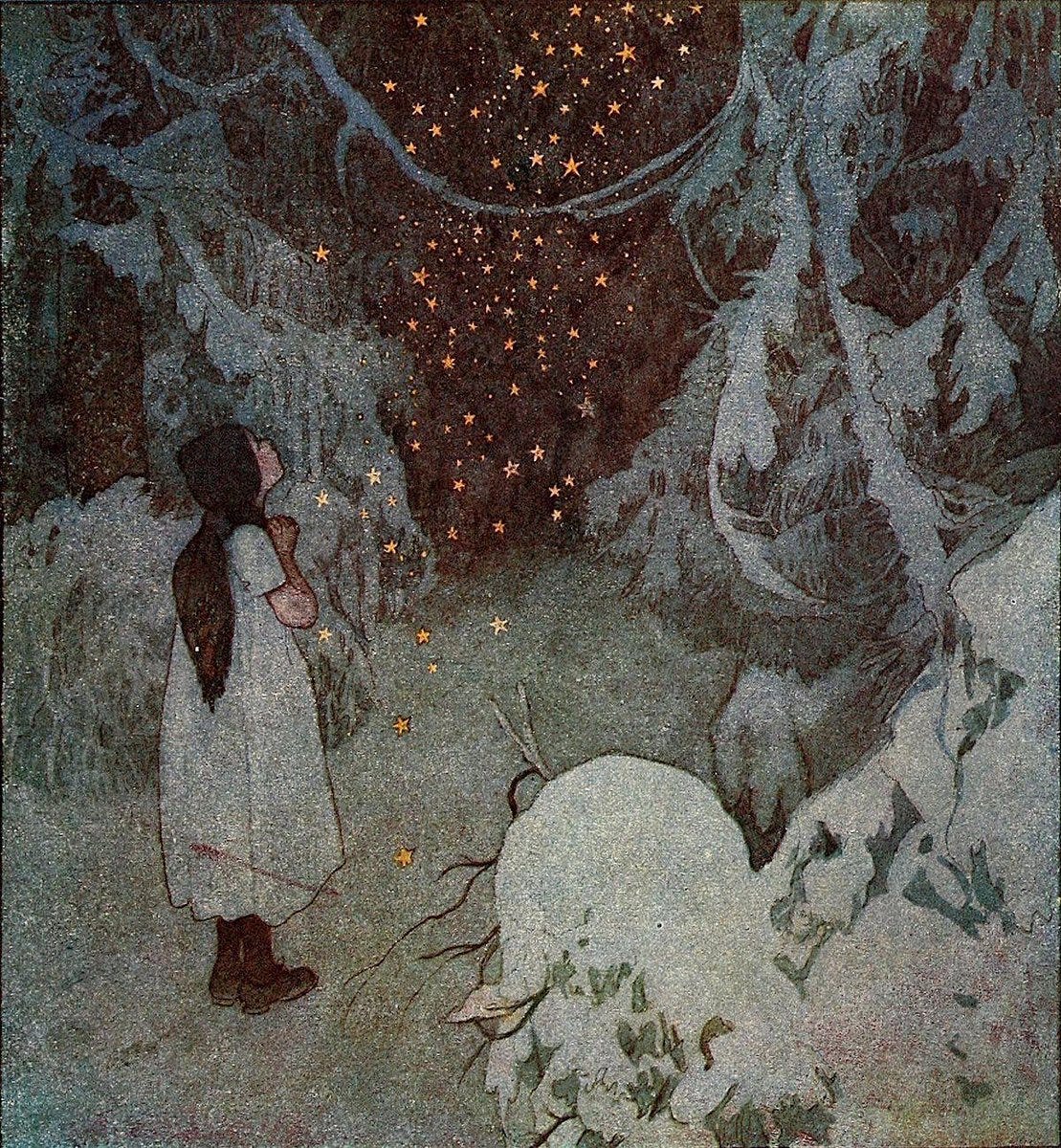
Aslan sings Narnia into existence from a state of darkness and emptiness, beginning with a deep, resonant voice that seems to come from all directions at once, even from the earth itself. This song is described as the most beautiful sound ever heard, with lower notes deep enough to be the voice of the earth. As the song progresses, stars suddenly appear in the sky, leaping into existence all at once, and the stars themselves join in harmony with Aslan’s voice, creating a celestial chorus. The creation continues as Aslan’s song shapes the land—forming mountains, valleys, rivers, and trees—while the earth swells and bubbles, each bubble bursting into a new animal.
Rudolf Steiner and the Threefold Forces in Our Time (Substack Article)
Ernst Bloch and the Philosophy of Hope (Substack Post)
Thank you for writing this piece. I just finished “The Silver Trumpet” and am now reading “Saving the Appearances.” Your insights have been extremely helpful in enhancing my understanding.
A phenomenology of intuitive activity, exemplified in Steiner's Philosophy of Freedom, is the critical method for restoring original participation in full consciousness. That begins in our imaginative life, where the 'inputs' animating the flow (our thinking gestures) and the mental outputs (pictorial and verbal thoughts) are already closely correlated.
For example, if we are driving from point A to point B, we experience many overlapping ‘movements’ (not necessarily movements in space). These include the movements of our lucid mental pictures of where we want to go and how we want to get there, which feel directly correlated with our intentions. These mental pictures are not located up, down, left, or right of our perspective; they don’t move in any spatial dimensions. But if we intend to change our minds and go to the ⛪️ instead of the 🛍, or travel by 🚌 instead of by 🚗, we surely experience the mental pictures transforming in lockstep with our modified intent, with almost zero delay. We also feel wide awake in the flow of these mental pictures. Put another way, because these mental pictures are so tightly correlated with our intuitive pushing in a certain direction of experience, we feel wide awake in them. It feels as if they form a crystal-clear mirror of what we are doing with this sub-spectrum of our inner life to intuitively navigate the flow.
At this 'event horizon' of our intuitive life, we can begin expanding intuition for the intimate phenomenal flow. For example, we can try slowly progressing through the numerical pictures from “1” to “10” in our mind, with an acute focus on the inner experience. As we progress from pronouncing "1" to "2" to "3", etc., we have a very clear intuitive sense of how our momentary verbalizations are structured through time. The auditory vibrations of our inner voice, as we pronounce the words of the numbers, do not meet us like a mysterious foreign object, such as the erratic movements of a buzzing fly, but rather as an orderly progression of inner counting states guided by our meaningful intent to count. If we are currently at "5", even though we haven’t yet reached ten, we have a good intuitive sense of where the process is going and what inner state will soon condense at our mental horizon, even though we haven’t yet pronounced the next numbers in our mind. This intuitive sense also orients us to how we have reached our present “5” state through the previously pronounced numbers. All the imaginative states experienced while counting feel like they precipitate and flow along the ‘curvature’ of our intuitive intent.
Through certain imaginative concentration exercises, where we intensify and purify this inner experience, we can gradually expand this intimate intuitive orientation into wider aspects of the phenomenal flow that aren't only constrained by our personal imagination, feeling, and volition. In this way, we begin to feel ourselves once again participating in the wider phenomenal flow with our intuitive inputs, illuminating their lawful dynamics from within.
"For everyone, however, who has the ability to observe thinking—and with good will every normal man has this ability—this observation is the most important one he can possibly make. For he observes something of which he himself is the creator; he finds himself confronted, not by an apparently foreign object, but by his own activity. He knows how the thing he is observing comes into being. He sees into its connections and relationships. A firm point has now been reached from which one can, with some hope of success, seek an explanation of all other phenomena of the world." (Steiner, Philosophy of Freedom)