



We would be hard-pressed to improve upon Palágyi’s monumental proposition: “The one source from which springs every possible human error is to be found in our seeing the spiritual in what is actually living, and in seeing living substance in what is merely spiritual.” Scornful of both “rationalism” and “sensualism,” from the outset he centered his research upon the separation and distinction of Spirit from life. He, and nobody else, re-discovered the natural-scientific theory of life (also called “neo-vitalism”), which he first elaborated as a counter-position to every possible theory of Spirit. He banished the drab twilight of so-called “epistemology” with the penetrating clarity of his research into the underlying grounds that render consciousness possible.
— Ludwig Klages1
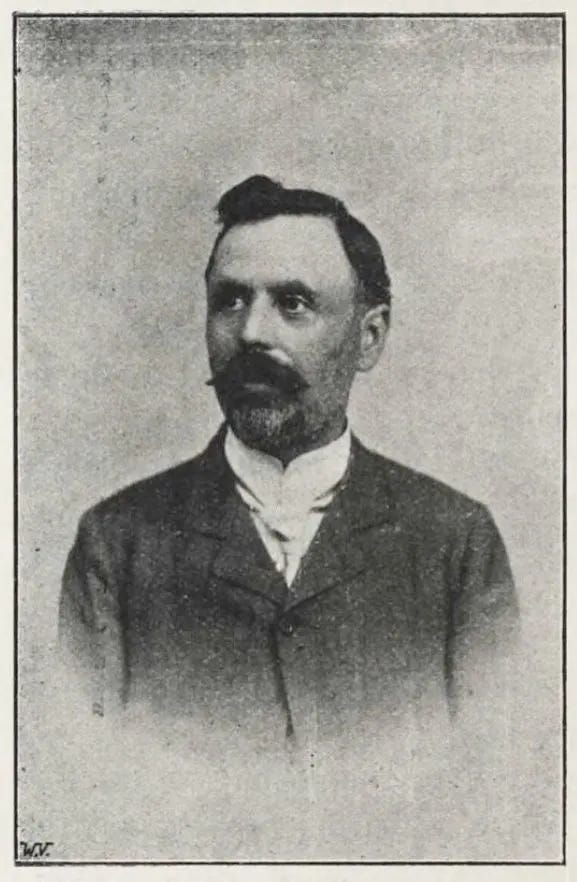
I’m not sure how accurate the search function is on Substack, as it seems pretty clunky, but I couldn’t find a single post on Menyhért Palágyi (1859–1924).2 Which isn’t surprising, as almost no one has heard of him, and none of his major works are readily available in a modern English edition. Yet this Hungarian philosopher was a proper syntropic thinker whom his friend and biggest fan, Ludwig Klages, regarded as one of the greatest minds of his age and of “an altogether higher order than the superficial Bergson.”3
The British philosopher Boyce Gibson published a two-part study of him in 1928, and from that you can get a feel for why he was forgotten.4 Palágyi was difficult to pigeonhole, as he straddled philosophy, psychology, mathematics, physics, epistemology, and the emerging debates around phenomenology, and he loved picking fights. He was ruthlessly critical of other people’s work, especially Einstein’s, which, in 1914, he called “that system of contradiction which passes under the name of Relativity.”5 You can’t be kicking around saying stuff like that and expect to be welcomed into the club.6
He also had beef with Edmund Husserl, because he thought Husserl’s phenomenology was still too tied to formal logic and static subject/object structures, rather than getting to the more dynamic, lived constitution of experience. Boyce Gibson later reported that Husserl had called the wider “Klages-Palágyi movement” the “most extreme opponent of Phenomenology,” although even Husserl seems to have recognised the unruly originality of his mind, describing Palágyi as a “wilder Kopf,” or wild mind. At heart, Palágyi’s philosophy was a kind of vitalist monism, where he saw living reality as a differentiated whole held together through polarity. I think it belongs in the syntropic lineage, and it belongs in serious conversation with many of the thinkers I’ve already written about. He was making moves in 1901 that contemporary thinkers are still trying to make now.
Space and Time
Probably the best starting point is Palágyi’s theory of space and time, which he published in 1901, four years before Einstein’s paper and seven before Minkowski’s 1908 formulation of relativistic space-time, although it’s important to say Palágyi was developing a philosophical metageometry, not relativity before relativity. His core issue was that we’ve basically been misled by language and intellect. He thought the words “time” and “space” have become split into independent concepts whereby we take these isolated words to stand for isolated meanings. But, for him, the two can’t be separated because nothing we experience takes place in space alone or in time alone. Instead, they make up what he called “flowing space,” which is space continuously renewing itself through time in “one single but twofold ordering of the world.” There’s a little echo here of Henri Bergson’s concept of “durée,” which I’ve written about before, insofar as both resist treating time as a sequence of isolated units.7
Here you can start to get a feel for how Palágyi saw dualism, which he thought was infected with self-contradiction. You can’t study a pair of opposites in isolation and then bolt them back together afterwards and call them a unity. By that point it’s already too late, and the bolting can’t work because you’ve already hardened the concepts by splitting them. The intellect has essentially separated what life gives together. Instead, Palágyi said, you need to recover the living connection that the abstraction killed. You do that by returning the separated concepts to what he called their “Urteilswiege,” their “cradle of judgement,” where their underlying correlation becomes visible again.
Palágyi’s big move is old-school syntropy, because he goes all the way back to our boy Heraclitus and attempts to give him a metageometrical formulation. Palágyi says we picture space as a fixed and stable container through which time flows, but this is exactly backwards, because space isn’t static. Instead, he says, space is flowing and dynamic, incessantly renewing itself, “new-born with each pulsation.” The whole spatial order is renewed with every temporal pulsation, which is why the ancient saying of Heraclitus that all things flow, Palágyi writes, “wins a certain precision it did not originally possess. We must say: all things flow because space itself is flowing.”8
The Principle of Polarity
At the core of Palágyi’s philosophy was a principle of polarity that Boyce Gibson explicitly compared with Hegel. A sort of interdependence of opposites and cooperative unity between pairs like mechanism and vitalism, static and dynamic, conscious and unconscious, nous (spirit) and psyche (soul), and immediate actuality and imaginative possibility. All these opposites may be distinguishable, but each acquires its character through its relation to the other, a “duality in unity.”
For example, Palágyi says, when you touch something with your hand, your hand is simultaneously active and passive. You feel the object, but you also feel yourself being affected by it. So, in effect, perception of the world and perception of yourself arise together. This is a recurring pattern in my essays, where polarities like freedom and organisation, organism and environment, individuality and participation, stability and becoming, and differentiation and integration mustn’t be eliminated if they’re to be a living whole. Palágyi’s version of unity is unity generated and sustained through differentiated opposition, which is a huge echo of William Blake’s “Without contraries is no progression.” Syntropy through this lens isn’t a type of order where everything becomes homogenised and uniform.
Palágyi wasn’t a fan of what he called “empiricism,” but he wasn’t rejecting science full stop. He certainly regarded his work as continuous with natural science; he just wasn’t big on mechanistic science. He thought it needed to be grounded in a far richer philosophy of life and psyche. He also thought that the source of all error is confusing what belongs to spirit with what belongs to life and, in the spirit of “polarity,” what belongs to life with what belongs to spirit.9 It was, among other things, the idea of polarity and constant change, of the interplay of vitality and spirituality, that really impressed Ludwig Klages.10 You can see where he got his fundamental opposition between “Seele” (soul) and “Geist” (spirit) from. Although Klages turned the polarity into a much more sweeping metaphysical and civilisational opposition where Geist becomes the adversary of the soul and the living world.11
Life Becomes While Consciousness Takes Photographs
Now, you might be thinking, if space is genuinely renewing itself at every instant, why don’t we perceive this? How the hell does the world appear stable and made of persisting points sitting in their persistent places? Palágyi’s answer involves what he calls “Verdeckung,” which translates as “concealment” or “covering over.” Each present phase covers the temporal phases from which it has emerged, leaving us with the appearance of something simply persisting in place. A related argument appears in his theory of consciousness. Palágyi thought consciousness didn’t flow as one perfectly continuous stream but occurred through discrete, pulsating acts, which he called “intermittencies.” The underlying sensory and vital processes continue, but conscious awareness arrives in pulses.
That sounds complicated, but I see it as we perceive the latest product of self-renewal, but not the renewal itself. What we’re actually intuiting is the “single static spatial element, a point persistently maintaining its position,” and the covering process creates the illusion of static space and conceals the whole dynamic of self-renewal from us. Reflection must therefore restore the temporal process that ordinary perception leaves out. And this lies at the heart of Palágyi’s philosophy: the world of fixed points and stable objects sitting still in their places isn’t the whole of reality but an appearance produced through concealment. The dynamic process from which the stable appearance arises remains concealed, and, on my reading at least, Palágyi therefore asks of us something like a discipline of thought where we make the effort to remember the dynamic process concealed by the stable appearances. This also explains his resistance to the familiar metaphor of a “stream of consciousness,” often associated with Henri Bergson and William James. The underlying sensory and vital processes might be continuous, but conscious acts themselves, Palágyi thought, occur intermittently. What flows isn’t necessarily consciousness as a single homogeneous current.
Instead, conscious awareness pulses, and we jump from one conscious act to another and then retrospectively stitch those moments together into the impression of an uninterrupted field of awareness. Perhaps more interestingly, Palágyi argued that a conscious act can’t be conscious of itself while it’s actually occurring. That’s because a subsequent act has to register the previous one. So we never quite catch the living present, as consciousness is always fractionally behind life. The abstract mind, therefore, turns the living flow into a succession of stable snapshots and then mistakes the snapshots for reality.
To regular readers, this will already sound familiar. There’s a striking structural resemblance to Iain McGilchrist’s argument about the hemispheres of the brain.12 In McGilchrist’s account, the left hemisphere apprehends a world of fixed objects, isolated and decontextualised and available for analysis and manipulation, while the right hemisphere encounters a world that’s contextually alive and continuously coming into being. Big Iain’s claim is that the left’s picture is a useful artefact, but we’ve come to mistake it for reality. Palágyi reaches a comparable pattern a century earlier from an entirely different starting point. You could say that “Verdeckung” describes something analogous to what the left hemisphere does, because the static, abstractable spatial point that persistently maintains its position is exactly the kind of object the left hemisphere loves.
There’s also a looser resonance with Heidegger’s treatment of truth as “alētheia,” or unconcealment, with concealment being the default.13 We don’t reach for the truth of things but stand in the clearing where they can show themselves. So Heidegger’s account resembles Palágyi’s in one limited respect: neither thinks the immediately available appearance is the whole truth of what’s appearing. In some ways, Palágyi’s argument is a psychobiological analogue of Heidegger’s complaint that reflective thought arrives after our more primordial “being-in-the-world.”
Palágyi also thought that language isn’t just some neutral tool for expressing already-finished thoughts but that it actually participates in forming and articulating thought itself.14 For Palágyi, language is woven into the process by which thoughts become structured and shareable; as such, language is constitutive and not just expressive. In other words, if memory and fantasy help generate the material of thought, then language helps give that material shape and conceptual form. Thought isn’t a finished thing that language just reports after the fact. Again, there are overlaps with Heidegger, who literally said, “Language is the house of Being,” which, although it’s more ontological and much more radical, rejects the idea that language merely labels an already completed world.
The Discipline of Imagination
It’s important to note here that Palágyi wasn’t saying all this concealment is some sort of moral failing, or that we’re all just lazy or careless. He sees it as structural. The “now” covers the past instants because that’s its nature, and our perception delivers static points because that’s how perception works. Perception is something the organism does and we’re just not in a position to see the self-renewal that’s going on directly. We can infer it, but then we have to train ourselves to think with the inference rather than against it.15
This is why understanding Palágyi’s flowing space requires what Boyce Gibson called a “discipline of imagination.” We essentially have to train ourselves to picture space as something flowing, which isn’t hard intellectually, but every habit of our perception is working against it. The covering wants to stay in place, and the static picture is always what arrives with ease, while the dynamic, flowing one has to be cultivated deliberately. There’s another clear line here back to Heidegger’s “letting-be,” which I explored in my last essay. We have to interrupt the automatic delivery of the static, already-categorised world and get back to dwelling, where what’s being concealed can reveal itself for what it actually is. Palágyi approaches the problem through metageometry, perception, and vital philosophy, while Heidegger approaches it through the question of Being.
Let Me Be Your Fantasy
A distinctive aspect for Palágyi was the role of “vital fantasy,” which he saw as being fundamental to human life and cognition.16 For him, like William Blake, imagination isn’t just a decorative add-on to the mind but a basic “life-power” that helps generate both perception and thought.17 What he meant is that fantasy is pre-reflective and already active in our perception of colours and shapes, as well as memory, dreams, and even theory-making. In that sense, fantasy is a kind of organising force of life rather than just “unreal” or optional mental activity. Palágyi called the separation of mind from life “the basic evil of the modern worldview.” In effect, he thought modern philosophy had made a disastrous mistake by treating consciousness as the primary reality and the living body as its supporting machinery. As with a lot of syntropic thinkers, René Descartes was at the top of Palágyi’s hit list, and he thought his “I think, therefore I am” needed to be counterbalanced by something more like “I feel, therefore I live.”
Palágyi distinguishes two different directions within fantasy. “Direct” fantasy binds consciousness to the present and helps transform immediate sensation into a spatially organised environment. It’s active in ordinary perception, where your surrounding world isn’t just received as disconnected impressions but virtually explored through imagined movement.18 “Inverse” fantasy moves in the other direction. It loosens consciousness from your immediate surroundings and allows it to become absent from the here and now. This is the fantasy of memory, reverie, imaginative projection and, in its purest form, dreams. When you dream, imagined spaces and sensations can acquire the character of perception without being corrected by your present physical environment.
The important point here is that Palágyi doesn’t treat fantasy as the opposite of perception. Direct fantasy is already involved in perceiving the real world, while inverse fantasy allows consciousness to withdraw from that world and inhabit what’s absent. Both depend on the same remarkable capacity of life to move virtually beyond where the body presently is.19
Virtual Movement
Where “vital fantasy” names the broader life capacity, what Palágyi calls “virtual movement” or “virtual imagination” names the anticipatory motor process through which it operates in perception. It’s essentially our preconscious ability to rehearse or anticipate a movement without fully performing it. Wherever imagination is involved, Palágyi thought there must be movement, and he called the process of imagination the “highest development of the vital.”
Let’s try a little experiment by adapting one of Palágyi’s examples.
If you run your finger around the rim of a mug, the isolated tactile sensations you feel don’t somehow add themselves together into your perception of a circular rim. Instead, the sensations stimulate your imagination, which virtually continues and organises the movement, allowing you to perceive the shape of the mug by tacitly tracing it.

According to Palágyi, every perception is a virtual grasping and touching of the object:
But the mere grasping of a place in space, the mere relocation of a thing or a process to any spatial location would be impossible, if we were not able to point to the place in question through real and imagined movements.20
Palágyi thought this applies far beyond touch. For example, a golfer doesn’t calculate the club, ball, lie, wind, moisture, trajectory, etc. as separate data points. They have to perceive the situation through a living repertoire of possible movements. In effect, the body already understands the shot before the intellect starts telling it what to do.
All perception, therefore, involves a kind of virtual “reaching” or moving through the world, because to perceive something is already to explore what you could do in relation to it. Objects show up to us through our possible movements towards, around, and among them, not as bundles of detached properties for a detached brain to decode. Which is, of course, a striking anticipation of themes central to Maurice Merleau-Ponty’s account of embodied perception and motor intentionality.21 There’s also an affinity with what James Gibson would later call “affordances,” although Gibson wouldn’t explain perception through an internal mediating imagination.22 After his death, Palágyi’s vitalism and theory of virtual movement also contributed to the emergence of philosophical anthropology.
There are obvious links to my boy Ray Peat here as well, especially in terms of energy, the orienting reflex, and our ability to respond to novelty and think creatively.23 Palágyi can provide something like the phenomenological side of what Peat approaches biologically. For Peat, perception and intelligence depend on the energetic and physiological condition of the organism rather than floating free as information processing. Palágyi also thought that long before consciousness arrives, the living organism has already selected and organised what’s happening through bodily feeling and imagination.
Purposeful Action
Palágyi’s “virtual imagination” also explains purposeful action. Before an actual movement happens, the organism anticipates its trajectory and expected sensations. So the imagined continuation of the movement guides the real one, and as skill develops, this virtual steering becomes increasingly tacit and automatic. I’m sure you know how brutal it is learning a musical instrument for the first time. Initially, you have to guide every movement deliberately until eventually the movement no longer needs to be commanded step by step. In Palágyi’s terms, its virtual steering has become tacit. It’s still there, but it has sunk deeper into the living process. Although he doesn’t use the language of syntropy, this is where I think Palágyi’s account becomes especially interesting from a syntropic perspective. He gives us one way of thinking about apparently future-oriented organisation without imagining backwards causation.
Rather than just being pushed from behind by external stimuli and prior causes, life is also drawn forward by anticipated possibilities. I don’t mean in a way that the future is literally causing the present in some paranormal sense, but that your present activity is shaped by what you’re preparing to encounter next as your perception and movement are organised prospectively. Which, to me at least, sounds like Palágyi has given us a philosophical model for one aspect of syntropic organisation: we, as living beings, continuously exceed our present by virtually moving into what may come next. Palágyi writes:
“It is an unparalleled wonder that life, without leaving the place where it is, can nevertheless behave as though it has escaped to another place in space or another place in time.”24
As is usually the case, much of Palágyi’s work is philosophically suggestive but not a worked-out biophysics, and some of his claims remain speculative and contested. But I think his central intuition has aged extremely well. You don’t just receive a finished world and then work out how to respond to it. Your anticipatory movement is partly what allows a world to appear at all.
The body moves before you do. Before conscious thought arrives to name the world, life has already begun leaning beyond the present, virtually inhabiting places it hasn’t reached and rehearsing movements it hasn’t made. That may be Palágyi’s deepest contribution to a syntropic philosophy of life: you remain yourself not by staying where you are, but by staying coherent enough to move towards what you are not yet.
My philosophical novel, The Syntropist, is available worldwide on Amazon. All royalties go to Hospice at Home.
Klages, L. (1974). Philosophische Schriften (E. Frauchiger, Ed.; Vol. 3). Bouvier.
I’ve used the Hungarian form Menyhért in this essay, but you’ll also see him commonly referred to as Melchior Palágyi in German and English-language scholarship.
It’s fair to say Klages wasn’t some neutral historian, as he was also Palágyi’s eventual literary executor.
Gibson, W. R. Boyce. (1928a). “The Philosophy of Melchior Palágyi: I. Space-Time and the Criticism of Relativity.” Journal of Philosophical Studies, 3(9), 15–28.
Gibson, W. R. Boyce. (1928b). “The Philosophy of Melchior Palágyi: II. The Theory of Life and Consciousness.” Philosophy, 3(10), 158–172.
Palágyi, M. (1914). Die Relativitätstheorie in der modernen Physik: Vortrag gehalten auf dem 85. Naturforschertag in Wien. G. Reimer.
To be fair, Palágyi’s metageometry never became a scientifically competitive alternative to relativity, so twentieth-century physics went down a different road and left him behind.
Henri Bergson and the Flow of Time (Substack Post)
Palágyi, M. (1901). Neue Theorie des Raumes und der Zeit: Die Grundbegriffe einer Metageometrie (New Theory of Space and Time). Verlag von Wilhelm Engelmann.
Palágyi, M. (1903). Die Logik auf dem Scheidewege. Berlin: C. A. Schwetschke und Sohn.
Heublein, H. (Ed.). (2018). Melchior Palágyi: Der Gegensatz von Geist und Leben. Schriften zur schöpferischen Verbindung von Erkenntnistheorie und Vitalismus. Munich: Albunea Verlag.
Ludwig Klages and the Living Soul (Substack Post)
I’ve checked, and McGilchrist makes no mention of Palágyi in his masterwork, The Matter With Things, which is a little strange to me, as the breadth and depth of his citations are incredible.
To be clear, both think appearance involves concealment, but for different reasons: Palágyi is analysing temporal perception and reflection, while Heidegger is asking how beings become intelligible at all.
See: The Tao of Heidegger (Substack Post)
Nyíri, K. (1996). Palágyis Kritik an der Gegenstandstheorie. In R. Haller (Ed.), Meinong und die Gegenstandstheorie (pp. 603–613). Rodopi.
Palágyi, M. (1925). Wahrnehmungslehre. Leipzig: Johann Ambrosius Barth.
Note: This posthumous volume includes an introduction by Ludwig Klages.
Palágyi, M. (1924). Naturphilosophische Vorlesungen: Über die Grundprobleme des Bewusstseins und des Lebens (2nd ed.). Johann Ambrosius Barth. Originally published in 1908.
William Blake and the Sacred Power of Imagination (Substack Post)
Palágyi, M. (1925). Wahrnehmungslehre. Leipzig: Johann Ambrosius Barth.
Note: This posthumous volume includes an introduction by Ludwig Klages.
Ibid.
Palágyi, quoted in Kehl, A. (2002). Die Bildung der Vorstellung: Grundlagen für Theater und Pädagogik. Bad Heilbrunn: Klinkhardt.
Maurice Merleau-Ponty argues that embodied perception is an active, pre-reflective engagement between the lived body (le corps propre) and the world. He rejects both empiricism (which reduces perception to atomic sensations) and intellectualism (which reduces it to conceptual judgement), proposing instead that consciousness is rooted in the body’s motor intentionality and spatial orientation.
See: Maurice Merleau-Ponty and the Art of Being Here (Substack Post)
James J. Gibson introduced the concept of affordances in his 1966 work The Senses Considered as Perceptual Systems and formally defined it in his 1977 paper The Theory of Affordances. An affordance is defined as what the environment offers the animal, providing or furnishing possibilities for action that are relative to an organism’s capabilities.
Ray Peat and the Orienting Reflex (Substack Post)
Noack, Martin. (2021). “Melchior Palágyi: Der Gegensatz Von Geist Und Leben. Schriften Zur schöpferischen Verbindung Von Erkenntnistheorie Und Vitalismus. Edited by Heiko Heublein. München: Albunea Verlag, 2018. 232 Pp”. Central European Cultures 1 (1):119–130.
“The “now” covers the past instants because that’s its nature, and our perception delivers static points because that’s how perception works.”
It’s very interesting to read of this work, and you’re right, I haven’t heard of him. I’m not sure, though, what you mean by “our perception delivers static points because that’s how it works.” Could you expand or point me to relevant literature? I will re-read in the meantime.