


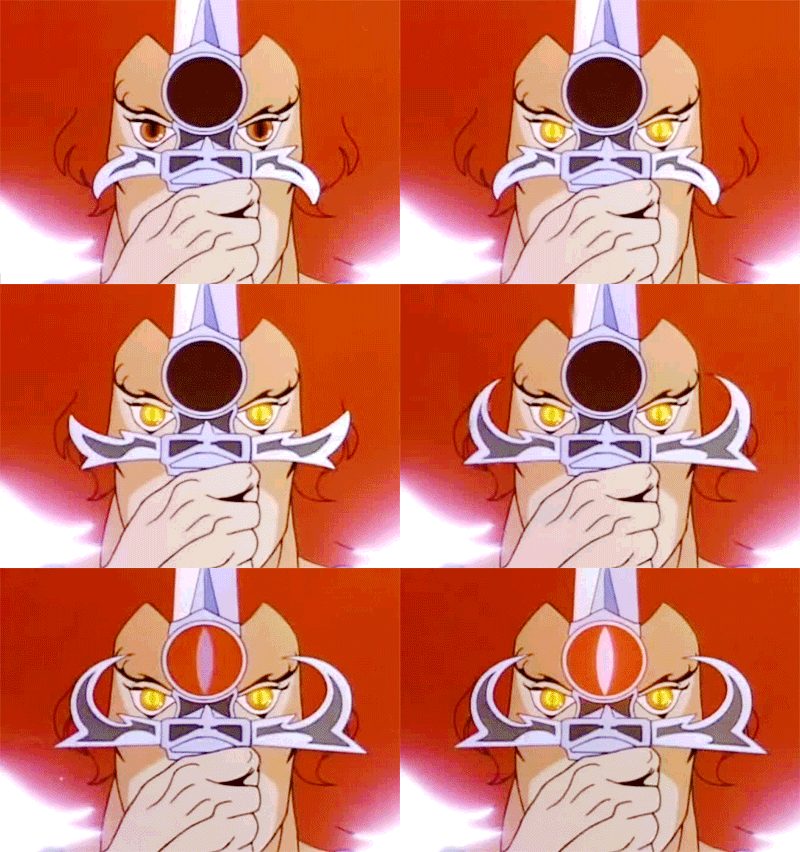
My wife and I were reminiscing recently about the TV shows we watched as kids growing up in the UK in the 80s. I told her nothing on television has ever topped ThunderCats for me. I was half-joking. The other half was ready to defend this hill to the death. That theme tune still gets me pumped, like I could charge through a brick wall.
Now you might dismiss it as cheesy 80s rubbish, or, like my dad, claim Bill and Ben the Flowerpot Men was miles better back in his day. But I think it’s a brilliant example of culture lining up just right.1 In 1985, American producers and Japanese animators produced a small masterpiece of syntropic coherence—a world where the story, music, look, and moral feel all pulled in the same direction.
I want to make a playful but serious claim here: for a certain generation, ThunderCats was a high point of Western life. It packed syntropic philosophy into 22-minute blasts of energy after school. And that was enough.
Peak Culture as a Feeling
When people say “peak civilisation,” they rarely mean it literally. They’re talking about times when things felt right: everyone on the same page, full of buzz, a sense of hope and possibility, a common imaginative world. ThunderCats hit that spot.
Mid-80s children’s TV existed before the internet destroyed attention but after global media had learned to build worlds at scale. Four channels, no on-demand, no pausing or skipping, no scrolling a second screen. If you missed an episode, tough. That scarcity made each show feel big. Kids across the country sat down at the same time for the ritual: theme tune kicks in, titles roll, a new adventure on Third Earth. By “peak culture” I just mean that brief moment when the show, the medium, and the people watching are all tuned to the same frequency.
Seventy Seconds of Syntropy
The ThunderCats introduction grabs you straight off the bat: pounding drums, horns blasting, “Thundercats Hooo!” and kinetic, explosive visuals. No messing. Nothing subtle. One job: yank a kid from normal life into ThunderCats mode.
Have a watch and feel the energy. Some people even say it’s the greatest piece of animation ever produced:2
The animation was outsourced to Topcraft in Japan, the very studio that would soon morph into Studio Ghibli. That’s why the movement seems so fluid and alive.
The sequence lays out the basics: jacked cat-people, lightning, swords, goodies against baddies. Nothing ironic or half-hearted. Bold as brass, giving kids an unembarrassed hero anthem at teatime. If syntropy is about things moving toward order and coherence, this opening feels like it squeezed that into a minute. Sounds, sights, and story all in sync.
And it hits your body first. Before a kid understands the plot, they already feel the timing, the speed, the danger, the weight of things. The Sword of Omens lighting up with the Eye of Thundera. Cheetara accelerating, Lion-O jumping, Panthro’s ThunderTank smashing through rock—these land in the right hemisphere long before left-hemisphere analysis kicks in. The theme doesn’t try to persuade you. It just pulls you along, with meaning arriving through motion.
Syntropy on Third Earth
The basic plot is simple. It’s a story of escape, collapse, and re-ordering. Thundera, the home planet of the ThunderCats, blows up as the series starts. A small group of survivors flee. They crash on a strange planet, Third Earth, a wild, future Earth swarming with a variety of different beings and aliens. There, they build a replica of their fortress while fending off an ancient evil, Mumm-Ra.
It’s a simple set up, but really about what happens when everything falls apart and you still have to build something from whatever’s left.
Each episode follows a familiar loop. Something goes wrong: a betrayal, an attack, an internal conflict, or a new monster turning up. The team responds through courage, cooperation, and some combination of technology and magic. By the end, balance is restored. But it never settles into comfort. Third Earth is always unfinished and under threat. Order here is something you have to keep earning. Each episode re-strings Heraclitus’s bow.3
Unlike peers such as He-Man—where every episode tended to hit a hard reset button—ThunderCats had a memory. It built multi-part arcs with lasting consequences across 130 episodes. Characters learned things in episode 4 that they still knew in episode 20. It was a story about people slowly “becoming” something more than they were at the start.
There’s almost always a clear moral lesson: courage over fear, honesty over deceit, self-control over rage, duty over selfishness, perseverance over giving up. Every week you watched them try to fix a small piece of a broken world. Ernst Bloch’s Principle of Hope in action.4 This pro-social nature was baked in: every storyline and script was reviewed by a consultant psychologist to ensure it would be a positive experience for young viewers.5 The show was even advertised to parents as such in newspapers:
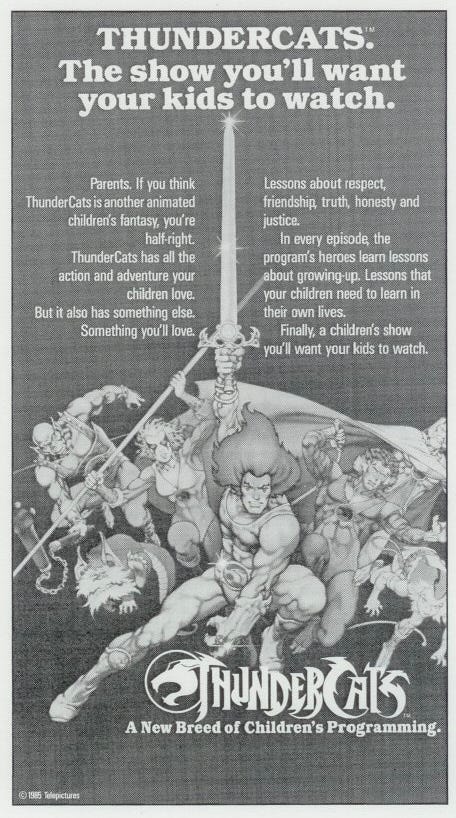
In practice, the ThunderCats are like a syntropic force pulling things back into shape. They turn a crash site into a home, a group of survivors into a community, a dangerous planet into a place worth fighting for. The message to kids is simple but potent: chaos can be faced, shaped, and transformed.
Ludwig Klages’ distinction between “soul” and “spirit” fits here.6 Soul lives in rhythm, image, and participation. Spirit abstracts, controls, and dominates. ThunderCats is soul all the way: bright colours, motion, mythic symbols, embodied loyalty. Mumm-Ra is spirit gone feral—sneaky, bitter, unable to participate in life except by exploiting it. The weekly struggle is Klages’ living image against dead abstraction, played out in primary colours.
Archetypes in Spandex
Part of the show’s power lies in its characters. Each one is an exaggerated but recognisable archetype.
Lion-O is the most interesting: he’s a boy forced into leadership too soon. Due to a malfunction in his suspension capsule during the escape from Thundera, his body aged while his mind didn’t. He’s literally a twelve-year-old in a man’s body. The series keeps returning to his impulsiveness, his need for guidance, his gradual maturation by integrating his mentors’ wisdom with his own youthful energy. It’s the perfect metaphor for the 80s latchkey kid—externally expected to cope with the world, internally still figuring it all out.
Then there’s Panthro, the engineer-warrior. He builds the ThunderTank from the remains of their wrecked spaceship, maintains the lair, solves mechanical problems, and fights with nunchucks. He’s grounded competence, craft, and reliability in one package.
Tygra is the stoic intellectual who serves as the architect and scientist of the operation. In a particularly wild episode, he essentially battles drug addiction when he becomes hooked on a fruit that offers blissful hallucinations, draining his will and endangering the team. A mature look at how even the smartest mind can surrender to chemical entropy.
And then Cheetara, who I had a massive crush on. I’d like to think it was because she represented pure, competent vitality. She wasn’t a damsel in distress. She was speed, intuition, and foresight. To admire Cheetara was to admire the idea that life should be fast and capable.
WilyKit and WilyKat, the twin “ThunderKittens,” are young tricksters and scouts who fight with gadgets and hoverboards. Even Snarf, often played for comic relief, stands for care, worry, and the messy side of attachment.
On the other side, Mumm-Ra is entropy personified. While the ThunderCats generate their own energy, he has to beg for his. He’s literally a mummified corpse who requires an external battery to function, stuck in repetitive transformations that never truly fix him. His dark lair, the Black Pyramid, is enclosed and cluttered with relics. The ThunderCats keep moving outward, building, exploring. Mumm-Ra turns inward, hoarding and hiding.
Although he gave kids the creeps, Mumm-Ra has a tragic side too, bound by pacts to the “Ancient Spirits of Evil” that grant him immmortality (I’m resisting another Bryan Johnson comparison here 😁). His evil has a personality, a depth that makes the ThunderCats’ struggle against him feel like a battle against a distinct, ancient force, not just a monster of the week.
There’s something of Alfred North Whitehead and Henri Bergson here—life as creative surge, improvising itself as it goes.78 Lion-O’s leadership is responsive rather than procedural. Panthro feels his way into solutions. Even the action sequences privilege flow over calculation with lots of leaps, twists, and spins. Mumm-Ra, by contrast, is stuck in rigidity. The ThunderCats move forward by inventing. Mumm-Ra survives by replaying.
None of this arrives as a lecture. It comes through the colour, design, sound, and animation. As a kid, you don’t need a philosophy dictionary to feel the difference between Panthro’s grounded competence and Mumm-Ra’s shrieking desperation.
Shared Ritual
Another reason ThunderCats felt so good is how it worked as group ritual. In the pre-internet, pre-streaming world, kids’ TV was one of the few mass, synchronised experiences outside sport and national events. You knew, more or less, that all your mates were watching the same battle, laughing at the same joke, hearing the same moral lesson.
The playground the next day was full of references and role play: “Did you see when…?”, “I’m Lion-O, you be Panthro.” It was embodied too. We didn’t just talk about the show: sticks became swords, cardboard boxes became lairs, the playground became Third Earth. It was culture as something you did, not just saw. I still remember debating and recreating the race between Lion-O and Cheetara:
From the vantage point of today’s media landscape, that looks like a golden age. Now, children’s worlds are highly personalised, split by algorithms so no two feeds look the same. Attention scatters rather than converges. More choice, more representation, more niches, but far fewer big shared stories. ThunderCats belongs to a moment when a single theme tune could anchor a whole micro-generation’s imaginative life.
Owen Barfield described the modern drift from living inside meaning to watching it from outside via “onlooker consciousness.”9 ThunderCats belonged to a still-participatory culture. Kids didn’t watch from a distance. They jumped in.
The Innocence of Unapologetic Heroism
These days culture often keeps sincerity at arm’s length. But something was gained, briefly, in the ThunderCats era from taking heroism at face value.
Consider the difference between this and the Warner Bros. classics like Bugs Bunny and Daffy Duck. They were brilliant, but they were built on irony, inside jokes, and double entendres, always winking at the audience. ThunderCats, along with peers like He-Man and She-Ra, dropped the wink. They traded in adventure rather than subtext. They focused entirely on the struggle between good and evil, and on teamwork.
Lion-O and his crew aren’t tortured by moral ambiguity. They’re good, in a straightforward way. They make mistakes, they grow, they argue, but the show never doubts the value of bravery, loyalty, or protecting the vulnerable. The baddies aren’t misunderstood geniuses trapped by circumstance. They align with decay and domination, plainly. The ThunderCats answer with unashamed nobility, affirming life rather than exploiting it. It pulls kids toward clear values instead of leaving everything blurry and confused.
This clarity won’t win any prizes for sophistication, but it’s existentially potent anyway. For a child, it’s a clean compass. “This is what we admire. This is what we reject.” As adults we can see every caveat. As children, we needed something solid to push off from. ThunderCats gave that without irony.
And it quietly trains something important in you: a sense of what’s actually worth standing behind. You don’t work out that Lion-O is courageous through some logical process: you feel it in how he moves, hesitates, fails, and tries again. Long before you can explain anything, your body already prefers how Panthro stands and moves to how Mumm-Ra lurks and lashes out. The show sharpens gut-feel value-perception. It trains what Max Scheler called the “vision of the heart” before it teaches any rules.10
Here’s an example from season 3 with Cheetara and Lynx-O (a blind wise elder), in what might be the most syntropic scene of all time:
Peak ThunderCats
Calling a cartoon “peak culture” sounds absurd if you measure culture by museums and opera. But if you measure culture by its ability to bind a generation in a shared moral rhythm, ThunderCats stands tall.
It represents a high point for a particular kind of cultural formation, what Clare Graves would call a shared value structure: analogue, collective, myth-heavy, morally straightforward, and energetically scored.11 Since then, we’ve gained complexity, diversity, and nuance, but lost some of that raw, unembarrassed vitality.
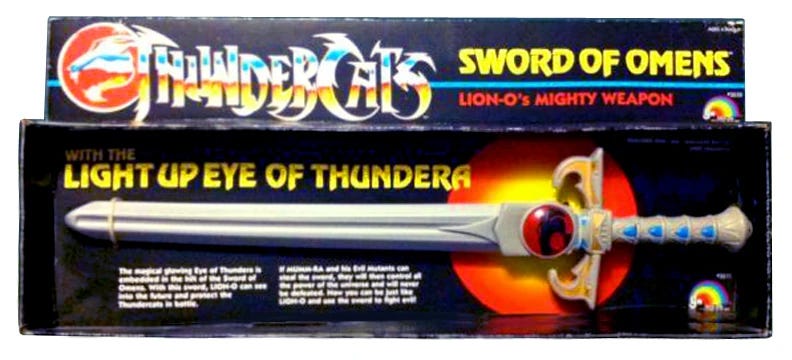
The real miracle isn’t just that it was “good,” but that Myth managed to hijack Commerce. On paper, this was another vehicle for plastic toys. In practice, it ended up teaching us about soul.
“Peak culture” here is a feeling of coherence. ThunderCats mattered because, again and again, it gave people the same moments to care about together. It shows, in a small way, what culture feels like when it remembers how to aim its energy at something living.
ThunderCats Hooo!
Of course, there’s likely a huge nostalgia bias here. Psychologists talk about a “reminiscence bump,” whereby we tend to form especially strong emotional attachments to music, films, and TV from childhood and adolescence, which then feel unusually vivid and important later in life. In other words, part of ThunderCats’ magic is almost certainly that it arrived when my brain was still wiring its sense of the world, meaning, and belonging.
ThunderCats and the impact of Japanese animation on film (Den of Geek)
Heraclitus and the Hidden Harmony of Change (Substack Post)
Ernst Bloch and the Philosophy of Hope (Substack Post)
A Cartoon Called ThunderCats (Huffpost Article)
Ludwig Klages and the Living Soul (Substack Post)
Alfred North Whitehead and the Dance of Life (Substack Post)
Henri Bergson and the Flow of Time (Substack Post)
Owen Barfield and the Wisdom of the Silver Trumpet (Substack Post)
Max Scheler and the Vision of the Heart (Substack Post)
Clare Graves’ model of value systems (often popularised as Spiral Dynamics) describes cultures moving from shared mythic coherence toward increasing pluralism and complexity, with gains in freedom but losses in collective rhythm and meaning.
Clare Graves and the Evolution of Human Consciousness (Substack Post)
https://thundercats.fandom.com/wiki/ThunderCats_Wiki - a treasure trove to explore :-)
Interesting break-down of what seems simple kids entertainment. Similar to how nursery rhymes have message.
Also something I noted was that it's not only children that don't necessarily share the experience at the same time, parents also don't have the same awareness. As kids move onto personalised screens it's not the same as having the childrens shows on in the background TV in the same room. Once they go past maybe Peppa Pig and the young children shows, adults also can lose the sharing experience.
This piece filled me with joy and resonance for this show. I need to get back to my Dad’s attic and see if I still have my thunder tank and Panthro. Thanks for the breakdown of the magic of the ThunderCats.